
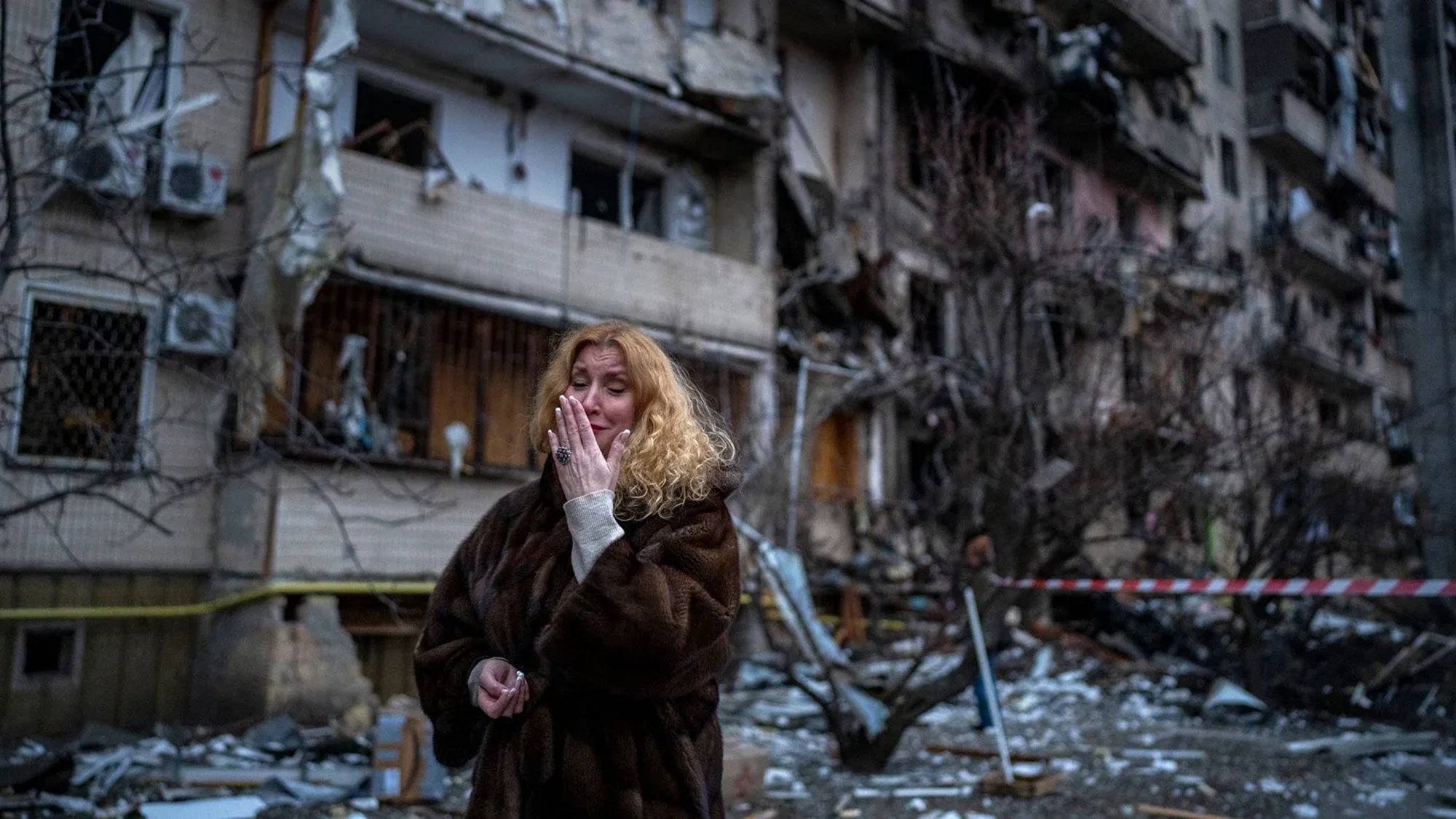
War—it sucks. But let’s keep fighting so someone can “win.” (Natali Sevriukova mourns the loss of her home in Kyiv; Sky News)


Sep 25, 2023 1:00 PM
Scorecard needed after Biden and Zelensky speak at UN and in DC
When Ukrainian President Zelensky visited Washington September 22, Joe Biden told him the United States would be “staying with you” in the ongoing conflict with Russia. Not everyone was on board, either in DC or around the country. An August 4 CNN poll found that “55% say the US Congress should not authorize additional funding to support Ukraine.” House Speaker Kevin McCarthy did not invite Zelensky to speak to Congress, and asked “Where’s the accountability on the money we’ve already spent?” Last year when Zelensky visited Congress, he was greeted as a war hero.
Times are changing, but it’s not due merely to Republicans in Congress.
When Biden and Zelensky spoke September 19 at the UN, they got “strong applause from some of the delegations in the hall, but many others did not clap.” The hall was about half empty for Zelensky’s speech, “with many delegations declining to appear and listen to what he had to say.”
Meanwhile leaders of Global South countries stood up to present their different views. South African President Cyril Ramaphosa recalled the success of the recent BRICS summit in Johannesburg, but said “our energies have once again been diverted by the scourge of war.” Ramaphosa has tried to mediate for peace in the Ukraine conflict but his efforts have been obstructed by the US and NATO. Brazilian President Lula Da Silva highlighted “unauthorized wars or regime change,” and called for serious peace talks on the Ukraine conflict, which he has offered to mediate together with China.
Related stories
Cuban President Miguel Díaz-Canel, who chaired the recent G77+China convention in Havana, said the G77 sees the current international system as “deeply unjust, anachronistic and dysfunctional.” He said it perpetuates a system of domination that “replicates a pattern of modern colonialism.” The G77+ met the week before the UN GA, with 134 countries attending. Diaz-Canel said “In the face of rising hunger and poverty, developing countries will continue their decades-long fight for a more just and equitable world.”
A week before the UN meeting, US National Security Advisor Jake Sullivan and Chinese Foreign Minister Wang Yi met in Malta (the central Mediterranean island south of Sicily). “The two sides had candid, substantive, and constructive discussions,” a US summary said, “on key issues in the US-China bilateral relationship, global and regional security issues, Russia’s war against Ukraine, and cross-Strait issues, among other topics.” The Chinese side did not issue a summary. Instead Wang Yi flew directly to Moscow for a four-day visit. The Chinese Foreign Ministry reported that Wang Yi said “both China and Russia pursue an independent foreign policy, and bilateral cooperation does not target any third party, is not subject to disruption by any third party, and is not swayed by any third party.”
The last phrase suggested Sullivan may have pressed Wang Yi in Malta to distance China from Russia, just as Biden had pressured Indian Prime Minister Modi during the G20 conference in Delhi earlier. Both efforts apparently failed. The Chinese report said Russia’s Foreign Minister “Sergei Lavrov shared his views on the Ukraine crisis, and applauded China's position paper for accommodating the security concerns of all parties and being conducive to eliminating the root causes of the conflict.” Lavrov added that “The Russian side will continue to be open to negotiations and dialogue, and Wang Yi said China is committed to the right direction of peace talks and will play a constructive role in the political settlement of the crisis.”
The meaning of all this is that US efforts to round up support for isolating Russia in the Global South has been unsuccessful. Russia’s BRICS allies remain its allies.
Failed arms control and escalating threats
Biden said at the UN that Russia had been “shredding longstanding arms control agreements.” But it was George W. Bush who pulled out of the Anti-Ballistic Missile (ABM) Treaty in 2002. Russia suspended the START II treaty in response to that US withdrawal. Trump withdrew the US from the Intermediate-Range Nuclear Forces (INF) treaty in 2019. Most recently US Secretary of State Blinken told ABC News September 10 it’s “up to Ukraine” whether or not it should target Russia proper with US-made long-range weapons.
In Washington Zelensky pleaded specifically for long-range ATACMS missiles, which can strike targets 190 miles away. “We have to have them,” he said, “because we don’t have another way out.” His appeal for weapons and money was stark: Ukraine would lose the war without the aid, he said.
Zelensky also told the UN delegates that “each decade, Russia starts a new war.” He highlighted Georgia and Syria. In Georgia the 2008 conflict followed a US-backed “color revolution,” after which the US pushed for Georgia to join NATO. In Syria, Russia helped defend against Al Qaeda jihadists backed by the US. Zelensky said nothing about US wars and interventions in Afghanistan, Iraq, Libya, Yugoslavia or Vietnam – or Pakistan, where the US orchestrated a coup to remove Prime Minister Imran Khan from office for his refusal to condemn Russia. Since 1776 the US has undertaken nearly 400 military interventions globally, according to a Tuft University report cited by China’s Foreign Ministry.
Peace Talks?
Biden told the UN delegates that “Russia alone bears responsibility for this war,” that “Russia alone has the power to stop it,” that “Russia alone… stands in the way of peace,” and that the US “strongly supports Ukraine in its efforts to bring about a diplomatic resolution.” In fact the US vetoed a peace agreement that was agreed in principle by both Ukraine and Russia in Istanbul back in April 2022. And it has blocked numerous other efforts at negotiation.
Russian Foreign Minister Sergey Lavrov told a roundtable of 35 ambassadors to Moscow September 15 that “There is a real plot around the topic of negotiations, and attempts to turn everything upside down through pseudo diplomacy.” He said “Russia is ready to respond to all serious initiatives” for a Russian-Ukrainian settlement.
But instead of a serious initiative, Lavrov said the West is trying to pull the countries of the global majority towards supporting Ukrainian President Zelensky’s “peace formula.” That formula insists on Russia’s complete withdrawal from the Donbas and Crimea, plus court-martialing the Russian leadership and forcing Russia to pay reparations. In other words, Russia must first acknowledge defeat, then negotiate.
Last April, as plans were afoot for Ukraine’s “Spring Offensive,” some new thinking emerged about negotiations. Foreign Affairs, the flagship publication of the prestigious Council on Foreign Relations, published a major article on April 13, 2023: “The West Needs a New Strategy in Ukraine: A Plan for Getting from the Battlefield to the Negotiating Table,” by Council President Richard Haass and Senior Fellow Charles Kupchan. Both men are former senior State Department officials. “It is difficult to feel sanguine about where the war is headed,” they wrote, and while “calls for a diplomatic end to the conflict are understandably growing,… conditions are not yet ripe for a negotiated settlement.” They proposed a “Plan B” for “a diplomatic initiative to be launched later in the year,” presumably after Ukraine’s counteroffensive might have changed the battlefield situation.
Plan B said “Ukraine’s Western supporters would propose a cease-fire… Ideally, both Ukraine and Russia would pull back their troops and heavy weapons…, effectively creating a demilitarized zone. A neutral organization – either the UN or the Organization for Security and Cooperation in Europe – would send in observers… The West would approach other influential countries, including China and India, to support the cease-fire proposal… the West could also offer some limited relief from sanctions in return for Russia’s willingness to abide by a cease-fire, agree to a demilitarized zone, and participate meaningfully in peace talks.
“Ukraine would enter such negotiations by demanding its top priorities: the restoration of its 1991 borders, substantial reparations, and accountability for war crimes. But because Putin would surely reject these demands out of hand, a prolonged diplomatic stalemate would then emerge, effectively producing a new frozen conflict. Ideally, the cease-fire would hold, leading to a status quo like the one that prevails on the Korean Peninsula…”
This “Korea-style solution” has made the rounds since last spring. Kupchan and Haas were reported to have talked about it privately with Russian officials in New York. But neither the State Department nor the Russian Foreign Ministry have expressed official interest. The problem is that it’s a “solution” with no attraction for Russia. It would essentially provide the West with time to re-arm Ukraine after its losses to date and leave open the possibility of Ukraine joining NATO – a major cause of the war in the first place. So either the war will go on indefinitely, or it will end on the battlefield after one side or the other “wins.”
Open-ended War: a problem or solution for Biden?
Columbia University Professor Jeffrey Sachs wrote in July that Biden “is trapping Ukraine in an open-ended war by continuing to push NATO enlargement to Ukraine. He is afraid to tell the truth to the American and Ukrainian people, rejecting diplomacy, and opting instead for perpetual war.” Sachs has been counselor to three UN Secretaries-General and is President of the UN Sustainable Development Solutions Network.
“Biden knows full well that NATO enlargement to Ukraine would trigger World War III,” Sachs says, adding that “rather than admit the truth – that Ukraine will not be part of NATO – Biden prevaricates, promising Ukraine’s eventual membership. In reality, he is committing Ukraine to ongoing bloodletting for no reason other than U.S. domestic politics.”
The domestic politics issue is complicated. In mid-September Speaker McCarthy launched an impeachment inquiry which focuses on “Biden’s evidently extravagant grifting and influence peddling in Ukraine,” according to Patrick Lawrence, writing in Consortium News. Ray McGovern, founder of Veteran Intelligence Professionals for Sanity, echoes Lawrence. He says “if the facts came out, it could be Joe Biden’s downfall,” adding that the “Biden-friendly Establishment media has mounted a full-court press to ‘prove’ that Biden is, well, not a crook.”
Lawrence says “the Democratic machine and its clerks in the press pretended for years there was nothing to allegations that Biden and his son Hunter were on the take from a Ukrainian oligarch, as well as various other business people in China, Russia and Central Asia. They have more recently pretended there is no credible evidence of misconduct, even as investigators sent piles of it to the House Oversight Committee.”
Biden’s friends in major media outlets have launched a campaign to discredit the impeachment charges, “dismissing the allegations against the president as baseless and debunked, attacking the investigators for distorting the evidence,” and so on.
Peace Movement: End the war and stop the propaganda
The peace movement in the US and western Europe has found a new level of unity and determination in response to the new situation. Instead of blaming the war on Russia, they agree that the war will end when the US and NATO stop the flood of weapons and money to Ukraine. They say “STOP the weapons, START the talks!” and “The White House and Congress must come to their senses to avert a wider war that poses the risk of nuclear annihilation.”
Major peace organizations are mobilizing in more than fifty cities nationally and hundreds more internationally. The effort is a response to a call by the International Summit for Peace in Ukraine, in Vienna last June, where hundreds of delegates from 32 countries on six continents called on “leaders in all countries to act in support of an immediate ceasefire and negotiations to end the war in Ukraine.”
In New York City the coalition will highlight that “corporate media is guilty of war propaganda,” marching from CNN’s headquarters to the New York Times offices near Times Square, demanding they “stop manufacturing consent for war.” The culminating slogan is “NATO out of Ukraine, Africa and everywhere!”
Comments

Powered by RoundtableAn AI/DeFi-powered Enterprise Media Operating System. Learn more at Roundtable.io.© Roundtable 2026. By using this site you agree to the Terms of Use and Privacy Policy