


Feb 28, 2026 11:36 PM
Updated Mar 1, 2026 12:13 AM
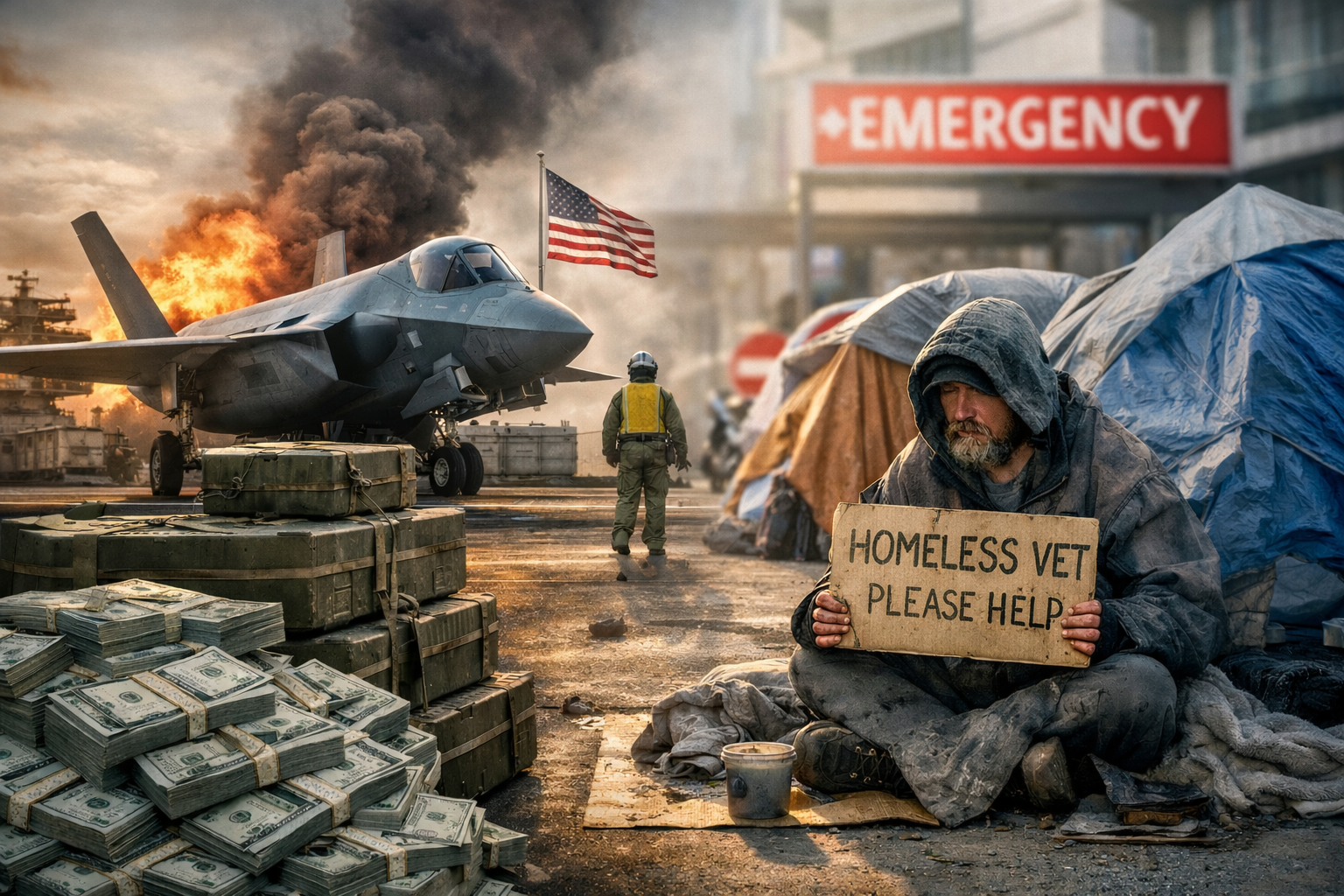
As new airstrikes expand U.S. military action, runaway defense spending and mass incarceration reveal a system built on control — not safety.
On February 28, 2026, the United States launched a new airstrike campaign against Iran. President Donald Trump described the strikes as “major combat operations,” language that functions as an acknowledgment of war. Missiles struck Iranian targets. Iran responded. Television panels debated escalation. Members of Congress argued about authorization.
It felt urgent.
It wasn’t new.
The strikes on Iran are not an exception in American policy. They are the continuation of a governing pattern — one in which insecurity is framed as existential, executive authority expands, and vast public resources flow toward institutions built around control.
Related stories
To understand this moment, we have to widen the lens.
When Michelle Alexander, author of The New Jim Crow, described mass incarceration as a moral and spiritual crisis, she was naming an organizing philosophy: a society that responds to social ills and instability with punishment instead of repair, coercion instead of investment.
That philosophy does not stop at the prison gates.
It extends outward — into foreign policy, into permanent war, into what can only be described as a security-industrial complex.
Security as Default Setting
President Dwight D. Eisenhower warned about the military-industrial complex in 1961.
After 9/11, Congress passed the Authorization for Use of Military Force (AUMF), granting sweeping authority to pursue vaguely defined enemies. Presidents from George W. Bush to Barack Obama to Joe Biden relied on it to conduct military operations across multiple countries without new declarations of war.
- No expiration date.
- No geographic boundary.
- No clear endpoint.
It became foreign policy’s version of mandatory minimum sentencing.
Meanwhile, domestically, the prison population ballooned from roughly 300,000 in the 1970s to over 2 million by the early 2000s.
Different arenas. Same governing instinct.
Security became the reflex.
Mission Creep Is the Pattern
Major U.S. military campaigns since Korea rarely remained limited.
Vietnam expanded into Cambodia and Laos. Afghanistan stretched from dismantling al-Qaeda to a twenty-year state-building effort. Iraq shifted from alleged weapons of mass destruction to regime change to counterinsurgency.
Afghanistan became America’s longest war.
Measured against original stated objectives, only a small fraction of expanded campaigns clearly succeeded.
And when we look for a domestic analogy, we don’t have to search far.
The War on Drugs and the War on Terror: Mirror Images
The War on Drugs and the War on Terror share the same architecture.
Both declared war on abstractions.
- You cannot defeat “drugs.”
- You cannot eliminate “terror.”
The War on Drugs expanded into:
- Mandatory minimum sentencing
- Civil asset forfeiture
- Militarized policing
- International eradication campaigns
- The largest prison population in the world[1]
The War on Terror expanded into:
- Afghanistan (20 years)
- Iraq (regime change)
- Drone campaigns across multiple countries
- The Patriot Act
- The Department of Homeland Security
Neither war achieved decisive victory.
Drug availability remains high; overdose deaths have surged.
Afghanistan returned to Taliban control in 2021.
Yet both wars produced durable institutional growth.
Follow the Money
The U.S. defense budget exceeds $800 billion annually.
Cumulative post-9/11 war costs are estimated at over $8 trillion when long-term obligations are included.
Major defense contractors — Lockheed Martin, Raytheon Technologies, Northrop Grumman — rely heavily on federal contracts.
An F-35 fighter jet costs approximately $80–$100 million per aircraft (procurement cost).
The lifetime cost per aircraft, including maintenance, exceeds $300 million.
By comparison:
- The average public cost to develop an affordable housing unit ranges between $150,000 and $200,000, depending on region.
- The entire annual budget of the Centers for Disease Control and Prevention is roughly $9–10 billion.
- Federal housing assistance spending totals roughly $60–70 billion annually, including vouchers and rental assistance.
- The Federal Bureau of Prisons budget exceeds $8 billion annually.
The contrast is not ideological.
It is arithmetic.
Where the Money Goes: Security vs. Capacity
- 1 F-35 ≈ 400–600 affordable housing units
- $1 billion ≈ thousands of addiction treatment placements
- A fraction of annual war spending ≈ universal healthcare expansion
Core Question:
Are we safer because we can bomb more countries —
or because fewer people sleep on the streets?
Institutional Incentives
This is not conspiracy. It is structure.
- Threat sustains budgets.
- Budgets sustain institutions.
- Institutions sustain political constituencies.
Private prison corporations such as CoreCivic and The GEO Group derive substantial revenue from detention contracts.
Defense corporations derive revenue from sustained procurement cycles.
When insecurity becomes the organizing lens, contraction becomes politically difficult.
Fear as Engine
Fear mobilizes.
Crime panic expands policing.
Terror panic expands military action.
The February 28 strikes against Iran followed the familiar script:
- Identify threat.
- Demonstrate strength.
- Debate authorization later.
But spectacle is not strategy.
Control vs. Capacity
Michelle Alexander called mass incarceration a moral crisis because it revealed a society willing to cage rather than repair.
The same critique applies to permanent war.
Safety through control means:
- More prisons
- More bombs
- More surveillance
- More enforcement
Safety through capacity means:
- Housing before policing
- Treatment before incarceration
- Diplomacy before escalation
- Public health before punishment
The United States spends hundreds of billions annually to maintain global military dominance. Yet homelessness has reached record highs.[11]
We are investing in force while underinvesting in resilience.
The Iran Moment
The new war against Iran is not an isolated decision. It is a continuation of reflex.
War has become administratively easy. In June 2025 the Trump administration claimed to have obliterated Iran's nuclear program. Then just eight months later Donald Trump declares war on Iran stating, "The lives of courageous American heroes may be lost and we may have casualities. That often happens in war."
Authorization debates immediately trail action. Budgetary flows soon follow.
But decades of evidence show that bombing campaigns without clear endpoints do not produce stable security.
- The War on Drugs did not eliminate drugs.
- The War on Terror did not eliminate terror.
Force without transformation produces repetition.
The Reckoning
The February 28 airstrikes will not make Americans safer.
If history is any guide, they are far more likely to widen the conflict, deepen hostility, and generate new cycles of retaliation. Military escalation against a regional power does not eliminate risk; it multiplies it. Blowback is not a theory. It is a pattern. When bombs fall, instability spreads. When instability spreads, new threats emerge. And those threats are then cited as justification for further escalation.
We have seen this before. Interventions framed as defensive have often produced new enemies, strengthened hardliners, destabilized regions, and prolonged conflict. If the goal is long-term safety, repeating a strategy that has repeatedly expanded insecurity is not prudence — it is denial.
But the blowback problem is not confined to foreign policy.
For decades, the United States has poured billions into militarizing urban police departments — transferring battlefield equipment to local forces, expanding tactical units, and normalizing no-knock raids and heavy weaponry in civilian neighborhoods. We have built sprawling surveillance networks, expanded domestic intelligence-sharing, and funded massive training complexes known as “Cop City.” We have fortified borders with walls, detention centers, and advanced tracking technologies. We have constructed the largest prison system in the world.
Each of these measures was justified in the name of safety.
Yet the social consequences are visible.
Militarized policing erodes trust between communities and law enforcement. Surveillance chills civic participation. Incarceration fractures families and destabilizes neighborhoods. Border militarization fuels humanitarian crises without resolving migration pressures rooted in global inequality and climate displacement.
This, too, is blowback.
When communities are treated as threats, they do not become more secure. They become more alienated. When entire populations are securitized, democracy narrows. When coercive institutions grow faster than social institutions, resilience declines.
The February 28 strikes reflect the same governing reflex that produced mass incarceration and the War on Terror: identify danger, deploy force, expand infrastructure, normalize permanence.
But force without transformation does not build safety. It builds escalation.
Real security would look different. It would mean reducing the conditions that produce desperation and conflict — at home and abroad. It would mean investing in housing, healthcare, addiction treatment, education, diplomacy, and climate resilience. It would mean measuring safety not by the number of missiles launched or prisons filled, but by the stability and dignity of the people who live here.
We have spent decades investing in control. The results are visible: permanent war, record incarceration, fragile communities, and recurring crises.
If the goal is genuine security, then February 28 is not evidence of strength. It is evidence that we are still reaching for the same tool — even as it continues to fail.
Comments

Powered by RoundtableAn AI/DeFi-powered Enterprise Media Operating System. Learn more at Roundtable.io.© Roundtable 2026. By using this site you agree to the Terms of Use and Privacy Policy