
Dave Lawler • Attribution-NoDerivs (CC BY-ND 2.0) • Flickr


Jan 14, 2023 10:55 PM
The peace movement needs the leadership and prophetic voice King provided, and the elemental force of the historic Civil Rights movement he led in the 1950s and ‘60s.
It has been a year of unprecedented war hysteria – remarkable in a country that has been gripped in continuous war hysteria for generations. The fading memories of mainstream media publishing major exposures of U.S. war crimes, like the 1969 MyLai massacre in Vietnam and the infamous Pentagon Papers that blew the lid off Washington’s hopeless misadventures – these are barely blips on a distant radar screen. But they are crucial reminders of the power of an aroused flood of antiwar protest that swept American society during the U.S. war in Vietnam. It was powerful enough to force all sectors in the country to take notice, and ultimately forced the government to stop the war. It fostered the “Vietnam syndrome,” a mass revulsion to war and war propaganda that put brakes on the war machine, at least for a while.
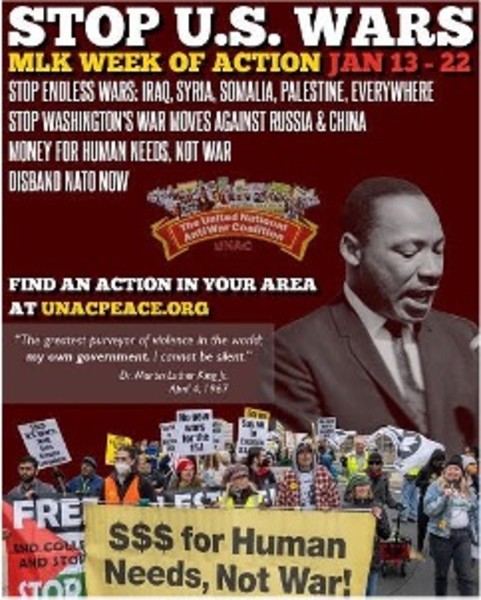
That can happen again, and it needs to. Over the week marking Dr. Martin Luther King Jr.’s birthday, January 13 – 22, there will be protests across the country to “Stop U.S. Wars.” King sparked an escalation of the antiwar movement starting with his historic April 4, 1967 speech at New York’s Riverside Church, when he said “the greatest purveyor of violence in the world is my own government. I cannot be silent.” King also said “We are now experiencing the coming to the surface of a triple prong sickness that has been lurking within our body politic from its very beginning. That is the sickness of racism, excessive materialism and militarism.” His words are as true today as 55 years ago. The peace movement needs the leadership and prophetic voice King provided, and the elemental force of the historic Civil Rights movement he led in the 1950s and ‘60s.
The government learned important lessons from its failure to suppress the historic movements of the sixties – despite massive repression – and it gradually revived the traditional American war spirit. Ronald Reagan famously declared “America’s back!” following the glorious 1983 invasion of tiny Grenada to stop a red revolution in “our back yard.” (Joe Biden used the same words on his first post-election victory lap to Europe in early 2021.) In March 1991, after terror bombing Iraq, George H.W. Bush declared “By God, we’ve kicked the Vietnam syndrome once and for all!”
Twelve years later Bush Junior declared “Mission Accomplished” after his dramatic landing on the aircraft carrier USS Abraham Lincoln on May 1, 2003. The specter of Iraq’s fabled “weapons of mass destruction” had been vanquished in an orgy of mass self-delusion.
Related stories
The secret of success for the war planners was mass deceit – brazen use of the Big Lie to cover the true nature of the government’s misadventure, and harness mass consent. It is now the weapon of choice for Biden and his neo-cons in waging the proxy war in Ukraine against Russia. But deceit is not enough. It’s combined with a war against disinformation, designed to suppress anything but the official narrative. Inspired by the torture and imprisonment of whistle blowers like Chelsea Manning and Julian Assange, this war makes it a crime to tell the truth. The whistle blowers have been condemned as “terrorists,” with the resulting terror effectively silencing journalists across the western mainstream media. An important by-product is self-censorship among antiwarriors, with a substantial sector denouncing vocal criticism of the official narrative.
In October, progressives in Congress quietly retracted a mild letter to Biden suggesting negotiation to stop the war. Progressive leader Pramila Jayapal met with Biden October 18 at the White House instead. Protesters are called “Putin pimps” for highlighting the dominant presence of U.S.-backed neo-nazis in Ukraine. But it has been impossible to suppress memories of the State Department’s Victoria Nuland blurting “Fuck the EU,” while hand-picking the U.S. choice for president of Ukraine in early 2014, on orders from then-Vice President Biden.
Protests in Europe
The western European NATO allies and their populations have become the major victims – along with Ukrainians – of this proxy war against Russia. The blizzard of brutal sanctions intended to “reduce the ruble to rubble,” as Biden delicately phrased it, has led to near-depression conditions for Europe. Working people have taken to the streets across Europe in protest, pressuring their leaders to stop doing Washington’s bidding. That may be to no avail, but the protests have not stopped. Striking workers have halted public transportation, government services, and even Britain’s National Health Service, demanding wages must rise in sync with galloping inflation. A June meeting of NATO ministers in Madrid, Spain, was confronted with a massive protest saying NO TO NATO! Two British prime ministers have been toppled along with an Italian president, and the future of “NATO unity” is in doubt.
Will anything like this happen in the USA? CodePink’s Medea Benjamin and Nicholas Davies wrote recently that “most Americans have no inkling of the deceptive way that Biden and his bubble-headed British allies cornered Zelensky into a suicidal decision to abandon promising peace negotiations in favor of a long war that will destroy his country.” But a strike wave has begun to make its way across the USA. Nurses are striking in various places. Tens of thousands of teachers’ aides and other university workers have struck in Massachusetts, New York and California. Rail workers came close to shutting down the country’s crucial rail freight system; a threatened strike was “called off” by presidential decree. Longshore workers on the west coast are discussing prospects for refusing to handle weapons freight bound for war fronts in Ukraine and Asia. Retail workers at Amazon, Starbucks, and fast food outlets like Chipotle have been organizing at hundreds of locations.
So far very few of these organizing efforts – with the notable exception of the west coast longshore workers – have linked their struggles to war protests. But nearly all of them demand wage hikes in sync with galloping inflation, echoing their cousins in Europe. This is significant, since the war is a major trigger for the inflation, which is unlikely to abate soon. It’s possible people will begin to connect the dots. If they do, they could become a force in really stopping the war machine. Most weapons makers use a lot of robots. But without at least some workers, even robots can’t work. And if workers decide to stop transporting things, the economy will grind to a halt. Then perhaps negotiations can start, including negotiations about an end to funds going to war instead of to solving people’s needs.
Military breakdown
Another sector of the working class was a major factor in stopping the U.S. war machine during the Vietnam era. A Marine colonel wrote at the time that the U.S. military had “broken down” in Vietnam, as soldiers refused to fight and combat veterans marched in protest after coming home. Sailors shut down ships that had been ordered to the war zone. Even bomber crews refused to go on raids into Vietnam, after witnessing at least thirty giant Stratofortress B52s crash after they were shot down.
Units of the Army’s 101st Airborne Division are now stationed in Poland and Romania, alongside about 70,000 active duty U.S. troops in the rest of Europe. These troops are involved in training Ukrainian regular troops and mercenaries, as well as those of NATO allies, most notably in Poland and Romania. To date there have been no reports of U.S. troops deserting or refusing duty in Europe, or of European antiwar groups reaching out to them. Such activity was common during the Vietnam era, and also during recent “endless wars” in Iraq and Afghanistan.
Today about 375,000 U.S. soldiers, sailors and air personnel are stationed in east Asia, surrounding China, or on war ships patrolling the South and East China seas. The largest concentrations are in the Japanese colony of Okinawa and in South Korea. They are bolstered by more than 600,000 regular South Korean Army forces and a suddenly resurgent Japanese military force. U.S. nuclear missile batteries are stationed in both countries, trained to target both China and Russia. There is a long history of civilian protest against these forces in both Japan and Korea. Antiwar groups in these countries often try to reach out to U.S. military personnel, encouraging them to demand to be sent home. Roughly 100,000 soldiers and family members are stationed in Hawaii, which is frequently used as a transit point between the U.S. mainland and the Asian theater.
There is a long history of resistance among U.S. soldiers and sailors in Hawaii and the rest of Asia. In 1969 there was a large and significant sanctuary struggle in Honolulu, in which numerous soldiers demanded a “bill of rights” for military personnel, and sought sanctuary in local churches. While the protest was short-lived due to military repression, it had a dramatic impact, both on the soldiers themselves and their civilian supporters. Key organizers of the action were the American Servicemen’s Union (ASU), and religious antiwar activists, similar to the GI resistance movement in mainland USA. The ASU’s newspaper, The Bond, reached tens of thousands of soldiers and sailors during the Vietnam era, and their were hundreds of GI resistance “coffee houses” near bases across the U.S., as well as in Europe and Asia. Many of these support centers developed their own “underground” presses, publishing leaflets and newspapers encouraging active duty people to resist.
Worldwide chorus urgently calling for peace in Ukraine
Medea Benjamin and Nicholas Davies reported in late October on calls for peace from UN Secretary General Guterres, Pope Francis and leaders of 66 countries speaking at the UN General Assembly in September, representing the majority of the world’s population. They also highlighted former U.S. Ambassador to the Soviet Union, Jack Matlock, who wrote an October 17 article in Responsible Statecraft titled “Why the US must press for a ceasefire in Ukraine.” The Ambassador said the United States “is obligated to help find a way out” of this crisis. The article concluded, “Until… the fighting stops, and serious negotiations get underway, the world is headed for an outcome where we all are losers.”
Henry Kissinger, who is not generally considered a peacenik, told the Wall Street Journal in August that “We are at the edge of war with Russia and China on issues which we partly created without any concept of how this is going to end or what it’s supposed to lead to.”
Marcy Winograd, CodePink’s congressional coordinator, reports that in 2020 the U.S. and NATO awarded Ukraine the status of an “Enhanced Opportunity Partner,” which meant it could share intelligence and participate in NATO-led military interventions such as Iraq, Afghanistan and Kosovo, and join in NATO “war games” near the Russian border. As recently as October 2021, these “games” included mock nuclear strikes against Russia.
On August 31, 2021, the U.S. and Ukrainian Defense Ministers signed the U.S.-Ukraine Strategic Defense Framework, “to continue our robust training and exercise program…” In November 2021, they co-signed the US-Ukraine Charter on Strategic Partnership, which committed the two countries to joint defense and security operations, “in areas such as Black Sea security, cyber defense and intelligence sharing.”
Biden says…
Last March President Biden said “this battle will not be won in days or months… We need to steel ourselves for the long fight ahead.” In May he said he is “doing everything within my power” to address “Putin price hikes.” He was really saying we need to endure higher prices for gas – and food, rent, clothes, and everything else – because of the reckless draconian sanctions war on Russia. So far Western Europe is suffering more than Russia. The poorest people in the world, especially in Africa and the Middle East, are likely to be hurt the most.
Margaret Kimberley, editor of Black Agenda Report, says “Joe Biden and his foreign policy team of incompetent ideologues hope to convince Americans to accept food shortages, rising gas prices, and the risk of a hot war. The steady diet of dangerous nonsense is a necessity for them. The game is up if the people begin to question what they are being told… The average person may not be well versed in the history of U.S. policy towards Russia, but they know when things don’t add up… Rambling, incoherent speeches punctuated by shouts of ‘war criminal’ and ‘genocide’ don’t cut it when working people can barely afford to put gas in the tank.”
On June 1, 2022, Biden issued a carefully crafted message as op-ed in the New York Times. “We do not want to prolong the war just to inflict pain on Russia,” he insisted. Instead, he said the flood of new weapons, ammunition, and billions of dollars, is meant to help Ukraine “be in the strongest possible position at the negotiating table.” But, he added, “I will not pressure the Ukrainian government – in private or public – to make any territorial concessions.” He did not say if the U.S. would exert pressure against such concessions, which would surely be required for talks to start.
Ukrainian President Zelensky insists on a status quo ante, meaning Russian troops leaving all the areas they have occupied. Neither the Russian government nor the people of the Donbas, Crimea and nearby areas can be expected to give up the gains achieved in the war.
Back in April, 2022, Ukraine negotiated a15-point peace plan for a ceasefire, a Russian withdrawal and a peaceful future as a neutral country. But the United States and United Kingdom refused to provide Ukraine with the security guarantees considered critical for the agreement. On April 9, Britain’s then-prime minister Boris Johnson flew to Kyiv to tell Zelensky the “collective West” was “in it for the long run,” but “wanted no part in any agreement between Ukraine and Russia.” After that Zelensky has been adamantly inflexible against any concessions to Russia.
A Path to Protracted Conflict
Retired Colonel Douglas MacGregor, a former senior military adviser to Trump’s Defense Secretary, wrote in late December 2022, that U.S. “refusal to acknowledge Russia’s legitimate security interests in Ukraine and negotiate an end to this war is the path to protracted conflict and human suffering.” He added that “inside the Biden administration, there is growing concern that the Ukrainian war effort will collapse under the weight of a Russian offensive.” He cited an interview published in the Economist, in which the head of Ukraine’s armed forces General Valery Zaluzhny admitted that “Russian mobilization and tactics are working. He even hinted that Ukrainian forces might be unable to withstand the coming Russian onslaught.”
MacGregor comments that “This spectacle is frighteningly reminiscent of events more than 50 years ago, when Washington’s proxy war in Vietnam was failing.” But “the idea that Washington was supporting a government in South Vietnam that might not win against North Vietnam was dismissed out of hand. Secretary of State Dean Rusk said, “We will not pull out until the war is won.”
It took another decade for the U.S. to withdraw from Vietnam, but not before U.S. commanding General Westmoreland told LBJ: “It is increasingly apparent that the existing levels of United States aid cannot prevent the collapse of South Vietnam... North Vietnam is moving in for the kill... Acting on the request of the South Vietnamese government, the decision must be made to commit as soon as possible 125,000 United States troops to prevent the Communist takeover.” Before it was over the U.S. deployed more than half a million of its own troops to Vietnam, and thousands more from South Korea, to bolster the totally ineffective South Vietnamese puppet forces, which collapsed after the U.S. left.
MacGregor says “the Biden administration’s unconditional support for the Zelensky regime in Kiev is reaching a strategic inflection point not unlike the one LBJ reached in 1965. Just as LBJ suddenly determined in 1964 that peace and security in Southeast Asia was a vital U.S. strategic interest, the Biden administration is making a similar argument now for Ukraine. Like South Vietnam in the 1960s, Ukraine is losing its war with Russia.”
Faced with this grim scenario, MacGregor predicts that “Biden will soon appear on television to repeat LBJ’s performance in 1965,” proposing not a NATO attack on Russia, but rather a U.S.-led “coalition of the willing” consisting of American, Polish and Romanian armed forces, to “establish the ground equivalent of a ‘no-fly zone’.” But, MacGregor says, “NATO’s governments are divided in their thinking about the war in Ukraine. Except for Poland and, possibly, Romania, none of NATO’s members are in a rush to mobilize their forces for a long, grueling war of attrition with Russia in Ukraine. No one in London, Paris, or, Berlin wants to run the risk of a nuclear war with Moscow. Americans do not support going to war with Russia, and those few who do are ideologues, shallow political opportunists, or greedy defense contractors.”
“Disaster wrapped in rhetoric is not the way to save the people of Ukraine,” MacGregor says. “The war in Ukraine is not a Call of Duty fantasy. It is an enlargement of the human tragedy that NATO’s eastward expansion created. The victims do not live in North America. They live in a region that most Americans can’t find on a map. Washington urged the Ukrainians to fight. Now Washington must urge them to stop.”
‘It’s an investment’
When Zelensky addressed the U.S. Congress on December 21, he declared “your money is not charity, it’s an investment.” He was greeted with repeated standing ovations. Congress approved $45 billion in additional aid to Ukraine, bringing the total for 2022 to $113 billion. That’s on top of “the $400+ [billion] in investment options” Zelensky offered September 9 when he appeared at the New York Stock Exchange via video stream to symbolically ring the opening bell. Ukraine is “open for business,” Zelensky declared. The financial news service Business Wire published a Ukrainian government press release that said “a USAID-supported project team of investment banks and researchers appointed by Ukraine’s Ministry of Economy will work with businesses interested in investing.”
Economist Michael Hudson compared the new emergency anti-labor laws imposed by the Ukrainian government to the brutal neoliberal policies implemented by Chile’s far-right Pinochet dictatorship after a CIA-backed coup in 1973. “It’s jaw dropping,” Hudson told Multipolarista. “This is exactly what [French president] Macron said when he announced the ‘end of abundance.’ The Ukrainian labor force has just experienced the end of affluence, neoliberal style… Ukraine is the poorest country in Europe, but Zelensky said it’s not poor enough… He said wait until our new law takes effect…’ “But,” Hudson said, “it’ll also be the richest country in Europe for the one percent!”
Ukraine’s Parliament starts 2023 with tribute to Bandera
On January 1, 2023, the Ukrainian parliament, army leadership and local officials celebrated the 114th anniversary of Stepan Bandera, the founding leader of Ukrainian fascism. The ceremony took place hours after a Ukrainian airstrike on a Russian military base in the Donbas that killed 89 Russian soldiers. During World War II, the Bandera-led Organization of Ukrainian Nationalists (OUN-B) and its paramilitary wing, the Ukrainian Insurgent Army (UPA), participated in the Nazi-led genocide of hundreds of thousands of Jews in what is now Ukraine and Poland; in 1943-44, the OUN-B and UPA engaged in massacres of an estimated 70,000 to 100,000 Poles.
Margaret Kimberley of Black Agenda Report issued the following report on January 9: Two years ago the neo-nazi Ukrainian National Resistance organization staged a march in which the words “White Lives Matter” appeared in English, with the name of the organization in small type below. October 14 is celebrated as the Day of the UPA, the Ukrainian Insurgent Army, which fought alongside Nazi Germany after it invaded Ukraine during World War II. The words in the pink graphic on the video read, “On the march of UPA Nazis carefully burned the poster of BLM [Black Lives Matter].” The National Resistance organization is known for its racist, anti-Russian, anti-LGBTQ, and anti-Communist beliefs.
To celebrate Bandera’s birthday, the Ukrainian parliament tweeted an image of Valeriy Zaluzhnyi, the head of the armed forces, under a portrait of Bandera. The tweet – later deleted – quoted Bandera: “The complete and final victory of Ukrainian nationalism will come when the Russian empire ceases to exist… A fight against the Russian empire is currently underway. And the guidelines of Stepan Bandera are well known to the commander-in-chief of the armed forces.”
In a January 3 phone call to Mark Milley, chair of the Pentagon’s Joint Chiefs of Staff. Zaluzhnyi thanked Milley for U.S.-delivered air defense systems. “I highly appreciate General Milley’s leadership in providing military aid to Ukraine,” Zaluzhnyi wrote afterwards, highlighting “mutual trust and a common vision.”
Jeffrey Sachs: ‘the edge of nuclear catastrophe’
“The world is on the edge of nuclear catastrophe in no small part because of the failure of Western political leaders to be forthright about the causes of the escalating global conflicts,” declared Jeffrey Sachs, Columbia University professor and Director of the UN Sustainable Development Solutions Network. “The relentless Western narrative that the West is noble while Russia and China are evil is simple-minded and extraordinarily dangerous. It is an attempt to manipulate public opinion, not to deal with very real and pressing diplomacy.”
Sachs writes “there is only one country whose self-declared fantasy is to be the world’s dominant power… It’s past time the U.S. recognized the true sources of security: internal social cohesion and responsible cooperation with the rest of the world, rather than the illusion of hegemony. With such a revised foreign policy, the U.S. and its allies would avoid war with China and Russia, and enable the world to face its myriad environment, energy, food and social crises.”
“Above all,” Sachs says, “at this time of extreme danger, European leaders should pursue the true source of European security: not US hegemony, but European security arrangements that respect the legitimate security interests of all European nations, certainly including Ukraine, but also including Russia, which continues to resist NATO enlargements into the Black Sea. Europe should reflect on the fact that the non-enlargement of NATO and the implementation of the Minsk II agreements would have averted this awful war in Ukraine. At this stage, diplomacy, not military escalation, is the true path to European and global security.”
The fundamental question is what will it take to get the U.S. government to stop pouring the means of war – money, weapons, mercenaries, and its NATO allies – into Ukraine. An all-sided and massive antiwar movement that does not depend merely on moral suasion or the enlightened words of illustrious sages will be required. Only if there is a gigantic upsurge of opposition determined to stop “business as usual,” if necessary, will it be realistically possible to bring peace. Antiwar forces must directly challenge the “Big Lie” official narrative, and unite with all who want to save the planet and oppose the onset of fascism.
Comments

Powered by RoundtableAn AI/DeFi-powered Enterprise Media Operating System. Learn more at Roundtable.io.© Roundtable 2026. By using this site you agree to the Terms of Use and Privacy Policy