


Jan 17, 2026 6:18 PM
To better understand Putin’s mindset, a brief look at NATO expansion into the former “Soviet Bloc” and into the former USSR itself might be helpful.
To understand why Putin’s war against Ukraine—now almost four years old and producing over one million deaths and wounded—is likely to continue, we should turn to his summer 2021 article, “On the Historical Unity of Russians and Ukrainians.” As I indicated in early 2022, Putin’s piece explains his view of Ukrainian history and Ukraine’s dealings with Russia and the West. To summarize my own 2022 article as briefly as possible, I made the following points about his views (quoted material in bulleted points is from Putin’s article). He thought:
- Russians and Ukrainians were historically “one people–a single whole”–and that the “wall” that emerged between them in recent years is a “great common misfortune and tragedy,” partly caused by “forces that have always sought to undermine our unity.”
- “Well before 2014, the U.S. and EU countries systematically and consistently pushed Ukraine to curtail and limit economic cooperation with Russia. . . . Step by step, Ukraine was dragged into a dangerous geopolitical game aimed at turning Ukraine into a barrier between Europe and Russia, a springboard against Russia.
- Nor were the interests of the Ukrainian people thought of in February 2014. . . . [when] Western countries directly interfered in Ukraine's internal affairs and supported the coup [that ousted Russian-backed Ukrainian President Viktor Yanukovych.] Radical nationalist groups served as its battering ram. Their slogans, ideology, and blatant aggressive Russophobia have to a large extent become defining elements of state policy in Ukraine. All the things that united us [Russia and Ukraine] and bring us together so far came under attack.”
Following the 2014 Ukrainian coup, Putin encouraged a vote for secession in Crimea, which was part of Ukraine but contained more than 50 percent ethnic Russians. After Crimea voted (illegally said critics) to secede, Russia then annexed it. Two other Ukrainian areas, aided by Russian “volunteers,” also chose to secede, both in the eastern Ukrainian Donbas region bordering Russia. Those secession movements proclaimed the establishment of the Donetsk and Luhansk Peoples’ Republics (DPR and LPR). According to the 2001 census almost six out of ten of the population of these two Donbas regions were ethnic Ukrainians, with almost four of ten being ethnic Russian. By the end of 2025, however, after intermittent fighting for over a decade, Russia controlled almost 90 percent of the Donbas area, including almost all of the LPR.
But back to Putin’s 2021 essay. In it he claimed “that the Russians in Ukraine are being forced not only to deny their roots...but also to believe that Russia is their enemy. It would not be an exaggeration to say that the path of forced assimilation, the formation of an ethnically pure Ukrainian state, aggressive towards Russia, is comparable in its consequences to the use of weapons of mass destruction against us.”
Related stories
Putin then switched to considering the Minsk Accords of 2014 and 2015, the latter signed by Russia, Ukraine, the Donbas separatist leaders, and the Organization for Security and Co-operation in Europe (OSCE), an organization of 57 countries including the United States. He also turned to Western (including NATO) influence in Ukraine, writing of “the supervision of the Ukrainian authorities, security services and armed forces by foreign advisers, military ‘development’ of the territory of Ukraine and deployment of NATO infrastructure.” Further, he claimed that Western countries established and maintain an “anti-Russia project,” but that Russia “will never allow our historical territories and people close to us living there to be used against Russia.” Finally, he stressed that true Ukrainian sovereignty “is possible only in partnership with Russia.”
To better understand Putin’s mindset, a brief look at NATO expansion into the former “Soviet Bloc” and into the former USSR itself might be helpful. In 1999, Poland, Hungary, and the Czech Republic became NATO members, and in 2004 so too did Bulgaria, Romania, and Slovakia. Later in 2004 the three former Soviet Baltic republics of Estonia, Latvia, and Lithuania also joined NATO. Moreover, at the NATO 2008 Bucharest Summit, the Allies agreed that two additional former Soviet republics, Georgia and Ukraine, would in the future become NATO members.
Former ambassador to Russia Jack Matlock (named by President Reagan and serving from 1987 to 1991) once stated that he thought that NATO expansion and talk of bringing Ukraine into NATO has been “Putin’s main concern” and that such talk has been “irresponsible.”
All of the above is not meant to suggest that Russia’s continuing attacks on Ukraine are justified. They are not. As I ended an essay three years ago, “There is no valid excuse for Russia’s invasion of Ukraine and its horrific ongoing war on that country.” Rather, my above NATO musings are an attempt to employ strategic empathy. As one expert explained the concept, “Getting inside other people’s minds requires that your own mind be open to their impressions—their hopes and fears, their beliefs and dreams, their sense of right and wrong, their perception of the world.” But once you utilize such empathy, you “bail out,” you switch from empathizing to trying to assess the current situation and decide the best course of action.
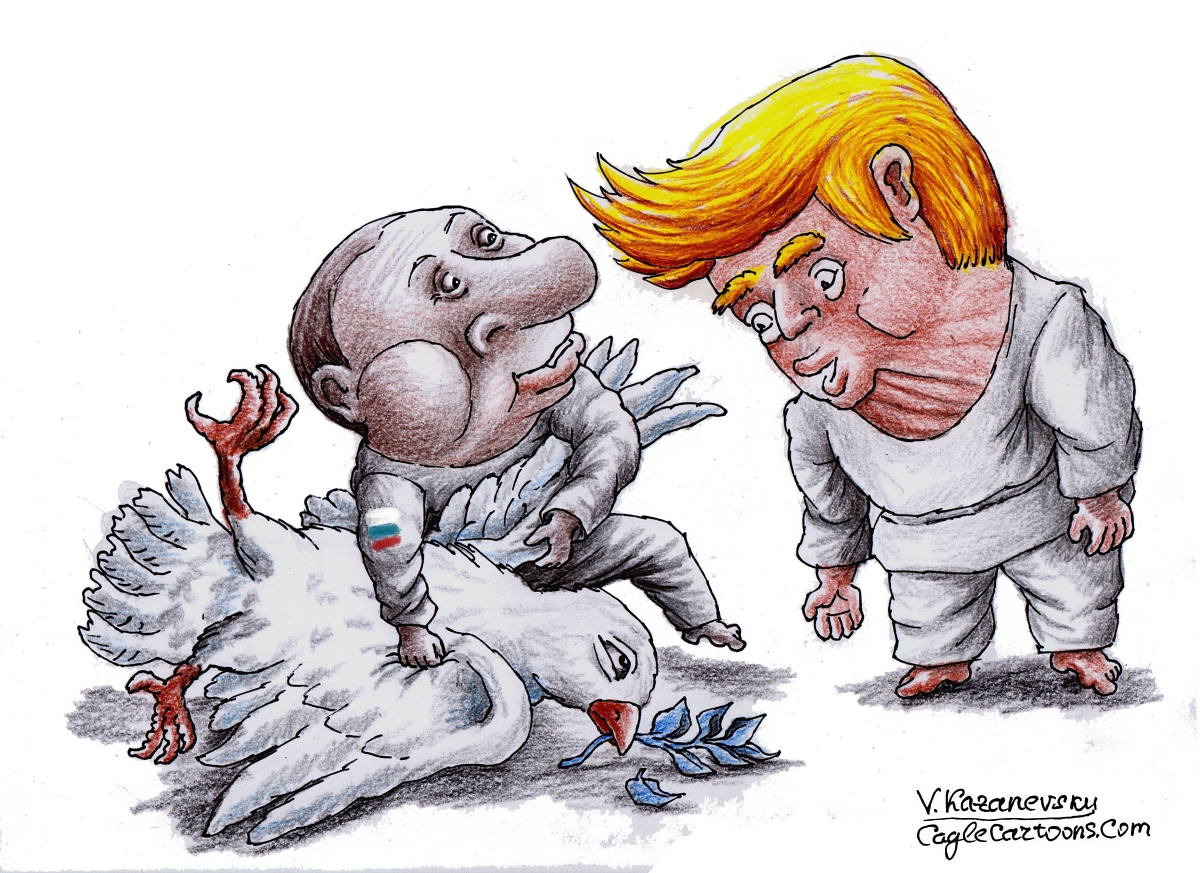
The look backward presented above, however, should provide us with the necessary background for understanding Putin’s present position regarding the ongoing Ukrainian war—and why President Trump’s peace efforts designed to end that war are likely to fail. Unless, of course, he alters them enough to please Putin. And to please the Russian strongman, Trump has to concede more than he has heretofore.
Not that Trump has been stingy in what he has offered Putin—but, most importantly, without Ukrainian leader Zelensky’s prior approval. In 2025, the U. S. president first met with Zelensky at the White House at the end of February, and then in August with Putin in Alaska. And he capped the year off with a 28-point peace plan in late November. Looking at 2026, even though we’re only half way through its first month, Trump has already stated that he thinks the main impediment to a Ukrainian peace deal is—Zelensky.
Not stingy to Putin and blaming Zelensky? Let’s look more closely at the behaviors of the three main actors, Putin, Trump, and Zelensky. Putin’s actions indicate that he still believes, as he did in the summer of 2021, that Ukrainian sovereignty “is possible only in partnership with Russia.” And he still insists that any peace deal must include a prohibition of Ukraine ever joining NATO. Regarding territory, he demands that Ukraine cede any remaining part, small though it be, of the Donetsk and Luhansk Peoples’ Republics not yet under Russian control. (And, of course, any other parts of the former Ukraine, such as Crimea and parts of southern and eastern Ukraine, now controlled or occupied by Russia, would become permanent Russian territories.)
Trump’s stance has wavered somewhat, but has generally been more favorable (despite other NATO members objections) to Putin than to Zelensky. For example, the U. S. president wishes Ukraine’s head to cede about 20 percent of it’s pre-2014 territory—most of it except for a small amount of Donbas lands now controlled by Ukraine—to Russia.
As far as Zelensky is concerned, he has constantly attempted to reduce Trump’s concessions to Putin. For example, after Trump’s 28-point peace plan of late November, 2025, Zelensky issued his own 20-point peace plan, which received more support from NATO’s European countries, and watered down some of Trump’s earlier November concessions to Putin.
In general, Trump’s relationship to Zelensky has been contentious—at their February 2025 White-House meeting, he told the Ukrainian head, “You're gambling with World War Three,” and “what you're doing is very disrespectful to . . . this country, that's backed you far more than a lot of people said they should have.”
Yet, as I’ve recently indicated, Trump has been obsessed with making peace deals that involve other countries, bragging that “it’s not hard for me to do. It’s what I do. I make deals.” But he seems more intent on being perceived as a peacemaker (and winning a Nobel Peace Prize) than creating a real and fair peace. As for Zelensky, despite his weaker position—Russia is about 28 times larger than Ukraine—he just wishes to defend his nation’s integrity, to avoid appeasing Putin, which he thinks would be a never-ending process.
Thus, the Russian war to gain more Ukrainian territory seems likely to continue in 2026—and perhaps beyond.
Comments

Powered by RoundtableAn AI/DeFi-powered Enterprise Media Operating System. Learn more at Roundtable.io.© Roundtable 2026. By using this site you agree to the Terms of Use and Privacy Policy