


Vietnam War in Southern California
May 16, 2024 1:31 AM
The American decision to disengage from Vietnam was made four years before Jane Fonda showed up in North Vietnam.
On May 9, 2024, the Los Angeles Times published an opinion piece by California Assemblyman Tri Ta berating the L.A. County Board of Supervisors decision to designate April 30 as Jane Fonda Day. His argument was that the South Vietnamese had fought for “freedom and democracy,” whereas Jane Fonda “participated in North Vietnamese government propaganda.” Honoring Fonda on the anniversary of the very date the South Vietnamese regime fell to the communist forces is allegedly an “insult” and “demonstrates a lack of empathy for the Vietnamese diaspora and highlights a need for greater cultural awareness.” There’s a problem with Tri Ta’s argument: he has his history wrong.
The soldiers of the Army of the Republic of Viet Nam (ARVN) fought to defend the dictatorship of Nguyen Van Thieu. To refer to a dictatorship as “freedom and democracy” is to engage in doublespeak unworthy of a California legislator. It’s a matter of historical fact that Nguyen Van Thieu regularly subverted democratic procedure in the South Vietnamese parliament by purchasing votes. The Thieu government also arrested much of its political opposition. Not a few of those arrested were sent to Con Son Island, where they were shackled in “tiger cages,” in which they could neither stand nor sit. Numerous officials in the South Vietnamese government made small fortunes siphoning the inflow of American aid dollars into their pockets through kickbacks, skimming, and padding of expense accounts. Rackets in gambling, drugs, prostitution, and extortion were endemic.
When Thieu and the thousands who lived on the profits of his violently corrupt rule lost the war in 1975, it’s quite understandable that they fled the country. This is not to say that every Vietnamese who left the country after April 30 was a lackey of the South Vietnamese regime; it is to say that there were some very bad apples among the refugees.
As for Jane Fonda, if Tri Ta put her actions in historical perspective, he should be able to see that her visit to Hanoi is not worth all the discussion it has since generated. Her trip to North Vietnam was at the tail end of many prior visits to Hanoi by Americans—more than two hundred between 1965 and 1972. More than eighty spoke on Radio Hanoi. Who condemns them? Who even remembers them?
Related stories
There is another reason that the criticism of Fonda is misplaced: The American decision to disengage from Vietnam was made four years before Jane Fonda showed up in North Vietnam. It was made in early 1968 when senior political advisors (“the Wise Men”) were brought together by Secretary of Defense Clark Clifford to reassess U.S. strategy. The United States entered 1968 with optimism that victory would soon be declared. That optimism was irrevocably shattered in late January by the massive Tet Offensive launched by communist forces; Tet took the war out of the rural areas where it had been fought for three years and thrust it boldly into the heretofore secure towns and cities. The military shock of Tet, coupled with a growing antiwar movement within the U.S. and a dollar-gold crisis stemming from the inflationary aspects of the war itself, led the Wise Men to recommend that the United States disengage from Vietnam to avoid untenable political and economic costs.
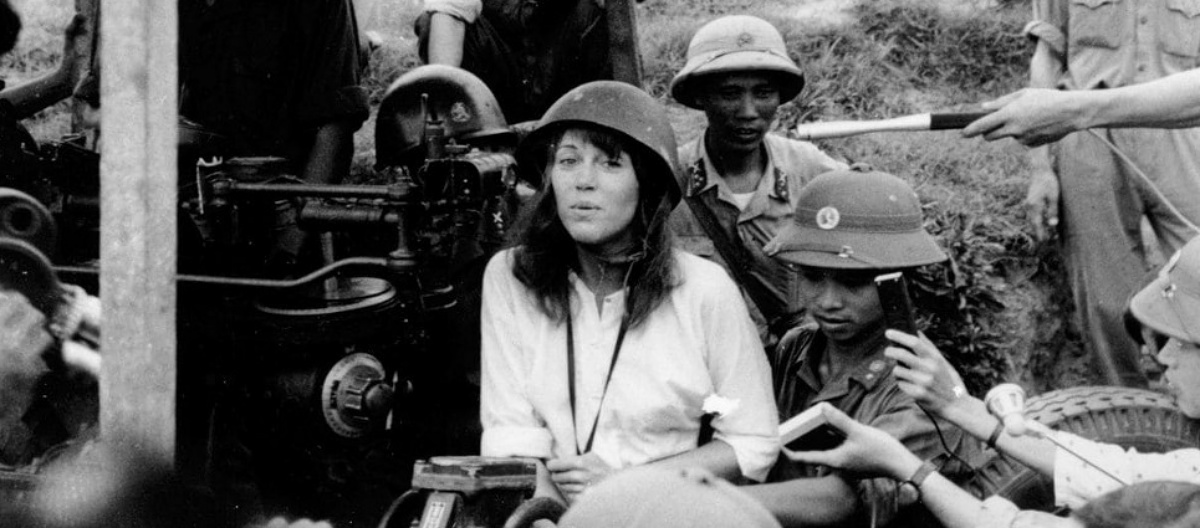
That decision became policy in 1969 when President Nixon announced a program for the “Vietnamization” of the war. It was reaffirmed when Nixon’s Secretary of Defense, Melvin Laird, began a methodical and continuous process of drawing down U.S. forces in Vietnam. It was reinforced when American military units began carrying out “search and evade” patrols in defiance of orders to “search and destroy” communist forces. By the time Jane Fonda sat down to rest at a North Vietnamese anti-aircraft gun in July 1972, there were fewer than 50,000 U.S. troops in South Vietnam—less than one-tenth the number of U.S. troops based there in 1968; the last ground combat unit was deactivated the very next month.
If Tri Ta wants to castigate the opponents of America’s Vietnam War, he should start with those who did most of the antiwar work in the years preceding Fonda’s appearance on the political scene. The opposition to the war began in the early 1960s with a few lone voices and began to take off after the United States sent its first combat forces to Vietnam in March 1965.
While many people seem to think the antiwar movement was a student movement, a variety of organizations of differing political perspectives participated: church groups, pacifists, civil rights groups, veterans organizations, mothers, socialists, communists, active duty soldiers, and retired high-ranking military officers. Among the latter was the retired Commandant of the Marine Corps, General David Shoup, who condemned the war and urged young men to engage in draft resistance; another was a Marine Lt. Colonel, William Corson, himself a Vietnam veteran, who in 1968 referred to the Saigon government as a dictatorship, the U.S. invasion as aggression, and U.S. military strategy as genocide.
Four years before Jane Fonda decided to actively oppose the war, active-duty American soldiers in Vietnam and the United States began undermining the war by publishing hundreds of antiwar newspapers, holding antiwar rallies on their bases, establishing antiwar organizations for GIs, staging “Armed Farces” Day parades, sabotaging military equipment, refusing combat orders, and assaulting superior officers. It was these subversive actions, as well as the Vietnamese communist resistance, that led to the defeat of the nefarious and hated Saigon regime of Nguyen Van Thieu.
The criticism of Jane Fonda’s visit to North Vietnam has functioned to draw attention away from discussion of her main antiwar activity. Together with Donald Sutherland and other entertainers, she cobbled together a roadshow for disaffected troops based in Southeast Asia—an antiwar antidote to the pro-war Bob Hope shows. Operating under the slogan FTA (Fun, Travel, Adventure or, alternatively, F—k The Army) it was well received by the troops, as documented in films such as FTA and Sir!NoSir! The enthusiastic reception of her roadshows revealed the antiwar politics of the troops and was a vindication of Fonda’s work.
Because of the ferocity of attacks on her, Jane Fonda eventually made a public apology. It was, however, unnecessary. It was unnecessary because Jane Fonda did not initiate a genocidal war of aggression, she did not support the brutal, corrupt Saigon dictatorship, she did not engage in war crimes. She did not drop napalm, cluster bombs, and other instruments of death and destruction on rice farmers and their children in South Vietnam, North Vietnam, Cambodia and Laos. She did not spend ten years spraying nineteen million gallons of toxic herbicide across South Vietnam—an herbicide that is plausibly linked to more than 500,000 subsequent birth defects.
She did not leave that country littered with unexploded ordnance—UXO—that has, since 1975, killed more than 42,000 Vietnamese and injured more than 62,000. She did not carry out search and destroy missions, declare certain areas pain-of-death free fire zones, or otherwise “pacify” the South Vietnamese countryside. She did not force several million people to become destitute refugees in their own country, turning men into beggars and women into prostitutes. She did not imprison thousands of South Vietnamese people opposed to the Saigon regime, forcing them to live in tiger cages. Someone else did that, and if anyone should apologize, it is them.
Finally, Tri Ta might note that history has moved on. It was several years ago already that former Republican President Donald Trump affirmed a U.S. commitment to increase defense cooperation with the communist regime of Vietnam.
Makes you wonder why we fought the war.
Comments

Powered by RoundtableAn AI/DeFi-powered Enterprise Media Operating System. Learn more at Roundtable.io.© Roundtable 2026. By using this site you agree to the Terms of Use and Privacy Policy