


Aug 17, 2026 5:13 PM
Updated Aug 17, 2026 5:35 PM
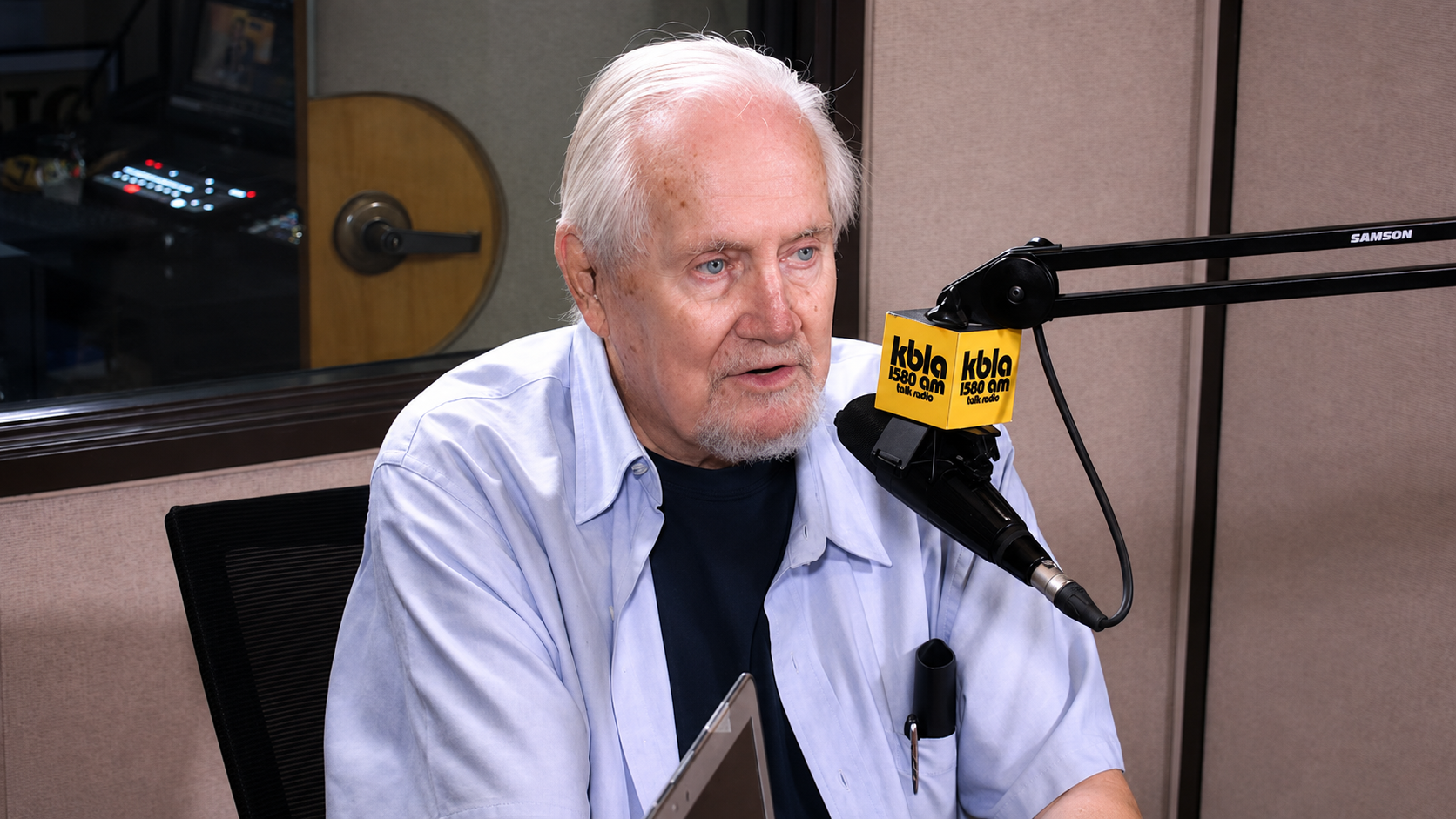
On KBLA’s First Things First, Vietnam veteran Dick Price talks with Dominique DiPrima about the war that changed him, the devastation in Gaza, America’s military-industrial complex, veterans’ care
My husband Dick sat down with Dominique DiPrima on KBLA Talk 1580's "First Things First," and by the time he left the studio, he'd talked about Vietnam, Gaza, a $1.5 trillion defense budget, and why he still doesn't believe much of what his government tells him. Watch the full conversation below, then read on for what stayed with me.
KBLA Talk 1580 interview with Dick Price, "First Things First" with Dominique DiPrima
It started with a rice paddy
Dick volunteered for the draft in 1968. He was 20 and according to him, struggling at an Ivy League university, drinking too much, and feeling like a failure. He volunteered when others like Donald Trump were doing everything they could to avoid the draft. Unbeknownst to Dick, basic training took away one of his major depressants, alcohol. In that way, the Army straightened him out, but then it sent him directly to the Mekong Delta.
"I recognized who they were," he said of the Vietnamese rice farmers he saw from the ground. He'd worked his uncle's dairy farm in northern Minnesota. Different crop, different faces, same thing: people trying to get through the day.
Related stories
"Here we were bombing their damn villages, running our tanks through their rice fields for what was apparently no good purpose."
He was 20 when he stopped believing his government. He calls it skepticism. I'd call it clarity that never left him.
A war he can still see
Dick rarely talks about the men he saw die in Vietnam. In all the years I’ve known him, I’ve never heard him speak about that part of his combat experience in front of anyone other than his doctors at the VA. But sitting across from Dominique DiPrima in KBLA’s Leimert Park studio, he opened that door. He remembered a young soldier from East St. Louis—a kid who kept his Bible close, followed orders, and did everything his country asked of him, only to step on a booby-trapped artillery shell.
"I can replay that," Dick said. "It's part of what my wife calls my PTSD."
That's not a line I fed him. That's 25 years of marriage talking. But I'm not the only one who arrived at that diagnosis. My opinion was backed by the docs at the VA. They made the same call but not until I insisted he get a diagnosis some 30 years after returning from Vietnam—right around the time that George W. Bush was using "shock and awe" in Iraq.
The bombs never stopped, we just stopped watching
Dick's clearest point of the morning: shock and awe over Baghdad broke something in him—a second time. "Did we learn nothing from Vietnam?" And now, he says, it's happening again—Iran, Yemen, Gaza, Ukraine, the strikes across Africa nobody even covers.
The difference this time isn't restraint. It's exhaustion. "People are numb to it," Dick said. "Even well-meaning people who want to do right by the country—it's hard to even keep track of it all."
He thinks that's by design. "It's to throw one thing every day, one atrocity, one stupid thing every day in our news feeds. So much so that you eventually give up and zone out on it. It's a great strategy, and it's terrible for the country."
Where the $7 trillion went
Since 9/11, the country has sent $7 trillion to defense contractors—a figure Dick credits to Andrea Mazzarino and Brown University's Costs of War Project. Now the administration wants a defense budget of $1.5 trillion in a single year, nearly double what it was.
Dick's answer to why is the plainest one there is: "There's lots of careers to be made, and they wouldn't dream of doing away with that." Eight hundred U.S. military bases around the world exist, in his telling, not because the country needs defending but because they generate paychecks — for defense contractors, for the senators who vote to fund them, and eventually, for those same senators once they retire onto K Street.
That, Dick argued, is the real reason so many "lame duck" Republican senators — men with nothing left to lose politically — still voted to confirm Pete Hegseth and Todd Blanche and will likely fund the $1.5 trillion request. It's not fear of Trump. It's the promise of a lobbying paycheck waiting on the other side of the vote.
Ask what could be funded instead, and Dick doesn't hesitate: healthcare for all, free preschool, free college tuition — the way it already works in much of Europe.
Gaza and the money trail
Dick called what's happening in Gaza what he believes it is: genocide. "The blood is on our hands because we paid for the bombs. We paid for the jets. We gave the authority to do that."
He pointed to Abdul El-Sayed's Michigan primary as the clearest recent proof of how that money enforces itself: the instant he won, AIPAC pledged $60 million to defeat him in the general election — more money than most of Michigan's own voters could ever put behind a candidate. The question AIPAC doesn't want asked, Dick said, is a simple one: "Does Palestine have a right to live?"
His answer to what comes after the devastation isn't Jared Kushner's beachfront real estate. It's a Marshall Plan — rebuilding Gaza for the Palestinians who survived it, the way the U.S. rebuilt Europe after World War II.
A caller from Compton pushed it further
A caller named Shayon didn't let Dick's Marshall Plan comparison stay abstract. We need one here too, he said — a Marshall Plan for America's own inner cities, made a condition of the Democratic Party's platform in exchange for Black votes in the midterms and in 2028.
Dick agreed without hedging. He pointed to California's Reparations Task Force as a starting framework: free college for Black kids, reparations addressing housing, education, and healthcare. "Instead of spending $1.5 trillion, wasting it the way we've talked about, we could have — it is what we should be doing."
What the VA got right
Dick came back from Vietnam into an era when VA hospitals were a national scandal, overwhelmed and undersupplied. So he didn't start using the VA until decades later. He learned, quite by accident, that he was entitled to free dental care. That began his reintroduction to the VA — a much improved healthcare provider that doesn't resemble what existed when he left Vietnam.
What struck him most and still does is the spirit. "We're all in it together," he said of the staff — guards, nurses, clerks, doctors. "It does feel like a family."
His larger point: veterans' organizations routinely fail to tell veterans what they're owed. A colleague once mentioned, almost in passing, that her tuition at a California state college campus had been paid in full because her father was a disabled Vietnam veteran. Dick is a disabled Vietnam veteran. He had a daughter headed to college at the time. That news was a godsend. Nobody had told him either.
Where this leaves us
Dick Price has spent more than sixty years distrusting the version of events his government hands him, ever since he was a twenty-year-old watching tanks roll through somebody else's rice field for no reason he could find. That distrust isn't cynicism. It's the only appropriate response to a country that keeps asking its poorest people to die for its wealthiest people's portfolios.
A democracy that spends $1.5 trillion on war before it spends a dollar on healthcare has already told you what it values.
Sources
- Full interview: KBLA Talk 1580, First Things First with Dominique DiPrima
- Costs of War Project, Brown University
- Andrea Mazzarino, contributing writer on veterans, PTSD, and military spending
Comments

Powered by RoundtableAn AI/DeFi-powered Enterprise Media Operating System. Learn more at Roundtable.io.© Roundtable 2026. By using this site you agree to the Terms of Use and Privacy Policy