


Jun 28, 2026 9:32 PM
Updated Jun 29, 2026 9:17 PM
As Washington shields Israel from accountability, member states should use Resolution 377, reconsider the UN’s dependence on the United States and reclaim the organization’s responsibility to preserve peace.
The Primary purpose of the United Nations according to its charter is to preserve peace, prevent conflicts if possible, or resolve them when they arise. With genocide in Gaza, wars in Ukraine and Russia, bombing and enclosures by Isreal in Lebanon, a US invasion in South America, enforced starvation in Cuba, it is apparent that intervention by the UN to achieve these goals has been ineffectual.
President Trump has clearly stated that he has achieved more peaceful conclusions to conflicts than the UN. Ignoring the vainglory and hyperbole in that evaluation, it is nevertheless clear that as a peacemaker that the UN has not been effective in recent years.
Reasons for UN failure
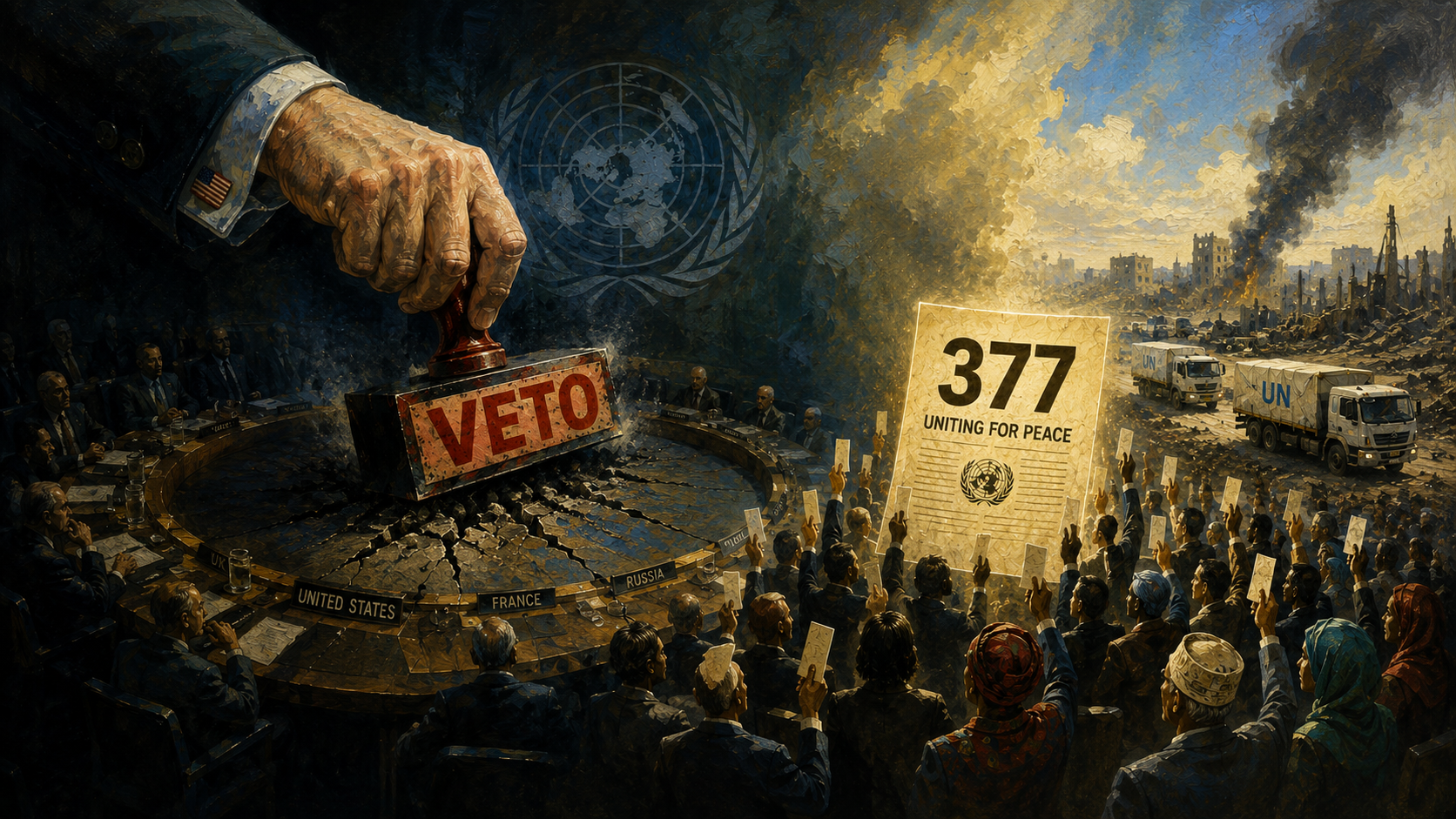
The reason for that is clear to most neutral observers. The United States presence on the Security Council and its excessive use of the veto, has inhibited the UN from promoting peace in any major conflict in which the United States had an interest. In the Israel-Palestine conflict alone, the United States has invoked the veto forty-nine times. It has refused to recognize the authority of the International Court of Criminal Justice which issued an arrest warrant for Netanyahu for genocide. It has refused to affirm the two-state recognition of the Gaza strip and the rights of Palestine. It has refused to veto the General Assembly resolution that Israeli violence against Palestine civilians cease, it has also vetoed the demand of the General Assembly for Israel to end rapacious expansion of illegal settlements in Arab territory.
Propaganda and suppression of dissent.
Meanwhile it has conducted a propaganda war to convince the people of the United States and their allies that any criticism of Zionist forces was antisemitism. It has blocked pro-peace protests on university campuses throughout the United States; it has imposed financial hardships on college administration who did not adopt a pro-Israeli position. It has deported foreign students favorable to peace in Gaza and proposed disciplinary action for those American students so engaged. It has refused to admit university professors from other countries who have expressed pro-Palestine views. Moreover, pro-Zionist groups have intimidated college administrations, banned documentary films showing the current crisis in Gaza, and prevented speakers of peace from appearing on university campuses including a US Congresswoman.
Related stories
The overall view of the average citizen in the US is that the UN is impotent and many outside the country share that view. However, a closer examination might indicate that there is some hope yet. Member states have been reluctant to use procedures which would challenge the American veto in the Security Council. There were many reasons for this: the UN headquarter was in the US and the government could retaliate by withdrawing visas from their diplomates; the fact that 22% of the UN budget was paid for by the United States; many nations had trade and military connections with the US that they did not wish to jeopardize by antagonizing the President, and finally, the feeling that the US as a founding member deserved a higher degree of deference than might be accorded to other member states.
By now it should be apparent that none of these reasons have the same weight they had before the Trump era. The President has contempt for the institution and its members. He has cut funding for major conflict resolution programs, aid to children, arts and education, disaster relief, medical research, and even annual dues to the UN, resulting in a major budget deficit for the organization. Over $15 billion USD has been cut from all US contributions by Trump this past year. Meanwhile, the US has provided Israel with $124.5 billion in military aid, including bombs used to destroy apartments, hospitals and schools, and missiles used to kill children housed in tents in protected refugee areas.
The location of the United Nations Headquarters in New York is no longer favorable to most members and especially unfavorable to countries which do not have large diplomatic budgets or are not on friendly terms with the US. The city is one of the most expensive in the world thus unfair to developing countries, while those such as Haiti, Lebanon, Syria, Cuba, and Iran are at risk of having their diplomatic credentials rejected by executive whim.
It is time for member nations to take extraordinary measures which might include moving headquarters to a location outside the United States (an Asian venue makes more sense both economically and in terms of accessibility to most members); and invoking long-neglected remedies for abuse of the veto privilege,
What remedies are available?
When one nation, which is a party to the conflict, repeatedly invokes the veto to oppose a General Assembly resolution to preserve peace, and refrain from support of on-going aggression, the following pertain:
(a) Invoking the ACT Code of Conduct to formally demand that the member nation refrain from using the veto especially involving any case where a charge of genocide has been leveled.
(b) The Veto Initiative which requires a formal debate within 10 days during which a spotlight is shone on the member state using extreme is General Assembly land and France the veto in which they must publicly justify their action.
(c) Resolution 377 (a) which was most successfully utilized during the Suez Crisis and resulted in the end of that conflict despite the vetoes of both England and France. This resolution is a clear precedent for ending hostilities occurring today exacerbated by a myriad of vetoes from a power which is a party to the conflict.
Suez Crisis and Resolution 377(a) Uniting for Peace
In 1956, President Gamal Nasser nationalized the Suez Canal. He wanted to finance development projects as well as assert Egypt’s sovereignty over its own resources after years of neocolonialism. Britain and France, which had commercial interests in the Suez Canal Company, joined Israel in invading the country to ensure their continued profits. The UN passed a resolution declaring that the invasion was contrary to international peace and must cease. Britain and France vetoed the resolution in the Security Council. The General Assembly responded by a two-thirds vote requiring intervention by a fourteen-member arbitration group which effectively put aside the vetoes and compelled the armies to withdraw.
While the UN Charter states that a veto from the Security Council is binding, there is a Uniting for Peace Resolution which can challenge that. Two-thirds of the Assembly declared that, according to the UN Charter, the permanent members cannot and should not prevent the General Assembly from taking any and all action necessary to restore international peace and security in cases where the Security Council has failed to exercise its "primary responsibility" for maintaining peace. Various official and semi-official UN reports make explicit reference to the Uniting for Peace resolution as providing a mechanism for the General Assembly to overrule any Security Council vetoes, thus rendering them little more than delays in UN action, should two-thirds of the Assembly subsequently agree that action is necessary. Now is the time for that to be invoked again.
What can we do?
In the General Assembly 193 members voted to adopt the two-state solution for Palestine and Israel and 149 members adopted the Gaza Ceasefire Resolution. More than a two-thirds majority exist to end the conflict. By writing to our ambassadors to the UN, we can help ensure that this matter follows the precedent established during the Suez conflict and the massacre of civilians in Gaza ends. The latest US statistics are that 174,000 have died and one third of them have been children. Now with most of the structures, apartment buildings, hospitals, and schools destroyed, the few structures left standing are canvas tents in refugee camps vulnerable to weather, random rockets, and intentional air attacks and murder.
Writing to the US ambassador will have negligible effect except a cumulative one. But if you live or work abroad or have friends and colleagues who do, writing to the UN ambassadors of Mexico, Ireland, France, Chile, Greenland, South Africa, or any of the 143 others will certain guarantee a majority vote to bring this matter to long-overdue conclusion so that starving Palestinians can be fed, the unhoused can begin construction, medical supplies reach the injured, and children can once again play in peace.
Comments

Powered by RoundtableAn AI/DeFi-powered Enterprise Media Operating System. Learn more at Roundtable.io.© Roundtable 2026. By using this site you agree to the Terms of Use and Privacy Policy