
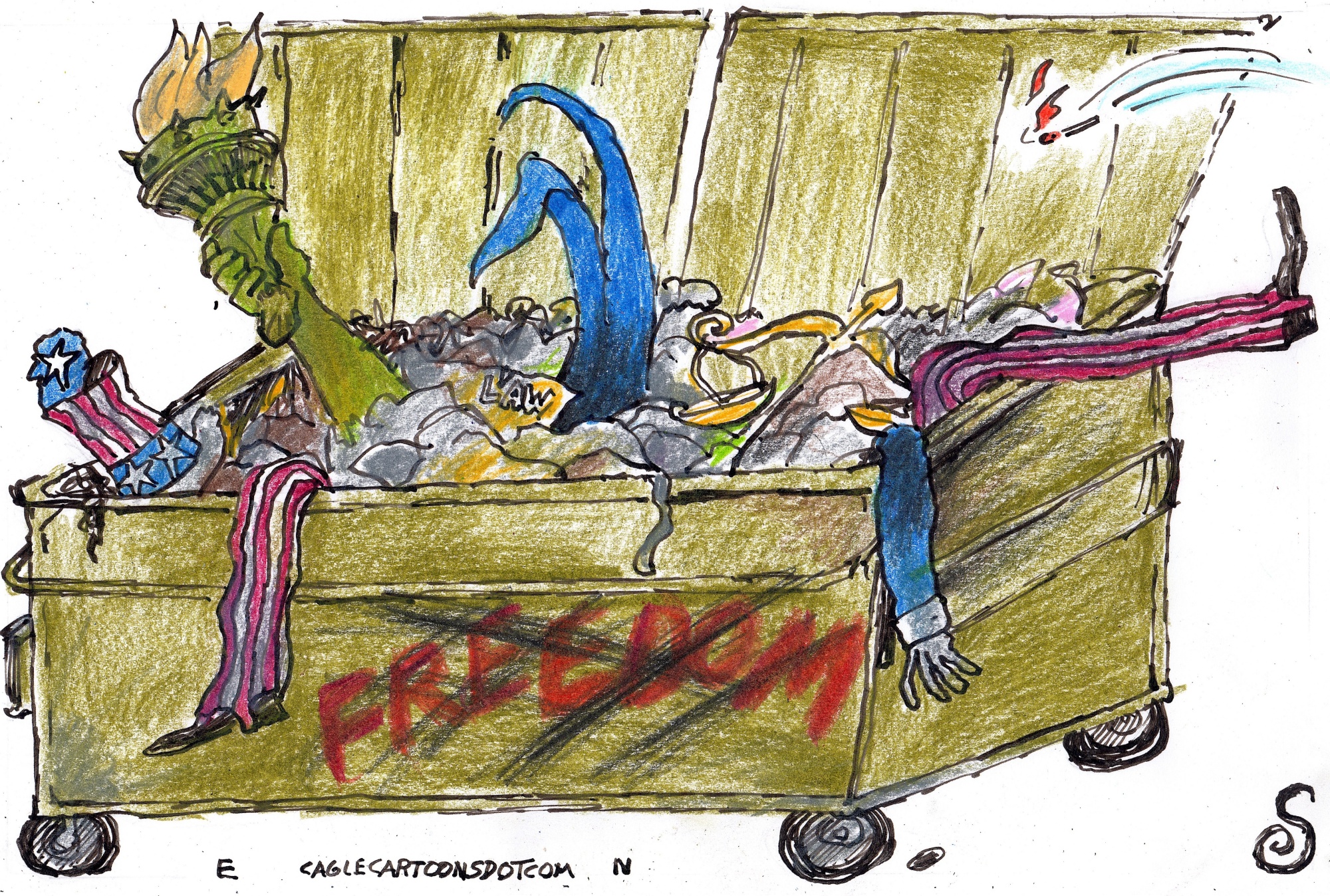


Things have indeed fallen apart. We know what rough beast has slouched into power in Washington, and the gaze it turns upon us is blank and pitiless as the sun.
Jul 25, 2025 5:22 PM
Updated Jul 25, 2025 5:28 PM
Things have indeed fallen apart. We know what rough beast has slouched into power in Washington, and the gaze it turns upon us is blank and pitiless as the sun.
"Things fall apart. The centre cannot hold; mere anarchy is loosed upon the world, the blood-dimmed tide is loosed, and everywhere the ceremony of innocence is drowned; the best lack all conviction, while the worst are full of passionate intensity. Surely some revelation is at hand; Surely the Second Coming is at hand.”
These lines, from one of William Butler Yeats’ best known poems, first appeared in print in 1920, four years after the outbreak of the Irish Republican rebellion against British rule in 1916. Yeats wrote the poem in the midst of the rebellion, and in the aftermath of the first world war. The chaos depicted in his words was all around him, and it must have seemed that the world he and others had known all their lives was coming to an end.
But the Second Coming Yeats envisions in this poem is not the promised return of Jesus Christ. Instead, he tells us, “...somewhere in sands of the desert a shape with lion body and the head of a man, a gaze blank and pitiless as the sun, Is moving its slow thighs....” And he wonders, “...what rough beast, its hour come round at last, slouches towards Bethlehem to be born?”
What would he have thought, if he had known what would happen in this country a hundred years later — the 2016 election of Donald Trump to his first term as president, the emergence into public view, with his encouragement, of anti-government and white supremacist militia groups that until then had remained in the shadows, the fracturing of the American consensus about who we are and what we stand for.
Related stories
The Irish Republican rebellion of 1916 came to an end with the1921 signing of a treaty that brought peace to Ireland and opened the way for an independent Irish dominion. A civil war followed, fought between pro- and anti-treaty forces, in which those who had fought together against Britain now turned against each other, setting off a period of bitter political and religious conflict that continued until 1998.
A century later, president-elect Joe Biden was duly inaugurated, despite a concerted attempt by members of Congress to overthrow the results of his resounding victory over Donald Trump. Of the 535 menbers of Congress, 147—nearly one in three—voted against the certification of Biden’s win, defying the will of the people whose votes not only had elected Biden but also had placed all of them in office.
No ceremony of innocence here; nothing but mere anarchy loosed in the very heart of our government. The center, in other words, did not hold, and while Trump’s supporters strove together in their passionate intensity to oppose the outcome of the presidential election, their opponents lacked the conviction to do more than cast their votes to certify and indignantly recite high-sounding platitudes about laws they were unable to enforce, and standards they were unable to uphold.
Moreover, as the Congress convened to certify the election, an angry armed mob, whipped into a frenzy by the outgoing president himself, attacked the Capitol, seeking to prevent the certification. AsTrump’s Congressional supporters scurried for safety, they began the process of trivializing the mob’s attack, referring to the attackers not as the terrorists they were, but as nothing more than tourists, and patriots.
Biden’s inauguration, however, did not end the American Republican uprising, nor bring any peace to this country, nor open the way for anything but a continued right-wing refusal to live by the rules of community and polity that had defined the United States for nearly two and a half centuries. The dominion they sought—and continue to seek—would privilege an intolerant and vengeful variant of Christianity over all other faiths, and would impose an Orwellian absolutist rule in place of what had been the most successful experiment in democracy since the glory days of Athens.
Yeats could not have foreseen the events of January 2021, however vividly he prefigured them. Those who voted for Biden in 2020 felt relieved and reaffirmed at his inauguration, believing they had saved the country from an authoritarian takeover. But the Second Coming of Trump in 2024 has given the lie to that belief.
Trump’s second inauguration has ushered in a relentless destructive rampage against the institutions of our government and the values that brought them into being. It’s not difficult to imagine, like Yeats, that the world we’ve lived in all our lives is coming to an end—things are falling apart before our eyes, and it feels as if there no longer is a center, much less one that can hold. We have our eloquent poets to portray our situation, as Yeats did his, but it now seems too late for us to benefit from their clear-eyed warnings, let alone from Yeats’ unwitting anticipation of events unfolding far away from him and long after he wrote.
Things have indeed fallen apart. By now, though, we know all too well what rough beast has slouched into power in Washington, D.C., and the gaze it turns upon us is every bit as blank and pitiless as the sun.
Comments

Powered by RoundtableAn AI/DeFi-powered Enterprise Media Operating System. Learn more at Roundtable.io.© Roundtable 2026. By using this site you agree to the Terms of Use and Privacy Policy