
Surrender of Ukraine


Capitulate to Trump
Feb 15, 2025 5:41 PM
Updated Feb 15, 2025 9:57 PM
Trump’s henchmen drape themselves in the language of peace, but their words are hollow, their intentions rotten.
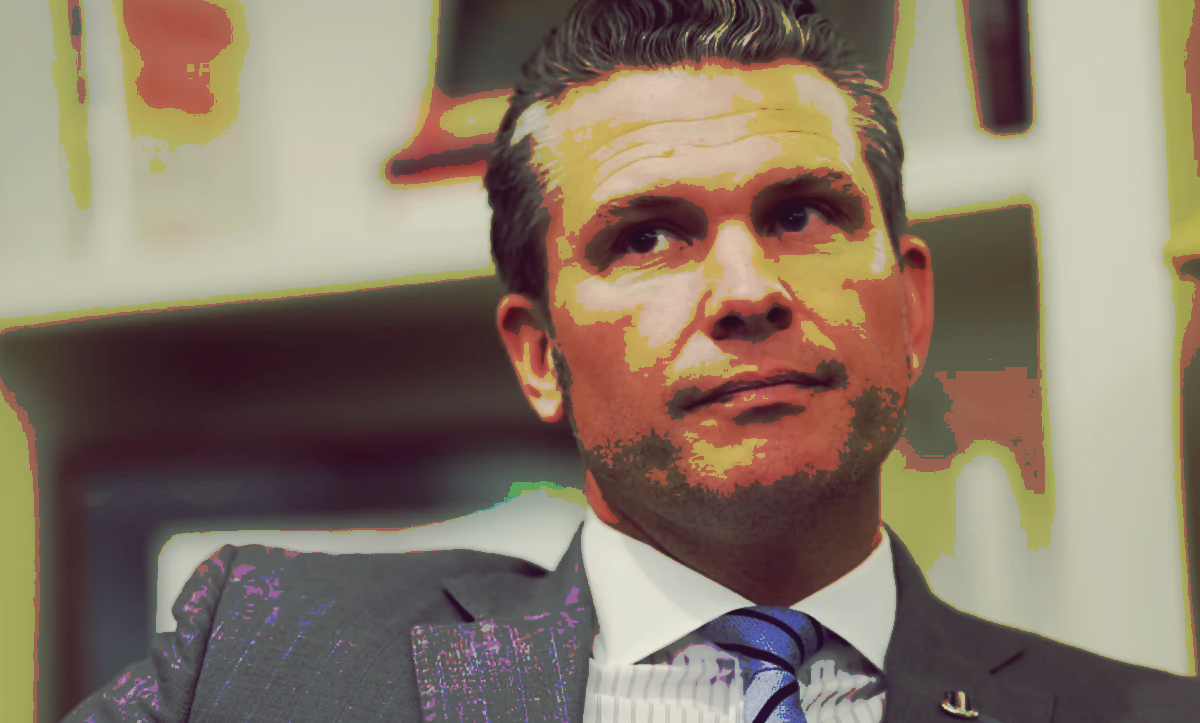
Defense Secretary Pete Hegseth’s recent remarks in Brussels—statements so jarring they sent shockwaves through diplomatic circles—sounded the death knell of American statecraft. Gone was the steady hand of leadership that once anchored the free world. In its place, a hollow shell of rhetoric, stripped of conviction, bending under the weight of appeasement.
Rather than reaffirming NATO’s unity, Hegseth wavered. Rather than condemning Russian aggression with the clarity history demands, he offered ambiguity—a lifeline to Moscow disguised as diplomacy. This was not a misstep; it was a signal. A retreat from principle. A slow-motion abandonment of allies who have staked their survival on American resolve.
In the halls of the Kremlin, there was no confusion. Only satisfaction. The great unraveling had begun.
With the full weight of American leadership behind him, Hegseth had the opportunity to reaffirm solidarity with NATO, to condemn Russian aggression with the moral clarity history demands.
Related stories
But he did not.
Instead, his words wavered, his message muddled—a dangerous equivocation in a moment that called for resolve. He did not stand as a bulwark against tyranny but as an echo of uncertainty, undercutting alliances that have, for generations, held the line against authoritarian conquest. This was not strategy; it was surrender dressed as ambiguity. Not strength, but retreat. A gift to the Kremlin, wrapped in the language of doubt.
In Moscow, they must have listened closely. And they must have smiled.
For U.S. allies, the message was chilling: America, once the bedrock of the transatlantic alliance, now stands on unsteady ground. And as Zachary Basu’s reporting makes clear, the world is left to wonder—was this a blunder, or a warning of what’s to come?
Defense Secretary Pete Hegseth delivered a blunt message to NATO allies Wednesday: U.S. troops will not be part of any future peace-keeping mission in Ukraine.
- Nor should NATO's Article 5 protections — under which the U.S. vows to respond if an ally is attacked — apply to any European forces sent to Ukraine to secure a postwar peace settlement, he said.
- Ukraine, meanwhile, should make a deal now — and give up on regaining all of its occupied territory, or becoming a member of NATO.
This is the tragic prelude to a full-scale retreat from American leadership, a surrender not just of Ukraine, but of the ideals that once defined the free world. And in that retreat lurks catastrophe. Because history has seen this before—the moment when democracies flinch, when appeasement is dressed as pragmatism, when cowardice masquerades as restraint. It never ends in peace. It ends in ruin.
But Hegseth wades through his rhetoric like a man lost in a fog of his own making. His words twist and turn, often contradicting themselves, leaving behind not clarity, but chaos. One moment, he strikes a tone of certainty; the next, he veers into contradiction, unraveling his own argument before it can take hold. The result is not conviction but confusion—a muddled narrative that serves no purpose except to obscure, distract, and leave the audience grasping at shadows.
The White House’s contradictory positions will be partly to blame here. We have seen a startling week in which the US Secretary of Defense Peter Hegseth said Ukraine could not join NATO or get its pre-2014 borders back. He either broadcast a key plank of US President Donald Trump and Russian President Vladimir Putin’s secret peace deal inadvertently or gave away a key part of Ukraine’s diplomatic negotiating hand to the shock of Europe.
Ukraine’s allies may have all known that, in reality, it would not join NATO soon, or get its borders back to when the east and Crimea were in its hands, but had kept that as a concession to make to Russia during, not before, negotiations.
But then, in a whiplash reversal, Hegseth told The Wall Street Journal the exact opposite. His words, already tangled in contradiction, collapsed entirely under the weight of their own inconsistency. One message for one audience, another for the next—leaving behind not a coherent argument, but a smokescreen of opportunism. Whether out of carelessness or calculated deceit, the effect remains the same: confusion, distortion, and a deliberate muddying of the truth:
US Vice President JD Vance told the Wall Street Journal, apparently, the US might send troops to Ukraine, in extremis – that it would use “tools of leverage” both military and economic. Did he really unveil the polar opposite of Hegseth’s comments in Brussels that no American soldiers would go to Ukraine? Why did he not mention Russia at all, when addressing European allies in Munich about largely fictional totalitarianism in western democracies? Also, did Trump misspeak when he said there would be “high-level people” from Russia, Ukraine, and the US in Munich for a key security conference – or did he mean Saudi Arabia?
If Pete Hegseth delivered a calamitous message to America’s steadfast allies, J.D. Vance provided precisely what the cynics expected—a full-throated echo of Trump’s erratic, and at times, inscrutable stance on Ukraine.
If Pete Hegseth delivered a calamitous message to America’s steadfast allies, J.D. Vance provided precisely what the cynics expected—a full-throated echo of Trump’s erratic, and at times, inscrutable stance on Ukraine. In his Munich address, Vance did not stand as a statesman but as a mariner lost at sea, his compass shattered, his bearings gone. Adrift in the tides of history, he seemed disconnected from the warnings of the past and ignorant of the realities of the present, drawn ever closer to the siren call of authoritarian appeasement.
Rather than anchor himself in the unshakable principles of democracy and resistance to tyranny, Vance charted a course straight into the storm, undermining the very alliances that have safeguarded the West for generations. His speech was not a beacon of leadership but a distress signal—one that, if ignored, could mark the beginning of a catastrophic unraveling.
He spoke not as a statesman, not even as a man burdened by the weight of history, but as an opportunist peddling a gospel of surrender, his words honeyed with the rot of political expediency. In a city that once bore witness to the cost of complacency, he dared to whisper the old, deceitful refrain: that we must turn away, that the defense of Ukraine is a burden too great, that America’s obligations to its allies are mere relics of a past he seeks to unmake. But America is not without its truth-tellers—critics who refuse to bow to power, who brave the storm of Trump’s wrath to speak plainly, without hesitation or artifice. One such voice is Steve Schmidt.
Schmidt, a seasoned political strategist and co-founder of the Lincoln Project, has spent years exposing the authoritarian rot at the heart of Trumpism. His analysis cuts through the noise, dissecting the dangers of a government hijacked by sycophants and strongmen. Whether warning of the existential threat posed by a second Trump term, the erosion of democratic institutions, or the cynical betrayal of Ukraine, Schmidt does not mince words. He understands that history does not forgive the complicit—or the complacent.
In an era when silence equals surrender, voices like his are more than necessary. They are a last line of defense.
Steve Schmidt’s The Warning is not just a podcast—it is a fire alarm in the night, ringing out over a nation teetering on the edge. It does not whisper. It does not soothe. It roars across the digital ether with the urgency of a prophet staring into the abyss. Schmidt wields language like a hammer, striking at the heart of the crisis with precision, never missing his mark. His voice is a scalpel, cutting through the fog of propaganda to expose the raw, unvarnished truth: a Trump, Musk, and Vance presidency is nothing less than a funeral dirge for democracy.
He paints Trump as he is—a groveling sycophant in Putin’s shadow, eager to trade American strength for the approval of a tyrant. Schmidt lays bare the treachery: Trump’s willingness to sell out our European allies, to turn Ukraine into a sacrificial lamb, to embolden the same Russian menace that history has already warned us about. This is not hyperbole. This is not speculation. It is a reckoning. And as Schmidt reminds us with every searing episode, the only question left is whether America will listen before it’s too late.
Steve Schmidt’s The Warning tore through J.D. Vance’s Munich Security Conference speech like a blade through prickly pretense, exposing it for what it was—not a condemnation of Russian aggression, but an abject betrayal of our European allies. Vance did not stand against tyranny; he stood against those resisting it. His words carried no fire for the Kremlin’s brutality, no outrage for the slaughter in Ukraine. Instead, he turned his aim on NATO, on those who have borne the weight of history’s harshest lessons, on the very alliances that have kept the world from descending into another abyss.
Schmidt eviscerated the Trump administration’s cowardice with the clarity of a battlefield dispatch, making one thing devastatingly clear: this is no mere rhetoric.
Schmidt’s The Warning peals like a cathedral bell in the storm, cutting through the fog of Vance’s revisionism with brutal clarity. Schmidt understands what Vance pretends not to see—that the specter of Trump, Musk, and Vance himself forms an unholy trinity of capitulation, a triumvirate of men who would let the fire of democracy gutter and die for the price of their own ambition. He strips away the mask, revealing Trump as the obsequious courtier to Putin, a man who kneels before the Russian autocrat with the eagerness of one who knows his debts will soon come due.
In Schmidt’s telling, Vance is no mere fool; he is something more insidious—a man who once feigned concern for the working class only to turn his back on them, trading in his conscience for a seat at the table of power. His performance in Munich was no different. He played the part of the sober realist while selling the fantasy that America’s strength lies in retreat, that Ukraine’s struggle for survival is not ours to fight, that history’s long arc can be bent backward with enough cynical pragmatism.
J.D. Vance stood before the assembled ranks of world leaders, not as a harbinger of wisdom but as a merchant of grievance, his words slithering through the hall like the first tremors of a coming quake.
J.D. Vance stood before the assembled ranks of world leaders, not as a harbinger of wisdom but as a merchant of grievance, his words slithering through the hall like the first tremors of a coming quake. He spoke not of unity, not of the burden of defending freedom, but of imagined betrayals, casting Europe as the villain in a fable only he and his cohort of aspiring autocrats could comprehend.
There was an irony so thick it choked the air—Vance, the mouthpiece of an administration that has turned censorship into an art form, accusing Europe of betraying free speech. He, who serves under a man who sues networks for telling the truth, who foments bans on books and history itself, who watches with silent approval as his party hunts down educators and journalists, dared to stand in Munich and lament the supposed silencing of dissent. The hypocrisy clung to him like the scent of rot.
But there was something deeper, something darker beneath his feigned indignation. He was not there to debate, not there to defend democracy, but to signal—to whisper in the ears of the gathered, as all aspiring strongmen do, that the old order is crumbling and that America, under his master’s hand, will no longer be its keeper. His sermon on migration was no mere policy stance but a hymn to the fears that fuel the fires of nationalism, a hymn that has been sung before—always before a great unraveling.
The room did not respond with thunderous applause but with silence—the kind of silence that follows an unexpected and unwanted specter at the feast. European diplomats, veterans of decades of alliances and hard-won peace, sat stunned, watching as the third most powerful man in the United States (next to Musk and Trump) spoke the language of retreat and resentment. "Gobsmacked," they murmured. "Frightening," they whispered. In another age, another time, another gathering in Munich, the world had once heard such rhetoric before.
Steve Schmidt sees with piercing clarity what J.D. Vance pretends not to—a nation not merely under external threat, but actively poisoning itself from within. America stands at the precipice, not because of foreign meddling alone, but because it has willingly invited the disease of authoritarian populism into its bloodstream. This is not a slow, creeping sickness; it has metastasized into something far more grotesque, so rancid that it is now projectile vomiting up fascism in broad daylight.
The masks have slipped. The quiet part is shouted. The once-veiled ambitions of strongman rule now parade through the streets, daring democracy to resist. Schmidt does not deal in euphemisms. He knows the abyss is near, and he knows history’s verdict on those who look away. The only question left is whether America will choke on its own bile—or rise before the sickness claims it completely.
Vance, Trump, Musk—their names will be written in history’s ledger, but not as defenders of free speech, not as guardians of democracy. They will be remembered as men who fanned the flames while pretending to be firefighters.
Munich was not a moment of strength for Vance. It was an unveiling, a pronouncement that the last vestiges of America’s moral leadership is being auctioned off to the resignation of the weak, bartered away in a marketplace of cowardice where principle is the first casualty. Once a beacon of resolve, the nation now flirts with appeasement, its commitments hollowed out by those too timid—or too compromised—to stand firm against tyranny.
This is not the posture of a superpower. It is the slouch of a nation in retreat, its credibility bleeding out with every equivocation, every waver, every failure to call evil by its name.
The world is watching. Moscow is taking notes. And history, as always, will deliver its judgment. The storm is gathering, and those who mistake silence for consent will soon learn that history never kneels.
Here is what Vance should have said: Putin’s justifications for his criminal invasion are eminently risible and potently dangerous, and need to be historicized and put under critical examination. We can, and should, support the Ukrainian people in their moment of need. As the reigning hegemon of a unipolar geopolitics, the US pledges its support for the unconditional withdrawal of Russian troops from Ukraine, and the right for Ukraine to be provided with the weapons it needs in order to defend its territory and its people. Russia must pay reparations for the damage that it has inflicted throughout Ukraine – in its cities, its suburbs, and its countryside. Failure to do so will result in US sanctions.
This is the final stage of the imperial death spiral—the moment when the propaganda machine, having exhausted its justifications for one genocide, simply broadens its scope to include the world. What began as a campaign to erase Ukraine has now become an indictment of all who refuse to kneel before Russian revanchism.
There is no longer pretense, no longer even the hollow echoes of diplomacy. The rhetoric of Russian state media has descended fully into the abyss, an orgy of nihilism where the only response to resistance is annihilation. Their pundits do not argue policy; they fantasize about cities reduced to ash, about entire nations swallowed in nuclear fire. When they are not satisfied with kidnapping Ukrainian children and carting them off to Siberia, they rejoice in the bombing of children’s hospitals, their bloodlust spurred on by the destruction of innocent life. They cheer their success in bombing a nuclear reactor, as though the poisoning of the land and the poisoning of the future could somehow satiate their hunger for conquest. This is not war—it is a doctrine of pure destruction, a monstrous testament to the rage of a wounded empire lashing out at a world that refuses to bend to its will.
And what does the United States do in response? It rewards such aggression. It coddles the criminals in the Kremlin by floating the idea that Russia must keep the land it has stolen as a "realistic condition" of peace. This is not diplomacy. This is capitulation. This is not justice—it is the betrayal of the principles the West claims to stand for. To surrender to this logic is to give up not just Ukraine’s future, but our own.
And yet, history tells us where such rhetoric leads. It is not just the words of propagandists screaming into the void—it is the prelude to horror. The world has seen this before: the fevered rants of dictators, the fanatical dreams of empire, the conviction that if victory is impossible, then ruin must be shared by all.
To wave away these threats as mere theater is to whistle past the graveyard of history. This is not the bravado of strength but the howl of a cornered beast, and wounded predators are the most lethal of all. The question is no longer whether danger looms—it does. The only question that remains is whether the world will awaken before the storm clouds break, or whether, as too often before, it will stir only when the deluge is already upon us.
There are always those who believe that the tide can be reasoned with, that the rising flood of fascism can be managed through measured words and diplomatic handshakes. They are the ones who whisper of compromise while standing at the edge of the abyss, mistaking the predator’s pause for a moment of reflection rather than the tightening of claws before the kill.
This is no moment for comforting delusions. The architects of annihilation have laid bare their designs with the cold precision of a blade to civilization’s throat. They do not come to the table seeking compromise; they come demanding capitulation. They do not hunger for peace; they crave silence—silence from Ukraine, silence from Europe, silence from every soul brave enough to raise a voice in opposition. Theirs is a war not for territory, but for the erasure of dissent itself.
To respond with anything less than unyielding resistance is to embrace self-destruction. There is no compromise between the inferno and existence—no delicate negotiation that can douse the flames of a regime now brazenly crafting a future forged in ash. The only choice left is to fight or to perish, for any hesitation will be the final surrender to a world consumed by its own destruction. And so, the choice stands before us, stark and unforgiving: Act now, or wait for the reckoning. Hold the line, or be swept away when the storm breaks. Because fate is merciless to those who thought they could negotiate with the inevitable while lying prostrate on the slaughter bench of history.
Trump’s henchmen drape themselves in the language of peace, but their words are hollow, their intentions rotten. Among the ranks of Trump, Vance, and the ultra-right, there is no true pacifism—only a masquerade, a cynical performance designed to disarm resistance while they clear the path for tyranny. They speak of diplomacy as they embrace the actions of dictators like Viktor Orban or Jair Bolsonaro; they speak of restraint as they excuse atrocity.
These are not the pacifists they feign to be, nor the neutral observers they claim to be. They are captives of a cult, their minds shackled to a machinery of grievance, their strength drawn not from principle but from the raw, unfiltered rage of their followers. They do not lead—they feed, gnawing hungrily at the decayed carcass of hate, their power sustained by the endless cycle of resentment and fear. Groomed for demagoguery, they have abandoned reason for spectacle, conviction for cruelty. And as they feast on the rot of division, they demand the nation do the same, dragging democracy to the table of its own destruction. They parrot Russian deceit not from conviction, but from fealty to a darker, more insidious cause, chained by the arrogance of a play ground bully. Their hands are drenched in ill-gotten wealth, earned not through merit, but through the betrayal of Ukraine and its European allies.
Their egos are fattened on the spoils of allegiance, well-compensated by the mob that fuels them with unwavering obedience. They drape themselves in the hollow pretense of peace, a threadbare disguise meant to mask their servitude. But their silence is not neutrality—it is complicity. With eyes wide open, they choose to look away, willfully blind to the Kremlin’s relentless war machine as it grinds forward, leaving smoldering cities and shattered lives in its wake. They are not peacemakers. They are enablers, their voices raised only to defend their own petulance. They echo Russian lies not out of belief, but out of loyalty to a darker cause, tethered by the arrogance of a school yard bully, their hands stained with unearned riches from those whom they betrayed.
And yet, they demand to be taken seriously, these merchants of cowardice. They insist that capitulation is wisdom, that abandoning Ukraine is prudence, that kneeling before Putin is the only path to stability. History knows their kind all too well. They are the collaborators, the appeasers, the isolationists who, in another time, would have watched Europe burn as the SS-Panzergrenadier divisions rolled in, with the Einsatzgruppen following, slaughtering every Jew and gypsy in their wake. These are the ones who, in every age, claim neutrality while turning a blind eye to the bloodshed, complicit in the darkest chapters of history, willing to stand aside as civilization crumbles beneath the weight of tyranny.
But they will not have the final word. Because the world has seen this deception before. And this time, there will be no illusions, no polite indulgence of their treachery. The stakes are clear. The battle lines are drawn. And the agents of an ersatz peace will be remembered for what they are: foot soldiers of fascism, betrayers of democracy, and cowards unworthy of the nation they claim to serve.
We need to remember what Putin said as he addressed the World Russian People’s Council. Putin proclaimed that Ukrainians and Belarusians are not independent but are, in fact, part of the ‘great Russian nation.’ According to Putin, an admirer of Stalin, these two nations have been artificially divided from Russia by the ‘separatist illusions’ of the 1991 Soviet collapse. Of course, Stalin’s famous predecessor had a very different view of what constitutes a nation as noted by Slavoj Žižek. Lenin stated his principles as follows:
The proletariat cannot but fight against the forcible retention of the oppressed nations within the boundaries of a given state, and this is exactly what the struggle for the right of self-determination means. The proletariat must demand the right of political secession for the colonies and for the nations that ‘its own’ nation oppresses. Unless it does this, proletarian internationalism will remain a meaningless phrase; mutual confidence and class solidarity between the workers of the oppressing and oppressed nations will be impossible.
In today’s blood-soaked geopolitical theatre, Vladimir Putin’s denial of Ukraine’s right to exist echoes like a discordant symphony, a dissonance carried by the sound of jackboots marching across the international stage, plagued by the gravity of history’s impending judgement on their actions. The denial of Ukraine’s right to exist is a narrative akin to denying a river its right to flow, an attempt to redirect the currents of history that have shaped Ukraine’s identity over centuries. Putin’s words resonate not just as a denial of political sovereignty but as an assault on the very essence of a people’s right to chart their own destiny. Anti-fascists recognize this pattern all too well. So do those whose relatives were victims of the Holodomor.
The metaphorical landscape painted by Putin’s denial is of a reality refracted by vainglorious schemes populated by a malice that grows more intense the longer Putin is denied his ignoble victory, where borders become mere illusions, and national identity is relegated to the whims of a taciturn autocrat in cognitive decline. It is akin to denying the sun its right to rise, an attempt to cast Ukraine into the shadows of obscurity.
In the face of Putin’s denial of Ukrainian nationhood, Ukraine stands as a testament to the enduring spirit of a people who refuse to be erased from the map of nations. As Tupac Shakur might put it, Ukraine is like a rose breaking through concrete. Its existence defies the authoritarian gusts that seek to extinguish its flame. In the grand theatre of nations, Putin’s denial of Ukrainian sovereignty may echo only temporarily, but the indomitable spirit of Ukraine persists as a powerful counterpoint, a reminder that the right to exist in a sovereign nation is an inalienable birthright, not subject to the capricious winds of geopolitical maneuvering. If a nation seeks to break free from Russia’s suffocating grip, it must not be forced to crawl, shackled in submission, and lick the boots of its oppressor. Freedom is not won through appeasement, nor is sovereignty preserved through servitude.
To demand that Ukraine bow before Putin is to demand that the prisoner kiss the chains that bind them, that the battered kneel before the fist that strikes them. This is not diplomacy—it is degradation. And those who advocate for such surrender do not seek peace; they seek subjugation, delivered gift-wrapped to the Kremlin.
Tupac Shakur’s poem about the rose breaking through concrete resonates with the indomitable spirit that characterizes Ukraine’s journey. The rose breaking through concrete is a potent metaphor for Ukraine’s ability to endure, adapt, and emerge stronger despite the formidable obstacles in its path. The story of Ukraine becomes a testament to the enduring power of the human spirit when faced with seemingly insurmountable challenges.
The story is not yet over. Ukraine stands to be tested amid flagging support from its allies.
In the ongoing conflict, we find ourselves engaged not only in a battle against Russian imperialist aggression but also in steadfast resistance to the encroachment of Vladimir Putin’s authoritarian regime. Presently, those aligned with the left ardently champion Ukrainian democracy, acknowledging its limitations and imperfections.
The imperative to stand with Ukraine endures, fueled by a profound recognition that this conflict is emblematic of a larger, global endeavor to foster unity among the disenfranchised and to challenge the hegemony of oppressive systems. It is a call to action resonating with the timeless principles of justice, equality, and the unwavering commitment to safeguarding the rights and aspirations of all those who strive for a more just and equitable world. Just as the left consistently supported earlier struggles for colonial liberation, it should align with the current liberation movement in Ukraine.
Here history can be ‘understood as a source of imaginative power’ as remembering invites us to remember in different ways so as to comprehend our social and political situatedness, and in this sense, remembering bears an affinity to Walter Benjamin’s concept of “redemptive history”. His idea echoes the hard-won wisdom of history—that those who fail to remember the past, or willfully ignore its lessons, are condemned to repeat its darkest chapters. But it goes further. It aligns with Paulo Freire’s notion of conscientização—the awakening of critical consciousness, the ability to see through the illusions of power, to recognize oppression not as fate but as a construct, designed and sustained by those who benefit from it.
To forget history is to sleepwalk into catastrophe. To awaken—to truly see—is to resist. And in this moment, when the ghosts of past tyrannies stir once more, the choice is clear: reclaim history as a weapon of truth, or become its next cautionary tale.
Walter Adamson, following Benjamin, insists that in the present era, remembering must take the form of a radical disruption – a blasting – that is strong enough to break through unconscious repression. This invites remembering to summon forth a hope that can ‘arouse dormant emancipatory energies.’
History, then, is not simply a ledger of past events, a repository of dates and deeds to be recalled or forgotten at will. It is a force—unruly, insurgent, and alive. To remember, in this sense, is not a passive act but an intervention, an act of defiance against the forces that seek to erase, distort, or bury the past beneath the weight of convenience and control.
Benjamin’s redemptive history rejects the stale adage that warns against repetition, for it recognizes that history does not merely repeat—it is reconstituted, reimagined, and weaponized by those who claim dominion over memory. Against this, remembering must be more than a quiet reflection; it must be a rupture, a disruption that blasts through the fog of repression. It must be an active, unsettling force that unsettles power itself.
Freire’s conscientização insists that memory cannot simply linger in the realm of the abstract. It must radicalize. It must unearth the silences imposed by domination. Hannah Arendt reminds us that to remember is to mediate, to bridge the raw force of experience with the discipline of thought. To truly remember, then, is to awaken—to call forth hope not as sentiment but as struggle, to arouse the energies of resistance that lie dormant beneath the surface of the present.
This is the memory that terrifies authoritarians. It is the memory that refuses amnesia, that resurrects the unfinished fights of the past and refuses to close the book on justice. It is the memory that does not comfort—it agitates, it demands, it summons us to battle. And in an age where fascists seek to rewrite history in their own image, there is no act more revolutionary than to remember truthfully, radically, and without apology.
At this crucial historical juncture, it is imperative that we focus on the power of memory, counter-memory, and redemptive remembrance in the face of imperial violence, historical erasure, and the ongoing brutality of war. We need to understand how historical agency is not simply about recollection but about transformation—about reclaiming the narratives and emancipatory possibilities that have been suppressed, distorted, or co-opted.
Here, counter-memory as a force that disrupts hegemonic histories resonates deeply, especially in the context of Ukraine, where the stakes of historical interpretation are not merely academic but existential. The struggle against the war-making machine is also a struggle against the coloniality of knowledge—the epistemic violence that justifies and sustains imperial aggression. Putin’s war is not only an assault on Ukraine’s sovereignty but an assault on memory itself, a violent rewriting of history in service of domination.
Henry Giroux calls on us to become critical intellectuals—not passive observers, not neutral arbiters, but engaged thinkers with the courage to name, resist, and dismantle the asymmetrical structures of power and privilege that sustain authoritarian narratives. This is not an abstract task; it is a moral and political necessity. To name is to strip deception of its disguise. To resist is to refuse complicity. To transform is to insist that history is not predetermined but shaped by those who dare to imagine something beyond the suffocating grip of repression.
In an era where truth is under siege, where power seeks to render us mute, critical thought is not merely an academic exercise—it is an act of survival, a weapon against the creeping normalcy of authoritarianism.
Ukrainian President Volodymyr Zelensky arrived in Munich not as a supplicant, but as a leader fighting for the survival of his nation. In his meeting with U.S. Vice President J.D. Vance, he did not seek empty assurances—he demanded security guarantees,a bulwark against the looming threat of abandonment as Washington accelerates its push for a deal with Moscow.
For Kyiv, the stakes could not be higher. The war, now in its third year, has already exacted an unbearable toll. But what is unfolding now is not just a battlefield struggle—it is a high-stakes political maneuver where Ukraine risks being sidelined by an administration eager to declare an end to a war that has not yet ended.
President Donald Trump’s stunning announcement this week—his intention to meet Vladimir Putin for truce negotiations—sent shockwaves through NATO and beyond It was not merely a policy shift; it was an earthquake, rattling decades of American commitments to European security. For Ukraine, the message was chilling: the rules of engagement are changing, and the fight for sovereignty may soon be waged not just on the frontlines, but in backroom deals where Kyiv’s future could be bartered away.
Here, dialogue is not a luxury—it is a matter of life and death. It is not an intellectual exercise but an ethical imperative, a moral line drawn before the shells fall, before the massacres begin. Dialogue, in its truest form, resists the cold detachment of abstraction, the comfortable reduction of suffering to mere statistics of who lost the most tanks or armored personnel vehicles this week, the war rebranded as a geopolitical puzzle rather than a brutal campaign of destruction.
To bear witness is to reject this erasure. It is to look into the eyes of those under siege, to hear their voices rise above the deafening roar of propaganda and political expediency. But how can this happen if Ukraine is not even at the bargaining table? How can a just peace be forged when the victim of an unprovoked war is forced to accept terms dictated by its aggressor?
It is Ukraine, and Ukraine alone, that must define the terms of peace. The nation that was invaded, bombed, and brutalized cannot be asked to kneel before a man who dreams himself a Czar, whose ambitions are stained with the blood of the innocent. To listen—truly listen—is not an act of passivity. It is an act of solidarity. And to refuse to look away, to refuse to accept the betrayal of a people fighting for their right to exist, is a justified act of defiance.
In this sense, our work is not just about dissecting the present; it is about claiming the future—a future that will not be dictated by the master narratives of a former KGB agent who dreams of empire or the mob boss prototype who now occupies the Oval Office.
This is not just a struggle over borders, but over truth itself. It is a battle against the slow erosion of democratic will, against the manufactured cynicism that turns war crimes into footnotes and autocracy into inevitability. The world stands at a precipice, and history will not be kind to those who look away, who choose complicity wrapped in the language of diplomacy.
The future must belong to those who refuse to bow to tyranny, who refuse to let the ideals of democracy be rewritten by a dictator’s pen or a conman’s deal-making. To surrender to this moment is to surrender everything. To resist is the only path forward.
We seek a future that refuses to be shackled to the cynical fatalism of those who profit from war and suffering. A future that insists—against all odds—on the redemptive power of justice, dignity, and liberation.
Bring Steve Schmidt to the negotiations. Let him sit across from those who speak in the hollow language of appeasement, those who twist “peace” into a euphemism for surrender. He will not be seduced by the diplomatic theater, by the polite fictions that mask betrayal. He will call it what it is.
Schmidt will not suffer the fools who would barter away Ukraine’s sovereignty for the illusion of stability. He will not entertain the craven arguments of those who mistake cowardice for pragmatism. He knows exactly what is at stake—not just Ukraine’s future, but the integrity of every nation that claims to stand for democracy, for self-determination, for the rule of law.
If the world is serious about justice, let Schmidt be in the room. Let him confront those who would hand Kyiv a poisoned chalice. Let him speak the truth that too many are too afraid—or too compromised—to say.
And while we're at it, bring in Jake Broe. A former U.S. Air Force Nuclear and Missile Operations Officer, he understands the stakes not just as an analyst, but as someone who has spent his life studying the mechanics of power—the kind measured in megatons and strategic deterrence. His podcast has been one of the most important sources of clear-eyed analysis on Ukraine since the first Russian tanks crossed the border. He doesn’t deal in illusions. He doesn’t sanitize war with euphemisms. He speaks the language of hard realities, of logistics, of strategy, of what it truly takes to win—not just on the battlefield, but in the long war against authoritarian aggression.
Let him sit at the table, not as a politician eager to cut a deal, but as a voice of unflinching clarity. He knows what happens when deterrence fails. He knows that a handshake with Putin is not a peace deal—it’s an invitation for the next war. Let him say, without hesitation, what too many in Washington and Brussels still struggle to admit: Ukraine does not need lectures on restraint. It needs weapons, support, and the absolute certainty that it will not be abandoned to the whims of a dictator and the indifference of fools.
Comments

Powered by RoundtableAn AI/DeFi-powered Enterprise Media Operating System. Learn more at Roundtable.io.© Roundtable 2026. By using this site you agree to the Terms of Use and Privacy Policy