
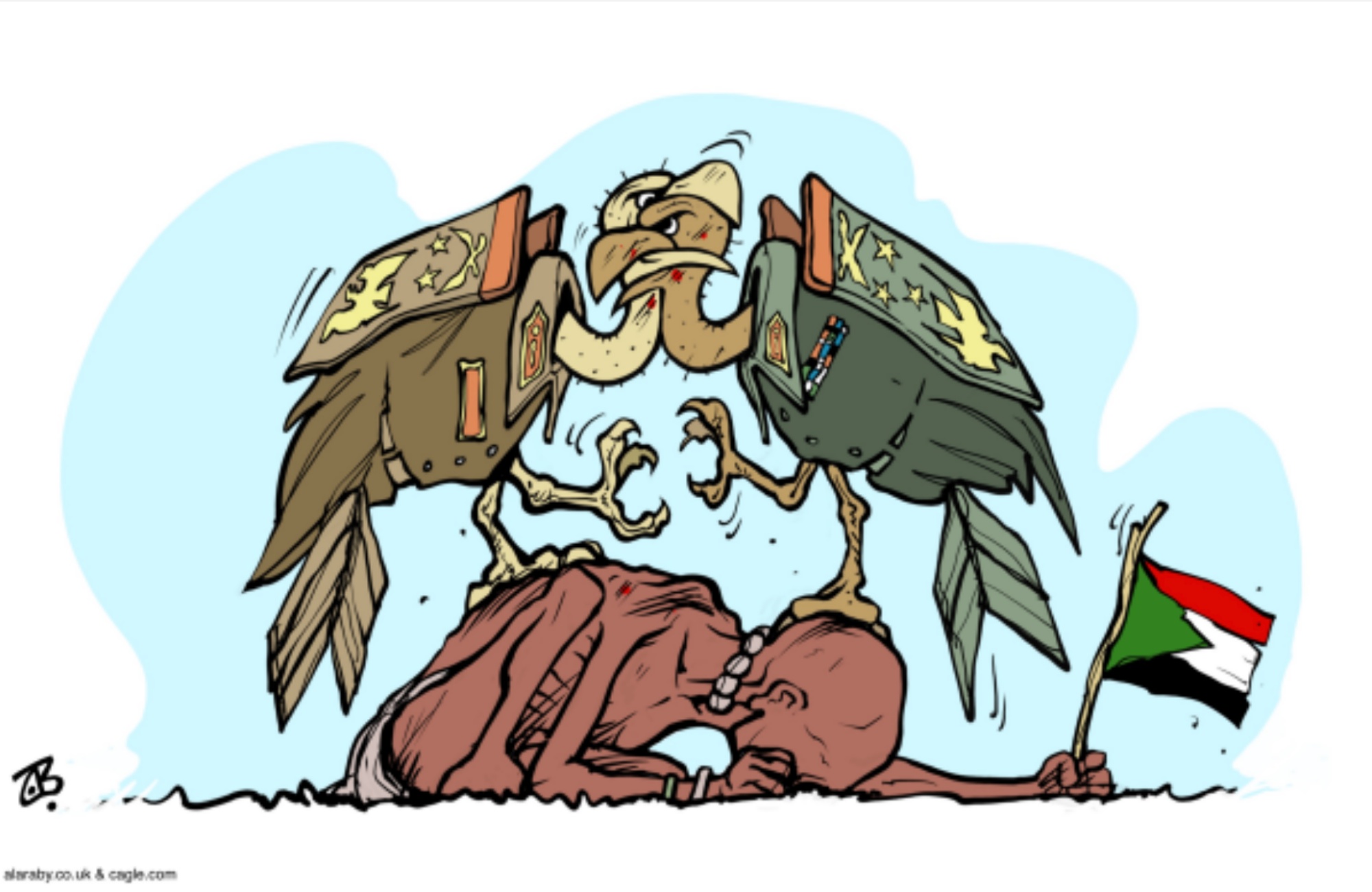


If we wish to do something about the suffering in Sudan, perhaps our best possible course is to turn to Oxfam America or some other worthwhile private charity.
Feb 20, 2026 5:38 PM
If we wish to do something about the suffering in Sudan, perhaps our best possible course is to turn to Oxfam America or some other worthwhile private charity.
During the last six months, LA Progressive has published a number of articles, including my own, dealing with the ongoing tragedy in Sudan. The following essay is an updating of that disaster. Although wars in Ukraine and Gaza have garnered most of global attention--and in the USA, the media focuses most on what President Trump has just done and will soon do--the Sudan calamity is well worth our heartfelt concern.
So far in February 2026, the excellent PBS News Hour has devoted two segments to it, the first on 5 February and the second on 13 February.
In his introduction to the first of these, William Brangham noted that “Sudan is already enduring the largest humanitarian crisis in the world.” And the UN says that the civil war there between the Rapid Support Forces (RSF) and Sudan's army (SAF) “has driven 14 million people [out of a population of around 51 million] from their homes and killed an estimated 40,000.” (Some other death figures are even higher.)
That civil war began in the spring of 2023. Several years earlier (until 2019) the country was still ruled by Omar al-Bashir, a former general who seized power in 1993. But, despite hopes in 2019 for a democracy, another military man, Army Chief Abdel Fattah al-Burhan, backed by the SAF, took over the country.
Related stories
Part of the problem is Sudan’s ethnic makeup, which would have been even more of an issue if South Sudan had not seceded in 2011. Despite that, however, Sudan still possesses hundreds of ethnic groups, with approximately 70% comprising a Sudanese Arab majority and about 30% a Black African minority.
In PBS’s 5 February segment, host Nick Schifrin interviews some of the afflicted and reports that “famine has spread in North Darfur [in western Sudan] and more than half of all children under five suffer acute malnutrition.” The greatest percentage of victims of the RSF has come from the non-Arab minority. A recent Britannica article declares that “the RSF in particular has been accused of genocide, engaging in the mass torture, rape, looting, and killing of non-Arab peoples in the areas it controls.”
The 13 February PBS piece, also introduced by William Brangham, began by noting that the UN accused the RSF “of committing widespread atrocities that amount to war crimes and possible crimes against humanity.” It reported that the RSF in its first three days of an offensive in the city of El Fasher (in Sudan's Northwestern Darfur region) killed “more than 6,000 people.” (With the SAF controlling most of Sudan, the RSF commands “much of western Sudan, including all Darfur states.”)
In a report filed by the News Hour’s Amna Nawaz she indicated that in the past week “hundreds of shelters at a displacement camp in the North Darfur region of Sudan were burned down, pushing an already traumatized people through more hardship.” Moreover, “nearly two-thirds of Sudan's population now need assistance, with hunger rising, health systems shattered, and families fleeing across borders.”
Nawaz also interviewed Ann Curry--the former (1997-2011) news anchor on the “Today” show--who was located at a displaced-persons’ camp in South Sudan, just across the border from Sudan. Curry talked to various refugees and relayed stories of women “running with their children, not always able to grab all of their children.
There was a woman we spoke to who carried her mother, her elderly mother, on her back because she was aging and ran with four kids and keeping them all in line to leave as the bombs were falling. And she said that her mom eventually died.”
To complicate matters more, various foreign countries have supported one side or the other in the civil war. Egypt, Iran, Turkey, Qatar, and Eritrea have provided drones, weapons, and/or other support to the SAF; and the United Arab Emirates (UAE) have backed the RSF.
In the summer of 2025, the American Enterprise Institute (AEI), a prominent conservative think tank, in an article entitled “Trump’s Dual Opportunity in Sudan” argued that the civil war provided a chance for the Trump administration to help end Sudan’s civil war. It stipulated that “the President can advance his security objectives in the Red Sea and bring relief to millions of suffering Sudanese—a move that would further strengthen his claim for a Nobel Peace Prize.” (In a LAP piece last month I cited a source that wrote of his “obsession” with gaining that prize and indicated that Trump’s focus on “winning” the prize as opposed to obtaining true peace, was misplaced.)
The AEI article mentioned the U. S.’s diplomacy with the new Syrian regime as a successful example of peace-seeking, and that in dealing with Sudan it should use a similar approach. Further, it argued that the U. S. “and its regional partners have a shared interest in ensuring there is no hardline Islamist return in Sudan,” and that it “should help Sudan lay the groundwork for a gradual transition to civilian rule.” It concluded by noting that “President Trump has framed himself as a peacemaker, and he has a prime opportunity to strengthen his legacy in Sudan.”
In February 2026, it was announced that the U. S. was working with Saudi Arabia, the UAE, and Egypt to “finalize a comprehensive peace plan to end the Sudan civil war. The initiative aims for an immediate, sustained humanitarian truce, a permanent ceasefire, and a transition to a civilian-led government.” The same online site concluded that “a breakthrough is possible. But it won’t happen quickly. A meaningful shift would require stronger international pressure.”
Meanwhile, however, according to Oxfam America, “the Trump administration has shut down the U.S. Agency for International Development (USAID), which funded the majority of U.S. humanitarian and development assistance worldwide to people in some of the worst crises. The effect of these cuts on people is dire,” especially in Sudan.
A Google search of “trump funding cuts Sudan” produced a number of points, including the following:
“As of early 2026, the Trump administration has significantly cut humanitarian aid to Sudan, forcing the closure of hundreds of U.S.-funded soup kitchens and suspending lifesaving services amidst a dire famine. These cuts . . . have severely impacted aid delivery in a country where 637,000 people are facing famine, with malnutrition rates 10 times above the emergency threshold. . . . with children particularly affected.”
As conservative columnist David Brooks pointed out last year, “Trump really seems not to give a crap about the working class.” My conclusion: “His focus is mainly how he, his family, and some other rich people who support him can become richer.” Trump does not really care about African countries, including Sudan--unless it would help him win a peace prize. In 2018 he referred to African nations as “shithole countries.”
In conclusion, a mid-February 2026 New York Times essay emphasized that “after a year back in the White House, Mr. Trump’s efforts to promote himself as the singularly dominant figure in the world have become so commonplace that they no longer seem surprising. He regularly depicts himself in a heroic, almost godly fashion, as a monarch, as a Superman, as a Jedi knight, a military hero, even as a pope in a white cassock.”
Thus, if we wish to do something--and do it now--for the suffering people of Sudan, perhaps our best possible course is to turn to Oxfam America or contribute to some other worthwhile private charity.
Comments

Powered by RoundtableAn AI/DeFi-powered Enterprise Media Operating System. Learn more at Roundtable.io.© Roundtable 2026. By using this site you agree to the Terms of Use and Privacy Policy