


Jul 1, 2023 1:00 PM
Updated Jul 3, 2023 2:43 AM
Was Prigozhin just another capitalist oligarch maneuvering with the Russian government to protect his cash flow?
Much has been made in the US propaganda heavy public media about the recently aborted ‘rebellion’ by Russia’s mercenary ‘Wagner’ division led by former fast food restauranteur Russian oligarch, Prigozhin. The US media and neocons in US government are trying to paint a picture the whole affair means there’s a deep crisis in the Russian government and major weakening of Putin’s regime. At least that’s the spin. But western media has not been all that accurate to date in its public portrayal of events in the Ukraine war.In reality, the Prigozhin affair likely has enabled a consolidation of the Putin regime in Russia.Origins of the Rebellion?
Alternative facts are slowly coming out removing the veil of events that may have led up to Prigozhin’s rebellion.
One such fact is that the Russian Ministry of Defense (MOD) moved to disband the Wagner forces well before the Prighozin rebellion. It announced weeks ago, back in April, it would sign contracts with individual Wagner fighters, paying them even more than Prigozhin, to re-sign up with Russian special forces units. But if they signed a contract with the MOD, then they obviously wouldn’t re-sign up with Prigozhin. That meant Prigozhin would not get paid anything remotely close to the $950M he got from the MOD in 2022-23, and likely lose his other $900B his food supply business to the military he was also paid last year.
Prigozhin’s contracts with the MOD for military services and supplies had already expired in early May 2023 and had not been renewed by the time of his rebellion. In short, Prigozhin the capitalist oligarch–selling military services and food to the MOD–was about to go out of business.
Related stories
One might ask: was his rebellion therefore a desperate effort on his part to force the Russian government to renegotiate a new deal? Was Prigozhin just another capitalist oligarch maneuvering with the Russian government to protect his cash flow?
Another interesting fact misrepresented by western media is the timing of the Prigozhin rebellion. The Wagner forces were being scaled down in terms of logistics and support by the MOD right after the fall of Bakhmut. It appears they were being pulled out of Bakhmut even before its final fall. And if Seymour Hersh is right, the Wagner was moved out of the front lines and sent to a camp near the Russian city of Rostov-on-Don, the regional Russian army center for the Ukraine war, just after the fall of that city. Unlike the western media’s report, therefore, Wagner forces did not ‘march on Rostov-on-Don’, take over that city from the Russian military by threat of force, and from there embark toward Moscow. They were already posted there at Rostov before they decided to move out on the road to Moscow, and then only 2-3,000 of the Wagner roughly 10,000 force followed Prighozin on the march toward Moscow.
US/UK intelligence knew Prigozhin’s rebellion was coming. Were they waiting to launch the Ukraine offensive which was repeatedly delayed?
Yet another interesting set of facts now just coming out is that Prigozhin reportedly had met with US/UK intelligence sources in Africa several months ago (where Wagner forces have for some time been engaged). What was that all about? Reportedly Russian intelligence discovered the contacts just days before Prigozhin’s rebellion and march on Moscow. Did that discovery by Russian intelligence just days before precipitate his march on Moscow prematurely? And why did the media in the UK predict a coming rebellion by Wagner in the days leading up to the fact? US/UK intelligence may therefore have apparently known Prigozhin’s rebellion was coming. If so, that raises another set of questions: were they waiting to launch the Ukraine offensive which was repeatedly delayed? The timing of the rebellion with the launch of the Ukraine offensive is suspect. Was it just coincidence? Or something more?
The picture painted by Prigozhin in the media in the weeks leading up to the rebellion was that the Wagner, the allegedly sole victors of Bakhmut, were suffering unusually high casualties in taking that city because the Russian MOD weren’t providing them ammunition or air support. There was even the claim by Prighozin that Russian forces fired on the Wagner while in Bakhmut. As the story goes, that was the last straw for Prighozin and set in motion his eventual decision to march on Moscow.
Just as likely, however, Wagner’s pull out of Bakhmut and relocation to a camp at Rostov-on-Don occurred just as Prigozhin’s contract with the MOD was allowed to lapse and the MOD simultaneously started offering Wagner fighters a better contract to join its own special forces. That coincident series of events signaled to Prigozhin his lucrative $2 billion annual revenue game was up. Those events—not claims of insufficient military support—may have just as plausibly initiated Prighozin’s decision to rebel.
With his forces encamped just outside Rostov-on-Don, Prighozin may then have been tipped off that his contacts with western intelligence were discovered by Russian intelligence. There are reports Russian intelligence discovered his communications in Africa with western sources just days before he started his march north to Moscow. He may have thus sensed he had no choice but to gamble and ‘march on Moscow’ to see if he could cut a new deal for himself. He apparently did cut a deal: Instead of being arrested or worse, he was allowed to go to Belarus in a deal mediated by Belarus president, Lukahsenko. It’s unlikely Prighozin will remain in Belarus, however. He’ll be eventually prosecuted while in exile, according to Putin. Belarus might eventually extradite him back to Moscow–once the Wagner fighters are fully dispersed into the Russian army. Or put him on an airplane to some destination. It’s not likely he’ll remain in Belarus. Where will he turn up? No one knows. Maybe somewhere in the west. Or else a Moscow detention center.
To sum up: like any good capitalist oligarch, in an act of desperation, Prighozin tried to keep his $2 billion business going as the Russian MOD decided to cut him loose. When discovered communicating with western intelligence sources, he then played his ‘last card’ and launched his march on Moscow to try to force a new deal for himself. It was a desperate adventure, a kind of a Russian version of Texas ‘all in’ poker. When his bet was called, however, he was unable to raise table stakes further. Lukashenko had to bail him out with a mediated offer to come to Belarus. So Prigozhin’s no longer a player at the war table. But he’s headed for the parking lot with lots of profits in his pocket. The question is: will he get out of the lot safely with all that cash on him?
The 3rd Ukrainian War Offensive
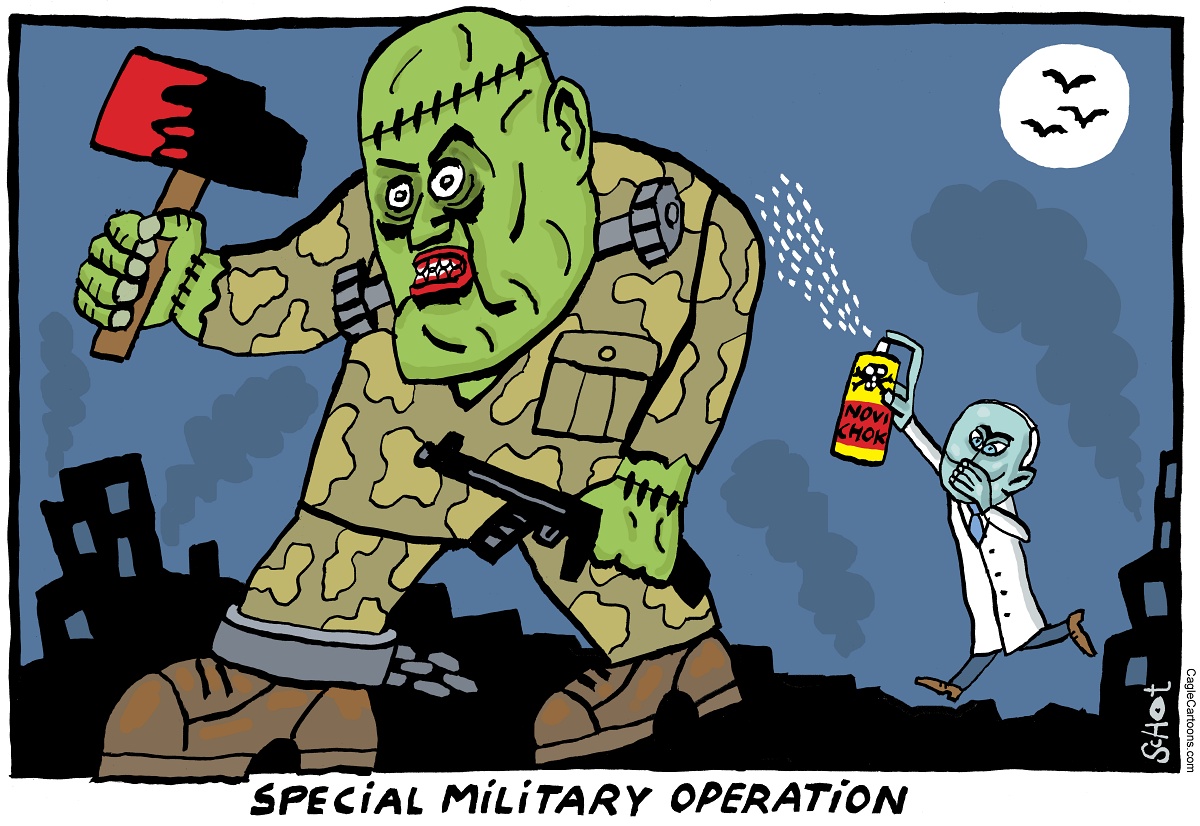
The demise of Prigozhin and absorption of Wagner forces may represent a new phase in Russia’s ‘Special Military Operation’. It may signal Russia has decided on a primarily defensive strategy to hold and consolidate the four provinces (called ‘Oblasts’) that it formally integrated into Russia back in September 2022. It will allow the Ukrainian army to deplete itself bashing its head against Russia’s deep defense wall in the Donbass and south, launching a desperate offensive without air superiority and at with a 10 to 1 disadvantage in artillery. On its face, the offensive appears quite reckless in a military sense.
After four weeks, the offensive is already going badly, with few gains at great costs in men and material. If Ukraine cannot make real gains by mid-July when NATO next meets in Vilnius, Lithuania, some kind of NATO reassessment of the war might occur. A failed Prigozhin rebellion plus Ukraine’s growing losses in men and equipment with little gained raises the specter that Ukraine cannot ‘win’. The dominant scenario for NATO becomes the need to provide a flow of a bottomless pit of money and equipment, and perhaps even support troops from the west. It’s extremely unlikely European NATO members—except for the most aggressively anti-Russian in the case of Poland and the Baltics—are willing to pay that price.
As this writer has noted elsewhere, no amount of western ‘wonder weapons’ can ensure a Ukrainian victory so long as Russia holds clear advantage in air superiority and a 10 to 1 advantage in artillery and is deeply entrenched in defensive positions. The ground forces of Ukraine and Russia are about equal in the eastern and southern fronts, about 500,000 each facing each other. But offensives require at minimum a 5 to 1 troop and equipment advantage to prevail—notwithstanding the defense having air superiority and artillery advantage as is the case of Russia.
In short, neither side—Ukraine or Russia—has sufficient advantage over the other to mount a successful offensive. Ukraine is reportedly already losing men and material at a 10 to 1 ratio, about 13,000 killed in less than a month.
Russia apparently realizes the relationship of military forces is such that a World War II-like general offensive by either side cannot succeed and has dug in defensively; Ukraine has not. And perhaps it can’t. The NATO/US forces providing the Zelensky regime with billions of dollars and euros and a flow of military hardware (dispersed in small distributions weekly) cannot make a decisive difference in the eventual outcome of the war.
First the media told us that javelin missiles would be decisive. Then it was US provided Himars and M777 artillery. Then Patriot anti-missiles. Then German Leopard tanks. Next it will be US F-16 fighter planes. And then maybe US long range ATACMS artillery capable of hitting the Russian naval base at Sebastopol, Crimea. It’s all somewhat reminiscent of Nazi claims in 1944 of wonder weapons that would turn the tide of war. No amount of hardware can substitute for the lack of sufficient ratio of troops on the ground needed to carry out a successful offensive. Again, that ratio is about even today. Ukraine would need at least 2-3 million men in arms for a successful general offensive. It has about a fifth of that.
Clausewitz vs. the Ukraine War
The principles of warfare explained several centuries ago by the Prussian military theorist of modern war, von Clausewitz, still pertain to the Ukraine War (principles later reaffirmed by Napoleon’s theorist de Jomini, Britain’s Riddell Hardt, China’s Mao, Vietnam’s Giap and others). At the top of the list of those principles are the need for a Concentration of superior forces, Internal lines of logistics and supply, sufficient Reserves, and Mobility and Surprise.
Ukraine’s military no longer has any of these advantages. It enjoyed a temporary advantage in Concentration of Forces and Surprise in its late summer 2022 ‘Kharkhov offensive’. But its temporary forces advantage, and its element of surprise, at that time disappeared when Russia mobilized 400,000 more troops of its own over the winter and concentrated them in the east and south.
Russia itself initially had an advantage in forces when it first launched its early February-April 2022 initial offensive; but that too ended once Ukraine mobilized several hundred thousand more over the summer 2022 and concentrated them on the Kharkhov northern front. With superior concentration of forces in the Kharkhov region last August, Ukraine also caught the Russians by surprise. Ukraine’s army achieved significant military gains in that, the 2nd major offensive of the war. However, that ended when the Russians consolidated in the Donbass and Kherson oblasts and mobilized another 400,000 or so over the winter and spring and then concentrated them in defensive positions. That left a more or less equal standoff between the two armies that prevailed until Ukraine launched its current June offensive, the 3rd in the war.
In its current (3rd?) offensive Ukraine now once again lacks the ability to concentrate sufficient forces for a successful offensive. It needs five times that of Russia’s roughly 500,000 entrenched in defensive positions. Add to that Russia’s artillery and air superiority advantage—and the dribbling out of equipment and ammunition from NATO—and the result is Ukraine cannot mount an adequate offensive. Its current offensive violates nearly all the principles of war.
Its offensive is also historically anachronistic: Ukraine’s current offensive is reminiscent of World War II of armored battalions rushing across open plains. But modern war technologies (drones, smart bombs, missiles, satellite and electronic surveillance, etc.) make maneuvering by armored battalions across open plains virtually impossible, especially when lacking air superiority and artillery advantages.
Modern warfare, whether in Ukraine or elsewhere, is no longer about massive tank and mechanized armor clashes, as it was on the ‘eastern front’ in 1942-44. Those kind of offensives are no longer possible given the development of modern military technologies.
The war on the ground will therefore soon freeze as Ukraine’s inability to break through Russian defenses becomes increasingly evident. Nor will Russia thereafter make the same mistake and launch a similar offensive thus repeating Ukraine’s offensive strategy debacle.
A New Phase in Russia’s SMO?
Russia’s Special Military Operation has moved to a defensive strategy that welcomes Ukraine to break its head against its defensive-in-depth stone wall, back up by air superiority and its 10 to 1 artillery advantage. Ukraine will eventually begin to run out of men on the ground should it continue to try to advance into deep defenses and without air superiority and at a 10-1 artillery disadvantage. It will therefore halt its offensive by August.
When that happens NATO & US will have to decide whether to openly send in support troops (the presidents of Poland and Lithuania are now in Kyiv discussing just that with Zelensky). If so, these NATO troops will likely occupy non-combat roles in western Ukraine so that Zelensky can release more Ukrainian troops to the eastern front. No doubt Poland also sees this as an opportunity to begin staking out a claim to western Ukraine (formerly Polish territory) should an eventual armistice deal with Russia end up splitting Ukraine like a Korea–which remains a not unlikely outcome.
But if Russia strategically has decided on a defensive strategy and if Ukraine cannot show clear signs of success in its offensive, the US/NATO won’t feed it arms and supplies forever. Russia’s strategy is longer term. It will let Ukraine try to destroy itself on its defensive lines and wait out the political changes that will almost certainly come with the US elections in November 2024 (and in several European parliamentary changes before that).
Biden as LBJ: Historical Parallels
Biden’s war in Ukraine will prove to be a US neocon-instigated geopolitical disaster, just like the neocon instigated wars in Afghanistan and middle east were. Those wars cost the US $8 trillion with little to nothing to show for it. Indeed, perhaps even less than little, as Saudi Arabia, Iran, Turkey, Egypt and others are now tilting economically toward China and the BRICS in trade relations and away from the US dollar by increasing trade in bilateral currencies and gold.
The US’s Ukraine war adventure may thus prove the event that sinks the Biden electoral ship, already taking on economic water from chronic inflation, deeper recession and growing regional bank instability.
Biden’s electoral support fades by the month. The Fed has just signaled central bank interest rates will now continue to rise through the rest of 2023 while inflation in services is likely to remain chronically high nonetheless. Higher interest rates will certainly slow the US economy and precipitate an earlier recession, as many economists now predict. Further Fed rate hikes may also precipitate a worse regional banking crisis by year end and into 2024, as deeper recession and higher costs combine to exacerbate a Commercial Real Estate sector already top heavy with $17 trillion in junk debt–of which no less than $1.7T will need to ‘roll over’ (i.e. be refinanced) within the next 12 months. The Fed in its recent ‘stress tests’ this past week projects a possible scenario of 40% asset price deflation in the Commercial Real Estate sector. That means banks may balk at refinancing much of the existing junk debt. In turn that means bankruptcies, defaults and more bailouts by the Fed and FDIC will be required for a regional banking system already being propped up by the Fed at the rate of $95 billion/week.
It’s hard to imagine how chronic inflation, deeper recession, and possibly worse banking instability converge in an election year, 2024, without a further drop in Biden/Democrat voter support. Meanwhile, opponents will point to the Ukraine war and how the US is throwing away more than $250 billion now to keep Ukraine’s government, economy and military afloat.
Biden is repeating the errors and failure of his predecessor and president, Johnson, in 1968. LBJ’s regime crashed on the rocks of the war in Vietnam. Double digit inflation followed that US defeat, as did the then worst recession since great depression in 1973-75. Isolated cases of financial instability accompanied the inflation and the US had to abandon the Bretton Woods international monetary system in 1973 and allow the US dollar to deeply depreciate. Economic recession was followed by stagnation and political instability.
All that was the legacy for the rest of the 1970s decade, originally set in motion by the costs and consequences of the Viet Nam war. Costly, unwinnable wars have a way of coinciding with economic deterioration and are typically followed by unforeseen political consequences.
Today something similar to the crisis of the 1970s is emerging, albeit perhaps this time even more serious in terms of economic decline and political instability. As in the 1970s, the US economy is experiencing chronic inflation. Recession is on the near horizon if not already here (certainly for the goods side of the economy in manufacturing and construction the downturn has already clearly begun). US imperial hegemony abroad is also under growing challenge. The US dollar is being undermined globally. Meanwhile, financial instability is no longer limited to the weakest individual companies, as in the 1970s, but is a problem now industry-wide (regional banks) and may become so even sectorally and globally (financial system at large).
Today the world has been economically globalized and financialized, and due to technology prone to almost immediate contagion in the event of a major financial instability event. So the situation is even more precarious for Biden’s re-election 2024 than it was for the Democrats in 1968. Despite his legal issues, Trump is already out-polling Biden and the gap is widening, especially among independents.
Some Conclusions
Russia decided weeks ago, apparently back in March, that Prigozhin and Wagner forces’ offensive tactics were unnecessarily wasteful of men and material and had little role to play in its defensive strategic shift. Prigozhin and Wagner served their purpose in the early phase of the Ukraine war. But Prigozhin would not accept this. His ‘business model’ was based on a contrary military strategy. Nor could he accept that his contract was not being renewed and his assets (his best fighters) were being sold off to another buyer (Ministry of Defense). The Russian MOD simply pulled the plug on him and the lights went out on any possibility for another $2 billion revenue for 2023-24!
The deeper meaning of the rebellion is that Prigozhin outlived his usefulness to the Russian war effort. As Seymour Hersh argues, Wagner’s offensive style special operations no longer fit with Russia’s primarily defensive strategy at this juncture. Wagner suffered significant losses in its offensive at Bakhmut, most of which were recently conscripted prisoners Prigozhin had quickly mobilized, briefly trained, and rushed to the front–something it appears Ukraine is now doing as well. Russia’s army isn’t about to continue waste manpower in that way at this stage of the conflict. It doesn’t have to. But apparently Zelensky must if Zelensky wants to continue the inflow of US/NATO arms and money. He must continue his offensive further, at least throughout the summer, and must as well show some results. Yet the principles of war dictate he cannot.
The Prigozhin affair is just a blip in the broader geopolitical and economic picture in which the US/NATO and Russia are engage in an immediate proxy war in Ukraine but are sliding into an even broader political and economic conflict globally. The Prighozin rebellion is just a single event in a war that appears increasingly protracted and unwinnable for Ukraine. The outcome of the war will be determined by economic and political events in the west, not by movements of troops and armor across the plains of eastern Ukraine. That latter scenario is the last war, not likely to be repeated in the world of new and increasingly lethal even non-nuclear military technologies.
Ukraine’s offensive, the 3rd thus far in the war, is a military adventure that violates just about all the major principles of war laid out by Clausewitz and successful military theorists and practitioners the last 250 years. Either those principles are now irrelevant in the Ukraine conflict, or else Ukraine is doomed to eventual military defeat and thus will never through force of arms recapture its four lost ‘oblasts’. Moreover, the longer it continues an unwinnable war on the battlefield, the more ‘real estate’ it may end up losing.
For its part, Russia has apparently decided not to launch a similar World War II like offensive, sending battalions of armor and men across the open Ukraine plain crashing into an adversary’s defensive in depth wall. Modern military technology has rendered that kind of offensive, reminiscent of World War II, outmoded. Tanks and armor–just like warships at sea as well–are ‘sitting ducks’, as they say. Both sides in the conflict are discovering that the hard way. But, as another saying goes, the generals always fight the last war.
Domestically in the US, continuing the war produces few political gains by Biden’s administration and growing political losses. The war reaps little domestic political gain and in fact risks significant damage for Democrat 2024 political strategy, as the US economy continues to weaken into 2024. Prosecuting the war may be important to the elites within the ‘beltline’ of Washington DC but are of little interest to the American people. The continuation of the war and its economic costs are eerily reminiscent of Biden’s prior Democrat president colleague, Lyndon Johnson, whose political fate also crashed on the rock of a former failed military adventure called Viet Nam.
Comments

Powered by RoundtableAn AI/DeFi-powered Enterprise Media Operating System. Learn more at Roundtable.io.© Roundtable 2026. By using this site you agree to the Terms of Use and Privacy Policy