
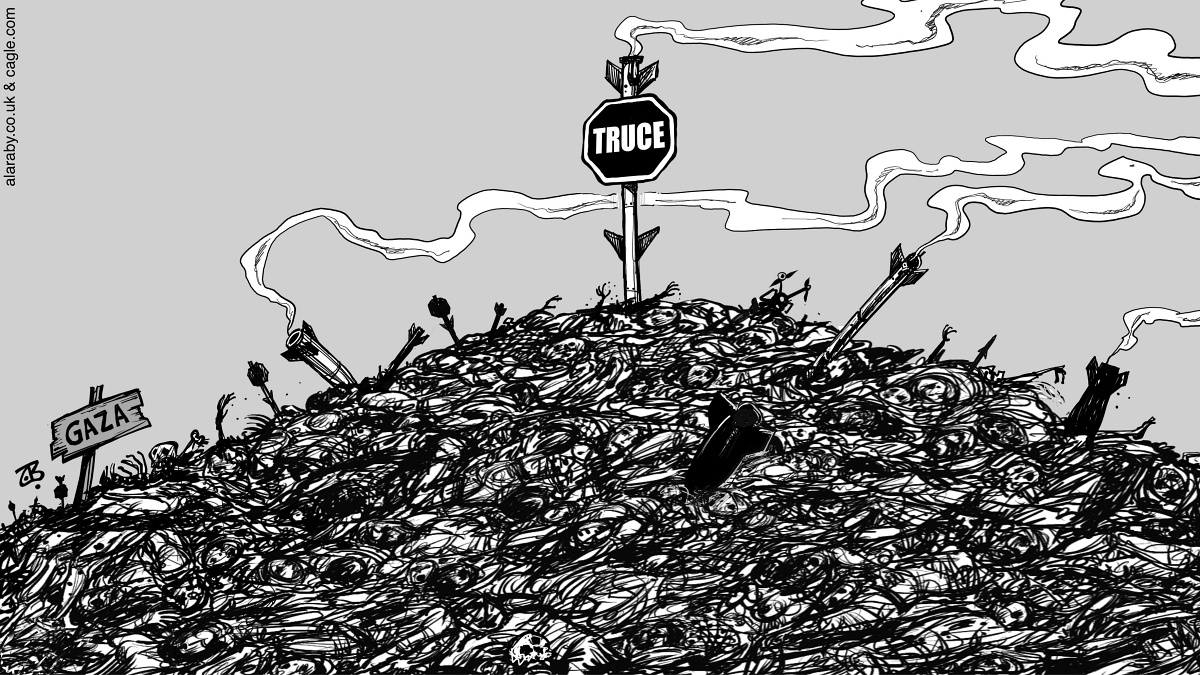
Cagle Cartoons: Emad Hajjaj


Pax Americana
Dec 31, 2023 4:44 PM
Switching victim and aggressor is a favorite US tactic for justifying slaughter in efforts to maintain domination.
“Why the fuss?” That’s the apparent reaction of Biden, Blinken and the DC war planners to worldwide horrified reactions at Israel’s US-backed genocidal slaughter in Gaza. As pressure built at the UN Security Council December 20 to avoid a US veto of another resolution to stop the bombing in Gaza, Blinken criticized nations calling for a cease-fire. He says he hears almost no calls for Hamas to lay down its arms and surrender, adding “How can it be that there are no demands made of the aggressor and only demands made of the victim?” Instead of surrendering, Hamas has held off an Israeli land invasion of Gaza.
The consequences and actual cost of “justifying” genocide are difficult to calculate in the midst of the operation itself. How many Palestinians will be killed? How many homes, hospitals and schools will be destroyed? Will there be anything or anyone left in Gaza? Will Israel’s goal of “crushing Hamas” be realized? How is this operation different from earlier attacks on Gaza, or the constant attacks on Palestinians in the West Bank now and in recent decades? What is the goal for Israel and its backer, the United States? And the results?
For Blinken and his boss, the Gaza conflict began October 7, when Palestinian forces broke through the apartheid wall caging them in, and staged an “unprovoked” attack in which a reported 1,200 Israelis died. Overlooked is the fact that Israeli forces have made repeated bombing attacks on Gaza almost every other year since 2008. So are Israeli admissions that “friendly fire” caused the majority of Israeli deaths on October 7 and the subsequent fighting, according to the largest daily English-language Israeli news source, Ynet (Ynetnews.com).
Israeli Air Force Colonel Nof Erez admitted on a Haaretz podcast (later reported in Electronic Intifada) that October 7 was a “mass Hannibal” event. Hannibal is a code name for Israel’s policy of firing to kill hostages and enemy fighters rather than allow the enemy to take hostages. The homes of settlers in the Kibbutz Be’eri were blown up even when occupied by Israelis, if the IDF suspected Palestinians might be inside, the report said.
Related stories
For Blinken and Biden, Israel was the “victim,” despite subjecting Palestinians in both Gaza and the West Bank to decades of constant intense repression and bombing as part of its refusal to allow for an independent Palestinian state.
Switching victim and aggressor
Switching victim and aggressor is a favorite US tactic for justifying slaughter in efforts to maintain domination. Back in 1964 it was a “Vietnamese attack” on a US ship in the Gulf of Tonkin that “justified” what US Air Force General Curtis Lemay called “bombing them back to the Stone Age.” Years earlier, the US Air Force bombed and destroyed all the cities and most towns in northern Korea rather than allow Korea’s revolutionary leadership to take over the country after the Japanese colonialists were defeated at the end of World War 2. This “carpet bombing” was also a warning to China’s post-1949 revolutionary leadership. But it backfired as half a million Chinese forces helped the Koreans push back the invaders at the 38th parallel and force an armed truce that continues today.
General Lemay admitted the US killed “about 20 percent of the north Korean population” during that war. And in 2017 then “President Trump Threatened to 'Totally destroy' North Korea. The US has done that before.”It’s a reminder of Hiroshima and Nagasaki, where the US used nuclear bombs against Japan after Japan was on the brink of surrender. That was a warning to the Soviet Union, which was poised to complete the defeat of Japan as it had earlier defeated Germany. It became the basis of a “balance of terror” between the US and the USSR that lasted until the Soviet collapse in December 1991.
For US war planners, the Cold War’s end was not enough. It would have been a disaster for the Military-Industrial Complex if its annual bonanza of military profits were ended for lack of enemies. So US war planners like Zbigniew Brzezinski and Paul Wolfowitz crafted elaborate plans for a New World Order with the US “uber alles.” Maintaining control of the oil-rich Middle East – really Western Asia – and aspiring to control “the World Island,” especially the EurAsian land mass, would facilitate long-term US hegemony.
Multiple aggressive US and NATO military interventions followed the Soviet collapse: in Iraq, the former Yugoslavia, Afghanistan, Libya and Syria. Millions of people died, and millions more have become refugees. The 1999 NATO bombing attacks against the former Yugoslavia destroyed the last vestiges of a socialist country in Europe. Following the events of 9/11/2001, the US declared “endless war against terrorism,” falsely claiming it was the “victim” of both Iraq and Afghanistan. Two decades of war in these countries ended in US defeat. In 2011 the US and NATO launched attacks against Libya, the richest country in Africa at the time. They killed President Muammar Gaddafi, who had provided an economic lifeline to the poorer countries of Africa. Now civil war continues to rage in Libya, spilling over into the countries of the Sahel – Mali, Burkina Faso, Niger, and Sudan. Crisis grips these countries and others across Africa. But US leaders don’t really mind collateral damage.
They have bitten off more than they can chew
The endless mess caused by three decades of “endless war” helps to explain the problem facing Biden, Blinken, and their NATO allies, as well as Netanyahu. They have bitten off more than they can chew. As they face defeat in their proxy war against Russia in Ukraine – a defeat they disguise as a “stalemate” – they are dreaming of an easy solution of the Palestine/Israel conflict, one that would maintain the status quo ante, as if nothing serious has happened as a result of the current genocidal slaughter. It’s an impossible dream.
Palestine’s allies in Yemen and Malaysia closed off the two most crucial “chokepoints” of world commerce following the US veto of the UN Security Council’s ceasefire resolution.
“The Yemeni position is clear,” a spokesperson of Ansar Allah (aka Houthis) told the NY Times. Attacks on ships in the Red Sea will stop “when the Israeli war on the people of Gaza stops.” If the US directly attacked Yemen, it could “turn the war in Gaza into an international conflagration,” the Houthi representative warned.
Malaysia announced a ban on all Israeli-flagged cargo ships from docking at its port in the Strait of Malacca, in “response to Israel’s actions that ignore basic humanitarian principles and violate international law through continuous massacres and atrocities against the Palestinians.” So while the oil-rich Arab monarchies have yet to cut off Israel’s oil supplies, shipments to Israel of oil and other cargo have slowed to a trickle.
Meanwhile intense diplomatic activity has continued, both at the UN in New York and in Cairo, to at least provide humanitarian aid to Gaza, if not a ceasefire. The US threatens to veto any call for a “suspension of hostilities.” And Israel has insisted on controlling and inspecting all cargo entering Gaza, which has left hundreds of trucks stalled at the border between Egypt and Gaza. The UN Secretary General’s spokesperson said an immediate humanitarian cease-fire would be “the most helpful thing for the delivery of humanitarian aid in a sustained high volume.” The US steadfastly continues to provide the bombs and other munitions for the Israeli massacre in Gaza.
Building for peace
Pressure is building for a genuine ceasefire – a permanent one, based on justice for Palestine. The streets are full of protesters almost everywhere. For the first time in decades, many labor unions in the US are calling for a ceasefire, and union members and organizers have hit the streets – by the thousands in both New York and Oakland, California, Dec. 16, and thousands more in New York Dec. 22. Labor for Palestine was the main organizer, with strong support from the United Auto Workers (UAW), American Postal Workers Union, the United Electrical Workers (UE), California and National Nurses Association, United Food and Commercial Workers (UFCW), National Education Association (NEA), Service Employees Union (SEIU), International Longshore and Warehouse Union (ILWU), UNITE HERE, Association of American Federation of State, County and Municipal Employees (AFSCME), and others. Teachers unions including the Chicago Teachers Union, the San Antonio Alliance of Teachers and Support Professionals, and the Massachusetts Teachers Association were early signers of a ceasefire resolution spearheaded by UE and UFCW.
“Workers have a special ability to stop Israeli genocide,” said Michael Letwin of Labor for Palestine. “If workers refuse to load or unload Israeli Zim Line ships, that’s worth a thousand resolutions.” Letwin is the former president of United Auto Workers Local 2325, the Association of Legal Aid Attorneys.
The new UAW President Shawn Fain said “ we take pride in our history of standing up for justice at home and around the world. I thank our UAW members for speaking out and pushing us to come out in support of a cease-fire.” UAW Region 9A director Brandon Mancilla declared Nov. 30, outside the White House where protesters were on hunger strike, “I’m proud today to announce that the UAW international has joined the call for a ceasefire in Israel and Palestine. From opposing fascism in WWII to mobilizing against apartheid South Africa and the Contra war, the UAW has consistently stood for justice across the globe. A labor movement that fights for social and economic justice for all workers must always stand against war and for peace.”
Jewish groups like Jewish Voice for Peace, Not In Our Name, and If Not Now have organized numerous disruptive protests, shutting down a highway in Los Angeles, as well as Grand Central Station and three major bridges in New York. Zucotti Park, the scene of the Occupy movement a decade ago, filled on Dec. 28 in a protest organized by Within Our Lifetime, a Palestinian community group that has led numerous protests.
The Shut-It-Down-for-Palestine Coalition maintains weekly and even daily actions in large and small cities across the country. The coalition includes the Palestinian Youth Movement, National Students for Justice in Palestine, Al-Awda, ANSWER, People’s Forum, International People’s Assembly, and many other local groups. Demands include an immediate ceasefire, cutting all US aid to Israel, and lifting the siege of Gaza. The coalition is committed to “keep building momentum and increase the pressure with more marches, walk-outs, sit-ins, and other forms of direct action to end collaboration with Israeli genocide and occupation.”
The Adalah Justice Project, a Palestinian-led advocacy organization, mobilized more than eighty community-based advocacy groups to “de-link” anti-immigrant repression and money for war in Gaza and Ukraine. They issued a joint statement against a deal Biden offered to send billions to Israel and Ukraine “in exchange” for a draconian anti-immigrant bill. Hundreds of activists occupied the Capitol Rotunda, where they sang and chanted slogans including “not in our name” and held signs reading “stop arming Israel” and “protect immigrants and asylees.”
80+ community groups descended on Washington Dec. 19 demanding ceasefire in Gaza and an end to anti-immigrant repression at the border and across the country. PHOTO: NYC Communities for Change
CodePink has also staged numerous disruptions in Congress, and is calling a national March on Washington for Gaza” on January 13, together with a coalition of numerous Muslim and Palestinian groups, and hundreds of local and national antiwar groups. CodePink “recognizes Palestinians as the rightful owners and caretakers of Palestine, their indigenous homeland. We support Palestinians’ right to resist the violent Israeli occupation of Palestine. We are committed to supporting Palestinian liberation, using the demands of Palestinians as our guideline for organizing, and we endorse the BDS movement, to Boycott, Disinvest and Sanction Israeli apartheid.”
The protests and the news from Gaza have had impact: a December 19 NY Times report said “Voters broadly disapprove of the way President Biden is handling the bloody strife between Israelis and Palestinians, with younger Americans far more critical than older voters of both Israel’s conduct and of the administration’s response to the war in Gaza.”
Global pressure for peace
While the US tries to bolster Israel as its proxy in the Middle East, the majority of countries in the world are looking for a different solution. The Arab League and Organization of Islamic States (OIC) met recently to call for a ceasefire and pursue joint action. This Arab-Islamic summit represents 79 countries, over half the global South. They met together with China, whose five-point peace proposal on Israel-Palestine was launched at the UN security council to coincide with the UN’s International Day of Solidarity with the Palestinian people on November 30. China calls for a comprehensive ceasefire; effective protection of civilians; ensuring of humanitarian assistance; diplomatic mediation; and an emergency international conference as soon as possible to forge a political settlement.
China says the root cause of the problem is “the long delay in realizing the dream of an independent state of Palestine and the failure to redress the historical injustice suffered by the Palestinian people.”
On December 29, South Africa filed a case against Israel before the International Court of Justice (ICJ), charging “genocidal acts against the Palestinian people in Gaza.” Where this can lead is uncertain, but it forces the UN system to grapple with Israel and the US – who are facing total global isolation.
Israel remains determined to crush the Palestinian resistance and expel Palestinians from their land once and for all, and has whole-hearted support in Washington. Their heads are stuck in a racist status quo paradigm by which they can somehow decide how Palestinians should be governed. But, as Khaled Elgindy wrote in a December 18, 2023 Foreign Affairs article, “Israeli and US officials will need to reconcile themselves to the fact that Hamas will, in one form or another, remain a force in Palestinian politics.” Kaligny, who is the author of Blind Spot: America and the Palestinians, From Balfour to Trump, adds that US and Israeli officials “must abandon the idea that they can reengineer Palestinian politics to suit Israeli (or US) political needs, a conceit that has helped erode the domestic legitimacy of Palestinian leaders since the Oslo process began in 1993.”
A new global paradigm
The crisis in Israel/Palestine follows on the heels of US and NATO failure in their proxy war against Russia in Ukraine. The “New World Order” that George Bush Senior announced after the Soviet Union’s collapse is now showing cracks. US and NATO planners are slowly awakening from their dream of “weakening Russia” through a proxy war in Ukraine. At his “hastily arranged” visit to Washington December 11, Ukrainian President Zelensky did not get a Congressional standing ovation as he had a year earlier. And he didn’t get a commitment for more billions. Joe Biden pressed hard for the money, declaring the US “should take pride that we’ve enabled Ukraine’s success thanks to the steady supply of weapons and ammunition we’ve provided them.” Biden really did say “success,” and then warned of “American troops fighting Russian troops” if Russia “attacks a NATO ally.”
Biden’s warning caused a reaction which might have led to a White House “walk back” of his reckless remarks. Instead, his Strategic Communications Director John Kirby repeated them the next day: “If you think the cost of supporting Ukraine is high now, just imagine how much higher it’s going to be — not just in national treasure, but in American blood — if he starts going after one of our NATO Allies.” Meanwhile Hungary blocked proposed new aid to Ukraine from the European Union.
The cost in lives and treasure of its endless wars has not bothered the US leadership ever. In a real sense the question now is what will it look like when they lose – as they are in Ukraine, and as they most likely will in Palestine – as US Defense Secretary General Lloyd Austin has predicted. The Palestinian resistance, and the massive solidarity it has inspired, are sapping confidence in both Washington and Tel Aviv. “Skepticism Grows Over Israel’s Ability to Dismantle Hamas,” was a NY Times headline December 27. “Critics both within Israel and outside have questioned whether resolving to destroy such a deeply entrenched organization was ever realistic,” the article says. At a Dec. 26 Beirut press conference Hamas leader Osama Hamdan said “the decision maker is the Palestinian people alone.” They are not literally alone, of course. Support for Palestine has mushroomed everywhere.
“The global mystique of the US, after two decades of disastrous wars in the Middle East and the assault on the Capitol on Jan. 6, is as contaminated as its Israeli ally,” Chris Hedges says. “The Biden presidency, which ironically may have signed its own political death certificate, is tethered to Israel’s genocide. It will try to distance itself rhetorically, but at the same time it will funnel the billions of dollars of weapons demanded by Israel… It is a full partner in Israel’s genocide project.”
Failure upon failure globally and at home is causing a cascade of disasters, not only for the Biden administration, but for the country as a whole, and for the world of its victims. The one positive factor is that the Palestinians have awakened a determination for peace and solidarity across the world and even in the United States. But it will take continued effort to make peace and solidarity a dream that can come true.
Comments

Powered by RoundtableAn AI/DeFi-powered Enterprise Media Operating System. Learn more at Roundtable.io.© Roundtable 2026. By using this site you agree to the Terms of Use and Privacy Policy