


Apr 27, 2024 1:39 AM
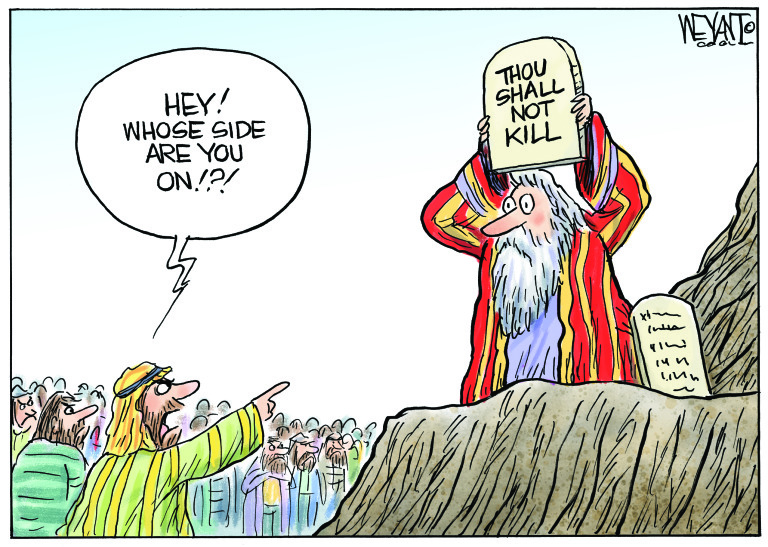
Jewish students protesting for Palestinians' rights for freedom are celebrating the Hebrew tradition of Passover in their opposition to bondage and oppression
Passover started on Monday evening. On Tuesday morning, the New York Police Dept. announced that it had arrested at least a dozen Jewish students at Columbia University for protesting for Palestinian rights.
Passover is a celebration of Hebrews escaping from bondage in Egypt. It is a foundation story that biblical scholars and historians say never happened. Hebrews were not enslaved in Egypt, and never had a great escape. But they were conquered by the Assyrian and Babylonian empires with some part of their population taken out of Palestine, into their captors’ society.
In most or all of the revolts and revolutions down through European history (including Europe’s colonies around the world), concepts from Jewish scriptures have been used to explain and justify peoples’ struggles for freedom from oppression.
Hebrew scholars and religious leaders worked hard to preserve their tribal identities while in captive exile. Oral stories and traditions were written down and organized. For the Jews, this became the foundations for Torah. For the world, these writings became one of humanity’s earliest expressions of rules of social contracts, moral behaviors and monotheistic religion.
Related stories
Every LA Progressive reader has heard of the Ten Commandments and may have found it difficult to keep all ten. But the Jewish scribes recorded more than 600 commandments for living. Many, written in the agrarian Bronze Age, are anachronistic in advanced industrial times, and some are downright offensive. But the books of stories and rituals crafted during the Assyrian and Babylonian captivities of the first millennium BC continue, almost three thousand years later, to inspire freedom seekers.
Brent Dowe’s 1970 reggae song By the Rivers of Babylon, with lyrics drawn from the Book of Psalms, (19:14 & 137:1-4) was a global hit because it revoiced the universal longing for freedom limned millennia ago as part of Hebrew hymns.
Focusing our discussion on Europeans, we see the 16th-century German Peasants War of the 1520s and the King Phillips War of Native Americans against colonial oppression as just two of numerous 17th-century uprisings. In the late 18th century, populations of nominally “free” people in the American colonies and then in France overthrew what they saw as oppressive rule. In the summer of 1831, Nat Turner led a group of slaves that killed about 60 people. The latter half of the 19th century and into the 20th century saw rebellions against repression in China, Russia, India, South Africa, and all over Southeast Asia and Latin America.
In most or all of the revolts and revolutions down through European history (including Europe’s colonies around the world), concepts from Jewish scriptures have been used to explain and justify peoples’ struggles for freedom from oppression. There would be no Christianity without Jesus’ devotion to Judaism. There would be no socialism or communism without the ancient Hebrew concepts that people, men and women, have value and rights (and duties) inherent in their very creation.
Those who have the power to do so will oppress. That, along with the inherent values seen by Hebrew theology, seems to be universal. We want security. And having obtained a little of it, we want more, and then comfort. Security comes with control of space around us, at home with a lock on the door, or in a small tribe beginning to farm, with the promise that our fellow farmers will come to our aid if “foreigners” come to steal our crops.
Once a neighborhood is secured, it looks sensible to conquer less secure neighbors, arguing that their weakness is a threat by being unable to resist outside intervention. Or because their weakness may lead them to try to steal from us when they can’t provide enough for themselves. It was the same for stone-age hunter-gatherers as it is for today’s industrial producers and factory farmers.
Those most successful at pacifying the neighborhood get excused from farm labor so that they can protect us. We need to provide for them, since they can’t protect us while providing for themselves. The strongest, or the most politically astute, take positions leading those who protect the rest—those who need to provide for the protectors.
Sed quis custodiet ipsos Custodes? But who protects us from our protectors? asked Juvenal (d. 130 ce) It is always the same. Squabbles for power among the ruling elite move things forward. In 1215, rebel Barons of England forced King John’s agreement to the Magna Carta, which began to impose legal limits on the absolute power of kings. In 1517, Martin Luther, a prosperous German priest, started a movement arguing that scripture was infallible but the Pope was not. Both Magna Carta and Martin Luther’s 95 arguments were written in church Latin and based on religious and social concepts from those early Hebrew scribes.
Many modern church leaders tell us that the U.S. was founded on biblical concepts of freedom and social responsibilities. Although the Founders’ own writings tell us that they relied as much on the Stoics, other Greek philosophers, and European Enlightenment writers, their belief in the fundamental freedom-seeking values of ancient Hebrew writers was foundational.
The slave rebel Nat Turner could read and was a preacher to other slaves, spreading biblical stories of freedom and the Passover escape from slavery before he led his revolt. The Civil Rights Movement was organized in churches and supported through synagogues. When James Chaney, Andrew Goodman, and Michael Schwerner were murdered in 1964, they were working to help Americans living in bondage break free of the chains of segregation and Jim Crow laws—working to help Black American Passover to freedom.
Oppressors also rely on the Bible. In 1845, plantation owners separated from the main Baptist church body to form a new church, the Southern Baptist Convention, whose only purpose was to preach that race-based slavery was ordained by God and sanctified in the Bible. In South Africa, Boer rulers tortured the words of ancient Hebrew scriptures to justify the bondage of apartheid.
Those who overthrew South Africa’s apartheid system used the same scriptures to argue for freedom. They belong to the historical pattern of Jews who revolted against Roman rule and desecration of Jerusalem’s temple, of feudal peasants who revolted against, and eventually overcame oppressive princes and kings, of American Black, Indigenous and Hispanic who still struggle against vote suppression, educational and workplace discrimination, and of Irish Catholics who fought and fight for equality with protestant overlords.
Jewish students supporting Palestinian demands for freedom are celebrating the Hebrew tradition of Passover no less than those faithful who sit drinking wine, reading the old tales, and practicing the ceremonial gestures.
Central and South America were colonized by bible thumping conquistadors. During the second half of the 20th century, their descendants quoted bible passages as they worked to throw off banana republic governments, controlled from a distant and uncaring Wall St., to passover into self-government.
Since the October 7, 2013 terrorist attack (yes, it was terrorists who attacked Israel), Israeli prime minister Netanyahu has proclaimed that the almost 60 year Israeli control of Palestinian territories and people has been necessary, and also that Palestinians can never be allowed independence or their own self-government. The Hamas organization behind the October 7 attacks was built and funded by the Israeli government. And the October 7 attacks were coordinated with a withdrawal from border fence areas by Israeli forces.
Now the Israeli government has killed 30 Palestinians, mostly women and children, in collective punishment for each of the 1200 killed by terrorists sent by a group built with Israeli funding. And Netanyahu promises that many more will be slaughtered.
This is not religious; it is economic. Palestinians in Gaza and the West Bank are held in an apartheid state, as South Africa’s Black population and the U.S. non-White communities have been. Apartheid systems provide cheap labor from disposable minorities. Israeli industries have prospered from cheap, under educated, underfed labor provided by government-enforced rules, no less than tobacco farms and diamond mines did.
In 1955, fifteen years before Brent Dowe’s Rivers of Babylon, Pete Seeger, a folk singer known for his song Turn Turn Turn, rooted in the book of Ecclesiastes, also wrote Where Have All the Flowers Gone, based on a Ukrainian folk song. The refrain from Where Have All the Flowers Gone asks, “When will we ever learn? When will we ever learn?”
For decades, Palestinians have demanded, demonstrated for, and caused violence to try to achieve freedom from oppression and freedom from apartheid exploitation for the profit of oppressors.
Jewish students demonstrating support for Palestinian demands for freedom are celebrating the Hebrew tradition of Passover no less than those faithful who sit drinking wine, reading the old tales, and practicing the ceremonial gestures.
Comments

Powered by RoundtableAn AI/DeFi-powered Enterprise Media Operating System. Learn more at Roundtable.io.© Roundtable 2026. By using this site you agree to the Terms of Use and Privacy Policy