


Orthodoxy and the War in Ukraine
Jan 5, 2025 6:26 PM
Putin fears the West’s culture wars will reach the Russian steppe, penetrating as far as Siberia, but further into the young minds of Russian youth.
Several months after Russia’s invasion of Ukraine, Jordan Peterson, penned an opinion piece for the Daily Wire, igniting a firestorm of controversy with a provocative argument steeped in cultural relativism. Casting the war in Ukraine as a tragic inevitability rather than an unprovoked act of aggression, Peterson suggested that Vladimir Putin’s incursion was not merely geopolitical but a desperate bulwark against the encroachment of what he termed "degenerate" American culture.
"The culture war," he opined, "is now truly part of why we have a war [in Ukraine]." In this reframing, the battlefield becomes a theater of ideological clashes, with moral certainties melting like wax under the heat of his rhetoric. “It is certainly the case,” he continued, “that we do not, therefore, have all the moral high ground…. In fact, how much of it we have at all is something rightly subject to the most serious debate.”
Peterson’s argument unfurls like a sprawling, tempestuous narrative, weaving threads of political critique, cultural despair, and philosophical provocation into a tapestry of discontent. He begins by lamenting Russia's aggression, only to quickly descend into a Dostoevskian meditation on the existential rot he perceives in the West. Like a craftsman constructing an intricate edifice, he builds his case for Western "derangement," drawing unexpected lines between Putin’s invasion of Ukraine and a U.S. Supreme Court appointment.
The pivot to Biden’s nomination process serves as a kind of fulcrum in his narrative, a shift from geopolitics to domestic cultural warfare. Here, Peterson paints the administration’s decision to prioritize the appointment on the Supreme Court of a Black woman not as a triumph of representation but as a moral and strategic failure—evidence, in his view, of a society where optics trump merit. He dissects the demographic mathematics of such a choice with clinical precision, invoking probabilities as though they might calculate the weight of justice itself, all while lamenting what he sees as the folly of placing identity above qualification.
Related stories
But it is the infamous question posed during the nominee’s confirmation—“What is a woman?”—that becomes, for Peterson, the zenith of his argument, a moment he frames as emblematic of the West’s descent into intellectual chaos. Her evasive answer—“I’m not a biologist”—is, in his view, a microcosm of a broader moral failure, an abdication of clarity in the face of ideological zealotry. For Peterson, this moment crystallizes the depth of cultural derangement, a reflection of a society no longer tethered to the bedrock of common sense but adrift in a sea of relativism.
Peterson’s prelude swiftly gives way to his familiar rhetorical terrain. Predictably, he invokes Dostoevsky, mining the Russian literary canon for existential gravitas, before plunging into an intricate exploration of Putin’s accusations against the West. From there, Peterson pivots with characteristic fervor, turning his lens once more toward what he perceives as the moral hypocrisy of American liberalism, focusing sharply on the supposed unfairness of one of Biden’s political appointments. This abrupt shift, both jarring and emblematic of his broader critique, morphs the essay into a tangled web of grievances—a tapestry where the brutal realities of war are interwoven with the ideological fissures of the West. The horrors of Ukraine’s battlefield and the perceived decadence of Western liberalism become inseparable, threads in a narrative that conflates global conflict with cultural decline, leaving the reader caught in the uncomfortable entanglement of his argument.
Peterson’s words, heavy with portent and cloaked in ambiguity, serve as a prism refracting the conflict in Ukraine into a kaleidoscope of cultural tensions rather than a straightforward battle for territorial sovereignty. In his framing, the war is transformed into an intricate danse macabre of ideological forces, where Western decadence confronts the iron resolve of a Russia fighting to preserve its moral fortress. Yet, as Peterson wields his pen to expose what he sees as the shadows of Western cultural decay, critics contend that he risks obscuring the stark and brutal realities of Russian aggression. His moral calculus, veiled in intellectual complexity, leaves readers to navigate a labyrinth of unsettling implications, where the clarity of right and wrong seems perilously blurred. In Peterson’s own words:
Putin regards the current West as decadent to the point of absolute untrustworthiness, particularly on the cultural and religious front. He is driven by economic and political necessity to trade with us (and us with him), so that Russian can be supplied by much-needed hard Western currency and Europe, in particular, with fossil fuel. But Putin tells his people that he sees us falling far too far under the sway of ideas very similar to those that produced the revolutionary frenzy of the Communist movement (and detailed so presciently by Dostoevsky in The Devils and analyzed for their catastrophic consequence so carefully by Solzhenitsyn). And whether he believes this or not—and I believe he does—he is certainly able and willing to use the story of our degeneration to make his people wary of us and to convince them of the necessity of his leadership and to unite them in supporting his actions in Ukraine.
Next, Peterson pivots to Dostoevsky’s most famous novel, Crime and Punishment. In Peterson’s words:
His Crime and Punishment is a psychological investigation focusing on questions of right and wrong, or good and evil. Are human beings, devoid of religious presuppositions, now free to make their own choices, even in matters of murder? In The Brothers Karamazov, Dostoevsky asks: Is everything permitted, now that God is dead? In The Devils (also known as The Possessed) he asks: what forms might belief take—and to what end—when the strictures of traditional belief are burst asunder? What dread demons might take the place of the displaced YHWH? Dostoevsky fervently believed in the necessity of a revival of Christianity, in the more psychological sense central to the Orthodox doctrine of theosis, the transformative process whose aim is individual likeness to or union with God, and he believed that the Russians would need to play a central role in that revival. Everyone reading this might be thinking “what could such arcane things possibly have to do with the practicalities of the current war?” but that is an indication of our superficiality and ignorance here in the West and not with the relevance of such things to the state of the world.
In Peterson’s own words, we in the West are both ‘ignorant’ and ‘superficial’ when it comes to deciphering the deeper messages a novelist seeks to convey to their readers. It is as though we uncritical and uncouth readers are only able to skim the surface of a profound ocean, mistaking the glint of sunlight on the waves for the depths below, failing to engage with the currents of meaning that swirl beneath the narrative. For Peterson, this failure is emblematic of a broader intellectual malaise—a culture too distracted by its own preoccupations to grapple with the weight of artistic and philosophical insight. We are somehow blind when it comes to cross-referencing the message of Dostoevsky and the current war in Ukraine. Peterson casts a withering eye on our intellectual capacities, describing us as cerebrally deficient—architects of a culture whose creations, he implies, could not even pass the Turing Test. In his view, our ideas, like dim shadows of human ingenuity, lack the depth and coherence needed to convince a discerning interlocutor of their vitality. We are, in his estimation, a civilization producing echoes rather than symphonies, reflections rather than revelations, stumbling through the vast labyrinth of meaning with minds ill-equipped to grapple with its complexities. It is not just our failure to comprehend but the very nature of what we create that he sees as the emblem of our decline—machines of thought that sputter and fail, incapable of simulating the brilliance they purport to embody.
He moves on to reference Aleksandr Solzhenitsyn and his masterful The Gulag Archipelago, while taking unprovoked jabs at Canada’s Justin Trudeau, New Zealand’s Jacinda Arden and US VP Kamala Harris:
When Aleksandr Solzhenitsyn wrote The Gulag Archipelago—the book that shook the foundations of the Cold-War-era world—he suggested, like Dostoevsky, that it would be necessary for the Russians to return to the path of incremental organic development that had been manifesting itself prior to the revolutionary disruptions of the Communist catastrophe. That meant a return to Orthodox belief. There is every sign of a revival of Christianity in Russia, including a veritable storm of church building and cathedral construction. Putin himself is a practicing Christian, and it appears that he has been strongly influenced by such ideas. The degree to Putin’s worldview and actions are shaped by his professed Christianity, is a topic subject to appropriate debate, but the same can be said about the views and actions of all who adopt or claim to adopt a faith. I certainly feel more comfortable knowing that Putin regards himself however indeterminately as subordinate to something beyond himself, as the alternative is dreadful to contemplate (that would be the absolute moral presumption of someone such as Stalin). Regardless of the depth or genuineness of his belief, however, it is beyond dispute that the Russian leader frequently speaks of his country’s role as a bulwark against the moral decadence of the West, and that he speaks in philosophical and theological terms to a degree unthinkable in a Western leader (all of whom tend towards a condescension in some matters that has reached its apotheosis in Canada’s Justin Trudeau, New Zealand’s Jacinda Arden and US VP Kamala Harris). He also collaborates in his thinking with a genuine philosopher, Alexander Dugin. You can say or think what you want about Dugin as a philosopher, but the fact remains that such thinking has exercised a deep influence on Putin and Russia.
Here you can clearly see how much Peterson regards Putin’s relationship with Alexander Dugin. What Peterson fails to mention in the above quotation is that Dugin is a fanatical ideologue, a professor at Moscow State University and one of the world’s most dangerous Christo-nationalists. Dugin has advocated the murder of Ukrainians and the wholesale banning of chemistry and physics, two ‘demonic’ modernist sciences, and he would also like to trash the internet if it were in his power. Dugin reveals a quaint reverence for Ivan the Terrible and Stalinist and Tzarist Russia and maintains that Orthodox Russians have the capacity to be truer fascists than Mussolini’s Italian fascists and that this is, in fact, a good thing. Dugin looks at history from the perspective of maritime nations versus land-based nations. He prophesizes the demise of secular liberalism that he believes supports a move towards a world government run by corporate elites, and he looks to a fourth geopolitical alternative grounded in Heideggerian Dasein, located in a multipower political arrangement with Russia recapturing its lost empire as head of what Dugin calls the Eurasian Union.
Dugin’s current opponent is Atlanticism, the cooperation between the group of liberal maritime nations of Europe, the US and Canada, which value individuality and market forces. Eurasia, by telling contrast, represents the conservative philosophy of hierarchical structure, law and order, traditionalism and religion. He compares modernity to ‘Satanism and degeneration’ and wishes to return to a medieval world ruled free from ‘science, values, philosophy art, modes, patterns, ‘truths,’ understanding of Being, time and space.’ He supports disinformation campaigns against the US and encourages a politics of extreme American isolationism. Dugin sees modernity and the Enlightenment tradition and the United States as essentially the product of a rootless and materialist society fallen from grace and seeks its remedy in a mishmash of esoteric teachings. One can imagine him pining for the vast power of the lost Soviet empire and longing for the creation of a Russian Orthodox state (there have been several unsuccessful attempts to fuse images of Stalin and Putin with those of Orthodox Christianity).
Dugin is convinced that ‘the Roman Empire and its medieval European successor are the best models for combating liberal modernity. His view of the Roman Empire and medieval Europe exalts the triumphs of monolithic white, Christian nationalism.’ He desires to return to ‘a time when there was a unified Christianity under an all-encompassing church.’ Steve Bannon is the US counterpart to Dugin, an American Svengali, a Rasputin figure of the ‘America First’ nationalist cause whose apocalyptic ideas will unite with the Great American Spirit of agrarian and industrial workers to crush the pawns of the transnational financial elite and usher in the new dawn for rural and inner-city America.
As the essay spirals toward its conclusion, Peterson’s critique becomes a fevered lament, his metaphors sharp and his judgments unyielding. The Supreme Court nomination, the cultural war, the existential crisis of the West—all these threads coalesce into a singular narrative of decline. Yet, in his relentless pursuit of illumination, Peterson risks leaving readers not with clarity but with the heavy shadow of his own despair, his mental tapestry of argument fraying at the edges with the weight of its ambition.
Peterson is convinced that we in the West have come deranged, and writes that we “have departed from the sphere of reason and reasonable discourse. You have departed from the realm of the rational. This means that you have become deranged. This means that you have become degenerate. This means that all who fail to call you on your deranged degeneration have become rowers on the same doomed boat. This means that you and all those who do not call you out have become insane You have departed from the sphere of reason and reasonable discourse. You have departed from the realm of the rational. This means that you have become deranged. This means that you have become degenerate. This means that all who fail to call you on your deranged degeneration have become rowers on the same doomed boat. This means that you and all those who do not call you out have become insane”
Peterson sounds the alarm that the culture war in the West is not only real but an existential battleground—and, in his estimation, culture itself is losing. He draws a sweeping arc, asserting that Russia, too, belongs to the cultural tapestry of the West and that this internal war has spilled over, becoming a key reason for the devastating conflict in Ukraine. “It’s a real war,” he intones, underscoring its gravity, before complicating the moral landscape by suggesting that the West, far from standing on unassailable moral high ground, is compromised by its own ideological fractures and, as he puts it, "insanity."
Invoking both Mearsheimer’s critique of geopolitical missteps and Frederick Kagan’s counsel on strategy, Peterson weaves a narrative where moral certitude dissolves into ambiguity. For him, the Western project—riven by contradictions and cultural decay—must now confront the uncomfortable reality that its own failings have contributed to the chaos. How much moral high ground remains, he argues, is not a foregone conclusion but a question demanding urgent and unflinching debate. And clearly Peterson wants serve as General Patton in this culture war.
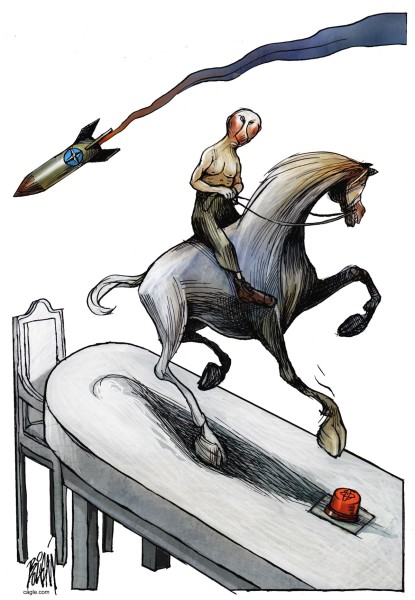
Why must so many Ukrainians die, according to Peterson? Because Putin fears the West’s culture wars will reach the Russian steppe, penetrating as far as Siberia, but further into the young minds of Russian youth. Is Peterson claiming that Putin is mobilizing his nuclear machinery and threatening world conflagration because of what Putin’s close friend, Patriarch Kirill, head of the Orthodox Church, fears – gay pride parades? Apparently so. But Peterson is more specific than Kirill – it’s more than just gay parades; it’s also trans rights and gender-neutral pronouns! One can easily see how an independent and democratic Ukraine threatens Putin, but it’s a huge stretch to believe pronouns are among the key causes of Putin’s invasion of Ukraine, even if we consider gender pronouns as representative of Western cultural decline, as does Peterson. It’s more likely that Peterson is batshit crazy when it comes to understanding the war in Ukraine. And that goes for his best buddy, Patriarch Kirill, Primate of the Russian Orthodox Church, or the Patriarch of Moscow and all of Russia:
Patriarch Kirill said the war is about ‘which side of God humanity will be on’ in the divide between supporters of gay pride events – or the Western governments that allow them – and their opponents in Russian-backed eastern Ukraine. ‘Pride parades are designed to demonstrate that sin is one variation of human behavior. That’s why in order to join the club of those countries, you have to have a gay pride parade,’ he said in his Forgiveness Sunday sermon. The Russian church leader characterized gay pride parades as a ‘loyalty test’ to Western governments, which Ukraine’s breakaway republics have ‘fundamentally rejected.’ ‘For eight years, there have been attempts to destroy what exists in Donbas,’ Patriarch Kirill said, referring to the region where Kyiv has been at war with the separatist republics since 2014. ‘And, in Donbas, there is a rejection, a fundamental rejection of the so-called values that are offered today by those who claim world power,’ he said. ‘We know that if people or countries reject these demands, they are not part of that world. They become strangers to it.’ Patriarch Kirill painted the Russian invasion of Ukraine in more apocalyptic colors as a conflict ‘far more important than politics.’ ‘If humanity accepts that sin is not a violation of God’s law, if humanity accepts that sin is a variation of human behavior, then human civilization will end there….’
Clearly, the good Patriarch would not appreciate Bob Dylan’s rendition of ‘With God on Our Side.’ I suppose that would be considered part of the West’s degenerate culture as well.
If Putin is really risking world war over gender pronouns and gay parades, I can imagine that, to assuage his panic, he has directed his armed forces to make sure Studio 54 and the Andy Warhol Museum are his first prime targets, sparing no megatonnage, although he might not realize that Andy Warhol died three and a half decades ago and Studio 54 is a Broadway theatre and no longer a disco nightclub. Perhaps those particular warheads will be personally blessed by the grand Patriarch himself to the tune of the Village People. ‘Little Boy and Fat Man send their greetings, yours truly, Vlad Kirill.’
To understand why so many right-wing fascists and neo-Nazis in America are ideologically and emotionally drawn to the Eastern Orthodox Church, which includes the Russian Orthodox Church Outside of Russia (ROCOR), we need only examine the shocking behavior of Kirill, leader of Russia’s dominant religious group. According to Peter Smith, Kirill has had no compunctions justifying his country’s invasion of Ukraine, ‘describing the conflict as part of a struggle against sin and pressure from liberal foreigners to hold ‘gay parades’ as the price of admission to their ranks.’ This has, no doubt, alienated many in Ukrainian Orthodox churches who had previously stayed loyal to the Moscow patriarch during a schism in their country (the formation of a more nationalist, Kyiv-based Orthodox Church of Ukraine, occurred in 2018 and 2019), and who are now ignoring Kirill in their public prayers and holding their noses when his name is mentioned. Some are even taking their deep-seated aversion to another level and demanding independence from the Moscow church. As missiles reign down on Ukrainian hospitals and schools, it doesn’t help matters that Patriarch Kirill has called Putin’s rule a ‘miracle of God,’ and ‘holds the hope that future generations will pick up the spiritual baton from past generations and save the Fatherland from internal and external enemies.’ ‘You, Vladimir Vladimirovich, personally played a massive role in correcting this crooked twist of our history,’ Kirill said, using the President’s patronymic.
Perhaps Peterson believes the Maidan Revolution was really orchestrated out of the gay bars in San Francisco’s Castro district. But one thing is certain: Peterson blames ‘degenerate’ US culture for the lives being lost in the war in Ukraine. Never mind the civilian women, children and men maimed and tortured and dumped into a ravine by the Russian army. Never mind the children blown apart in hospitals and schools. The war in Ukraine makes sense, according to Peterson, because Putin’s greatest fear is gay bars coming to Moscow, and he only wants to protect his people.
The war, in other words, is all about Peterson’s personal phobias. It’s all about his pet peeves – gender pronouns – proving once again that the narcissistic obsession this toxic transphobe has with gender knows no rational bounds.
The moment when Supreme Court Justice Ketanji Brown Jackson was unable to answer, ‘What is a woman,’ when asked during her confirmation hearing in March, was, for Peterson, emblematic of the unyielding reach of the culture wars. In an era when it’s apparently okay for the Supreme Court to eviscerate women’s control over their bodies in overturning Roe vs. Wade, it doesn’t surprise me that the J. Edgar Hoover of the Canadian gender police identifies the first Black female Supreme Justice as initiating a historical moment equivalent to that of the Archduke Franz Ferdinand of Austria and his wife Sophie being shot to death by a Bosnian Serb nationalist in the Bosnian capital of Sarajevo on June 28, 1914, thereby starting a chain of events that led to World War 1. What an early accomplishment for Justice Brown! She is the flashpoint for what could end up becoming World War III. Thank you for pointing that out, Professor Peterson. But, for some reason, I don’t think this is going to pass muster with the historians, at least the good ones who are reluctant to replace the temporal narratives of our political unconscious with the tyranny of the sign. You would think that Peterson, a psychology professor, would know enough about the theory of projection to do a little self-diagnosis. One would think that being the first Black female Supreme Court Justice would have given Justice Brown enough to deal with. Now she is having to take responsibility for the possible end of the world.
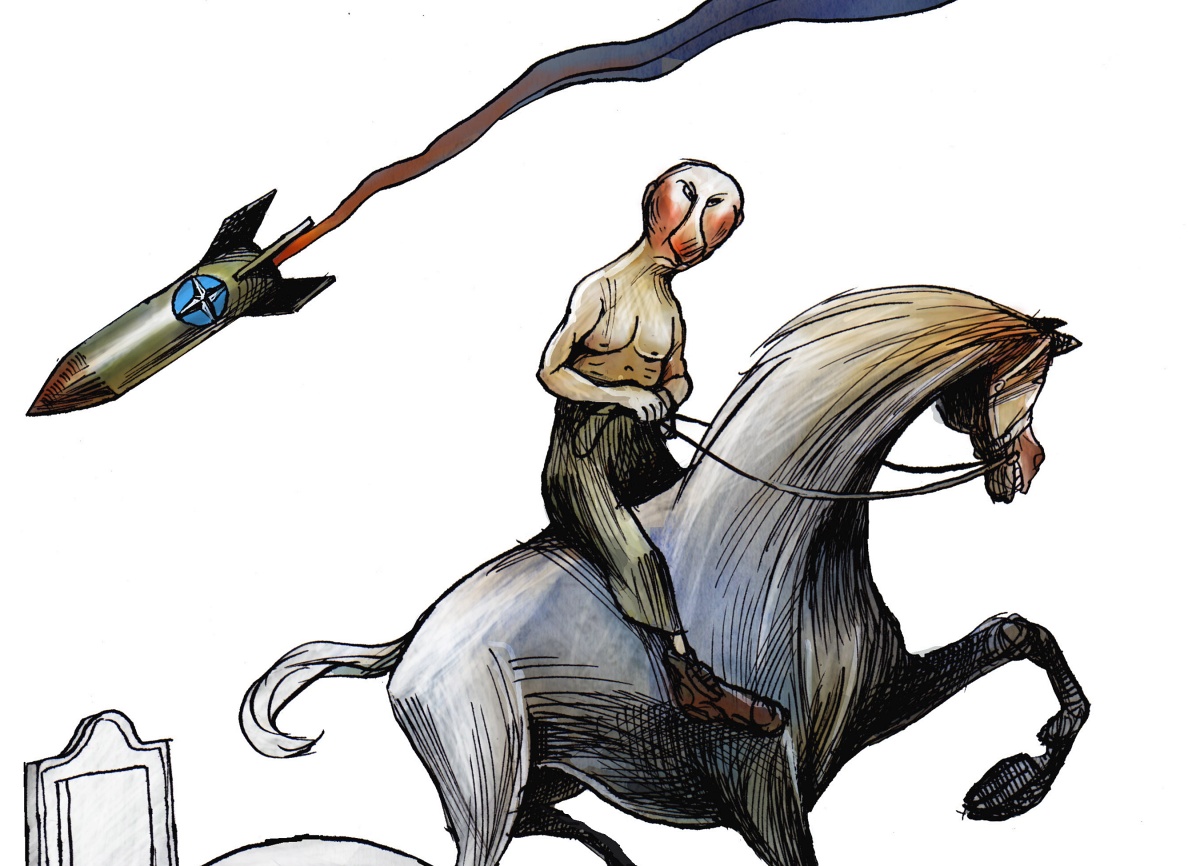
I suppose that, in Peterson’s imagination, he believes that Putin is shuddering, coiled beneath his white-topped oval table made from a single 20-foot-long sheet of beech wood (all the better to protect himself from a parade of ‘otters’ that might make it past the Kremlin’s ceremonial guards watching over the long golden doors of the Grand Kremlin Palace), obsessing that a Russian version of transgender star Elliot Page might appear any moment as a newscaster on Channel One Russia, fomenting a tidal wave of degenerate Western ideology, perhaps spurring on the gayification of Russian culture, even transforming state-controlled media into a Russian variant of the ‘woke’ regime media such as MSNBC. Can you believe how threatening a Russian version of ‘Morning Joe’ would be to public morality? Please!
I suppose that for Peterson, all this paranoia on the part of Putin justifies Putin’s unleashing hell and fury against Ukraine, friend of Babylon. ‘Ivor, start targeting those ICBMs immediately over West Hollywood!’ French puts it this way:
A clash over whether to use the word woman or a person with the capacity for pregnancy is a moral and philosophical dispute that can be mediated through the instruments of liberal democracy. A Russian cruise missile launched into an apartment building, by contrast, represents a truly different order of depravity. A nation or culture does not have to be perfect to be right, and make no mistake – in the clash between the war criminal in the Kremlin and Ukraine and its NATO allies – the true moral high ground could not be more clear.
This, of course, does not absolve the US and NATO in its shift to the East. I am fully aware of how Putin and his administration worry about maintaining their fictitious sphere of influence, and US attempts to weaken Russia further. But it is striking and disturbing what excuses North Americans, including scholars and activists on the left, offer up in the cause of justifying Putin’s war. Americans, for example, are now joining the Russian Orthodox Church precisely because they agree with Putin’s attacks on democracy and his anti-LGBTQ laws and his strongman persona.
And speaking of strongmen at war with democracy, let’s not forget that white evangelical Christians have thrown their lot in with a former fist-pumping POTUS who ‘publicly admires despots, tyrants and other authoritarian leaders who kill their enemies and take away the rights of anyone who oppose them.’. In this way, they have shown their true face. What can we say about a frenetic allegiance to a man whom ‘[m]ental health professionals have repeatedly warned … is likely a sociopath with an erotic attraction to violence and mayhem.’. This is a man who is touted by none other than Tucker Carlson, who has created ‘the most racist show in the history of cable news’ that is gleefully watched by millions of Americans. Holding the country’s progressive democracy in contempt, a form of governance preserved since the days of its blood-soaked independence from England, its far-right custodians are shamelessly ripping the scabs from festering old wounds in the hope of stirring up a race war, taking it down the same road to perdition it has yearned to escape since the days of slavery.
Trump and his fawning, infantilized sycophants, his glad-handing, back-slapping buffoons, are behaving not unlike Hitler’s top brass circle of Borman, Goring, Himmler, Goebbels, and Speer at their apogee of obsequiousness in the late 1930s, as these goose-stepping lickspittles sought to curry favor with their leader, trying to upstage the other with extravagant gestures to prove who was the most loyal servant (Ted Cruz certainly comes to mind as the most cartoonishly servile). That they refuse to denounce Trump’s many clarion calls for violence and his brutish extolment of racism means that they are ‘all in’ for white rule and its fraught political calculations. It has been the dream of rich white people on the far right for generations to roll back taxes on the rich and to control the Supreme Court. Thanks in part to Trump, they have achieved their goal of reversing the civil rights victories of the 20th and 21st centuries won by Black and brown people, women, LGBTQ people, people with disabilities and other marginalized groups. Evangelical Christianity and the cult of Trump have certainly been complicitous in such a catastrophic victory.
I left my evangelical Christian church in Toronto, Canada, at age seventeen, the day my pastor gave a sermon proclaiming that in the moments before his suicide. Adolf Hitler would have gone to heaven had he sincerely repented for his crimes and accepted Jesus Christ as his personal lord and savior. Yet the millions of Jews and others that he had enslaved and executed, he declared, were suffering in hell for eternity unless, of course, they also had accepted Jesus as their personal savior.
The term ‘legacy Americans’ used by Tucker Carlson is telling. It’s a deeply racist catchphrase or buzzword in his discussion of race that attempts to make white supremacy seem more respectable, a term that is meant to signify the inverse of ethnopluralism, or what the Proud Boys gleefully champion as ‘the Spirit of Western Chauvinism.’ What sounds like an Ivy League term to some is nothing more than a toe rag Barnumesque idea resplendently reserved for a deeply racist hellhound pursuing white America.
For White MAGA Christians, ultracrepidarians when it comes to racism, Christianity is the sole preserve of ‘legacy Americans,’ whose DNA can be found in the primeval issue of their Anglo-European forebears, including all of their descendants and offspring whose spawn has been deposited in the swamp of settler colonialism that white Christianity is trying to transform into a cesspool of historical amnesia. It doesn’t want ‘we the people’ to be taught the truth: that legacy Americans settled the land which they stole from first nations peoples, whom they came close to exterminating, and then forcibly brought Africans across the Atlantic as slaves to work their cotton plantations. Which is why the creation of a legacy White God whose symbolism makes clear who is at the top of the racial hierarchy is so important for evangelical white Christians. This truth can be found in the words proclaimed by Trump’s MAGA crowd: ‘We may be poor and hungry, but at least we’re White’! Seems like this is the side of the US culture wars that Putin hopes will emerge victorious. And I am sure Patriarch Kirill is all smiles each time a Lauren Boebert or Margorie Taylor Greene sounds off.
While I support Ukraine against Russian settler colonial domination, since the national question should always be front and center, I do not support the neoliberal Ukrainian government, propped up by oligarchs. Rather, my support lies with the self-determination and struggle for national independence of the people of Ukraine. Marxist humanists rightly point out that the practice of campism – the notion that leftists should support any state power or force opposed to the US or NATO – is now dangerously afoot but must be rejected. The right of peoples to their national self-determination must be protected by all forces on the left. For this reason, I stand with the people of Ukraine against the Russian behemoth’s punitive irruption into history, an ultranationalist regime that supports far-right organizations all over Europe and beyond. I stand with the people of Ukraine and especially those who are trying to foster new, non-alienating human relations in the struggle for socialism.
Peterson’s attack on US culture points to the moral wreckage wrought by campism, by condemning anything that could, however remotely and unproven, be associated with American and Western imperialism or culture. And we should recognize those ‘campist’ journalists for their moral complicity with Russian aggression. And I am saying this as someone who has fiercely criticized Western imperialism for over thirty years. As Schulman and La Botz maintain in their important article against campism in Socialist Forum, socialists that include Karl Marx, Eugene Debs, Rosa Luxemburg and C.L.R. James had always foregrounded that workers in each country should support those in another in their struggles for democracy and social justice. Support for Ukraine in the spirit of international working-class solidarity and democratic socialist internationalism roundly rejects the inverted nationalism of ‘the enemy of my enemy is my friend.’
Putin may well abhor ‘woke’ American culture for the same reasons Margorie Taylor Greene (who advocates a blood-and-soil Christian nationalism) despises it. Or for those held by Jordan Peterson for that matter. Peterson may resent Elliot Page for showing off his abs, and Putin might be jealous, but by trying to convince others that it is reasonable for a fascist dictator to destroy a sovereign country like Ukraine, claiming it is for their own moral good and for the salvation of Mother Russia IS both wrong-headed and a dangerous form of lexical opportunism masked as profound and complicated thought.
It is well known that the sunflower is Ukraine's national emblem. It has long danced across the central and eastern steppes, its golden faces tilting to greet the sun since the mid-18th century. It has, over the centuries been rooted in the soil of resilience, serving both as sustenance and symbol. But today I am preoccupied with roses. I am thinking of Sophie Scholl of the non-violent White Rose group, whose clandestine leaflets fluttered like fragile doves, carrying a spark of truth into the suffocating abyss of Nazi darkness. She was beheaded by guillotine at age 21. I am thinking of Las Trece Rosas, thirteen young Spanish women ranging in age from 18 to 29 years old, who stood as radiant sentinels against Franco’s fascism, their lives extinguished by firing squad but their courage immortalized, petals falling in defiance of tyranny.
This is what unfolds when the powerful feel the ground shifting beneath their feet, threatened not by armies or weapons but by the quiet, insistent call for justice from the disenfranchised. Social justice, like a rose, emerges as both fragile and defiant—a beauty born of struggle, its petals unfurling amidst the sharp defenses of its thorns. To the threatened, however, the rose is not a symbol of hope but a warning, its thorns a menace to their unyielding grip on power.
One can choose, as the wise might, to rejoice that the thorns have given rise to the rose—a testament to resilience and the possibility of a more equitable world. Or one can curse the rose for its thorns, fixating on its defenses while ignoring its promise. Putin, unsurprisingly, chooses the latter. In his vision, the rose does not symbolize progress but peril, an intrusion upon the garden he seeks to control. He cannot see the beauty for the barbs, or perhaps he fears that the rose, once fully bloomed, will sow seeds of transformation too potent for his empire to withstand. And so, he moves to trample the rose underfoot, hoping that the soil, once scorched, will yield no more blooms.
This is an expansion of an article published in Pesa Agora.
Comments

Powered by RoundtableAn AI/DeFi-powered Enterprise Media Operating System. Learn more at Roundtable.io.© Roundtable 2026. By using this site you agree to the Terms of Use and Privacy Policy