


Nonviolent Activism
Apr 27, 2024 2:38 PM
For the past six months, a committed group of activists has been meeting on Mondays in front of Rep. Judy Chu’s office in Pasadena on Mondays from 5 to 7 pm, shouting “Not in our name!”
“Those who love peace must learn to organize as effectively as those who love war.” Martin Luther King Jr.
When letter writing, phone calls, letters to the editor, etc. aren’t grabbing the attention of lawmakers, then the public is forced to resort to other methods of nonviolent action. In the early 1970’s, scholar and activist Gene Sharp promoted nonviolent resistance through his seminal work “The Politics of Nonviolent Action”. One of the key components of that trilogy of books is the list of ‘198 Methods of Nonviolent Action’ which has been utilized by community organizers and activists since its publication to advocate for numerous social, racial, environmental, political, etc. justice issues. It is a comprehensive list for how to garner the attention of elected officials, decision-makers and the public in order to create change peacefully.
In the case of Gaza, where the Israeli military has leveled cities, killed thousands of civilians, destroyed infrastructure and continues to act with impunity, how does the community respond in a way that convinces the House, Senate and President that tax dollars should not be used to fund genocide? And as seen with the recent silencing of the USC valedictorian, Asna Tabassum, standing up to those in power can come with serious risks. Nevertheless, in order to save lives, for many there is no choice but to continue to oppose sending military aid to a government that stands accused of committing genocide by the International Court of Justice.
For the past six months, a committed group of activists has been meeting on Mondays in front of Rep. Judy Chu’s office in Pasadena on Mondays from 5 to 7 pm, shouting “Not in our name!” The objective of the group has been to convince Chu to join dozens of other Members of Congress to call for an immediate ceasefire in Gaza and to end Israel’s occupation of Palestine. A loosely formed collaborative of Buddhists, Muslims, Jews, Christians, humanists and others, these advocates for peace have incorporated many of the tools listed by Sharp in their tactics to draw attention to the plight of Palestinians and to change Chu’s position on funding Israel’s military.
Related stories
As one member of the group, Teri Stein, observed, “I am here because this moment demands the presence of everyone who dreams of a world with liberation and safety for all. I am the Jewish granddaughter of Holocaust refugees, and the descendant of many murdered in the Shoah. To see their memories used as justification to commit another genocide is a desecration of the highest order. I see how the Holocaust and the very real scourge of antisemitism are being weaponized to deflect accountability for the genocide Israel is waging against Palestine and her people.”
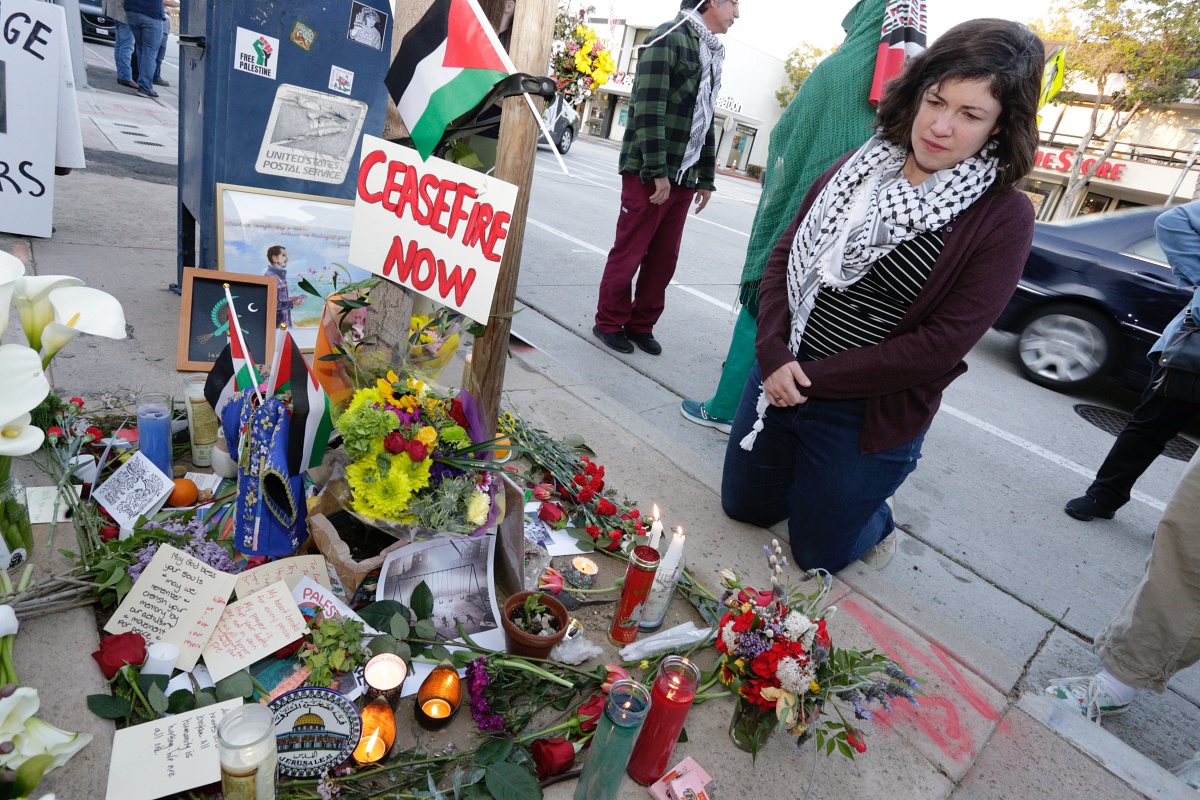
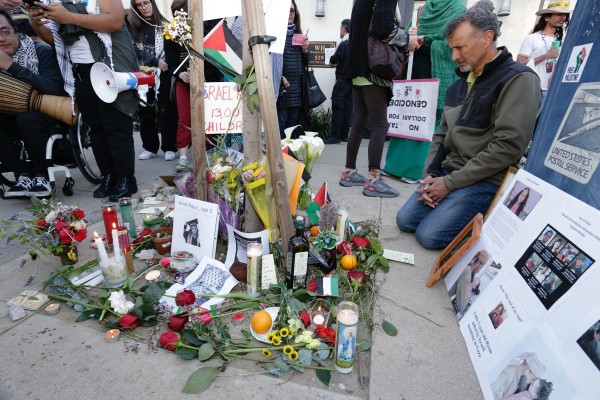
Week after week, the methods for raising awareness in Pasadena have included: peaceful marches up and down Lake Ave., a busy shopping promenade in the city; leaving a pile of children’s shoes in the form of a heart in front of Rep. Chu’s office; creating a memorial altar on the sidewalk in front of Chu’s office that included flowers, candles, poems, handwritten notes to Palestinian families, and images of people killed in Gaza by the Israeli government with US military aid; sending a multi-faith delegation of advocates for peace to Chu’s office to speak with her directly; advocating in front of Pasadena’s City Council to pass a local ceasefire declaration; and organizing a car caravan that wove through the neighborhoods of the city calling for a ceasefire before arriving at City Hall for a rally and speeches.
Randy Heyn-Lamb, the co-chair of Middle East Ministries at All Saints Episcopal Church, has been to the West Bank multiple times and has personally witnessed the damage to Palestinians that the Israeli government’s apartheid system has caused: “Over the past 25 years I have established and sustained friendships with Israelis and Palestinians who are seeking a more just and equal society. I now see those friends threatened by death, displacement, famine, and disease. And our elected officials are increasingly unresponsive; unwilling, or unable to take the needed steps to end the violence. And so I join together with others of different creeds, ethnicities and genders; united by a common love of freedom and concern for the oppressed, willing to engage in sacred, nonviolent resistance to bring about needed change.”
Has this dedicated activism made a difference? It is difficult to measure how marching in the street is able to change public policy. However, it is important to note that Rep. Judy Chu joined 36 of her Democratic colleagues in the House by voting ‘no’ to the $26 billion Israel Security Supplemental Appropriations Act on April 20. Gene Sharp would certainly assert that the visibility and urgency created by the weekly demonstrations, marches, vigils, altars, etc., along with a swollen river of emails and phone calls, landed squarely with Chu and her staff, helping them to think differently about Congress’s role in funding Israel’s military.
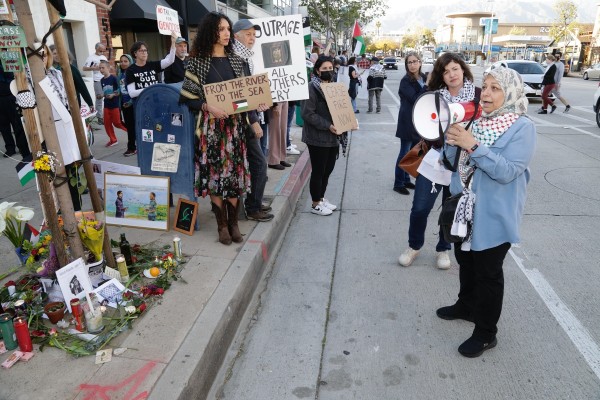
Even so, the violence has not ended. There are still people dying in Gaza and the West Bank every day, so the Monday evening vigils from 5 to 7 in front of Judy Chu’s office will continue until there is peace.
As one Palestinian American vigil participant (name withheld to protect their family in Palestine) recently stated, this is a struggle for liberation that may take years to achieve and defined his commitment in this way: “I am here today not in sadness and anger (though those feelings certainly exist), but in confidence of the inevitability of Palestinian liberation. My grandfather always knew that this would be realized, and he instilled it within us, even if he did not live to see it. And as we see the people of Gaza forced to endure unimaginable violence, a violence that is financed by America's military aid and allowed by America's politicians (despite the majority will of their constituents), Palestinians continue to remain calmly steadfast in their perseverance toward liberation. If they can so confidently persevere in the most dire of circumstances, there is no justification for any of us here to not confidently stand on the side of justice, liberation, and an enduring peace.”
Comments

Powered by RoundtableAn AI/DeFi-powered Enterprise Media Operating System. Learn more at Roundtable.io.© Roundtable 2026. By using this site you agree to the Terms of Use and Privacy Policy