
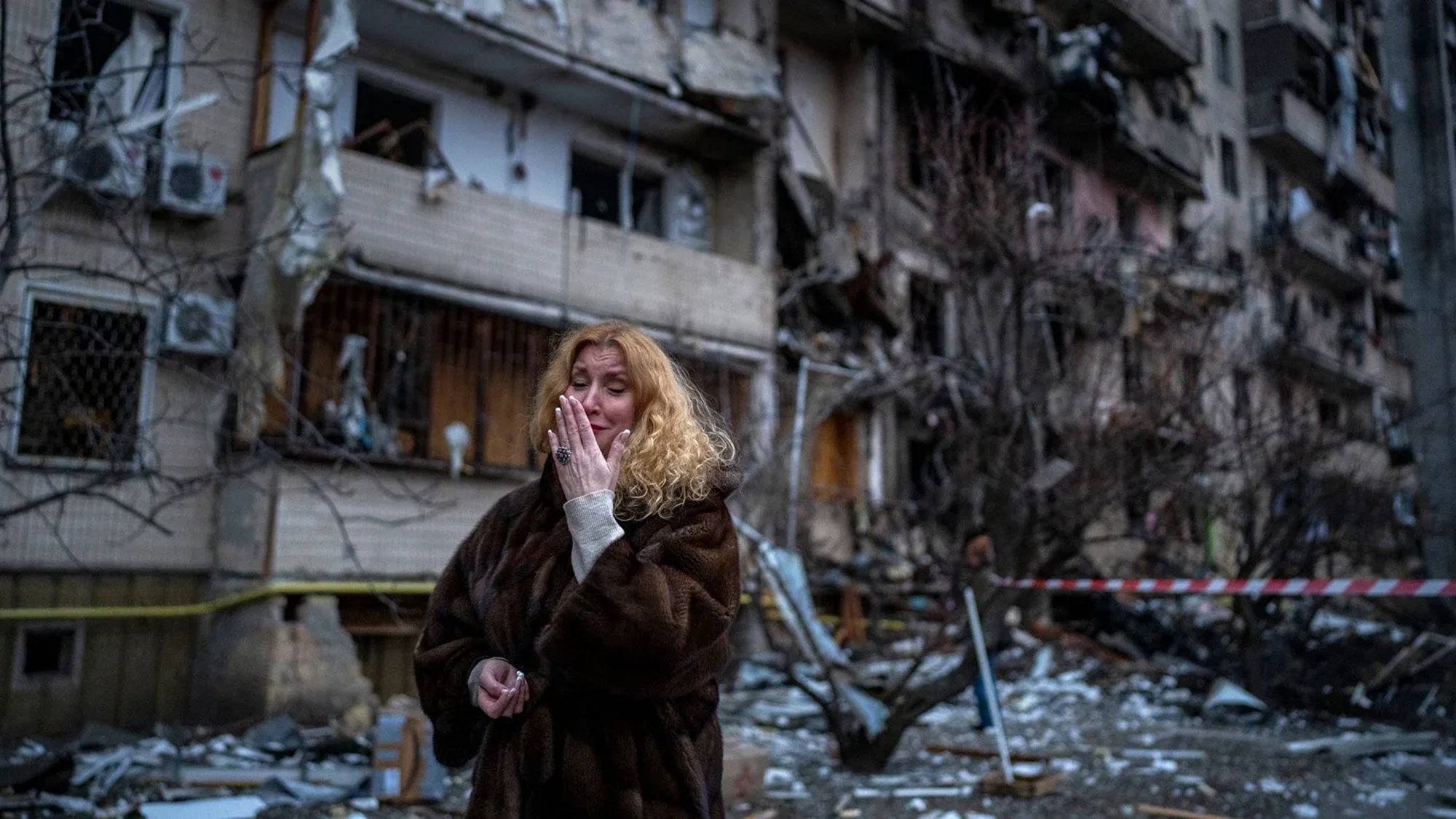
War—it sucks. But let’s keep fighting so someone can “win.” (Natali Sevriukova mourns the loss of her home in Kyiv; Sky News)


Apr 19, 2023 11:00 AM
The gloom reflected a Defense Intelligence Agency assessment found among the highly sensitive U.S. government materials leaked in early April.
For the neocon war planners in Washington, DC, new realities – and enduring ones that cannot be ignored – have become a constant challenge. A Washington Post headline blared on April 14, 2023, that “the U.S.’s gloominess on war in Ukraine is now clear to see.” The story said “U.S. officials have privately conveyed their concerns over the course of the war in Ukraine,” pointing “to a tougher reality”:
A total military victory for Ukraine seemed impossible; the military-industrial base in Western countries required to sustain the flow of foreign munitions and arms to the front was under severe strain; and, at some point, the support of Western publics, especially Americans, would wane, and the spigot gushing tens of billions of dollars in aid to Ukraine would get turned off.
Nevertheless, as an April 12 article in the Post said, “Negotiations to end the conflict are unlikely during 2023 in all considered scenarios,” and “the war in Ukraine… will likely drift into 2024 with no resolution in sight.”
The gloom reflected a Defense Intelligence Agency assessment found among the highly sensitive U.S. government materials leaked in early April. President Biden told reporters “I’m concerned that it happened, but there is nothing contemporaneous that I’m aware of that is of great consequence.” Secretary of State Blinken “reaffirmed the ironclad U.S. support and vehemently rejected any attempts to cast doubt on Ukraine’s capacity to win on the battlefield.”
Related stories
Foreign Affairs, the flagship publication of the prestigious Council on Foreign Relations, issued its own view on April 13, 2023: “The West Needs a New Strategy in Ukraine: A Plan for Getting from the Battlefield to the Negotiating Table,” by Council President Richard Haass and Senior Fellow Charles Kupchan. “It is difficult to feel sanguine about where the war is headed,” they write, and while “calls for a diplomatic end to the conflict are understandably growing,… conditions are not yet ripe for a negotiated settlement.”
The approach Foreign Affairs proposed is “first bolstering Ukraine’s military capability and then, when the fighting season winds down late this year, ushering Moscow and Kyiv from the battlefield to the negotiating table.”
Before any “ushering from the battlefield” would take place, Haass and Kupchan say it’s “time for the West to stop deterring itself,” and help Ukraine more militarily, with “tanks, long-range missiles, and other weapons,” and “also begin training Ukrainian pilots to fly F-16s.”
Despite their concern that the West has been “deterring itself,” the authors acknowledge that “continued large-scale support of Kyiv carries broader strategic risks.
Despite their concern that the West has been “deterring itself,” the authors acknowledge that “continued large-scale support of Kyiv carries broader strategic risks. The war is eroding the West’s military readiness and depleting its weapons stockpiles; the defense industrial base cannot keep up with Ukraine’s expenditure of equipment and ammunition. NATO countries cannot discount the possibility of direct hostilities with Russia, and the United States must prepare for potential military action in Asia… and the Middle East.”
They add that “the war is imposing high costs on the global economy,” and “economic duress is triggering political unrest,” and “is also polarizing the international system.” Against this backdrop, they say “neither Ukraine nor its NATO supporters can take Western unity for granted… Washington faces mounting pressure to reduce spending, rebuild U.S. readiness, and bulk up its capabilities in Asia.” With Republicans in control of the House of Representatives, getting more aid for Ukraine is now harder, and “policy toward Ukraine could change significantly should Republicans win the White House in 2024. “It is time to ready a Plan B,” they say.
Plan B: “Washington should start consultations with its European allies and with Kyiv on a diplomatic initiative to be launched later in the year… Ukraine’s Western supporters would propose a cease-fire… Ideally, both Ukraine and Russia would pull back their troops and heavy weapons…, effectively creating a demilitarized zone. A neutral organization – either the UN or the Organization for Security and Cooperation in Europe – would send in observers… The West would approach other influential countries, including China and India, to support the cease-fire proposal… the West could also offer some limited relief from sanctions in return for Russia’s willingness to abide by a cease-fire, agree to a demilitarized zone, and participate meaningfully in peace talks… [emphasis added.]
“Ukraine would enter such negotiations by demanding its top priorities: the restoration of its 1991 borders, substantial reparations, and accountability for war crimes. But because Putin would surely reject these demands out of hand, a prolonged diplomatic stalemate would then emerge, effectively producing a new frozen conflict. Ideally, the cease-fire would hold, leading to a status quo like the one that prevails on the Korean Peninsula…”
[emphasis added.]
So Foreign Affairs wants a demilitarized zone and a prolonged diplomatic stalemate in Ukraine, something like the division of Korea seven decades ago. That is not peace. The U.S. war in Korea never ended. The United States has continued to isolate – really strangle – its enemy in the north of Korea while fostering a client state in Korea’s southern half, with a huge military establishment controlled operationally by the U.S., including nuclear weapons aimed at North Korea, China and Russia.
If the Foreign Affairs writers think Russia would accept such a deal, they haven’t been reading the Pentagon’s leaked intelligence reports. In realistic terms, the Ukrainian forces – and their NATO backers – are exhausted. Russian forces are establishing security for Russian speakers in eastern and southern Ukraine, and defending their self-determination. In effect they are implementing the Minsk accords, which all parties agreed to years ago.
In the seven decades since the armed truce in Korea, a lot has changed. Most importantly, China is no longer exhausted from a century of humiliation and three decades of revolutionary war. Its leader, Xi Jinping, recently returned from an historic visit to Moscow where he reaffirmed China’s close friendship with Russia. Just before that, China’s top diplomat presented a 12-point peace plan to the West at the Munich Security Conference. Then French President Macron and European Commission President Van der Leyen visited Beijing to secure economic ties with China. Germany’s Chancellor Scholz did the same last November. Europe trades more with China than the U.S.
Global Times reported that “after concluding his visit to China, Macron emphasized that ‘the great risk’ Europe faces is that it ‘gets caught up in crises that are not ours, which prevents it from building its strategic autonomy… The paradox would be that, overcome with panic, we believe we are just America's followers’.” The Global Times report says “The French President’s rational plea for Europe jams the brakes on some Eastern European nations and European Parliament, lured by the U.S., in their attempt to lead the continent astray… Macron is warning Europe not to go so far on this issue and risk damaging Europe’s own interests. Macron’s stressing the need for Europe’s strategic autonomy was a result of a sober awakening from the U.S.’ selfish policies on Europe, especially since the Russia-Ukraine crisis, and also from being emboldened by his ‘very successful’ visit to China, during which he saw China’s good will toward France and the huge potential of cooperation with China.”[i]
The Wall Street Journal editorialized April 9 that “Macron Blunders on Taiwan – and Ukraine,” saying he “weakens deterrence against Chinese aggression and undermines US support for Europe.” The U.S. is jerking Macron’s leash.
On April 14, Brazil’s President Lula De Silva met with Chinese President Xi Jinping as part of a five-day state visit. The New York Times report was headlined “Brazil’s Lula Meets Xi in China as They Seek Path to Peace in Ukraine.” Their joint statement said negotiation is “the only viable way out of the crisis in Ukraine.” They want China’s 12-point peace plan to be the basis for talks. The Times report said U.S. and some European officials “have been critical” of China’s plan, “because China has not suggested that Russian forces must withdraw from occupied Ukrainian territory.” Lula also wants other countries, like South Africa, India and Indonesia, to help mediate the conflict. They also have not signed on to isolating Russia.
As part of his visit to China, Lula helped inaugurate his political ally Dilma Rousseff as president of the New Development Bank set up by the BRICS nations. Roussef was Brazil’s president from 2011 to 2016, when she was impeached in a “soft coup” backed by the U.S. At the inauguration ceremony Lula said “Why should every country have to be tied to the dollar for trade?... Who decided the dollar would be the (world’s) currency?” He added that “No bank should be asphyxiating countries’ economies the way the IMF is doing now with Argentina, or the way they did with Brazil for a long time and every third-world country… No leader can work with a knife to their throat because (their country) owes money.”
A Changed Environment in the World
Lula’s comments are a signal of the changed environment in the world. He also called for China’s territorial integrity to be respected with regards to Taiwan, as Macron had done.
Just before hosting these high level visits from France, the EU and Brazil, China hosted the leaders of Iran and Saudi Arabia, scoring possibly the most significant peace agreement of this century so far. No military guarantees were needed to convince Iran and Saudi Arabia to abandon hostilities. Instead the parties agreed to peace on the basis of cooperation in attractive trade deals with China. It’s a new concept, right out of China’s Global Security Initiative Concept.
Of course there is no guarantee that a similar approach could work for peace between Russia and Ukraine, or Russia and the EU and NATO. In all these cases the main obstacle is the United States, which does not want peace based on mutual cooperation. But the U.S. may not have a choice. Its European “allies” could still decide to abandon the NATO alliance for their own survival.
The people of Europe are calling for such a solution. That’s the message of the massive protests that are sweeping Europe. They need the people of the United States to also demand such a solution. That would bring the day of reckoning for U.S. hegemony closer. The U.S. will no longer be able to control the world. There is a shift coming, a balance of forces away from the West back to the people.
“The Ukraine conflict promises to constitute a major turning point,” says Radhika Desai, author of Capitalism, Coronavirus and War: A Geopolitical Economy. She says: “The conflict the West calls Russia’s invasion of Ukraine, and Moscow its special military operation for Ukraine’s demilitarization and denazification, is not a conflict between Ukraine and Russia. It is a phase in the hybrid war that the United States has been waging… against any country that chooses an economic path other than subordination to itself…”
The hybrid war is also aimed at China, but it faces the same gloomy prospects as the U.S. war planners have found in Ukraine. In both cases, they’ve made bad gambles. Popular forces in this country, in Europe and around the world need to intervene to stop the madness.
Comments

Powered by RoundtableAn AI/DeFi-powered Enterprise Media Operating System. Learn more at Roundtable.io.© Roundtable 2026. By using this site you agree to the Terms of Use and Privacy Policy