
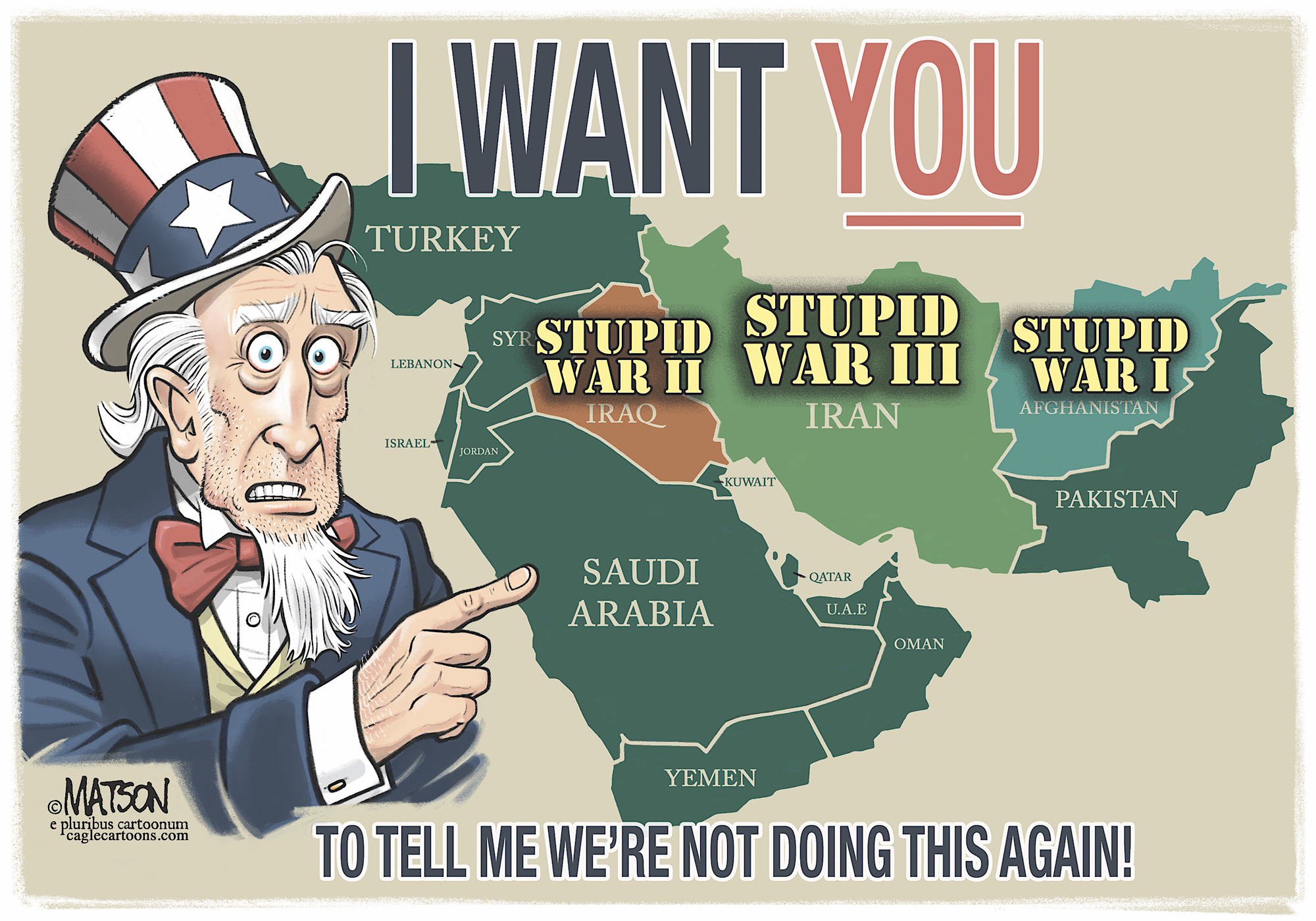
Illustration by R.J. Matson on CagleCartoons.com


Attacking Iraq was a terrible idea. I do not regret my attempt to stop the Iraq war. It is better to try and fail than to have never have tried at all.
Aug 11, 2025 3:41 PM
Attacking Iraq was a terrible idea. I do not regret my attempt to stop the Iraq war. It is better to try and fail than to have never have tried at all.
When President George W. Bush was about to invade Iraq in 2003, I wrote an article suggesting how U.N. Secretary General Kofi Annan could prevent the U.S. from attacking.
Mr. Bush had asked Annan to withdraw the UN's weapons inspectors from Iraq so they would not be harmed when our forces attacked. I suggested that Annan refuse to withdraw them unless the UN Security Council ordered him to do it.
Any such order would have been vetoed by Russia, China, or perhaps even France.
Imperiling the UN inspectors would have been a public relations nightmare for President Bush, hopefully forcing him to forget about invading.
Related stories
Annan's maneuver would have increased the inspectors' clout over Iraqi leader Saddam Hussein. As long as inspectors remained, they would protect Iraq from an American attack. But if not allowed to do their work, Annan could yank them out, allowing the U.S. to attack.
The decision would have enhanced the Secretary General's power. Until then, the veto enjoyed by the U.S., Great Britain, France, Russia, and China had limited the power of the United Nations to do anything.
But by assuming the power to act on behalf of the human race unless the Security Council tells him he cannot, the Secretary General would make the veto work to increase his own power, and thus the power of the United Nations.
I hadn't come up with this idea for turning the UN's leader into a "Machiavelli for peace" on the spur of the moment. At my suggestion, one of my outstanding Adrian College students had explored this possibility in a major paper back in the 1960s. But 2003 seemed like a great time to put the idea into practice!
It is not clear whether my idea ever got to Mr. Annan, but there were several attempts to bring it to his attention.
None of the newspapers which published my then occasional columns would run this article. I emailed it to friends to see if they had any ideas where I could find a publisher. One helpful suggestion came in: Common Dreams, a widely read on-line progressive newsletter, which I had never heard of.
Common Dreams had the article on the air immediately. It drew over 400 emails asking me for Kofi Annan's email address so my readers could send the idea to him!
Of course if I had Annan's address I would have used it myself. But, as I responded to my readers, Annan probably would never have seen my suggestion. Famous people are protected by their staff from being inundated with ideas, even when some of the ideas might be good ones.
What we really needed was someone personally acquainted with Annan or who was famous enough to barge in to his office and present the idea in person.
I had tried to exploit a personal acquaintance between my friend Stan Caine, then president of Adrian College, and Kofi Annan, who had been his undergraduate classmate at Macalester College. But they had not kept in touch.
Some Methodist ministers from the Seattle area thought they had found a famous spokesman. They were scheduled to meet with South African bishop Desmond Tutu. Bishop Tutu was famous enough to obtain an audience with the Secretary General and present him with my proposal.
Unfortunately, Bishop Tutu cancelled his visit to the United States.
We don't know whether my proposal ever reached Annan.
My efforts were not unique. Most prominently, former National Security Advisor General Brent Scocroft penned a Wall Street Journal op-ed explaining why attacking Iraq was a terrible idea.
Alas, we now know that the Iraq war was a disaster, costing thousands of American and Iraqi lives and several trillion (with a T!) dollars.
I don't regret my attempt to stop the Iraq war. It is better to try and fail than to have never tried at all. And it did introduce me to an excellent publication where my articles still occasionally appear.
Comments

Powered by RoundtableAn AI/DeFi-powered Enterprise Media Operating System. Learn more at Roundtable.io.© Roundtable 2026. By using this site you agree to the Terms of Use and Privacy Policy