


May 6, 2018 8:57 PM
Updated Feb 10, 2022 11:07 PM
Lance Simmens: I will never forget the day after the shootings when one of my teachers broke down in tears before our class and begged us to think and think very carefully about what had happened the day before.
Forty-eight years ago today I was welcoming spring and preparing to end my junior year in high school. Looking forward to summer, trips to the Jersey shore, working at a summer construction job, nights driving around in my ’62 Chevy with the windows down (no air conditioning), dates at the drive-in, and the long-anticipated upcoming senior year and preparations for who knows what, maybe college, maybe just freedom like hitchhiking across the country. The only wild card was the ongoing conflict in Southeast Asia that had rocked the nation seemingly off its moral foundation. But that was far away despite its prominence in our living rooms each night via television.
For years the evening news with Walter Cronkite had the ominous numerical reminder in the upper right hand corner of the broadcast of American troops killed that day in Vietnam. Uncle Walter himself had by this time offered, in his most reassuring way, his verdict on our involvement in this far off land and it was that it could not be won. LBJ had succumbed to the inevitability that the war was a lost cause and withdrawn from the ’68 Presidential race. The Democratic convention in Chicago was revolution in the streets of America and yes the whole world was watching. Civil unrest was a constant theme in our culture, whether through television, movie screens, or our music.
By 1970, seventeen-year-old boys such as myself were coming face to face with the reality that playing football, whether on Sunday afternoons (playing for a school in the Philadelphia Catholic League meant we had to play at a public school facility where Friday nights were already taken) or pick up games on the beach on weekends, meeting girls at the Friday night dances, or figuring out ways to procure alcohol were soon to give way to the draft. This made the decision on college, in the age of deferments, a far more palatable consideration.
In the spring of 1970 many of us were experimenting with, among other things, FM music: the Doors, Jimi Hendrix, Cream, Crosby, Stills, and Nash but since the Chevy did not have an FM radio we were also in touch with AM hits. At that time “Let It Be” had just lost its #1 Billboard rating to “ABC” by the Jackson 5. However, the #1 hit of the year would end up being “Bridge Over Troubled Waters” by Simon and Garfunkel, which could not have been more prophetic. The world was seemingly coming apart at the seams and the rebellion was being led by youth not much older than myself.
Related stories
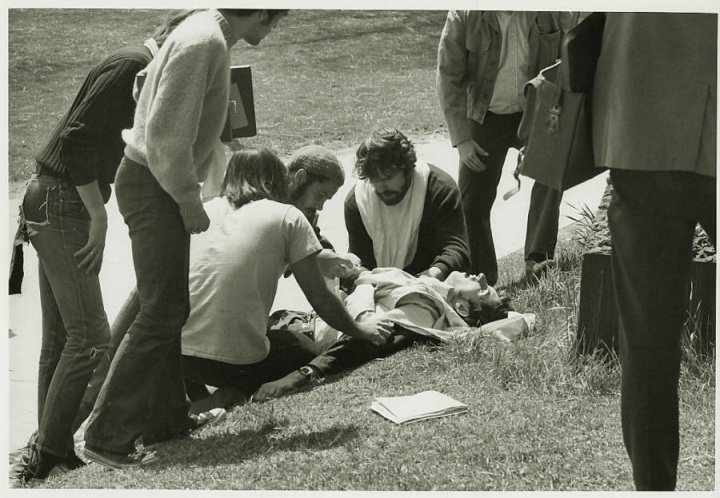
On the evening of May 4, 1970, the shocking news that catapulted to the top of Cronkite’s news broadcast would not be the deaths in Southeast Asia but rather those in Northeast Ohio. Four students at Kent State University had been shot to death by National Guardsmen on the bucolic campus that day. Philadelphia had had its share of unrest throughout the turbulent decade that had just ended and many whites had fled the city for the suburbs in order to avoid the violence. But this was a violation of the sanctity of a college campus, the students were white, the Guardsman were white and not much older than the students they had confronted and attacked. For me and many of my fellow students our world changed that day and the stark realities of a world in chaos hit home.
I will never forget the day after the shootings when one of my teachers broke down in tears before our class and begged us to think and think very carefully about what had happened the day before.
While my Catholic high school was run by priests, a dwindling pool of candidates dictated that our share of lay teachers was increasing. Most of these teachers were young men who had avoided service in the military through the very college deferments we would soon cherish. I will never forget the day after the shootings when one of those teachers broke down in tears before our class and begged us to think and think very carefully about what had happened the day before. In an agonizingly pained diatribe, his voice rising with indignation, our teacher asked “do you know what happened yesterday, they killed four kids on a college campus, do you understand what that means, do you, they killed kids on a college campus.”
Throwing a few f-bombs in for effect brought the point home even more powerfully than the tears and the pained expression on Jack Cruze’s face as he tried to reach us. Until that point I do not believe we had fully understood the seriousness of the future that awaited us. After the outburst we did. We would not even be safe on a college campus, but surely the odds were much better there than in the jungles of Vietnam. The cocoon that protected us from the world was fraying if not shattering before our very eyes. Could this be happening to us? I was still trying to date one of our cheerleaders! Well, by a quirk in timing most in my class of 1971 would not have to fight or serve in the military as the war ended just in time. But it was that close, missed it by a year. The killings at Kent State served as a brutal wake up call to those of us who might have been considered cannon fodder if we had been born a year earlier.
Seven years later I was in graduate school and teaching American government to fulfill the requirements of the fellowship that had allowed me to attend Temple University. Given my liberal proclivities some of my more enlightened and politically active students approached me one day after class and asked if I would accompany them on a bus trip to Kent, Ohio to protest the building of a gymnasium on the campus at the foot of blanket hill where the shootings had occurred. Buses were being organized on campuses all across the country and celebrities like William Kuntsler, Dick Gregory, and Ron Kovic were slated to speak. I joined these students for an all-night bus ride to the Ohio campus where we sang songs, smoked pot, and generally engaged in serious political conversations throughout the night.
The next morning we disembarked to a gray, drizzly, cold Kent State morning and joined thousands of students from UCLA, Berkeley, Columbia, Michigan, Wisconsin and elsewhere and spent the day marching across campus, up over the hill and eventually congregating at the Iron Victory Bell on campus where speeches commemorating the 7th anniversary of the killings were delivered. I was interviewed by a Cleveland television station, armed guards were positioned on the campus buildings, this time with long range camera lenses rather than rifles with bayonets.
The demonstration was relatively peaceful but the fences around the construction site were torn down and for the better part of several hours we occupied the hallowed ground where the gymnasium was to be built. At the end of the day we boarded our busses and found our way back to our respective campuses.I only assume that the gym was eventually built but the experience and expression of concern was really all that mattered that day.
The killings at Kent State had a profound impact upon the nation and it had a particularly profound impact upon my thinking and the direction of a career devoted to public service and policy that followed. Never again should we allow senseless killing of men and women who are the foundation of a brighter future. Not in Vietnam, not at Kent State, not at Jackson State, not in the streets of our cities, not in some far off outpost where diplomacy surrenders to brute strength.
So on this day let us dedicate ourselves to peaceful coexistence, equal justice to all creeds, colors, religions, sexual orientations, and political ideologies. Let us truly show the world that we are a beacon of freedom and liberty, that we are a paragon of diversity, that immigrants who built this nation are welcome, that the reality of changing demographics dictate that we will continue to grow and prosper, and most importantly that we never stop learning. This is America.
Lance Simmens
Comments

Powered by RoundtableAn AI/DeFi-powered Enterprise Media Operating System. Learn more at Roundtable.io.© Roundtable 2026. By using this site you agree to the Terms of Use and Privacy Policy