
https://caglecartoons.com/asset/280788


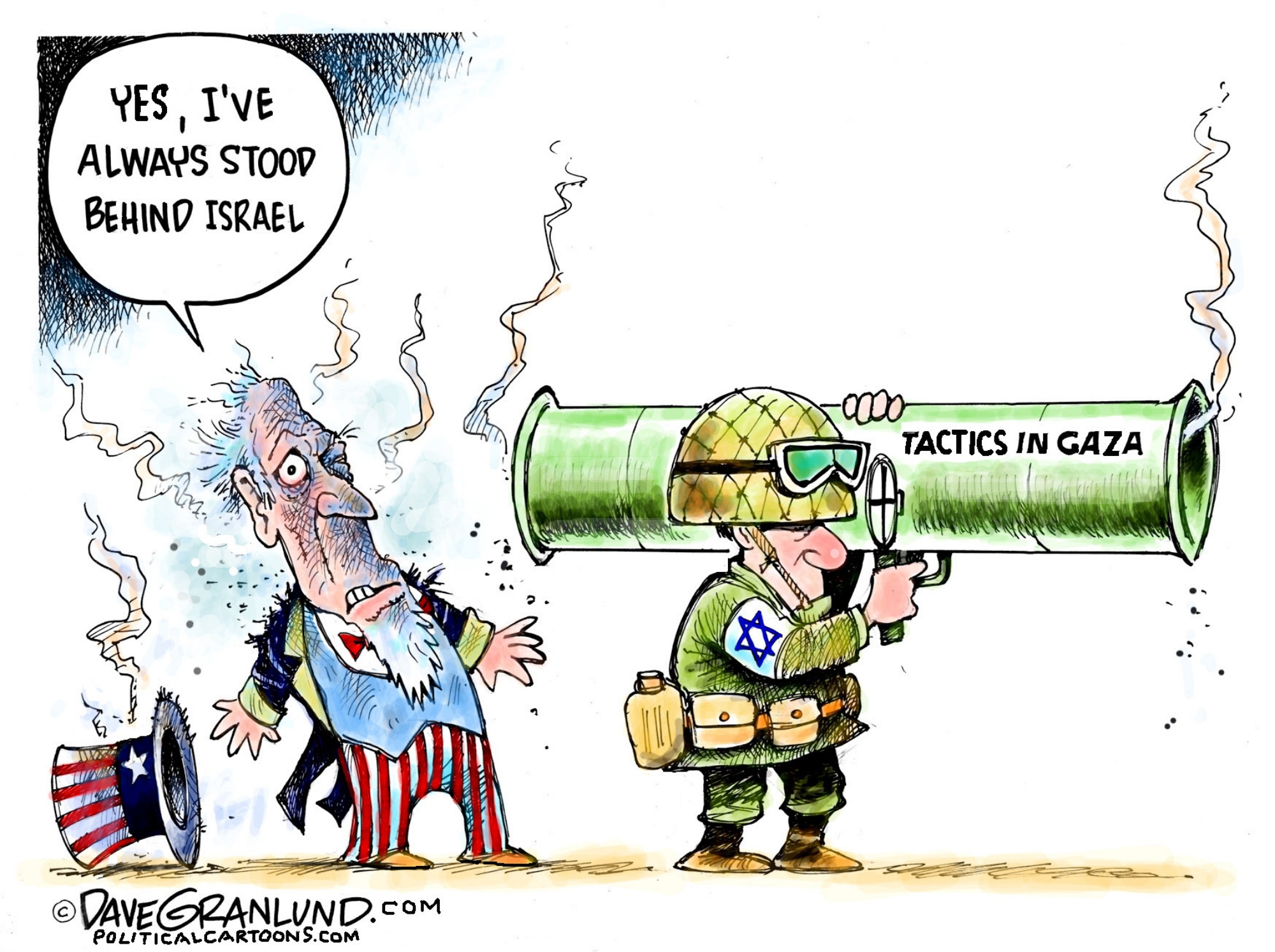
Illustration by Dave Granlund on Cagle Cartoons
Dec 13, 2023 4:18 AM
The genocidal Israeli assault on the people of Gaza and the West Bank could end the Zionist apartheid project and collapse the Israeli state as constituted
US Secretary of Defense Lloyd Austin said recently that Israel faced “strategic defeat” if Palestinian civilians were not better protected. What would that look like? And would it be Israel’s defeat alone, or would it also belong to the United States, which has provided the bombs, weapons and funds for Israel’s determined campaign to “crush” its enemy in Palestine.
“The center of gravity is the civilian population and if you drive them into the arms of the enemy, you replace a tactical victory with a strategic defeat,” Austin said in a speech at the Reagan National Defense Forum in Simi Valley, California, on December 2nd. “It would compound this tragedy if all that awaited Israelis and Palestinians at the end of this awful war was more insecurity, more rage and more despair,” Austin said. “Israelis and Palestinians have both paid too bitter a price to just go back to October 6.”
A few weeks earlier on November 7th, Jon Alterman, of the Center for Strategic and International Studies (CSIS), a prestigious DC think tank, wrote that Israel could lose:
“It is quite possible that the war in Gaza will be the first war in Israel’s history that the army has fought and lost. That loss would be catastrophic for Israel and deeply damaging to the United States.”
Related stories
A senior vice president at CSIS, Alterman holds the Zbigniew Brzezinski Chair in Global Security and Geostrategy. Before joining CSIS in 2002, he was a senior State Department official, serving as special assistant for Near Eastern affairs.
Alterman highlighted “the checkered history that has afflicted the United States since the Vietnam War” – a colossal strategic defeat for the US. He also mentioned the post-9/11 wars in Iraq, Afghanistan, and the Syrian-Iraqi border area, which “were serious efforts with serious resources behind them, but years of fighting, billions of dollars, and thousands of US deaths failed to secure victory.”
He didn’t mention the US proxy war in Ukraine against Russia, which competes with the current crisis for attention, resources and lessons. Alterman asks:
“What if the lesson that the United States offers is that even weak parties can repel strong ones with the right strategy?”
The lessons from Vietnam are especially relevant. A David and Goliath contest in which David humiliated Goliath, the Vietnam war was the beginning of the end for US invincibility, and a signal to colonized people everywhere. “Our people will always exist,” Vietnam’s President Ho Chi Minh wrote in his political testament in May 1969.
“With the American invaders defeated, we will rebuild our land to make it ten times more beautiful […] Our homeland will be reunified.” Ho’s words resonate among Palestinians, not only in Gaza, but in the West Bank and in refugee camps in Lebanon, Syria, Jordan and Egypt.
Restoring historic Palestine, and rebuilding it as a land of peace where everyone can live together in equality and harmony would be many times more beautiful than the apartheid horror that Israel and the US are currently forcing on the Palestinian people.
The Vietnam war led to the collapse of the US military in Vietnam. The massive rebellions among US youth in response to US genocidal bombing there, the spiraling economic cost of the war, the disarray in the government and society, and growing international isolation all serve as warnings to both Israel and the United States of potential dangers looming in the present crisis. “Knee deep in the big muddy,” the iconic description of the US predicament in Vietnam, suddenly seems familiar.
“A Mutiny Brewing”
There is “a mutiny brewing” in the State Department “at all levels,” a State Department official told The Huffington Post shortly after Blinken greenlighted Israel’s bombing assault on Gaza. Hundreds of Jewish and Muslim congressional staffers signed an open letter urging lawmakers to demand a cease-fire of the bombing of Gaza. A senior State Department official, Josh Paul, publically resigned October 18th, saying,
“I fear we are repeating the same mistakes we have made these past decades, and I decline to be a part of it for longer.”
In his resignation letter Paul said “I cannot work in support of a set of major policy decisions, including rushing more arms to one side of the conflict, that I believe to be shortsighted, destructive, unjust, and contradictory to the very values that we publicly espouse.”
Paul's resignation came the same day that Joe Biden embraced Israeli Prime Minister Netanyahu in Tel Aviv and “reiterated his steadfast support for Israel,” in spite of condemnations at the United Nations and among human rights organizations and international law scholars, who claim the US-backed Israeli bombing of Gaza is genocide.
The US is facing a storm of criticism globally following its sole-vote veto December 8th of a UN Security Council resolution calling for a cease-fire in Gaza. One day earlier the US voted alone (or with a tiny and shrinking circle of allies) in the General Assembly against several resolutions to help the Palestinians with
- Humanitarian assistance to Palestinian refugees
- Support for the operations of the UN agency for refugees that works on the ground in Gaza
- A stop to Israel’s illegal settlements on occupied Palestinian territory
France’s UN ambassador, voting with the majority against the US in the UN Security Council, called for a “new immediate and lasting humanitarian truce.” Other European Union states are going further.
Spain’s Prime Minister has called for the European Union to recognize a Palestinian state. And the Belgian government, “questioned the legality of some Israeli airstrikes, condemned its collective punishment of the Palestinian population, and called for targeted sanctions and accountability for those responsible.”
Belgium also called for an International Criminal Court investigation on the situation in Palestine.
A Mark of Shame
The US veto of the Security Council ceasefire proposal was “a mark of shame that will follow the United States for many years,” declared Mahmoud Abbas, president of the Palestinian Authority, which Washington and others have floated as a potential governing body for postwar Gaza. He called the United States “aggressive and unethical.”
An overwhelming majority of US voters – 84 percent – are either very concerned (43 percent) or somewhat concerned (41 percent) that the United States will be drawn into a military conflict in the Middle East, according to a Quinnipiac University national poll of registered voters released November 2. A Reuters/Ipsos poll released Nov. 13 found that 68 percent think Israel should call a cease-fire in its attack on Gaza.
Meanwhile the leaders of both Russia and China have taken initiatives to help end the crisis. Chinese President Xi Jinping hosted an emergency meeting of BRICS countries – including new members Saudi Arabia, Iran, Egypt and Ethiopia, as well as South Africa, Russia and Brazil – calling for an international peace conference on the crisis as soon as possible. China’s Foreign Minister Wang Yi appeared in New York in late November as part of China’s month-long presidency of the Security Council. He announced a proposal to end the Israel-Palestine conflict through intensified diplomatic mediation, leading to a “comprehensive, just and lasting” settlement of the Palestinian issue.
Russian President Putin got lavish welcomes in both Saudi Arabia and the United Arab Emirates on a state visit December 6, where he offered to help resolve the crisis. The Saudi and Russian leaders of the world's two biggest oil exporters called for all OPEC+ members to join an agreement on output cuts “for the good of the global economy.” Neither side claimed the call was political, or aimed at Israel. But on December 9 the leaders of Turkey and Saudi Arabia announced sanctions against Israel.
Massive US financial and military aid to Israel provides a kind of shield for its ally. But any disruption of the global oil market could have unpredictable consequences. “A strategic move, such as embargoing oil exports to Israel and countries that do not support an immediate ceasefire in Gaza, could exert considerable pressure,” wrote Yemeni author Karim Shami in The Cradle, a Middle Eastern publication.
Inside Israel, in spite of a public show of united rage against Hamas for its daring October 7 attack, there has been much speculation that Prime Minister Netanyahu is fighting for his political life. Many Israelis blame him for ignoring an intelligence report showing “Israel Knew Hamas’s Attack Plan More Than a Year Ago,” according to a New York Times report December 2. Hundreds of thousands of Israelis have had to leave their homes during the conflict, and many of those with dual nationality have been leaving the country.
The Ground War in Gaza
Palestinian sources describe a situation much different from the official Israeli, US government and mainstream media narrative. Writing in The Electronic Intifada, a Palestinian online publication based in the United States, Susan Abulhawa said “Israel tried desperately to control the narrative in a series of fabrications that immediately unraveled… Sensational lies about rape and beheaded babies were quietly retracted despite being uncritically parroted by mainstream western media.”
The Electronic Intifada report says Israel’s threatened land invasion was repeatedly delayed, “even after the US came to its rescue with two aircraft carriers and America’s most sophisticated nuclear submarine to the Mediterranean (along with bombs and other weaponry, plus billions of US tax-funded financial aid).” The report says each Israeli “attempt to roll into Gaza was met with fierce Palestinian resistance… With light armament, men in knock-off Adidas track suits and flip flops are successfully blowing up one Israeli tank after another and taking more and more prisoners, outsmarting the most celebrated Israeli and American military minds.”
A spokesperson of the Palestinian Alternative Revolutionary Path Movement, Masar Badil, writes that “a small, brave, organized fighting force can defeat a well-equipped, large army. This is a lesson of history, what we have learned and what humanity has learned, from Algeria to Vietnam and today in Palestine.”
Despite their grief and outrage at the genocidal assault on the Palestinian civilian population, Masar Badil says “the resistance is unified, completely – Islamic, nationalist and leftist forces, fighting together, on one path, one united front… Palestinians fight together because they know what Israel wants is to erase them. This is a battle of existence for us and for the resistance. And, therefore our people have no choice but resistance, no choice but steadfastness and no choice but unity.”
Palestinians in Exile and in the Diaspora Regain Their Role
Palestinians in exile and in the diaspora have also begun to regain their involvement, particularly in Lebanon: “This has already been apparent, and we can expect a rise in the armed struggle in the Golan Heights, potentially in Jordan and elsewhere in the region. This reflects the restoration of the struggle in the Arab region to its compass, to the primary contradiction, with the Zionist regime and with imperialism...” This includes Lebanon, Syria, Iraq, Iran and Yemen, as well as popular forces in other nearby countries.
“We believe that Arab youth across the Arab homeland will join the Palestinian struggle and the Palestinian resistance,” Badil says. “We know that our allies are all of those who confront imperialism: the Black Liberation Movements, the Filipino movement, the liberation movements and workers’ movements all over the world. We salute all of those who are fighting together against all forms of repression against the illusions promoted by the capitalist media.”
It is also possible that friends of the people of Gaza will break through the Israeli blockade at Rafah to force in food, medicine, and fuel. The Palestine Information Center reported November 23 that approximately 1,000 boats gathered in Türkiye November 22 before heading toward Gaza in an attempt to break the Israeli blockade. Organizers said the boats will carry 4,500 people from 40 countries, “including anti-Zionist Jews.”
The South African government and people are steadfastly supporting the Palestinian struggle. Their battle against apartheid achieved victory in the early 1990s, after the same decades of struggle the Palestinians have waged since 1947, and even before.
The solidarity movement in the US and EU, as well as globally, have a significant role to play. The massive protests that continue and are intensifying, are having impact. They can be credited, at least partially, for the resignations of staff and interns in the White House, State Department, and Congress. Thousands of protesters flooded Wall Street as the U.S. vetoed the ceasefire resolution on December 8. They called for a shutdown of the New York Stock Exchange. At the same time, thousands were protesting a Biden fundraising event in Los Angeles.
The genocidal Israeli assault on the people of Gaza and the West Bank is being confronted with a very large regional and global response. That response could actually cause not only the defeat of the Zionist apartheid project, but actually lead to the collapse of the Israeli state as currently constituted, and also to further crisis in the United States. It may also lead to fracture of major US alliances in the region, as it has already in Turkey.
The governments of Egypt, Jordan and Saudi Arabia have all rejected the urgings of Blinken (et al) to provide an “outlet” for Palestinian refugees. Now a key question is whether the people in these countries can force their official leaders to take it a step further to stop the slaughter and siege of the people of Gaza and the West Bank.
Comments

Powered by RoundtableAn AI/DeFi-powered Enterprise Media Operating System. Learn more at Roundtable.io.© Roundtable 2026. By using this site you agree to the Terms of Use and Privacy Policy