
caglecartoons.com


Cagle Cartoons
Apr 2, 2026 9:46 PM
Updated Apr 2, 2026 10:59 PM
Trump’s Crusade: The Weaponization of Ignorance and the Spectacle of Death
The escalating war involving Israel, the United States, and Iran is not merely another geopolitical conflict; it signals the emergence of a political culture in which militarism fuses with religious fundamentalism and a deep contempt for knowledge, accountability, and critical judgment. In part, this is Netanyahu’s war, framed as an existential struggle between good and evil. But it has quickly become Trump’s crusade, driven less by strategy or respect for international law than by a politics of ignorance that elevates instinct, spectacle, greed, and ideological fervor over informed judgment.
From Strategy to Spectacle: How War Became Performance
At the same time, this war must be grasped as part of a wider landscape of global neoliberal fascism, where religious, economic, cultural, and political fundamentalisms converge and harden into a single machinery of domination and violence. Here, gangster capitalism fuses its expansionist fantasies with militarized cruelty, driven by a colonial logic that renders whole populations disposable and treats equality, democratic values, and accountability as enemies to be eradicated. This is a capitalist global war machine, ruthless in its ideological certainties, predatory in its hunger for profit, and genocidal in its governing imagination.
What we are witnessing is not simply a series of conflicts but the consolidation of a new political formation, one that normalizes barbarism as policy and cruelty as virtue. Power speaks through the language of annihilation, organizes itself through regimes of disposability, and dreams in the architecture of camps, borders, and permanent war. From Iran to Lebanon, from Gaza to countless other zones of abandonment, this violence is not episodic, it is predictive. It offers a terrifying glimpse of a future in which entire societies are governed through threats, erasure, and the calculated production of death. The war in Iran, Lebanon, Gaza, and elsewhere is a snapshot of the future.
Sanctifying Violence: The Role of Religious Fundamentalism
Religious fundamentalism does not merely accompany this violence, it sanctifies it. It provides the alibi through which power escapes accountability, cloaks mass destruction in the language of destiny, and renders suffering invisible. Under its cover, domination is recast as virtue, and the machinery of death is made to appear both necessary and sacred. Religious fundamentalism offers a cover for making power unaccountable and mass destruction, dispossession, and death invisible.
Related stories
What is most alarming is how global violence is being narrated among war criminals whose policies make a claim to divine right. Within segments of Trump’s political orbit, it is no longer understood in strategic or diplomatic terms but cast in apocalyptic and biblical language, invoking visions of Armageddon and divine purpose. In this fusion of religious absolutism and political ignorance, violence is sanctified, dissent is delegitimized, and reason itself is pushed aside.
War, in this context, ceases to function as a last resort and becomes a form of public pedagogy. It teaches citizens not to question domination but to admire it. Violence, white Christian nationalism, and militarized spectacle merge into a cultural script in which cruelty is normalized and power is aestheticized. Once war is framed as sacred destiny, it no longer requires justification through evidence, diplomacy, or ethics. It becomes something to be staged, consumed, and celebrated.
The religious framing flows seamlessly into a culture of spectacle. War is no longer presented as tragic necessity but as theater, a performance of domination in which destruction is recast as strength. This shift signals a deeper transformation in how violence is imagined and legitimated.
The Language of Annihilation: When Death Becomes Policy
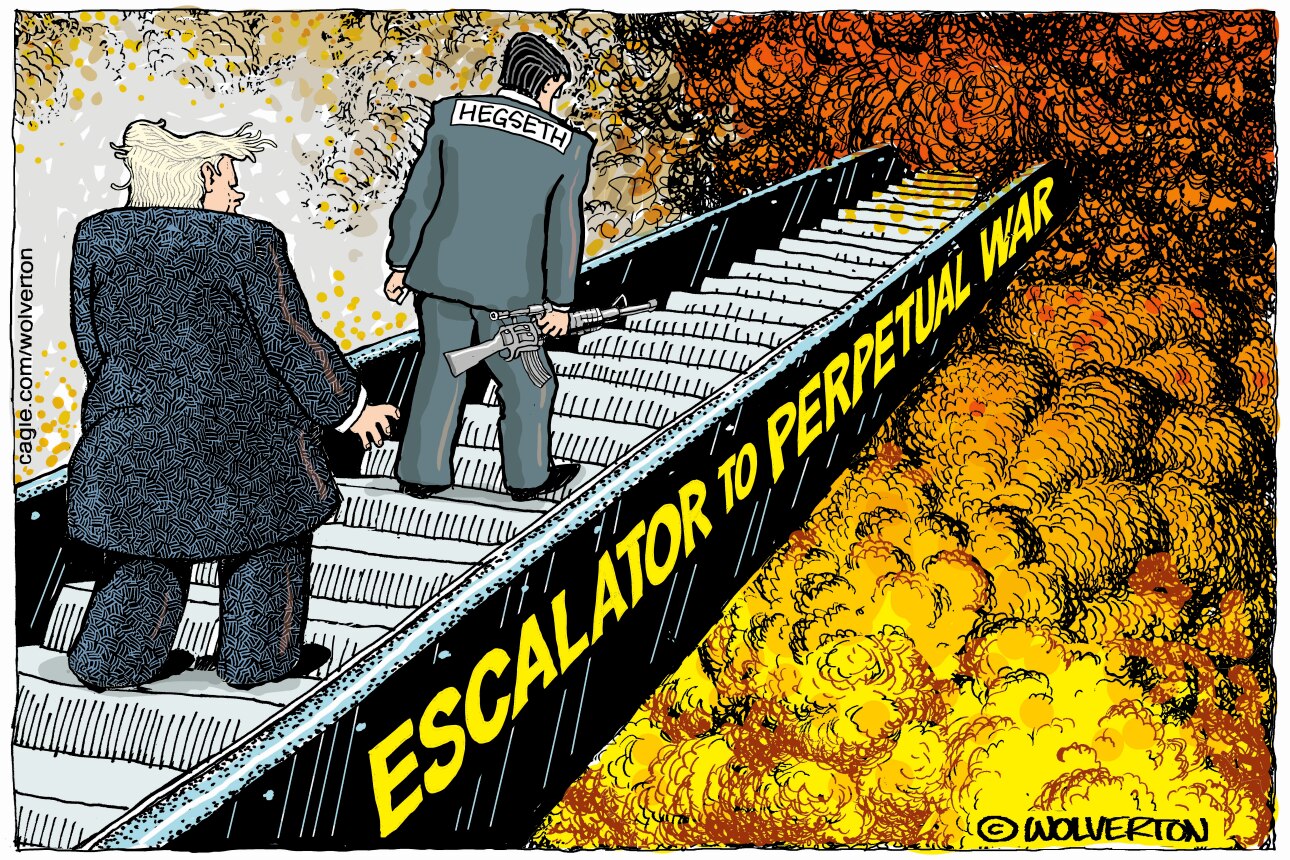
Trump’s Secretary of Defense, Pete Hegseth, gives this worldview one of its most chilling expressions, declaring that the mission of the U.S. military is ““to unleash death and destruction from the sky all day long.” In such language, war is stripped of restraint, law, and even the pretense of tragic necessity. It becomes an open celebration of annihilation as virtue.
Trump’s remarks intensify this collapse of judgment. His claim that the war will end when he “feels it in his gut,” or his remark about bombing Iran’s Kharg Island “just for fun,” are more than reckless; they reveal a governing logic where impulse replaces knowledge. Jan-Werner Muller puts it bluntly “Never before has an administration so openly glorified outright killing as the current White House propaganda machine does with its obscene snuff videos of the Iran war and the destruction of small boats.” If spectacle provides the stage, Trump’s language supplies the script, turning war into a performance of unchecked domination.
This logic extends beyond individual statements into a broader war culture. Language itself becomes militarized, reducing the purpose of armed force to the capacity to destroy without restraint. Culture is weaponized, politics is aestheticized, and violence becomes a central organizing principle of public life.
War as Public Pedagogy: Teaching Citizens to Accept Cruelty
Such a culture does more than legitimate war; it educates. Through media imagery, political discourse, and the aesthetics of military power, it teaches citizens to admire cruelty, accept disposability, and equate strength with annihilation. Enemies are stripped of their humanity, while destruction becomes routine. Violence no longer hides behind the language of democracy; it appears openly as a ruthless instrument of imperial power.
The consequences are devastating. Bombing campaigns across Iran have produced widespread destruction, fear, and civilian casualties, even as media narratives celebrate technological precision and military dominance. At the same time, the economic costs are staggering. The war is estimated to cost the United States roughly $1 billion per day, exposing a society that invests more readily in destruction than in human need.
Within this political culture, such contradictions barely register. Militarism becomes a governing logic that displaces democratic values with a celebration of force. The influence of Christian nationalism intensifies this transformation. When war is framed as part of a divine plan, it is removed from critique. Political decisions are cloaked in religious certainty, and opposition is rendered not merely wrong but heretical. The line between democratic governance and holy war begins to collapse.
The greatest danger lies not only in the devastation unleashed abroad, but in the culture this war authorizes at home. A society that comes to embrace war as spectacle, ignorance as leadership, and violence as destiny erodes its very capacity for judgment, dissent, and resistance.
But something even darker is at work. This is not only a weaponization of ignorance, a collapse of morality, or a war on equality and justice. It is the opening of an abyss, one filled with blood, broken bodies, shattered countries, and the lingering stench of death.
This fusion of religious fundamentalism, ignorance, spectacle, and cruelty does more than weaken democracy; it lays the groundwork for fascist politics, where domination replaces dialogue, repression displaces justice, and the language of war organizes everyday life.
Comments

Powered by RoundtableAn AI/DeFi-powered Enterprise Media Operating System. Learn more at Roundtable.io.© Roundtable 2026. By using this site you agree to the Terms of Use and Privacy Policy