


Mar 14, 2026 4:50 PM
More often than not, we’ve rushed off without a purpose, or a plan, or any formal authorization, leading all too often not to triumph but to frustration, embarrassment, and humiliation.
In 1989, Geoffrey Perret published a book called A Country Made by War, covering the history of American wars from the Revolution to the debacle in Vietnam. He argued that much of what we Americans hold true and dear about ourselves and our country has arisen from our collective experience of war. Others have written on this topic—Tom Englehardt, Andrew Bacevich, John Dower, Barbara Ehrenreich, Susan Jeffords, Susan Griffin—but I think Perret’s title captures the issue nicely.
We see ourselves in the context of our wars as champions of freedom and self determination, and as enemies of tyranny and oppression, and we like to think of our wars as humanitarian interventions motivated by altruism. We swell with pride at our willingness to rush to the rescue without waiting to hear calls for help. And more often than not, we’ve rushed off without a purpose, or a plan, or any formal authorization, leading all too often not to triumph but to frustration, embarrassment, and humiliation.
Since 1789, our Congress has exercised its Consitutitonal authority to declare war eleven times: against Great Britain in 1812, Mexico in 1846, Spain in 1898, Germany and Austria-Hungary in 1917, Japan, Germany, and Italy in 1941, and Bulgaria, Hungary, and Rumania in 1942. What about Korea, you ask. What about Vietnam, Iraq, Afghanistan, Iran, and all those other wars, big and small, that Americans have waged since the defeat of the Axis powers in 1945. In that time, there have been many wars, but there have been no Congressional declarations of war.
Nevertheless, since the end of World War II, there has been no time when American troops were not waging war somewhere in the world, or when American economic and military support was not flowing generously to other countries engaged in wars. Moreover, since the end of World War II, while America has fought many foes, it has had only three enemies: communism, Islam, and tyranny, and every war we’ve fought or supported in that period has been intended to contain the spread of communism to thwart Islamist terrorism, or to overthrow a tyrannical government on behalf of its people. As Phil Ochs once sang, we are the cops of the world.
Related stories
Notice, though, that all three of those redoubtable enemies are abstractions, not actual countries or persons. Communism is an economic system, Islam is a religion, and tyranny is a form of government. We can point to places where they’re in effect, but we can’t point directly to them because they don’t exist other than as intangible systems of concepts and practices.
Nevertheless, there’s great virtue in making war against abstractions, as other examples make clear.
The war on poverty and the war on drugs have never achieved their ends, largely because the real problems they claim to address are complex and ambiguous, while the abstractions standing for them in official discourse are never explicitly defined and thus remain eternally adaptable to changing circumstances. The people never know exactly who or what is the current enemy, so the society remains focused on how the war is going and never bothers to wonder whether the enemies actually even exist. Still, few things bring a community together and silence dissent like a shared existential struggle against an evil foe. We’ve seen this repeatedly in our own time.
In 1983, American forces invaded Grenada to eliminate a communist regime and restore freedom to the people. In 1989, American forces invaded Panama to overthrow a tyrannical regime conveniently embodied in Manuel Noriega. In 1990, American forces invaded Iraq to liberate Kuwait and free its government and people from Iraqi tyranny. In 2001, American forces invaded Afghanistan to find and destroy a terrorist group called al Qaeda, conveniently embodied in Osama bin Laden. In 2003, Amnerican forcres invaded Iraq to find and destroy weapons of mass destruction and to contain a national security threat conveniently embodied in Saddam Hussein.
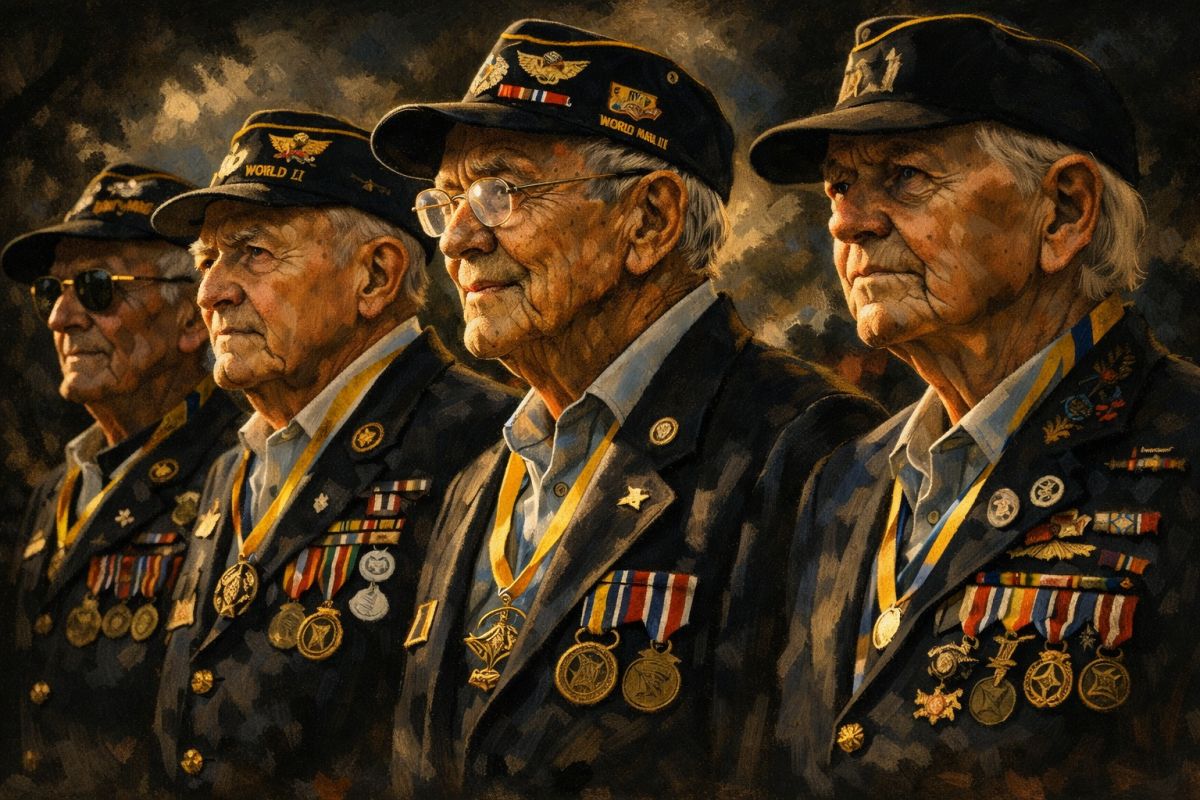
There’s a clear pattern here of US military power launched against actual places and people where the ostensible enemies have always been abstractions. The majority of Americans have closed ranks in support of their government’s wars. The sense of eternal peril held at bay only by heroic troops and a determined government permeates the culture. And the impulse to thank veterans for their service in those wars becomes more pervasive.
Yet the more things change, the more they stay the same. Recently, American forces overwhelmed the government of Venezuela, supposedly to liberate the people from a tyranny conveniently embodied in Nicolas Maduro. And here we are now, fighting a war against Iran, with the ostensible purpose of overthrowing a tyrannical regime and liberating the people from Islamist oppression, not to mention cutting off support for a vague and amorphous terror network conveniently embodied in Hezbollah.
America’s last war against an actual threat ended in 1945. Since then, all of our enemies have been abstractions, malevolent forces seeking to impose communism, Islamism, or tyranny upon freedom-loving people. However, each of those wars has had the effect of shaping and reconfirming a coherent awareness in the American public of their country’s government and soldiers fighting heroically to make the world free and safe for all, and of a civilian public standing shoulder to shoulder in support of the effort.
We are, indeed, a country and a people made by war. It remains to be seen whether we’ll ever be able to become anything else.
Comments

Powered by RoundtableAn AI/DeFi-powered Enterprise Media Operating System. Learn more at Roundtable.io.© Roundtable 2026. By using this site you agree to the Terms of Use and Privacy Policy