
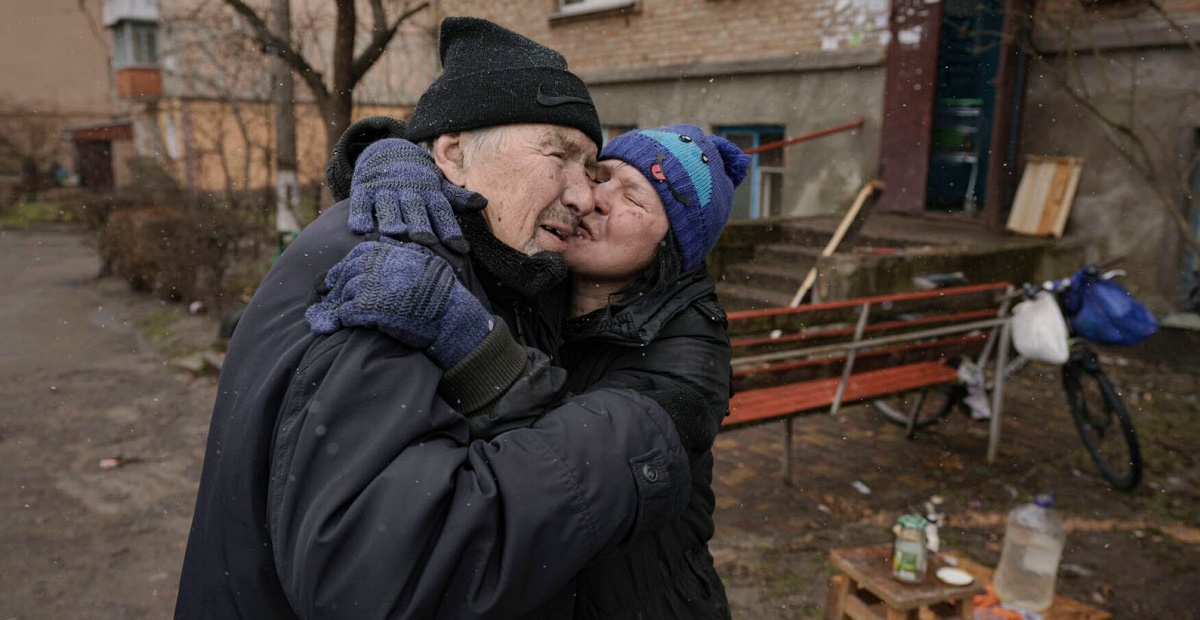
OLEKSANDR STASHEVSKYI and NEBI QENA • Attribution (CC BY 2.0) • Flickr


Dec 22, 2022 4:36 PM
As Peace Groups Call for a Christmas Truce in Ukraine, a New Book Reveals What We’re Not Being Told About This Tragic War
Peace activists around the world are calling for a Christmas Truce in the war in Ukraine as a step toward a ceasefire and eventually a permanent end to the hostilities. But the fog of war obscures a host of questions about the events that led to this bloody conflict in the first place.
In a lucid and timely new book, War in Ukraine: Making Sense of a Senseless Conflict, Medea Benjamin and Nicolas J. S. Davies examine the key questions about the origin of this conflict and the roles played by all countries involved – roles that the corporate media have largely failed to address. What happened in Ukraine in 2014? Was there really a “coup”? What role did the United States and Russia play in those pivotal and complex events? Why did civil war break out in eastern Ukraine in 2014? What was the 2015 Minsk II agreement? Why did Russia decide to invade Ukraine? Don’t Ukrainians have a right to join NATO if they want to? Are neo-Nazis a powerful influence in Ukraine, or just a red herring? How did NATO, a military alliance built to defend Europe from attack by the U.S.S.R., outlive its purpose, expand beyond its borders, and end up invading Yugoslavia, Afghanistan, and Libya? How did those actions affect Russia’s view of NATO expansion? In the United States, are the corporate media telling the truth about the war, or are they shaping their own narrative, or just repeating government propaganda? What are the Russian people thinking about the war, and how do Western sanctions affect them? Is there a way to end this war peacefully? Who and what are holding up diplomatic talks? And most important of all, what are the possible diplomatic solutions?
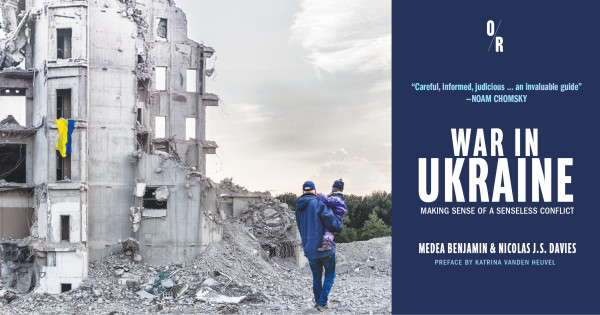
This concise and revealing 185-page primer, written with clarity and compassion, is indispensable for anyone who wants to get behind the daily headlines and breaking news, to gain a better understanding of this brutal war in which, as of November 20, 2022, the Office of the UN High Commissioner for Human Rights has recorded 16,784 civilian casualties (6,595 killed and 10,189 injured). The dead include 2,575 men, 1,767 women, 172 young girls and 206 young boys, as well as 1,838 adults and 37 children whose sex is yet unknown. The injured include 2,212 men, 1,579 women, 211 young girls, and 299 young boys, as well as 5,643 adults and 245 children whose sex is yet unknown.
Benjamin, co-founder of CODEPINK and the fair trade advocacy group Global Exchange, is the author of several books and the recipient of the 2010 Martin Luther King, Jr. Peace Prize from the Fellowship of Reconciliation, as well as the 2012 U.S. Peace Memorial Foundation’s Peace Prize, and the 2014 Gandhi Peace Award. Davies is the author of Blood On Our Hands: the American Invasion and Destruction of Iraq, and has written extensively for Huffington Post, Alternet, Consortium News, Common Dreams, Salon, The Progressive, and Foreign Policy in Focus. Together they provide a wealth of much-needed historical and political information that is largely ignored in American corporate media and obscured in U.S. government press releases and orchestrated interviews.
Related stories
On the most essential level, Benjamin and Davies are very clear that “Russia’s invasion was illegal on many counts. It was not an act of self-defense and it was certainly not authorized by the United Nations. Under international law, including the Kellogg-Briand Pact and the UN Charter, the invasion was an illegal crime of aggression.”
“In our view,” the authors explain, “the Russian invasion of Ukraine was not only criminal, but also a catastrophic move and a territorial miscalculation.” They cite veteran U.S. diplomat Chas Freeman who calls it “the worst strategic decision that any Russian government has made since Czar Nicholas II decided to go to war with Japan in 1904.”
But Benjamin and Davies do not leave it there. They argue that there are in fact “two simultaneous wars in Ukraine.” One is Russia’s military intervention on February 24, 2022, in which Russia was the aggressor. The other is a “proxy war” between the U.S. and Russia: “a broader geopolitical conflict between the United States and NATO on the one side and Russia on the other, in which the U.S. and NATO were the instigators and the more aggressive parties.” They argue that while the Russian invasion was illegal, “it was not by any means ‘unprovoked,’ as U.S. officials repeatedly claim.” By the same token, they refuse to “exonerate Russia for the killing of thousands of civilians, whom the Fourth Geneva Convention defines as ‘protected persons,’ regardless of whether their killing is deliberate, unintentional, or simply the inevitable and predictable result of using explosive weapons of war in places where people live.”
Indeed, Benjamin and Davies report that “there were certainly hundreds of examples of horror perpetrated by the Russian invaders, and similar allegations of atrocities against civilians and prisoners by Ukrainian troops. Every bombing of a hospital or a school or a residential neighborhood was an atrocity. There was credible evidence of summary executions, rape and torture carried out by Russian forces in Ukraine. These criminal acts should be investigated by independent authorities.”
The question of whether Russia was “provoked” into invading Ukraine, and if so, what that means in terms of the responsibility for the war, deserves more examination than Benjamin and Davies give it in their short book. It appears they are using the term “provoked” in a political sense to explain the context of Russia’s invasion rather than in a legal sense to excuse Russia’s aggressive conduct. During an interview with Interfaith Communities United For Justice and Peace on December 16, Benjamin made clear that in her view explaining the events preceding the war, including the expansion of NATO, in no way justified Russia’s invasion of Ukraine. When a listener argued that “Russia has made its goals very clear — “de-militarization and de-Nazification,” and that, in their opinion, “Russia’s special military operation, after 8 YEARS of war, is justified,” Benjamin firmly disagreed, reiterating her point that explaining is not excusing.
As Jonathan Steele, former Moscow Bureau Chief for the Guardian, recently wrote in Counterpunch, it is “true that most people on the left believe the expansion of Nato to Russia’s borders since 1999 was disastrously wrong and unnecessary, and that Washington and its European allies bear most of the blame for poisoning relations between Russia and the West over the last thirty years. A few people on the left argue that Nato’s enlargement strategy provoked Putin’s invasion, but the vast majority have avoided the trap of claiming that Putin’s aggression was legitimate and justifiable. They condemned it and still condemn it unreservedly. However angry Russia may be about Nato, nothing justifies invading a neighboring state.”
Ironically, given how much Benjamin and Davies criticize the corporate media, it was mainstream columnist Thomas Friedman, in that corporate newspaper The New York Times, who may have best captured what Benjamin and Davies are driving at. In his column on February 21, 2022 - three days before Russia invaded Ukraine - entitled, “This Is Putin’s War But America and NATO Aren’t Innocent Bystanders,” Friedman wrote that Vladimir Putin “is the most powerful, unchecked Russian leader since Stalin, and the timing of this war is a product of his ambitions, strategies and grievances. But, with all of that said, America is not entirely innocent of fueling his fires.”
How so? Friedman explains, “Putin views Ukraine’s ambition to leave his sphere of influence as both a strategic loss and a personal and national humiliation.” In his speech justifying the invasion, “Putin literally said Ukraine has no claim to independence, but is instead an integral part of Russia — its people are ‘connected with us by blood, family ties.’” Friedman called this “ugly, visceral stuff. Nevertheless, there is a back story here that is relevant.” According to Friedman, “there are two huge logs fueling this fire. The first log was the ill-considered decision by the U.S. in the 1990s to expand NATO after — indeed, despite — the collapse of the Soviet Union. And the second and far bigger log is how Putin cynically exploited NATO’s expansion closer to Russia’s borders to rally Russians to his side to cover for his huge failure of leadership.”
Friedman, like Benjamin and Davies, insists we need to look at both of these logs. “Most Americans paid scant attention to the expansion of NATO in the late 1990s and early 2000s to countries in Eastern and Central Europe like Poland, Hungary, the Czech Republic, Latvia, Lithuania and Estonia, all of which had been part of the former Soviet Union or its sphere of influence. It was no mystery why these nations would want to be part of an alliance that obligated the U.S. to come to their defense in the event of an attack by Russia, the rump successor to the Soviet Union.” The mystery was “why the U.S. would choose to quickly push NATO into Russia’s face when it was weak.”
Friedman writes that Bill Clinton’s defense secretary, William Perry. recalled that moment years later, at a 2016 conference convened by The Guardian newspaper: “In the last few years, most of the blame can be pointed at the actions that Putin has taken. But in the early years I have to say that the United States deserves much of the blame. Our first action that really set us off in a bad direction was when NATO started to expand, bringing in Eastern European nations, some of them bordering Russia. At that time, we were working closely with Russia and they were beginning to get used to the idea that NATO could be a friend rather than an enemy … but they were very uncomfortable about having NATO right up on their border and they made a strong appeal for us not to go ahead with that.”
In May of 1998, immediately after the Senate ratified NATO expansion, George Kennan, the architect of America’s successful containment of the Soviet Union, who served as U.S. ambassador to Moscow in 1952, told Friedman: “I think it is the beginning of a new cold war. I think the Russians will gradually react quite adversely and it will affect their policies. I think it is a tragic mistake. There was no reason for this whatsoever. No one was threatening anybody else. This expansion would make the founding fathers of this country turn over in their graves....Don’t people understand? Of course there is going to be a bad reaction from Russia, and then [the NATO expanders] will say that we always told you that is how the Russians are — but this is just wrong.”
Friedman adds that “[o]f course, none of this justifies Putin’s dismemberment of Ukraine.” Recently, as Russia’s economy stagnated, “Putin either had to go for deeper economic reforms, which might have weakened his top-down control, or double down on his corrupt crony capitalist kleptocracy.” He chose the latter, And to both cover and distract from that choice, Putin shifted the basis of his popularity from “being the distributor of Russia’s newfound wealth and an economic reformer to the defender of the motherland.” And right when Putin “opted for domestic political reasons to become a nationalist avenger and a permanent ‘wartime president,’ what was waiting there for him to grasp onto was the most emotive threat to rally the Russian people behind him: ‘The low-hanging fruit of NATO expansion.’”
“Yes, it’s all more complicated than that,” Friedman concludes, “but my point is this: This is Putin’s war. He’s a bad leader for Russia and its neighbors. But America and NATO are not just innocent bystanders in his evolution.”
Political Turmoil in Ukraine Leads to War
The most significant contribution that Benjamin and Davies make is their brief but incisive description of the events in Ukraine that preceded Russia’s invasion. Despite the thousands of hours of news coverage and analysis that have been recently devoted to Ukraine, very few people are aware of that complicated history. If you’re not an expert on Ukraine, it’s worth the time to consider a short summary.
“Ukraine became a battleground between East and West in the Second World War,” Benjamin and Davies write, in which “Ukrainian nationalist militias fought on the German side, and took part in the mass killings of Jews and ethnic cleansing of Poles from western Ukraine.” Neo-Nazi groups “experienced a revival in Ukraine in the early 21st century and played important roles both in the 2014 coup and in the civil war in Eastern Ukraine that followed it.”
According to the authors, the “2004 election was the first act in Ukraine’s tragic and fateful division between Western- and Eastern-backed political leaders and parties, which ultimately set the stage for war.” The country was sharply divided along regional and ethnic lines. Viktor Yanukovych, the former governor of the eastern province of Donetsk, with close economic ties to Russia, narrowly defeated proWestern Viktor Yushchenko, a former prime minister, in the presidential run-off. Yushchenko, with the backing of the US, the European Union, and the Organization for Security and Cooperation (OSCE), challenged the outcome and his supporters took to the streets in what became known as the Orange Revolution. The Ukraine Supreme Court threw out the results and in a rematch, now Yushchenko won by 52 percent to 44 percent. But Yushchenko was widely accused of corruption and in 2006 he appointed his former rival Yanukovych as prime minister. In 2010, Yanukovych defeated Yushchenko, whose disillusioned supporters had abandoned him.
But Yanukovych proved as corrupt as his predecessors. In 2012 he retained narrow control, but that election saw the rise of Svoboda (Freedom), a neo-Nazi party, that ran on explicitly Ukrainian nationalist, anti-Russian rhetoric, winning 37 of the 450 seats in parliament, with 10 percent of the popular vote.
On November 21, 2013, in a reprise of the 2004 Orange Revolution, thousands of protesters filled the Maidan, the main square in Kyiv. Riot police assaulted the protesters as crowds grew over the next few days to between 400,000 to 800,000. Svoboda leader Oleh Tyahnybok called for a national strike while Svoboda co-founder Andriya Parubiy, who had headed its Patriots of Ukraine paramilitary organization from 1998 to 2004, was appointed “Commandant” to organize armed resistance to the police in the Maiden. Meanwhile, a shadowy radical right-wing group, Right Sector (Pravyi Sektor) led by Dmytro Yarosh took a leading role in the defense of the Maidan. Right Sector identified with the Ukrainian Insurgent Army (UPA), which had killed thousands of Jews and Poles during the Second World War.
As the violent clashes continued, on January 16, 2014, the Ukrainian parliament passed new draconian anti-protest laws that criminalized such tactics as wearing masks and helmets, organizing car convoys, and camping in public places.
Meanwhile, as Benjamin and Davies reveal, a (now notorious) audio recording appeared on YouTube showing U.S. Assistant Secretary Victoria Nuland and U.S. Ambassador Geoffrey Pyatt handpicking opposition figures and planning what to tell them they should do in a post-Yanukovych government, meanwhile suggesting that Svoboda’s Tyahnybok “and his guys” would be more useful “on the outside.” While Russia accused the U.S. of funding the opposition to the tune of $20 million a week, Nuland boasted in a speech that “We’ve invested over $5 billion to assist Ukraine in these and other goals that will ensure a secure and prosperous and democratic Ukraine.”
Between February 18 and 20, 2014, 85 civilians were killed in the protests, along with 18 police and security officials. According to two academic researchers cited by Benjamin and Davies, the massacre was committed by members of Svoboda, Right Sector, and other militants, as a climatic provocation that could be blamed on the police to seal Yanukovych’s fate, which it effectively did. On February 21, after meeting with opposition leaders, Yanukovych agreed to a plan for a political transition, with new elections to be held by the end of the year. But when opposition leaders announced the plan, they were shouted down and the plan was rejected by Right Sector. The next day, Right Sector and other armed militants occupied the parliament building. Yanukovych as forced to resign and he was reported to have sought refuge first in Donetsk and then in Russia.
On February 27, the parliament appointed Arseniy Yatsenyuk as prime minister, exactly as Nuland and Pyatt had planned. The new prime minister rewarded Svoboda’s role in the coup with three seats in his cabinet as well as governships of three of Ukraine’s 25 provinces. Svoboda “Commandant” Parubiy would be appointed to various senior positions and become speaker of parliament from 2016 to 2019.
In reaction, as anti-coup protests spread across the east and south of the country, the Crimean parliament announced a referendum on the region’s future. On March 16, 97 percent (of an 81 percent turnout) voted to secede from Ukraine and reintegrate with Russia. But a monitoring committee for the Council of Europe called the result “implausible” and both the U.S. and the European Union condemned the referendum as illegal.
Ukrainians were ambivalent toward the new government. A Gallup poll conducted two months after the coup found only 51.2 percent agreed that the post-coup government was in fact legitimate. In April, anti-coup protestors in Donetsk and Luhansk formed the Donetsk People’s Republic (DPR) and the Luhansk People’s Republic (LPR), respectively, and announced referendums for May 11, which passed by huge numbers: 89 percent in Donetsk and 96 percent in Luhansk, with high turnouts in both.
In the post-coup presidential election on May 25, Petro Poroshenko was elected with 55 percent of the vote, over several other candidates including representatives of Svoboda and Right Sector. Over the summer of 2014, the conflict in Donbas grew into a civil war, giving Ukraine’s neo-Nazis a new role to play. Russian veterans and volunteers came to fight alongside the separatists, while Western veterans and volunteers fought with Ukranian government forces. The new government formed new National Guard units. The openly neo-Nazi Azov Battalion, founded by Andriy Bilatsky as an offshoot of the Right Sector, became the most feared of these units. The Azov Battalion grew into the Azov Regiment, which became the hub for neo-Nazi networks around the world, and a magnet for neo-Nazis, white supremacists, and other extreme right-wing militants seeking military training and combat experience.
After months of brutal fighting across Donbas, peace talks were held in Minsk, the capital of Belarus. On September 5, 2014, Ukraine signed the Minsk Protocol with Russia, France, and Germany, to bring the fighting to an end and establish a political way forward for the Donbas region. This first agreement failed to end the war, but further negotiations that included the DPR and LPR led to the Minsk II agreement on February 12, 2015. The ceasefire held, with a 30- kilometer-wide buffer zone, free of heavy weapons, and the release of prisoners by both sides. Nearly 700 ceasefire monitors, plus 600 support staff, drawn from 43 mostly European countries, including the United States and Canada, remained in place until 2022.
According to Benjamin and Davies, the Ukrainian government “failed to follow through on the constitutional changes to which it committed in Minsk.” In particular, the Ukrainian parliament failed to authorize elections in the DPR and LRP, failed to decentralize power, and failed to grant Donbas a new, autonomous constitutional status. According, as Benjamin and Davies see it, on the political and diplomatic front, “Minsk II failed due to a lack of will on the part of the government in Kyiv, the anti-democratic power of the extreme right in Ukraine, and a lack of diplomatic and political support from EU countries and the United States. The United States seemed more interested in blaming Russia for the continued crisis than in actually resolving it.”
In 2017, the Ukrainian parliament passed a law defining DPR and LPR as Ukrainian territory under Russian occupation, without any mention of Minsk II at all. After Donald Trump was elected, he reversed Barack Obama’s prohibition on lethal military aid to Ukraine, and the U.K. and other NATO countries followed suit. The far-right Azov Regiment was one of the first units to receive U.S. training on new U.S. grenade launchers.
In 2019, Volodymyr Zelenskyy was elected President of Ukraine on a platform of peace and unity. In response, the leader of Right Sector threatened Zelenskyy’s life on live TV. In October 2019, Zelenskyy signed a new agreement with Russia and the people’s republics to pull back heavy weapons from the Donbas contact line, exchange prisoners, grant autonomy to the DPR and LPR, and cooperate on a new election, as agreed in Minsk II. But extreme right-wing groups set up armed checkpoints and impeded the withdrawal. With no support for his peace initiatives from the United States, Zelenskyy abandoned his efforts. The United States, Benjamin and Davies write, “did not have his back, because the antipathy to Russia that it shared with the extreme right in Ukraine effectively made it an ally of Svoboda, Right Sector, and the Azov Regiment in their campaign to undermine the peace process.”
Meanwhile, according to Benjamin and Davies, “the U.S. 7th Army Training Command built up the NATO military training base in the western Ukrainian town of Yavoriv into a major NATO base staffed by U.S. Army and National Guard troops, as well as forces from the U.K., Canada, and other NATO countries. NATO also built up the Ukrainian Navy and deployed U.S., British, and other NATO warships to challenge Russia’s naval dominance in the Black Sea.” The authors report that the “CIA also admitted to sending small teams of special operations forces to eastern Ukraine to train Ukrainian forces in sniping, sabotage, and assassination, which appeared to pay off in the form of several assassinations of Russian generals after the Russian invasion.”
On March 24, 2021, shortly after Joe Biden took office, Zelenskyy issued a decree that it was now Ukrainian policy to recover Crimea from Russia. On April 5, the Russian Deputy Foreign Minister called on the United States to use its influence on Ukraine to enforce the Minsk agreements. Four days later, the commander-in-chief of Ukraine’s military told Zelenskyy that the use of force to “liberate” Donbas or Crimea would lead to “unacceptable” military and civilian casualties, Zelenskyy accepted the advice and called for a new truce.
In 2021, the Biden administration gave Ukraine $275 million in military aid, bringing total U.S. military aid to $2.5 billion since 2014. Meanwhile, in November 2021, Biden sent CIA Director William Burns, an experienced diplomat, to Moscow to discuss Ukraine. In December 2021, Russia proposed two draft mutual security treaties, one between Russia and the United States, and the other between Russia and NATO. Benjamin and Davies characterize these as “drafts for negotiations,” not “take it or leave it” demands. Nevertheless, the U.S. and NATO summarily dismissed both proposals.
In the four days preceding the Russian invasion in 2022, the nearly 700 OSCE ceasefire monitors and 600 staff in Ukraine documented a huge escalation of artillery fire and other ceasefire violations: 5,667 violations in total and 4,093 explosions. Based on the maps that accompanied the OSCE reports, Benjamin and Davies conclude that the explosions “could only have been the result of a major escalation in artillery fire by government forces.”
After repeatedly denying that it was planning an invasion, Russia invaded Ukraine on February 24, 2022. Four days later, Russian and Ukrainian negotiators met on the border between Belarus and Ukraine. They met again on March 3 and 7. On March 10, the foreign ministers of Russia and Ukraine met in Antalya, Turkey. The talks continued by video conference from March 14 to 17 and produced a 15-point plan that Zelenskyy called “more realistic” than previous proposals.
But according to Benjamin and Davies, “the international atmosphere surrounding the talks was becoming more hostile. Western politicians and corporate media were amplifying allegations of serious Russian war crimes in Bucha and Mariupol. President Biden inflamed the atmosphere further by saying that Putin ‘cannot remain in power,’ implying that U.S. war aims were escalating from helping Ukraine defend itself to a policy of regime change against Russia.”
“The first phase of the Russian invasion,” Benjamin and Davies write, “left death and devastation in its wake. Amnesty International accused Russia of deliberate killings of civilians, rape, torture and inhumane treatment of prisoners of war” and said “Russian troops used indiscriminate weapons such as cluster munitions in populated areas.”
Meanwhile, by May 6, the U.S. had sent Ukraine a total of $3.7 billion in military aid since the invasion began. The war generated huge profits for the big U.S. weapons makers Lockheed Martin, Raytheon, General Dynamics, and Northrup Grumman. At that point, according to Benjamin and Davies, “U.S. officials poured cold water on the idea of immediate peace negotiations, and Zelenskyy still seemed to be in lockstep with the U.S. and British allies.”
However, on May 19, as Congress passed a further $40 billion Ukraine bill, The New York Times published an editorial titled, “The War in Ukraine Is Getting Complicated, and America Isn’t Ready.” It asked: “Is the United States, for example, trying to help bring an end to this conflict, through a settlement that would allow for a sovereign Ukraine and some kind of relationship between the United States and Russia? Or is the United States now trying to weaken Russia permanently?” The Times predicted that a “decisive military victory for Ukraine over Russia, in which Ukraine regains all the territory Russia has seized since 2014, is not a realistic goal.”
As Benjamin and Davies see it, “Realistic assessment was clearly required all around. As hundreds of Ukrainians were killed every day, it was becoming increasingly urgent for Western states to reassess what they could possibly gain by fueling and prolonging a war that was gradually destroying Ukraine and must sooner or later end at the negotiating table.”
How on Earth Will This End?
That’s the title of the last chapter of War in Ukraine. Of course Benjamin and Davies don’t know. What they do know is this: a “21st century that began with broad recognition that solving humanity’s existential problems required us all to set aside our divisions and work together was riven by the same wars and hostility as the last one.”
Benjamin and Davies and OR Books have rendered a public service by publishing a full-length work analyzing a devastating war while it still raging. In addition to providing a detailed yet brisk history of the historical context and the roles played by the key countries involved - assessing their separate but unequal responsibilities for Russia’s unjustified invasion of Ukraine - the authors have also offered trenchant observations that have been largely ignored in the endless coverage of the war.
In a revealing chapter entitled “Information Warfare,” Benjamin and Davies explore how the “dominant voices on U.S. cable news were retired generals, often with undeclared conflicts of interest such as financial involvement with armaments companies, and hawkish think tank staffers, who promoted sending more weapons and ‘winning’ the war. Voices that faulted the U.S. for its involvement in Ukraine’s internal affairs since before the 2014 coup or suggested that NATO expansion set the stage for war were dismissed as pro-Putin and, for the most part, kept off the air. And anti-war voices that insisted on negotiations, not escalation, were consistently ignored.”
In the U.S., Canada and EU, RT (formerly Russia Today) was banned. “Anyone who thought it was important to hear the Russian viewpoint,” Benjamin and Davies write, “even if only to understand what kind of propaganda the Russian media was feeding its viewers - was left in the dark.”
But the censorship was not confined to the Western side of the conflict. Benjamin and Davies describe how Russian authorities muzzled the press and enacted a law punishing “fake news about the Russian army,” which included citing Ukrainian sources and using the word “war” instead of “special military operation.”
Meanwhile, in 2014 the pro-Western Ukrainian government had already shut down several websites accused of “promoting war, ethnic hatred and violent change.” In the lead-up to Russia’s invasion, the Ukrainian government blocked key pro-Russia stations, news outlets and websites for disseminating “pro-Russian propaganda.”
Benjamin and Davies also provide the following little-heard insight: While they applaud the extraordinary humanitarian response to the plight of Ukrainian refugees as “an example of how all refugees should be treated: as full human beings deserving of compassion and support,” they hasten to point out that “most of the refugees were white and European.” At the border with Poland, Ukrainian soldiers divided people into two groups. White women and children were quickly boarded onto waiting buses and trains. But women of color were forced to wait outside in the freezing cold. The authors document how comments “by news reporters and politicians alike showed the depth of racial bias when it came to helping refugees from a country that is overwhelmingly white.”
Benjamin and Davies also devote entire chapters to the consequences of Western sanctions on the Russian people and the extent to which this war reveals how dangerously close we are getting to nuclear war.
In a poignant conclusion, Benjamin and Davies observe that this tragedy was not driven by the people of Russia, Ukraine, the U.S. or any other nation, but by “leaders on all sides who repeatedly sacrifice our hopes and dreams on the altar of their wars and imperial ambitions.” They quote the Russian pacifist Leo Tolstoy, who wrote: “In all history there is no war that was not hatched by governments, governments alone, independent of the interests of the people, for whom war is always pernicious - even when successful.”
As in all wars, it is the people who must insist on an end to endless deadly military conflict that today threatens a nuclear holocaust by recognizing the fundamental right of all people to self-determination and peace.
[For more information on how you can support the Christmas Truce in Ukraine and ongoing efforts to end the war in Ukraine, go here]
Comments

Powered by RoundtableAn AI/DeFi-powered Enterprise Media Operating System. Learn more at Roundtable.io.© Roundtable 2026. By using this site you agree to the Terms of Use and Privacy Policy