
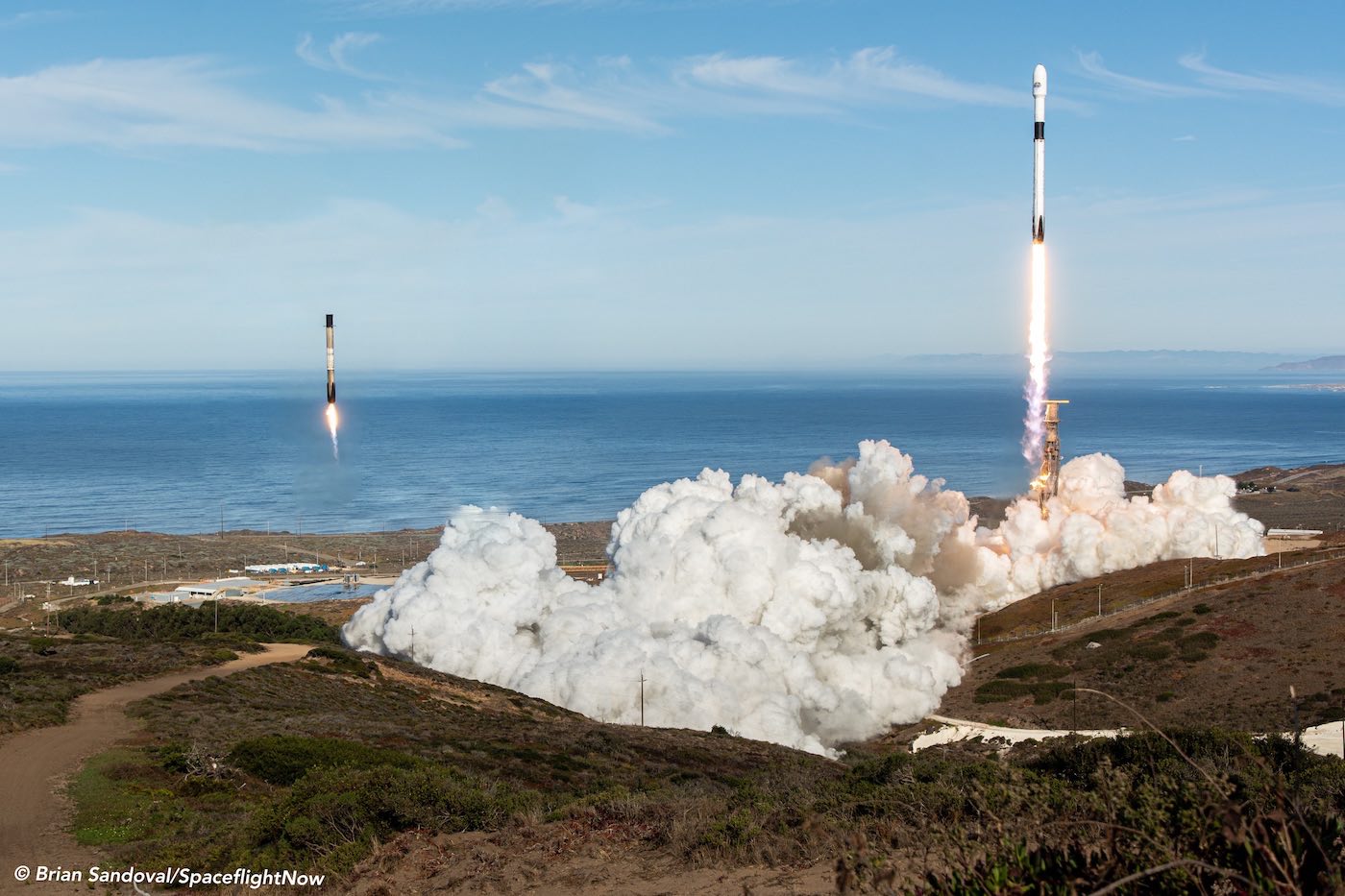
Falcon 9 launch, 2020, Vandenberg Space Force Base-Credit: Brian Sandoval / Spaceflight Now


Jul 24, 2024 6:16 PM
Updated Jul 24, 2024 6:56 PM
Santa Barbara and San Luis Obispo counties already have a plethora of weapons corporations refining technology for drones and F-16 and F-35 attack jets.
CODEPINK, World Beyond War, and the Central Coast Antiwar Coalition are urging Santa Barbara and San Luis Obispo counties to rethink plans to expand industries that will devastate the environment while widening the gap between the haves and have nots.
REACH
Santa Barbara and San Luis Obispo counties have partnered with REACH, a politically savvy San Luis Obispo-based public-private partnership intent on expanding aerospace–missiles, bombs, semi-autonomous weapons, surveillance satellites, private jet service, and billionaire space travel–on California’s Central Coast, a mecca for surfers and tourists lured by the dazzling ocean, not the promise of endless war or ozone depletion.
Over the past few years, REACH–funded by Bank of America, Deloitte and others–convinced San Luis Obispo County to spend $1.3 million and Santa Barbara $250,000 on preliminary contracts to address anticipated fall-out from the closure of the Diablo Canyon nuclear power plant in 2030.
REACH predicts 1500 workers will lose their jobs–this while the state and San Luis Obispo county say goodbye to $22 million in tax revenue. What REACH glosses over in its REACH2030 and assorted documents is that, according to Scientific American, it could take 5,000 workers ten years to decommission the plant. An accident at the aging Diablo, built in 1985 near several earthquake faults, could cost the state and federal government $75-200 billion to clean up a radioactive meltdown. The sooner the plant closes, the better–but that’s another story.
Related stories
Backed by Bank of America, Deloitte, Vandenberg Space Force Base (SPFB), Cal Poly, the Governor’s Military Council and California Office of Business and Economic Development (Go-Biz), REACH in 2020 rolled out a blueprint for priority industries for economic growth in a six-county area, from Ventura to Monterey–or the rim of the Pacific in the Pentagon’s preparation for war with China.
Misguided priorities
REACH’s priorities include expansion of aerospace, precision manufacturing and advanced technology–all of which overlap to service the Pentagon, the largest institutional consumer of fossil fuels and emitter of greenhouse gasses.
Santa Barbara and San Luis Obispo counties already have a plethora of weapons corporations, including Raytheon, Lockheed Martin, Northrop Grumman, L3 Harris and Teledyne-Flir, refining technology for drones, F-16 and F-35 attack jets and night vision goggles to turn night to day as soldiers hunt for prey.
Vandenberg expansion
A central part of the REACH plan to provide 15,000 jobs paying more than $50,000 is the expansion of the 99,000 acre Vandenberg Space Force Base (VSFB). The base is located on ancient Chumash land in the northern end of Santa Barbara County outside Lompoc, where the Honda car dealership displays “Rocket Town” next to its logo, a rusted relic of a drive-in theater sits near retail store murals of military officers and the Minuteman beach beckons the enlisted to its ominously named white sand shore.
Amid the towering Eucalyptus trees and the ocean breeze, Vandenberg Space Force Base tests unarmed Minuteman nuclear weapons that if ever armed and launched could get five billion of the earth’s 8 billion people killed, with Santa Barbara and San Luis Obispo county residents–breathing bullseyes–among the first to perish in a nuclear war that sets us ablaze.
It is here where the Falcon 9, a kerosene-fueled rocket, launches Elon Musk’s Starlink internet and surveillance satellites that threaten to deplete the ozone layer, multiply greenhouse gas emissions, and light up the night sky like a Christmas tree, leaving astronomers searching for stars with twinkles impossible to see even through a telescope.
Last year Vandenbeg launched six Falcon 9 rockets–each of which can boost over 20 satellites into low earth orbit (LEO), 300 miles above our planet, on top of the stratosphere which contains the ozone layer to protect us from the sun’s ultraviolet rays. Next year Musk–who has signed a contract with US intelligence for swarming surveillance satellites and works with Israeli military on artificial intelligence– intends to launch 36 Falcons–an estimated 720 satellites–from Vandenberg, provided the reticent California Coastal Commission approves or, failing that, the federal government overrides the commission’s disapproval, arguing that even though Starlink is a private enterprise its federal contracts put the FAA and U.S. Air Force in the driver’s seat.
Not everyone applauds Vandenberg’s plans. Residents near the base complain of rocket noise, rattled windows and destabilized foundations, not to mention space debris– chunks of black soot and fiberglass–slamming into their backyards.
If this sounds like science fiction, it’s not. In 2021, mountain bikers in the hills of Orcutt 12 miles from Vandenberg, were nearly hit when large pieces of carbon–some as large as a Volkswagon bug–crashed to earth following a Firefly Alpha rocket explosion over the Pacific Ocean.
Ozone depletion
Diamonds last forever. Maybe. Satellites, never. When Starlink satellites reach five, they are ready to die and re-enter the Earth’s atmosphere, burning up to release toxic chemicals–aluminum oxide and similar metallic particles–that deplete the ozone layer.
That’s not all.
When LEO rockets blast off, they burn large amounts of propellant, releasing chlorine and alumina particles that also destroy ozone molecules. Scientists point out the kerosene-Falcon 9 rocket emits so much black carbon it alters the atmospheric radiative balance of Earth, meaning incoming radiation exceeds the radiation leaving the planet, turning up the earth’s thermometer to increase global warming.
Space traffic jams
Musk, the founder and CEO of SpaceX, boasts 6200 low earth orbit satellites in space, but envisions 42,000 LEO’s in the coming decade, which will only increase the likelihood of collisions, particularly since Starlink experienced 25,000 near-collisions in a six-month period between 2022 and 2023.
With approximately 12,500 total LEO’s speeding through space at 17,000 miles per hour with little regulatory oversight, the risk of collisions looms large. Scientists dread a possible Kessler Syndrome where one satellite crashes into another, which then crashes into another and so on until all the satellites fall like pins at a bowling alley in the sky with mortals on earth shouting, “Watch out!”
A nightmare scenario of massive amounts of space debris smacking Earth leaves environmentalists praying wetlands’ wildlife–birds, frogs, squirrels and bears– are not knocked on the head by a satellite fragment or suffocated in a shroud of black soot.
According to Scientific American’s Space Trash Threatens Global Economy, the U.S. Air Force tracks more than 25,000 pieces of space junk larger than a bagel zipping around Earth at 22,000 miles per hour. Eighty tons of this trash–engines, screws, cables, cameras, sensors, propellers–re-enter Earth’s atmosphere each year, releasing chemicals that deplete the ozone layer and increase global warming.
With Vandenberg’s master plan calling for expansion of runways and pipelines–even a spaceport in sleepy Paso Robles for planes to deposit CubeSats–satellites the size of a Rubik’s cube– in low orbit, proponents of commercial space activity are banking 2040 will usher in a trillion-dollar commercial space boom–not an environmental bust to make life on earth less habitable.
The National Oceanic and Atmospheric Association predicts that a 10-fold increase in hydrocarbon fueled launches within the next twenty years would decimate the ozone layer we thought we had protected when we banned chlorofluorocarbons in air-conditioning units, aerosol cans and refrigerators.
Not so.

Rocket rides for the rich
REACH argues expansion of the military and commercial space sectors will “uplift” Santa Barbara and San Luis Obispo counties, where over half the adult population works low-wage jobs, and the $4500 rent is too darn high for multiple families squeezed into two-bedroom apartments. REACH’s plan, however, will not “put people first” as the economic strategy group claims, but likely put large corporations and billionaires first, with rich patrons of the private space sector flocking to the Central Coast to purchase residential and commercial real estate that will only inflate the price of housing and small business leases.
In promoting the commercialization of space, REACH bows to the uber rich, like Amazon and Blue Horizon mogul Jeff Bezos, net worth $216 billion, who can afford to rocket into space for a four-minute ride that costs $5.5 billion. Richard Branson of Virgin Atlantic and Virgin Airlines wants some company in lonely space, so he’s selling rocket tickets for $450-thousand. Musk, net worth $267 billion, has yet to blast off but dreams of making the space trek to colonize Mars with a million people.
Back on earth, the climate statistics are grim. According to the 2022 World Inequality Report, a single space flight emits more carbon dioxide than most people in the world will generate in their entire lifetime. If the billionaire boys keep it up with multiplying rocket launches, either for thrills or profit, and if the prospect of commercializing space continues to seduce lawmakers, the ozone layer could go the way of vinyl records while a fiery heat scalds the earth. Summer temperatures in the Persian Gulf already top 144 degrees in Dubai, where an orchestra of humming air conditioners plays an ominous tune.
It is morally indefensible to turn the Central Coast into a playground for super polluters, regardless of who the industry uplifts, though odds are the only lifting up will be done by serfs in low-wage jobs lifting pool trays piled high with french fries at beachside hotels that rent rooms for $1,000 a night.
Speaking of which, the Ritz Carlton Bacara, Goleta’s luxury resort with panoramic views of the Pacific, will host REACH’s gathering on 1/30/25 to promote expansion of aerospace on the Central Coast with a laser focus on chartered jet travel.
Private chartered jets
Not everyone can afford a private rocket ride. Some can only afford a chartered jet that rents for $10,000 an hour.
REACH’s plan to expand aerospace includes promotion of private chartered jet companies for the one percent, as the Institute for Policy Studies notes the “median net worth of a full and fractional private jet owner is $190 million and $140 million respectively.” Money aside, we do not need more private jet companies to set up shop in Santa Barbara and San Luis Obispo–or anywhere for that matter. In “High Flyers 2023: How Ultra Rich Private Jet Travel Costs the Rest of US and Burns Up the Planet,” authors Chuck Collins, Omar Campo and Kalena Tomhave stress that private jets emit at least 10 times more pollutants than commercial planes per passenger.
To add insult to injury, private jets–say the authors– make up approximately one out of every six flights handled by the Federal Aviation Administration (FAA), but contribute just 2 percent of the taxes that compose the trust fund that subsidizes the FAA. “Instead, the majority (roughly 70 percent) of the tax revenue that makes up the aviation trust fund is financed by passengers purchasing commercial air travel.”
Resistance at local colleges and universities
REACH wants to capitalize on area assets, such as UCSB and Cal Poly to cement even more contracts with companies involved in drones and semi-autonomous weapons technology, but the economic strategy group with Cal Poly’s president on its board is not listening to the rising tide of resistance at colleges up and down the Central Coast.
Last spring, UCSB Researchers Against War began circulating a pledge to engineering and other science students to vow never to work for military contractors. Graduate students struck over the right to speak out against UC complicity in Israel’s genocide in Gaza, calling off the strike but not student outrage when a court ruled the strike must end pronto.
In other acts of resistance, the UCSB student senate sided with the Santa Barbara chapters of Students for Justice in Palestine and Jewish Voice for Peace to pass a resolution in support of UC’s divestment from Israel, a move that would require the UC system to reallocate an estimated $32 billion out of a $175 billion portfolio.
UCSB students and community members also organized a 54-day “Decolonize the World” encampment to protest the genocide before police raided the UCSB Liberated Zone in the middle of a foggy night.
At Cal Poly, students walked out of class to conduct a die-in on the lawn, demanding divestment from Israel and US militarism and an end to research contracts with weapons manufacturers.
With student resistance, however, comes increased militarization on our college campuses, as evidenced when armored vehicles of SWAT police wielding batons confronted encampment protesters at UCSB, demolishing the food kitchen, ripping down tents in a flash, zip-tying hands so tightly students complained of lack of circulation, and arresting those who refused to disperse, thereby ending a mutual aid community that featured hot meals and distributive leadership with a media team, a security team, a food team and more.
Alternatives to REACH
We must stop the money flow to REACH for economic expansion that will wreak havoc on our environment, bloat the military industrial complex and exacerbate income inequality. At the very least we must demand county supervisors hold public hearings up and down the Central Coast on whether we want our seaside communities to become bastions for billionaires and weapons developers for plunder and profit.
It is time for us to debate growth versus degrowth (redistributive wealth) and for us to replace the war economy with the peace economy: a decentralized energy grid for small-scale solar; farmers markets, regenerative agriculture, housing cooperatives and local businesses that enhance our quality of life.
On a cold gray morning, a bright-eyed waitress, mid-30s, at the breakfast diner in Lompoc shivered when I asked her what she thought of the plan to expand aerospace. “I don’t like it,” she said, “but I can’t do anything about it. I’m just one person–just a waitress. I don’t have any power.”
“Yes, you do,” I said, “we all do. Some people want us to think we have no power because if that’s what we think then we will be powerless and they’ll have license to do whatever they want.”
Her eyes lit up.
I handed her my phone.
She entered her contact information and said to sign her up for the Central Coast Antiwar Coalition.
Comments

Powered by RoundtableAn AI/DeFi-powered Enterprise Media Operating System. Learn more at Roundtable.io.© Roundtable 2026. By using this site you agree to the Terms of Use and Privacy Policy