



Biden’s Vietnams
Nov 21, 2023 4:19 PM
Israel’s assault on Gaza is already Biden’s Vietnam. Ukraine could become another.
With just a few minor changes, President Biden’s recent op-ed in the Washington Post could have been taken from a half-century-old time capsule. “The United States is the essential nation,” he writes. “The world looks to us to solve the problems of our time. That is the duty of leadership, and America will lead.”
It’s a blast from the past, and not in a good way. The op-ed speaks of wars to fight and enemies to defeat, from Russia to the Middle East, with the US once again serving as global police.
Pax Americana is back.
In the face of global outrage, the president has proposed a “humanitarian pause” in US-backed violence. While that would be welcome, the president’s words show us that he’s had no change of heart. “The world looks to us to solve the problems of our time,”tThe op-ed asserts. Most of the world would be happy if we didn’t create any more problems than we already have.
Related stories
The op-ed tells us that the president holds an obsolete view of the world as a stage, with the US as chief protagonist in a Manichean struggle between the forces of light and those of darkness. America’s enemies represent “pure, unadulterated evil” who are “fighting to wipe a neighboring democracy off the map’ (as if Israel were a democracy), while the US is a planetary Dudley Do-Right who will “stand up to aggressors and make progress toward a brighter, more peaceful future.”
The word “law” only appears once, and “diplomacy” isn’t mentioned at all.
The Hopes of All Humanity
Biden’s op-ed brought to mind the words of Lyndon Johnson, who said:
“For today we Americans share responsibility not only for our own security but for the security of all free nations, not only for our own society but for an entire civilization, not only for our own liberty but for the hopes of all humanity.”
Those words were spoken nearly sixty years ago. They have not aged well.
“Will Israelis and Palestinians one day live side by side in peace,” President Biden writes, “with two states for two peoples?” But the dream of a two-state solution has been crushed under the weight of 700,000 Israelis on Palestinian land, subsidized by a rightwing government that built illegal settlements under the passive gaze of US politicians like Biden.
Lyndon Johnson said this about Vietnam in 1965: “We will not be defeated. We will not grow tired. We will not withdraw, either openly or under the cloak of a meaningless agreement.”
But in the end, after all the killing, that’s exactly what happened. It will probably happen again.
Biden’s op-ed is another attempt to paint the administration’s multiple military sprees as a single, unified, glorious mission. That mission is failing in its goals and harming US interests at home and abroad.
In that way, at least, Biden’s presidency increasingly resembles LBJ’s. Johnson presided over the creation of Medicare and the passage of the Voting Rights Act, but the growing unpopularity of the war in Vietnam forced him to step down rather than face defeat. The result was the presidency of Richard Nixon, whose one-and-a-half terms altered the trajectory of American history.
It’s odd. When we were protesting Johnson in high school, he seemed like an old man. But Johnson was 59 years old when he withdrew from the 1968 race, more than two decades younger than Joe Biden will be next November. This president cannot afford too many missteps.
Biden has won some policy victories, but the public doesn’t seem to be feeling them. His age also has voters worried. And yet, despite these weaknesses, he’s thrown caution to the winds on military adventurism. In that, he seems to be following in his younger predecessor’s footsteps.
Losing Voters at the Speed of War
In Israel’s case, it reflects longstanding loyalty on his part – a loyalty that is not reciprocated by Benjamin Netanyahu, who humiliates him virtually every chance he gets. But Biden is a true believer. He said this in a 1986 clip that will almost certainly be recycled in next year’s campaign:
“It’s about time we stop apologizing for our support for Israel. There’s no apology to be made, none. It is the best $3 billion investment we make. If there weren’t an Israel, the United States of America would have to invent an Israel to protect her interests in the region.”
In other words, let’s fight them over there so we don’t have to fight them over here.
But Biden’s $3 billion “investment” is approaching $17 billion this year, and it’s becoming increasingly clear that — like the nation’s wasteful military adventures in Iraq and Afghanistan— it’s likely to create more enemies than it kills.
The public isn’t buying it. The latest NBC News poll shows that his handling of Israel and Gaza is crushing his already shaky poll numbers. As NBC reports:
President Joe Biden’s approval rating has declined to the lowest level of his presidency — 40% — as strong majorities of all voters disapprove of his handling of foreign policy and the Israel-Hamas war, according to the latest national NBC News poll.
“The erosion for Biden is most pronounced among Democrats,” NBC adds, “majority of whom believe Israel has gone too far in its military action in Gaza, and among voters ages 18 to 34, with a whopping 70% of them disapproving of Biden’s handling of the war ...”
The NBC report continues:
What stands out in the new survey is the shift among voters ages 18 to 34. In September, 46% of these voters said they approved of Biden’s job performance. Now? Biden’s approval rating dropped to 31% among these voters.
Biden is losing groups he can’t afford to lose. He’s already seen his support plunge from 59 percent to 17 percent among Arab Americans, a critical voting bloc in several swing states. Now he’s losing young voters. These numbers are likely to get worse as voters hear more about the mass killing of innocents in Gaza with American weapons.
That’s undoubtedly why the White House tried to conceal the kinds of weapons we’ve been sending Israel, but Bloomberg News got the list. They include 36,000 rounds of 30mm cannon ammunition, 1,800 M141 bunker-buster munitions, precision-guided munitions, drones, small-diameter bombs, and 155mm artillery shells.
As Bloomberg reports, over 30 relief organizations asked Austin not to send these weapons, especially the 155mm shells. ‘In Gaza, one of the world’s most densely populated places, 155mm artillery shells are inherently indiscriminate,’ the organizations said. ‘These munitions are unguided and have a high error radius.’
Too late. Austin had already declared that “U.S. security assistance to Israel will flow in at the speed of war.”
Blank Check
When it comes to military interventions, Biden is spending money hand over fist. This chart from the Council on Foreign Relations outlines the amount spent and publicly disclosed through July 31:
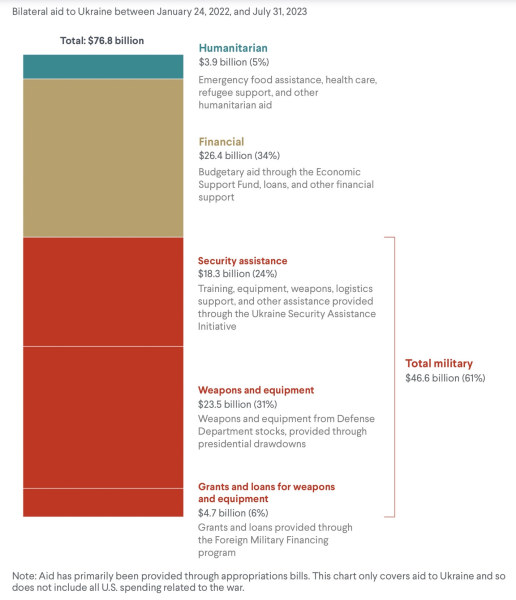
Biden’s new supplemental spending bill would provide another $66 billion in aid for Ukraine ($44.4 billion of which is military), an additional $14.3 billion in direct military aid for Israel, and $7 billion for a buildup in the South China Sea.
The projected total in direct military assistance to Ukraine alone is greater than the 2022 military budget of any nation on Earth except the US and China – and the US spends nearly three times as much as China.
That leaves the president and his party vulnerable to right-wing appeals like this one from Tucker Carlson:
Unlike so many of our elected leaders, (Trump voters) have been to America recently. They know what it looks like. Have you seen it? If you've got a few days this summer, find out. Take a road trip and see for yourself. Drive 500 miles in any direction and then come home. How are things looking? …
There are potholes and Jersey barriers everywhere. Looks like Tegucigalpa before the Chinese decided to rebuild the infrastructure of Honduras ... And you wonder as you see all of this, where did all the money go? It's certainly not here. Well, it's in Washington ... And of course, a huge chunk of it went to Ukraine, to Zelensky and his friends.
Whatever one’s feelings about Ukraine, it’s hard to deny that rhetoric like this could resonate with a war-weary and economically insecure electorate.
One, Two, Three, Many Vietnams
Biden’s relentless militarism, especially in Israel, is markedly driving down his already weak poll numbers. His support for Ukraine has not yet hurt him among his party’s base, but that could change. The conflict is at a stalemate even as he calls for $66 billion in additional aid. What happens next?
Americans largely support Ukraine’s independence, as they should, but the public’s patience is not unlimited. They may demand diplomacy instead of war, especially as the fighting drags on – and especially if they learn that the US alliance appears to have blocked a diplomatic settlement early in the conflict. That’s something Republicans will be eager to tell them about.
Americans’ compassion for Ukraine may take a different form as they watch its people continue to die in a war that’s not making progress. The Defense Secretary’s stated goal of using Ukrainians to “weaken” Russia’s military strength may start to look as inhumane as it is wasteful.
The most striking thing about US involvement in the bombing of Gaza is how rapidly public support for it has fallen. In that sense, Israel’s assault has already become Biden’s Vietnam. By next November, his expenditures in Ukraine could become another.
Vietnam was originally a popular war, too, but the ongoing loss of life, the expense, and its well-publicized brutality eroded its support and ended LBJ’s presidency. It’s true that, unlike Vietnam, today’s conflicts don’t involve US soldiers. But there is a greater sense of economic distress today — and a smart Republican will play on fears of a nuclear confrontation with Russia.
Comments

Powered by RoundtableAn AI/DeFi-powered Enterprise Media Operating System. Learn more at Roundtable.io.© Roundtable 2026. By using this site you agree to the Terms of Use and Privacy Policy