
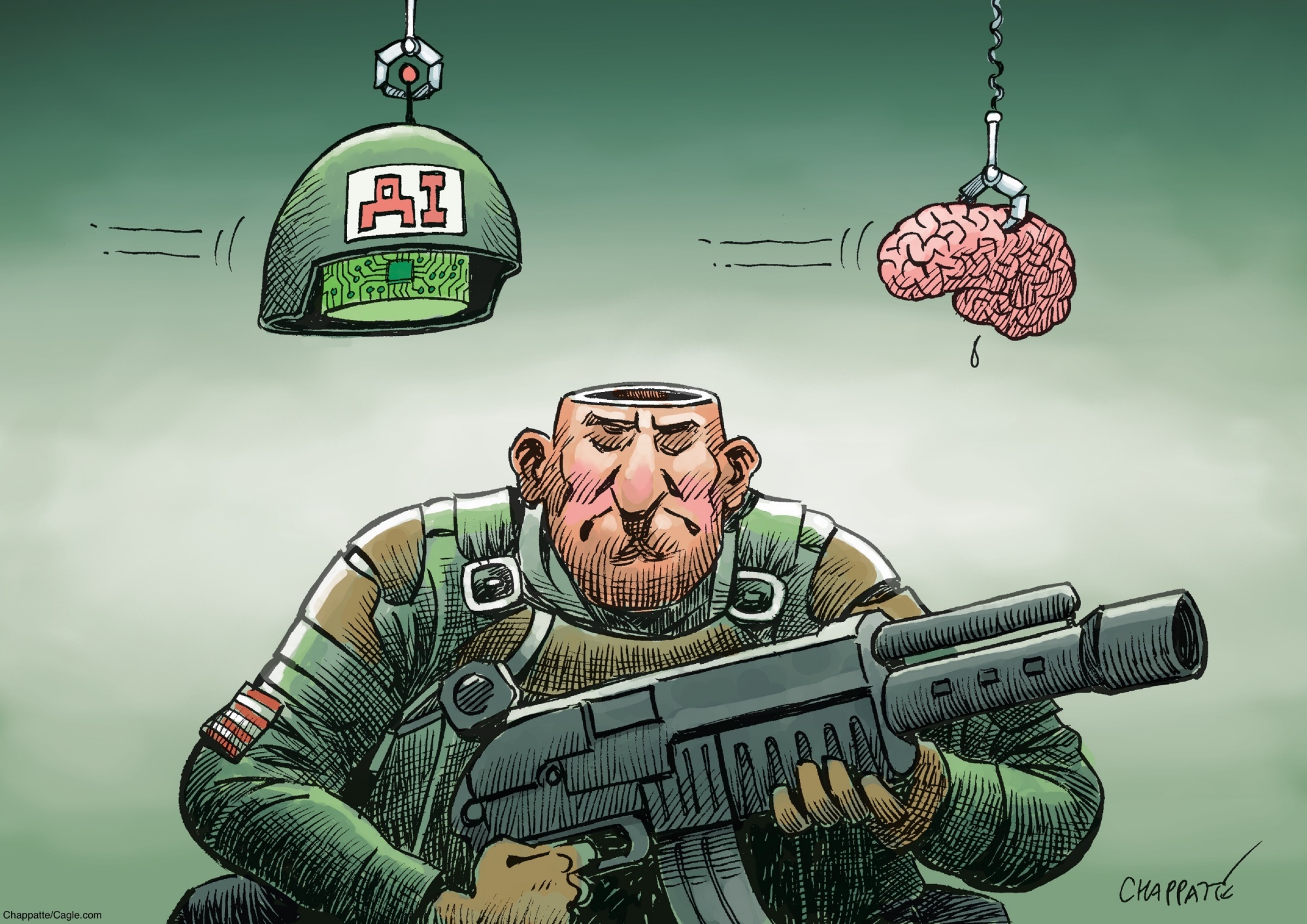


Congress has failed to regulate even the riskiest uses of AI, like automating lethal force, the privatization of war or the surveillance of Americans.
Mar 14, 2026 3:30 PM
Congress has failed to regulate even the riskiest uses of AI, like automating lethal force, the privatization of war, or the surveillance of Americans.
I’m sure many DemocracySOS readers are following the bizarre trajectory of the invasion of Iran. Here at DemocracySOS, we have a wide definition of “democracy,” and there’s no question in my mind that this invasion is a threat to American democracy. Congress has not declared war so President Donald Trump’s unilateral declaration against Iran, and just weeks ago against Venezuela — Cuba next? — is a giant step toward an even more imperial presidency in which Congress is sidelined.
It fits with an ongoing pattern of the Trump administration, expanding presidential power in every possible corner of the federal government. Despite the fact that they were mandated by the US Congress to be substantially independent of presidential authority, Trump has tried to aggressively assert executive authority over federal agencies like:
- the Federal Reserve
- Federal Trade Commission
- Federal Communications Commission
- Securities and Exchange Commission
- the Consumer Financial Protection Bureau
Trump has unilaterally withheld funds from congressionally-funded agencies and fired watchdogs. He has demanded control over the Department of Justice and ordered the US attorney general to use the powers of that office to attack political opponents. Way before the undeclared war in Iran, Trump has invoked emergency powers for domestic issues in areas where there is clearly no “emergency,” by any common sense or legal definition of that term, such as his invocation of sweeping tariffs and immigration and border enforcement, sidelining congressional and state roles in the process.
Related stories
Operating under the whacky “unitary executive” theory, and trampling the revered US Constitution in the process, all of these actions are direct threats to the American system of democratic governance and its checks and balances based on separation of powers among the three federal branches, and division of powers between the federal and state governments. And the ridiculously dangerous Supreme Court ruling in July 2024 giving to the president a “presumptive immunity” for all official acts – a “Get Out of Jail Free” pass for outrageous acts by unhinged presidents – provides all the legal cover Trump needs to -- as Silicon Valley says -- “act fast and break things.”
Democrats Too?
Some have pointed out that Democratic presidents Joe Biden, Barack Obama and Bill Clinton also used questionable exertions of executive power through executive orders and agency directives. Certainly that is true. Biden initiated broad student loan forgiveness and COVID vaccine mandates for private businesses through executive action, and Obama relied on a broad interpretation of the Clean Air Act to instruct the EPA to implement the Clean Power Plan.
Obama also used executive action to create the Deferred Action for Childhood Arrivals (DACA) program, shielding “Dreamers” from deportation, and authorized military intervention in Libya in 2011 without obtaining explicit congressional authorization. President Bill Clinton authorized the 1999 bombing of Yugoslavia without obtaining a formal declaration of war or a joint resolution of authorization from both houses of Congress.
No question, since Pulitzer Prize-winning historian Arthur Schlesinger wrote The Imperial Presidency in 1973 during the peak of the Watergate scandal, which traced the historical growth of US presidential power from George Washington through Richard Nixon, the awesome powers imbued into the occupant of the Oval Office has increased at a dangerous pace, with both major parties as participants.
Through one crisis after another, under the multi-dimensional pressures from Americans demanding results from their government, and with the US shouldering substantial responsibility for global leadership, for good or ill, the passage of time has favored increasing authority endowed in the presidency at the expense of the elected representatives seated in the legislatures.
This is a dangerous trajectory, no matter which party is in power. But under Donald Trump, the scope and scale of this authoritarian grab has been injected with steroids. The man has no restraint or honor, and he has surrounded himself with cronies who revel in their lust for power and attacks on political enemies. Collectively as a team, the Trump administration is hurling the nation further down a slippery slope into a giant abyss in which representative governance itself is treated like an obstacle to their ambitions. Even with Trump’s own MAGA-fied GOP having a majority in both chambers, the Congress has become a supine disgrace to the legacy of representative government.
The White House is establishing precedent after precedent about how to maximize the power of one man in the Oval Office. This is dangerous, and by definition undermines American democracy. I assume that at some point a Democrat will win back the presidency, and that president will be faced with a tempting choice: will a Democrat, say for instance a Madam President, now further open the door that Trump has shoved open, and act in a similar and unilateral way to strongarm Democratic priorities into existence, and even to unwind some of the horribly destructive policies of the Trump administration? Or will that Democratic president act to restore the checks and balances and separation of powers?
One Possible Future, Dictated by Authoritarian AI
Authoritarianism, at its core, is based on unilateralism and a nearly complete lack of checks and balances. It is anti-Founders and Framers, who drafted the US Constitution in response to an authoritarian king in an attempt to divert such toxic unilateralism from rolling onto American shores.
The onset of AI into nearly every nook and cranny of our society opens the door even wider to more authoritarianism. What happens when you gear your society to increasingly rely on AI that that makes automatic decisions, with little or no human discretion? What happens when AI, under the guise of responding to “emergencies,” is increasingly used to sidestep those pesky checks and balances? And as we are now seeing in Iran, what happens when you do that in the waging of war?
Suddenly we are faced with a whole new type of authoritarianism – the authoritarianism of unilateral AI.
Right now, the Trump administration, led by maniacs like Pete Hegseth and Stephen Miller, is pushing this reality forward. A major future-defining shift just reared up in the clash between the Trump administration and tech company Anthropic.
Anthropic’s AI system, known as Claude, is being used throughout the federal government and is at the core of military operations in the illegal attack against Iran, and it was used in the illegal overthrow of Venezuelan President Nicolás Maduro. Anthropic CEO and co-founder Dario Amodei insisted on strict “safety guardrails” to prevent his company’s technology from being used for autonomous lethal weapons (killer robots) or mass domestic surveillance of Americans.
Instead, Defense Secretary Pete Hegseth demanded “unrestricted military use” for “all lawful purposes,” arguing that private companies should not dictate how the military operates its most powerful tools and weapons. But given the Trump administration’s clear pattern of pushing the limits of statutory authority and daring the courts to stop him, Anthropic did not trust the Trump administration to interpret “lawful purposes.”
Predictably, President Trump publicly labeled Anthropic a “radical left woke company” and ordered all federal agencies to cease using Anthropic’s AI technology. Secretary Hegseth officially designated Anthropic as a “supply chain risk” to national security, a designation historically reserved for foreign adversaries like China, which prohibits any defense contractors and military partners from conducting business with Anthropic.
But as the unfolding war in Iran is demonstrating in real time, Anthropic’s concerns are valid. Rarely does a Silicon Valley company take the right ethical or moral stance, but in this case Anthropic is establishing an important guardrail for these powerful new-ish technologies. Right now in Iran, AI technology is being rapidly injected into military operations, deploying “death by robo auto kill” into the thick smoke of attack operations. This to me is another threat to US democracy, since it means no checks and balances and reduced accountability during that most significant of all human decisions: when to take a human life.
AI on the Battlefield in Real Time in Iran
Admiral Brad Cooper, commander of US Central Command and the leader of military operations across the Middle East, including the “Operation Epic Fury” campaign against Iran, has confirmed that his military forces are using “advanced AI tools” to “sift through vast amounts of data in seconds” that has allowed them to hit over 5500 targets and counting in Iran.
A cutting-edge platform called Maven—overseen by Palantir and powered by Claude—generated thousands of targets and “issued precise location coordinates and prioritized those targets,” reported the Washington Post. Advanced AI tools, says Cooper, sped the pace of the bombing campaign, reduced Iran’s ability to counterstrike and turned weeks-long battle planning into instant real-time operations. Though Cooper was quick to emphasize that “humans will always make final decisions on what to shoot and what not to shoot and when to shoot.”
That’s supposed to be reassuring, but the ferocious pace of bombing kept up by US forces would not have been possible without AI technology. Besides, says Heidy Khlaaf, chief AI Scientist at the AI Now Institute, “Generative AI algorithms are a flawed and inaccurate technology that fabricate and ‘hallucinate’ outputs, often at a rate of 50% accuracy, where they’re unlikely to be able to solve tasks outside of their data distribution and training data sets.”
Steven Feldstein, an expert on digital repression and AI surveillance from the Carnegie Endowment for International Peace, adds to skepticism and concern. “One of the lessons learned,” he writes, “from the use of AI targeting systems in conflicts such as Ukraine and Gaza is that they are prone to make mistakes with mounting reports about civilian harm.” He wonders if as the data analyzed by Claude becomes noisier and susceptible to distortion (what he calls the “AI slop problem”) in the heat of battle, will the AI algorithms correct for potentially lower accuracy or limited verifiability?
We have already seen one major tragic blunder in the attack on Iran, in which a deadly strike by a Tomahawk cruise missile on an elementary school reportedly killed 168 people, including about 110 children. The US is blaming the mistaken target on “outdated data” that misidentified the school as a military target. But is it possible that the AI guidance system had a hallucination that caused the misidentification? I doubt we can count on the Pentagon or Trump to be honest about that.
Khlaaf says these hallucinations are an inherent property of the AI given their “probabilistic nature.” Translation: AI is never exact, instead it sifts through massive data loads and looks for statistical probabilities in the blink of an eye. “Generative AI’s inability to handle novel scenarios that would arise from the fog of war thus raises serious questions about whether they can be successful in military settings…current LLM safety is far from the reliability and accuracy measures that have long been a prerequisite for defense and safety-critical systems.” Deploying them “may ultimately lead to conflicts becoming indiscriminate lethal campaigns.”
Multiple Threats to US Democracy
The multiple threats to our democratic form of government are looming in front of us. And yet the US Congress has failed to regulate even the riskiest uses of AI, like the automating of lethal force, the deepening privatization of warfare, or the surveillance of millions of Americans.
The Brennan Center for Justice warns that military intelligence agencies already have disregarded legal restraints against buying upAmericans’ data without a warrant, including location and browsing history, from commercial data brokers. “AI tools supercharge the government’s ability to collect and analyze this information” writes Brennan’s senior counsels, Emile Ayoub and Amos Toh.
“They enable the government to gather and piece together data to expose a person’s movements, associations, and habits at scale” — undermining a central aimof the Fourth Amendment to protect an individual’s right to privacy.
Ayoub and Toh conclude, “Congress should urgently impose safeguards to align autonomous weapons with the laws of war and restrict the use of weapons that fall short.” But I’m not holding my breath. In the meantime, authoritarianism is on the loose, stomping like an orange-haired Frankenstein monster across the US political landscape. It’s not clear that even a Democratic victory in the US House this November will be able to rein it in.
This article was produced by DemocracySOS.
Comments

Powered by RoundtableAn AI/DeFi-powered Enterprise Media Operating System. Learn more at Roundtable.io.© Roundtable 2026. By using this site you agree to the Terms of Use and Privacy Policy