
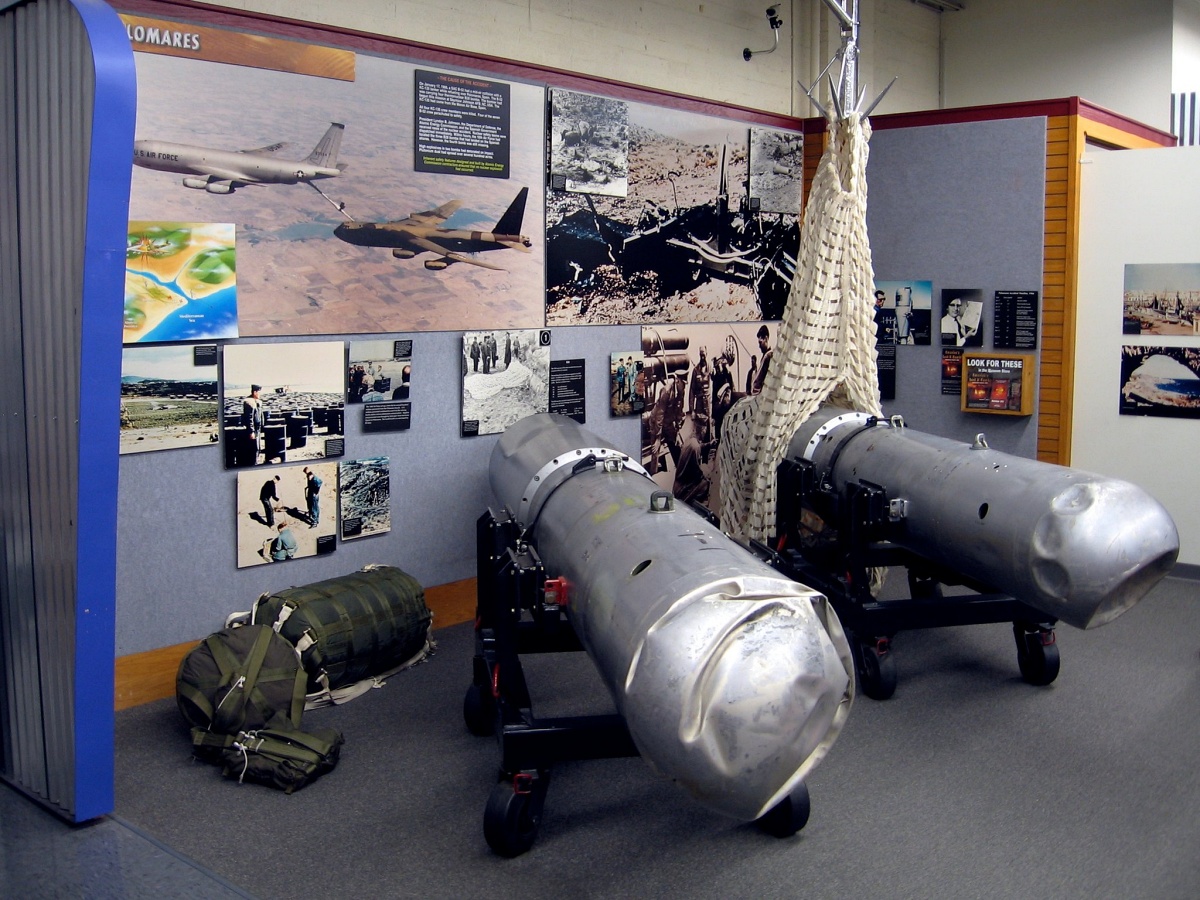
The two Palomares bombs that didn't explode are now in a museum in Albuquerque, New Mexico, and here the now-empty casings are. Attribution (CC BY 2.0) Flickr


Apr 21, 2023 4:00 PM
The more nuclear weapons exist, the greater the likelihood that catastrophic near misses will take place.
Nuclear Near Misses: Cuba (1962), Palomares (1966)
Over the years, at least 10 nuclear near misses have been documented and described on the Internet. An analysis of two of the most significant events of the Cold War is of interest. The Cuban Missile Crisis of 1962 was clearly an example of unintentional consequences not foreseen by the protagonists. The 1966 accident over Palomares, Spain, was an accident clear and simple.
Both events are examples of what can happen when nuclear weapons exist. With so many nuclear devices in the world, the law of statistics dictates that these types of events will occur. The more nuclear weapons exist, the greater the likelihood that these catastrophic near misses will take place. Fortunately Lady Luck intervened in both of the above situations. Who can predict that this will be the situation for future events.
The Cuban Missile Crisis was initiated by the Soviet Union when it placed nuclear missiles in Cuba, 90 miles from the U.S. mainland. The reason for this action was complicated. Fidel Castro’s Cuba, an ally of the Soviet Union, felt severely threatened, especially after the Bay of Pigs fiasco in 1961. The U.S. had nuclear missiles in Turkey, close to the Soviet Union and was a clear threat to the Soviets. The Soviet action was logical on their part but with unpredictable consequences which were not figured into the equation.
The Soviet action was logical on their part but with unpredictable consequences which were not figured into the equation.
Related stories
The strong U.S. response and the determined resolve by President Kennedy were not considered. The Strategic Air Command (SAC) was placed on Def Con 2 alert indicating that a nuclear confrontation was imminent. The 13 days in October, 1962 had the entire world on edge. Fortunately cooler heads prevailed. Having Kennedy and Khrushchev in charge allowed a catastrophe to be averted. The U.S. made a promise not to invade Cuba and the missiles in Turkey were to be removed. This series of events could easily have been different if there were different actors on the scene. Lady Luck intervened.
The Palomares event was clearly an accident. Mid-air refueling is an action that requires great precision, timing and skill for successful execution. This did not happen on Jan. 17, 1966 and four hydrogen bombs dropped out of the sky and 7 airmen were killed. Fortunately the two bombs that imploded did not result in nuclear explosions. One bomb landed in the Mediterranean and was successfully retrieved intact in an amazing operation. The other bomb had a soft landing by parachute with no mishap.
Unfortunately the Spanish countryside at Palomares was greatly contaminated with Plutonium 239, a deadly radioactive substance. Over a thousand U.S. airmen arrived from U.S. air bases in Spain and the clean-up proceeded over the next few months. The airmen had poor protection from the Plutonium 239 dust, with subsequent severe health issues in later years, including malignancies. These airmen are still waiting for appropriate recognition and compensation for their heroic action.
The 1962 and 1966 events are examples of what can happen in the future, if nuclear weapons are not eliminated. The world is watching and waiting. These two events have strong relevance to the current situation in Ukraine.
Note: I was a medical officer assigned to 7th Air Division, Strategic Air Command (SAC), High Wycombe, UK during the Cuban Missile Crisis. Currently, I am working with surviving Palomares veterans who are waiting for recognition and compensation.
Comments

Powered by RoundtableAn AI/DeFi-powered Enterprise Media Operating System. Learn more at Roundtable.io.© Roundtable 2026. By using this site you agree to the Terms of Use and Privacy Policy