
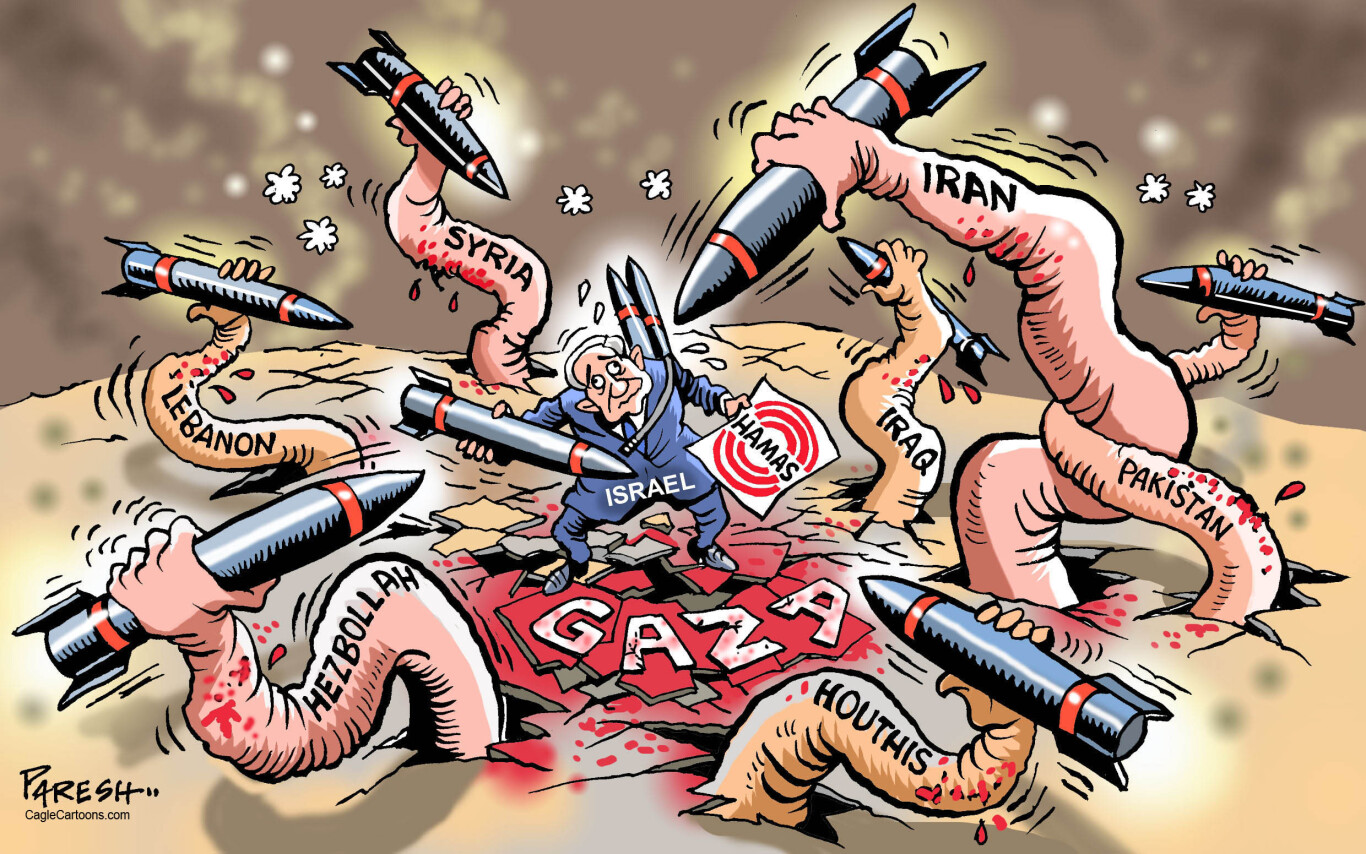


Netanyahu vs. Houthis
Feb 8, 2024 12:00 AM
The official US pretext for attacking Yemen is to “protect commerce” that flows through the Red Sea. Is that more important than the slaughter of Palestinian children?
As the United States deployed B-1 bombers to attack Iraq and Syria, and other US and UK aircraft attacked Yemen, the world is witnessing a three-front war that could be avoided by a simple phone call. If Joe Biden were to notify Israel’s leadership that he wants to end the flood of weapons and money supporting genocide against the Palestinian people, the war would end abruptly. Instead the US is compounding its problems in a region it can’t control.
The official US pretext for attacking Yemen is to “protect commerce” that flows through the Red Sea. That seems more important to the US than the slaughter of tens of thousands of Palestinians. The leaders of Ansar Allah (aka Houthis) insist their disruption of Israel-related commerce through the Red Sea will stop when there is a permanent ceasefire in Gaza. Biden prefers to attack Yemen than stop genocide against the Palestinian people.
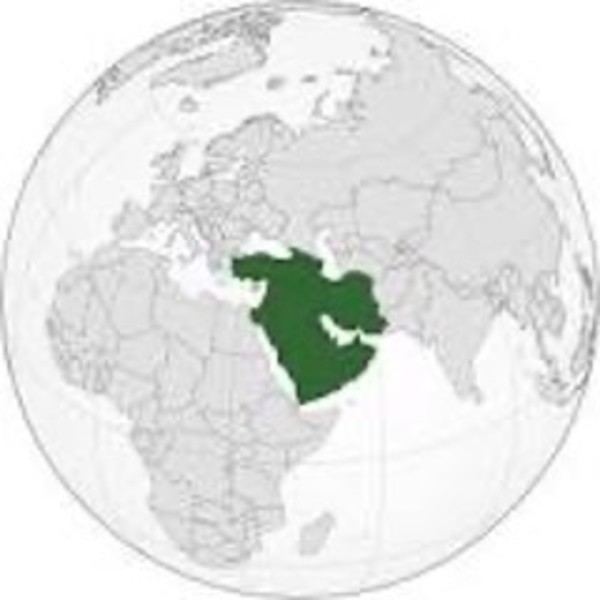
West Asia covers 2.3 million square miles, with a population of about 313 million. That’s roughly three fifths (62%) the size of the continental US, with about 90 percent of the US population. Some 40 percent of world commerce flows through the Red Sea and Persian Gulf. As US attacks escalate, they risk a world scale economic disruption. The Yemenis control the Bab-el-Mandab Strait (aka “Gate of Grief”) at the southern end of the Red Sea. Iran controls the Strait of Hormuz, at the southeast end of the Persian Gulf. If both choke points were to close, it would cause economic disaster.
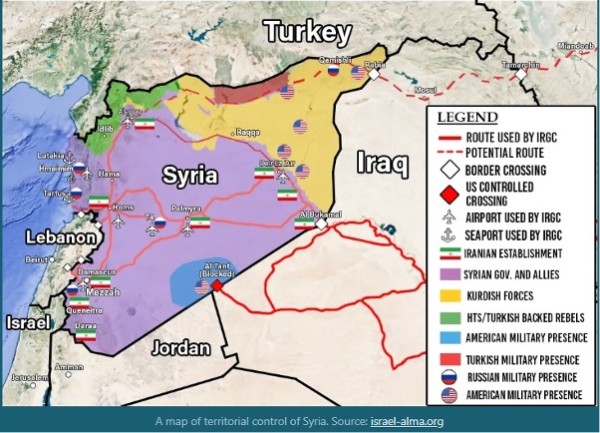
A close-up view of the area the US attacked in Syria and Iraq shows a number of Iranian and Russian military bases – all there by invitation of the Syrian government – as well as several illegal US bases which remained after the US officially withdrew from Syria in 2018.
Related stories
The “Tower 22” US base is adjacent to the Al Tanf base, on the Jordanian side. Al Tanf is reportedly the largest US base in Syria, used for training anti-government Syrian rebels.
B-1 Bombers
The US deployed B-1 bombers, directly from Dyess Air Force Base in Texas. They flew non-stop about 5,000 miles across the Atlantic Ocean, the Mediterranean Sea and the Arabian Peninsula to launch more than 125 missiles at 85 targets in Iraq and Syria. The New York Times reported “the US military [is] assessing the dozens of airstrikes,” which killed at least 39 people – 23 in Syria and 16 in Iraq. Iran’s Foreign Ministry called the attacks “an adventurous action and another strategic mistake.” Using B-1s “carried its own message,” a Times report said: “they were also the same warplanes that would be used in any attack on Iran’s nuclear facilities.”
Large B-52 strategic bombers like the B-1 were deployed decades ago against Vietnam. Over a third of those B-52s were shot down by Vietnamese anti-aircraft fire during the so-called “Christmas bombing” of 1972, just prior to the January 1973 peace agreement. Iran has highly sophisticated anti-aircraft weapons, which might complicate US plans.
U.S. defense secretary Lloyd Austin said “We do not seek conflict in the Middle East or anywhere else.” A call to Israel to stop its genocide in Gaza might be more effective than the current approach.
An expanded view of the West Asia map shows how close it is to both Russia and China – both allies of Iran. That makes the US attack on Syria and Iraq an extra challenge and threat. Are Biden, Austin and Blinken ready for a global war? The NATO proxy war in Ukraine against Russia has been a disaster – a case of imperial over-reach and self-deceit – with hundreds of thousands of lives lost. Meanwhile a gigantic military force of the US and its allies remains poised for war against China. US plans for a “pivot to Asia” may be delayed due to this new US adventure, which is really a “re-tread” of two decades of “Endless War” in the region. Or maybe the US wants to fight on yet another front?
Taunting the World Court
The International Court of Justice recently ruled “plausible” South Africa’s claim that Israel is committing genocide against the Palestinians. It called on Israel and those countries supporting it to refrain from and prevent more acts of genocide, and facilitate emergency delivery of humanitarian aid – food, medicine, water and fuel. The court’s decision, reached by a score of 15 to two, reflected several similar overwhelming votes for ceasefire in the UN highlighting the degree of global isolation the US and Israel are facing.
Israel’s denounced the World Court’s decision, and then raised a hue and cry that a few employees of the UN Relief and Works Agency (UNRWA) had helped the Palestinians’ October 7 attack. It provided no evidence. It had tried this type of accusation before, and a leading Israeli politician was caught on TV arguing passionately that “if we want to win this war we need to destroy UNRWA.” This time the US State Department took immediate action to freeze its mandated funding to UNRWA, and encouraged its Western allies to do the same, despite the fact that UNRWA fired the dozen accused staff. These acts were a direct insult to the World Court, and a clear and conscious move to intensify Palestinian suffering.
Secretary of State Blinken headed back to the region February 4 “as part of continuing diplomatic negotiations.” The US national security adviser Jake Sullivan said a “top priority” for Blinken in meetings with the Israeli government would be “making sure more humanitarian aid reaches civilians in Gaza.” Such efforts have been fruitless before, raising questions of credibility and sincerity: does Blinken really want relief for Palestinians?
Ceasefire Talks
Other very real negotiations for a permanent ceasefire took place in Paris in late January featuring a top Hamas leader talking with the US and Israeli intelligence directors, the prime minister of Qatar, and a French representative. Hamas leader Osama Hamdan released a statement saying “we affirm [the general framework proposal] is based on… reaching a complete end to the terrorist aggression against our Palestinian people, and a complete withdrawal of the occupation army from the Gaza Strip.” He added “that our study of the proposal is also based on lifting the ongoing siege on the Gaza Strip for 17 years, providing shelter for the displaced, rebuilding what was destroyed by the occupation, completing a serious prisoner exchange deal, and practical international recognition of the right of our people to self-determination and establishing their independent, fully sovereign state with Jerusalem as its capital.”
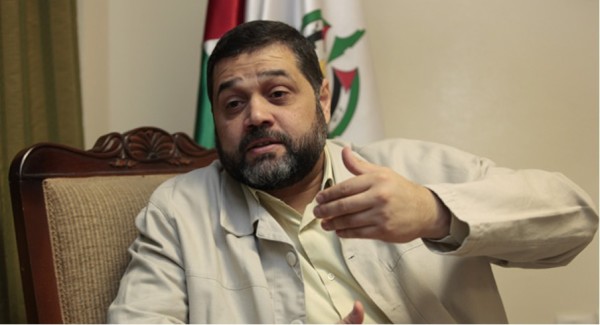
The Hamas leader also said “We warn of the danger of dealing with news and reports published by hostile parties regarding the course of the truce agreement negotiations, with the aim of misleading and influencing the state of popular cohesion, and steadfastness among the masses of our people in the Gaza Strip.”
The statement also denounced that “countries suspending their funding for UNRWA, due to misleading and flimsy Zionist claims, is an irresponsible step and actual participation by these countries in the policy of restricting our people, punishing them collectively, and actual participation in the war of extermination waged by the Zionist enemy against civilians, displaced persons, and refugees among our people.” It said these countries should retract their decision, the UNRWA administration should not surrender, but continue its work, “and not to be an accomplice in this crime.”
The Hamas leader called for people, countries, and governments “to intervene quickly and urgently, to put pressure on the occupation and the American administration supporting it, in order to bring in all relief, medical and service aid, and to save the Palestinian people in the Gaza Strip from death from hunger, thirst and disease.”
A New Version of an Old Story
The current US escalation in West Asia can be seen as a variation of the “Endless War” in the region, which it has waged for two decades, as well as its determination to maintain the brutal 75-year-long Israeli colonization of Palestine. In a larger sense, it reflects the Crusades of the late middle ages, in which the Christian forces of the “Holy Roman Empire” fought the Muslim infidels who occupied the Holy City of Jerusalem. In 1187, the infidels (i.e., faithful Muslims) defeated the Western invaders. “One by one, the Christian cities surrendered to Saladin, culminating in the surrender of Jerusalem.”
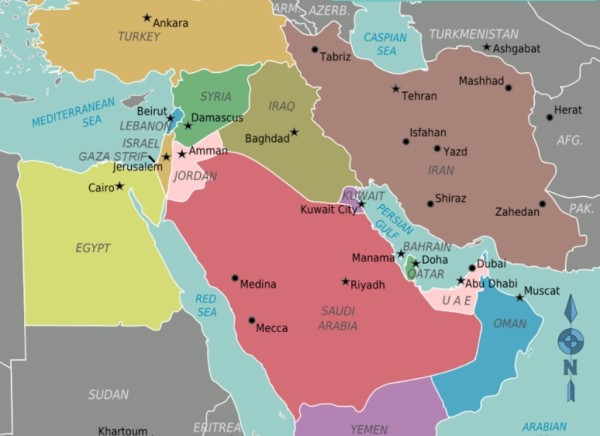
There has been a change in the balance of forces, both in historic Palestine and in the surrounding region. Next to Palestine in Lebanon, the forces of Hezbollah are much stronger than they were when they repelled the Israelis from south Lebanon in 2006. Since then, they have fortified themselves as a major factor, alongside Russia and Iran, in fighting the US and its proxies to a standstill in the Syrian civil war. They are reported to have hundreds of thousands of hardened troops and tens of thousands of long- and medium-range missiles, which they haven’t deployed yet in spite of driving tens of thousands of Israeli settlers away from the Lebanese border area.
In Iraq, the Popular Mobilization Units (PMU), which formed in 2014 at first as a civilian militia, have gradually been incorporated into the official Iraqi armed forces. After the US left ISIS in a position to cripple the Iraqi state, according to one report, “the PMUs stood steadfast and defeated ISIS over and over again.” This report says the PMUs have “around 250,000 fighters from all throughout the region, and they remain one of the most steadfast and effective enemies of America’s many pet Jihadis.”
In Yemen, the Ansar Allah has defied both the US and its allies and claims to be ready for more. Like the Palestinians in Gaza, most of their military assets are safely underground but ready for rapid deployment—ready enough to have basically idled the Israeli port of Eilat on the Gulf of Aqaba through their blockade of the Gate of Grief.
An Iranian Foreign Ministry statement said “the roots of the tension and crisis in the region go back to the occupation by the Israeli regime and the continuation of this regime’s military operations in Gaza and the genocide of the Palestinians with the unlimited support of the United States.”
It seems to be another hint for Biden to make that call.
Comments

Powered by RoundtableAn AI/DeFi-powered Enterprise Media Operating System. Learn more at Roundtable.io.© Roundtable 2026. By using this site you agree to the Terms of Use and Privacy Policy