
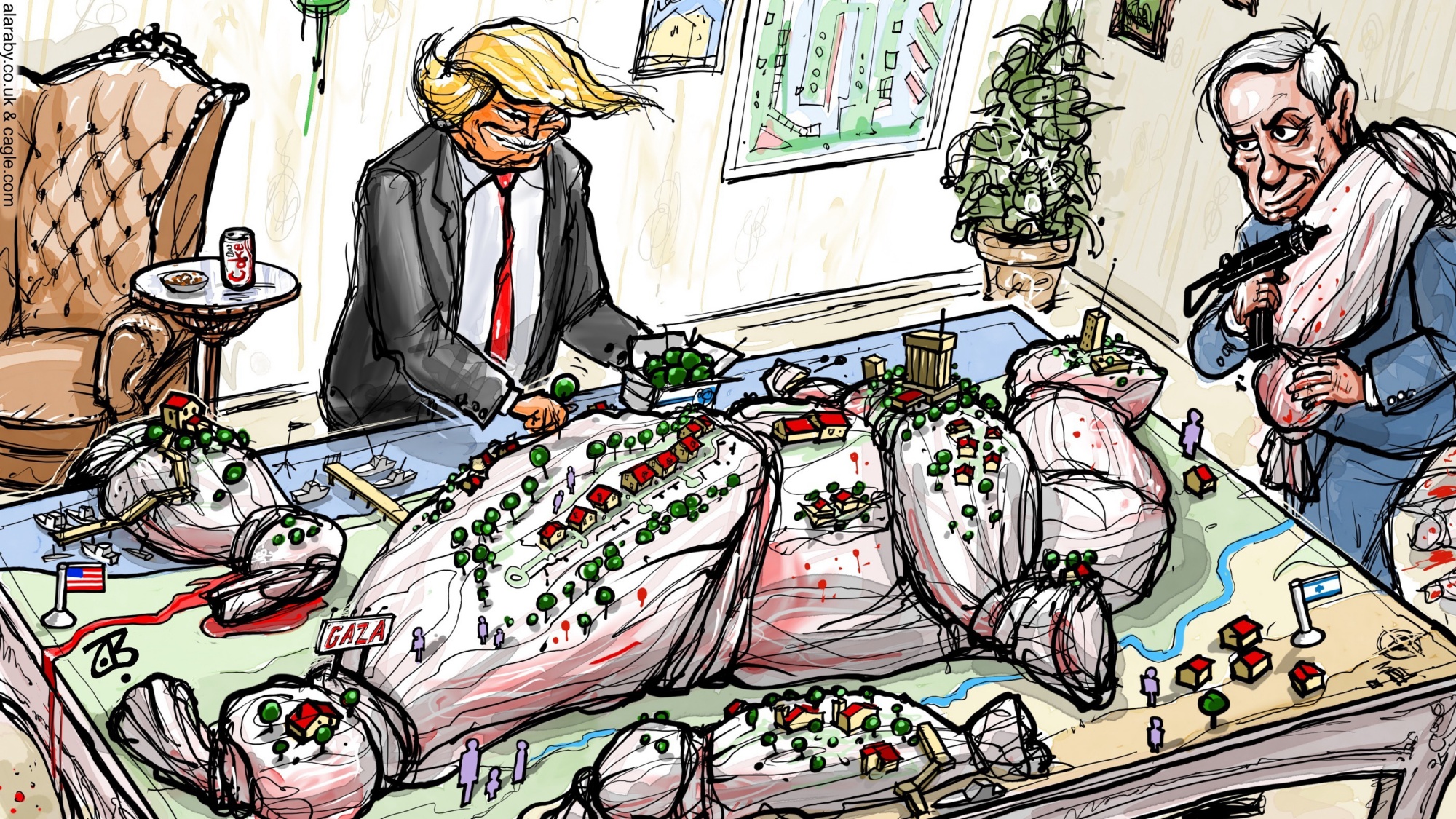
Illustration by Emad Hajjaj on CagleCartoons.com


We cannot allow Donald Trump to dictate Ukraine’s fate in backroom deals with a fellow fascist. We must demand action. We must hold those in power accountable.
Feb 20, 2025 4:03 AM
Updated Feb 21, 2025 7:23 PM
We cannot allow Donald Trump to dictate Ukraine’s fate in backroom deals with a fellow fascist. We must demand action. We must hold those in power accountable.
For the first time in world history, the leaders of two imperialist powers—two fascists, one representing Russia and the other, the U.S.—are negotiating the terms of a so-called peace settlement that determines the fate of a sovereign nation, while one of them continues to wage war against it.
This is not diplomacy; it is the spectacle of predators dividing the spoils. It is the logic of conquest dressed in the language of negotiation, a brutal farce in which the victim is absent from the table, its survival treated as a bargaining chip between tyrants.
Trump and Putin do not seek peace—they seek a pact. A deal that cements Russia’s aggression as legitimate and Ukraine’s sovereignty as expendable. A deal that undermines not only Ukraine but the very idea that nations have the right to exist beyond the will of imperial masters.
This is Munich without the pretense of shame, Yalta without the illusion of order—a moment when history repeats itself, not as tragedy, but as deliberate, calculated betrayal—in other words, as farce. A grotesque pantomime in which the fate of a sovereign nation is decided by two men who neither respect its existence nor acknowledge its right to resist. It is the theatre of imperialism at its most brazen, where the invader dictates terms and the supposed arbiter serves as his echo.
Related stories
There is no diplomacy here, only the choreography of submission. No pursuit of peace, only the rebranding of surrender. And yet, this farce has consequences. Behind the empty rhetoric and cynical handshakes, cities still burn, soldiers still fall, and a people still fight—not for the favor of emperors, but for the simple and undeniable right to be free.
For the first time in US history, an American leader is not merely appeasing a foreign autocrat but actively aligning himself with one, joining in the Orwellian lie that Ukraine, the invaded, is somehow the aggressor. This is fascism unmasked, its logic laid bare: blame the victim, absolve the strongman, rewrite the story until resistance itself is cast as the crime.
There is a close parallel in world history, when Adolf Hitler denied the legitimacy of the Czechoslovak state. Timothy Snyder writes:
As German chancellor, he [Hitler] systematically denied that it had a right to exist. Although its leaders were democratically elected, he claimed that they had no right to rule. Because its people spoke various languages, he claimed that there was no such thing as a body of Czechoslovak citizens. Hitler argued that Czechoslovakia itself was artificial, the result of a historical turning point that never should have happened, the settlement after the First World War. He claimed that the existence of national minority gave him the right to intervene in Czechoslovak politics.
In May 1938, he ordered his army to make preparations for a quick strike on Czechoslovakia. He also activiated his agents inside the country. On September 12th Hitler gave a rousing speech to Germans about the entirely fictional extermination of the German minority in Czechoslovakia. We know what comes next: Britain and France, together with Germany and Italy, decided in Munich on September 30th that Czechoslovakia should cede crucial border territories to Germany. These were the most defensible parts of the country. Czechoslovakia’s leaders, although they were not consulted, chose to accept the partition of their country
To carve up a nation without its consent is to strip it of agency, to reduce its sovereignty to a bargaining chip. No historical analogy is ever perfect, but the shadows of Munich in 1938 and the Molotov-Ribbentrop Pact in 1939 loom over such arrangements, grim reminders of what happens when great powers decide the fate of smaller nations in backroom dealings. The longer record, of course, stretches across the history of colonialism, where borders were drawn and redrawn by imperial hands with little regard for the people who lived within them.
Trump and Putin’s partnership is not solely about geopolitics. It is about power—raw, unchecked, and hostile to the very idea of a free and sovereign people. It is a dark moment in American history, a rupture in the country’s democratic fabric, when the leader of a major political party stands not with those fighting against tyranny, but with the tyrant himself.
Russia’s war against Ukraine is imperialism in its rawest form—undisguised, unapologetic, and ruthless. It is not a conflict born of security concerns or geopolitical necessity, but of a colonial hunger to erase a nation’s sovereignty and subjugate its people. Every missile that falls, every village that is razed, every child abducted and deported to Russia is a testament to this brutal ambition.
Moscow does not seek compromise; it seeks dominion. Putin’s war is waged not just on Ukraine’s land but on its identity—its language, its culture, its very right to exist beyond the shadow of Russian rule. This is not a clash of competing powers but an assault on the fundamental principles of self-determination and human dignity. It is empire-building in the 21st century, and those who refuse to see it for what it is are complicit in its advance.
Moscow denies that Ukraine is a true state, that Ukrainians are a people, that their elected leaders are legitimate. A war cloaked in such colonial ideology enables the exploitation of stolen Ukrainian resources, right down to and including stolen children. It is a war built on a foundation of lies, in which Russians cast themselves as the aggrieved, the innocent empire forced—against its will, they claim—to invade a neighbor they refuse to recognize as a nation. In this twisted narrative, Ukraine is not a sovereign state but a rogue province, overrun by so-called Nazis, whose very existence is framed as a threat to Russia’s security and identity.
This is not merely propaganda; it is the mythology of conquest. A story designed to justify the unjustifiable, to mask aggression as self-defense, to transform a war of imperial expansion into a reluctant act of necessity. But reality shatters the illusion. It is not Russians who fight for their homeland, but Ukrainians. It is not Russian cities that are bombed and burned, but Ukrainian ones. And it is not fascism that Ukraine embodies, but the simple, uncompromising demand to exist on its own terms—free, whole, and beyond the grasp of empire.
Snyder writes:
And so if you have a perfect myth which defines you as always innocent, then you never have to take responsibility. And then, no matter what you do, even if you invade your neighbor for no reason whatsoever, you're still innocent because your myth has taught you that you are always innocent. Your myth has taught you that evil always comes from the outside.
And that, unfortunately, is one account of what's happening today in the Russian invasion of Ukraine. Russians can invade Ukrainians, sincerely believing that they're going out into the world to kill Nazis or Fascists because the thought simply can't occur to them that what they're doing is actually Fascism or what they're doing is actually Nazism, because a perfect political myth takes responsibility away completely. It puts all responsibility on the side of the other.
Trump and Putin are not merely allies of convenience; they are twin faces of the same authoritarian resurgence, two men who despise democracy and see truth itself as something to be bent, broken, and reshaped in their own image. That an American leader and a Russian dictator now speak in unison to condemn Ukraine—the very nation fighting for its survival against unprovoked aggression—is not just unprecedented. It is a grotesque perversion of history.
And yet, despite the ceaseless rhetoric from Trump’s camp, the U.S. contribution to Ukraine has been modest compared to Europe’s. As a percentage of GDP, America lags behind nations that Trumpists deride as freeloaders. European nations, particularly those closest to the war, have borne a far greater burden—both in direct aid and in the economic toll of sanctions that hit their economies far harder than America’s.
European nations, particularly those closest to the war, have shouldered a far greater burden—both in material support for Ukraine and in the economic fallout of sanctions that have struck their industries, supply chains, and energy markets far more deeply than those of the United States.
While Washington’s military aid often remains within its own borders, fueling domestic arms production and sustaining American jobs, Europe has paid in real sacrifice: absorbing millions of refugees, severing economic ties forged over decades, and weathering the inflation and energy crises that followed.
Yet despite these hardships, European nations—especially those with the longest memories of Russian aggression—have stood firm, understanding that the cost of appeasement would be far greater than the price of resistance. Their economies may bend under the weight of war, but their resolve has not broken. They know, perhaps better than anyone, that Ukraine’s fight is not just its own—it is a battle for the very survival of a Europe that refuses to be ruled by fear and force.
But the greatest cost of all has been borne by Ukraine itself. No American, no European, has suffered as the Ukrainian people have suffered. Their cities reduced to rubble, their economy shattered, their families torn apart by forced migrations, their young men and women maimed and killed in numbers too vast to comprehend. It is they who have paid the true price of this war, not the armchair critics in Washington who whine about dollars spent while ignoring lives lost.
To abandon Ukraine now—to treat their struggle as an expense rather than a moral and strategic imperative—would not only be a betrayal of everything America claims to stand for. It would be the height of foolishness, a short-sighted failure of leadership that history would judge with the contempt it deserves.
And yet, Trump—who speaks of Putin not as an indicted war criminal, not as the aggressor in the bloodiest European war since 1945, but as a man seeking peace—seeks to erase the moral weight of Russia’s crimes. In doing so, he lends legitimacy to the very force that shattered the most basic principle of international law: that one nation cannot invade and destroy another at will.
Even if Trump’s rhetoric never translates into formal policy, its consequences are already clear. Words from a former U.S. president and potential future one matter. His insistence on “peace talks” that position Putin as a reasonable actor rather than a warlord drenched in blood serves a singular purpose—it rehabilitates Russia’s crimes in the eyes of the world.
It is one thing to betray a nation through diplomatic cowardice. It is another to launder the reputation of the invader, to cleanse the hands still wet with the blood of the innocent. That, too, is an act of war—one waged not with bombs, but with words that pave the way for further violence.
Like prophets of false peace, figures on both the far-right and the far-left, cloak themselves in the rhetoric of reason while peddling revisionist history. They spin the Ukrainian people’s defiant uprising against corruption and tyranny in 2014 known as the Maidan Revolution or Revolution of Dignity into an American-orchestrated coup, reducing a nation’s struggle for self-determination to a mere chess move in Washington’s grand imperial game.
Those who argue that the war started with a U.S. coup in Ukraine in 2014 (a more accurate analysis is that it was popular protests that led then-president Viktor Yanukovych to flee to Russia) promote distortions that do not emerge from ignorance but from a deep compulsion to see the United States as the omnipotent imperialist puppet master, as if agency does not exist beyond its borders.
The United States, with its long history of imperial ventures—from Vietnam to Iraq, from Chile to the Philippines—has rightly earned the suspicion of those who resist empire. But history’s echoes do not always harmonize, and to assume that every war is America’s doing is to fall into a reflexive, almost mechanical anti-imperialism that blinds itself to the agency of other aggressors.
This is the mistake too many left libertarians made with Ukraine. Because the U.S. has so often been the villain, they assume it must be the villain here as well—that Russia’s invasion is merely another chapter in a Cold War script written in Washington. But history is not so simple, and facts do not bend easily to ideological convenience.
It is important to reject this narrative, not out of any blind faith in the West, but because we need to understand the gravity of the stakes. This war was not provoked by NATO expansion—it was provoked by Ukraine’s insistence on its own sovereignty, its refusal to be absorbed into the Russian sphere of influence. Putin’s invasion was not a response to Western aggression; it was an assertion of imperial dominion, a declaration that Ukraine does not and should not exist as a free nation.
The emphasis on NATO expansion as a provocation to Russia overlooks historical context. The actions of the Soviet Union, including invasions of neighboring countries like Poland, Hungary, and Czechoslovakia, highlight the aggressive tendencies that prompted Eastern European nations to seek security within NATO.
Ukraine, facing Russian aggression despite its modest military budget, seeks NATO membership not out of a penchant for aggression but out of a legitimate desire for security and peace. Russia’s differential treatment towards Ukraine compared to Finland and Sweden’s NATO aspirations underscores the flawed notion of ‘spheres of influence’ and highlights the need for collective defiance against aggression.
Russia’s annexation of Crimea in 2014 violated international law and various treaties, including the Budapest Memorandum and the Treaty on Friendship, Partnership, and Cooperation. Suggesting Crimea’s de facto integration into Russia, grievously undermines fundamental principles of territorial integrity and sets a dangerous precedent for future aggression. Upholding Ukraine’s sovereignty is not only essential for its security but also for preserving global peace and stability.
does
Proposals to cede Crimea and Donbas to appease Russian aggression overlook the fundamental question of trustworthiness. Russia’s history of broken promises and its avowed goal of destroying Ukrainian sovereignty render any peace negotiations reliant on Kremlin proposals futile and dangerous. President Zelensky’s peace plan, endorsed by the Ukrainian people, offers a more viable path towards a lasting resolution.
The portrayal of Ukraine as a divided nation perpetuates Russian disinformation campaigns aimed at undermining Ukrainian unity. Contrary to assertions of deep ethnic and political divisions, recent polls indicate overwhelming support for Ukrainian sovereignty and unity across linguistic and regional lines. Ukrainians’ rejection of territorial concessions and identification as citizens of Ukraine underscore the nation’s resilience and cohesion in the face of external threats.
Ukraine’s democracy is imperfect, born not from centuries of stable governance but from the volatile struggle between oligarchic patronage networks and the aspirations of a people determined to break free from their post-Soviet inheritance. The 1990s, a period of revolutionary upheaval in the private sector, saw the state left underdeveloped, its institutions captured by competing neopatrimonial groups—clans and patronal pyramids that vied for control, shaping a constitution that remains fluid and contested. This instability is not an accident of history but a reflection of Ukraine’s ongoing battle to define itself, a nation caught between the weight of its past and the promise of its future.
Yet acknowledging Ukraine’s democratic struggles does not justify Russia’s war. If anything, it underscores the stakes of the conflict. Ukraine’s democracy, however fragile, is still a democracy—one where elections matter, where opposition voices exist, where the people have overthrown corrupt leaders and demanded a different path. The same cannot be said of Russia, where power is absolute, dissent is crushed, and the state serves the will of one man.
Ukraine’s fight, then, is not just for territory—it is for the right to determine its own future, however turbulent that process may be. The presence of corruption, instability, and oligarchic influence does not negate Ukraine’s sovereignty; it makes it all the more vital that its people, not a foreign invader, decide the nation’s fate.
To claim that the U.S. “caused” this war, as Trump has claimed is to strip Ukrainians of their agency, to suggest that their struggle for independence is merely a pawn’s move in a superpower chess match. It is an argument that serves not peace, but Putin’s war machine, by obscuring its true nature. The left, if it is to be worthy of its name, must oppose imperialism in all its forms—including the brutal revanchism of the Russian state.
The Maidan Revolution was not merely a geopolitical pivot; it was a cry for self-determination, a rejection of oligarchic rule, and a demand for a future aligned with European democracy rather than post-Soviet authoritarianism. Ukraine’s desire to join NATO and the EU was not the provocation of an aggressor but the aspiration of a nation long denied its sovereignty.
Yet, in an obscene reversal of cause and effect, some now argue that Putin was justified in invading—that Russia was “forced” into war by Western actions. This is the fiction of imperial apologists, a narrative spun to absolve a tyrant of his naked ambition. They claim that the U.S. crossed a “red line” of Putin’s making, as if an autocrat’s decree should dictate the fate of a sovereign people. No such agreement existed, nor does any self-respecting nation owe its future to the whims of an empire that seeks to erase its borders.
Trump, a man who has openly admired despots and whose politics echo the darkest strains of fascism, parrots this lie—blaming the U.S. for Putin’s war, as though it were Washington and not Moscow that sent tanks rolling across Ukrainian soil, that bombed hospitals and stole children, that sought to erase a people’s identity by brute force.
This is not a war of defense. It is a war of conquest. Russia fights not for security but for land, for empire, for the same colonial hunger that has driven wars of subjugation for centuries. To pretend otherwise is to stand with the invader against the invaded, with tyranny against the right of nations to be free.
The United States, with its long history of imperial ventures—from Vietnam to Iraq, from Chile to the Philippines—has rightly earned the suspicion of those who resist empire. But history’s echoes do not always harmonize, and to assume that every war is America’s doing is to fall into a reflexive, almost mechanical anti-imperialism that blinds itself to the agency of other aggressors.
This is the mistake too many on the left have made with Ukraine. Because the U.S. has so often been the villain, they assume it must be the villain here as well—that Russia’s invasion is merely another chapter in a Cold War script written in Washington. But history is not so simple, and facts do not bend to ideological convenience.
Timothy Snyder stands among those who reject this narrative, not out of any blind faith in the West, but because he understands the stakes. This war was not provoked by NATO expansion—it was provoked by Ukraine’s insistence on its own sovereignty, its refusal to be absorbed into the Russian sphere of influence. Putin’s invasion was not a response to Western aggression; it was an assertion of imperial dominion, a declaration that Ukraine does not and should not exist as a free nation.
To claim that the U.S. “caused” this war is to strip Ukrainians of their agency, to suggest that their struggle for independence is merely a pawn’s move in a superpower chess match. It is an argument that serves not peace, but Putin’s war machine, by obscuring its true nature. The left, if it is to be worthy of its politics, must oppose imperialism in all its forms—including the brutal revanchism of the Russian state.
The struggle for Ukraine is not a simple clash of empires; it is a battle against the machinery of imperialism itself, whether it marches under the banners of the East or the West. True liberation demands that we raise a banner untarnished by the interests of great powers, one that belongs only to the oppressed who seek to break their chains.
To accept the lie that there is but one imperialist bloc—only the United States and its allies—is to blind ourselves to the full weight of oppression. To believe that opposing one empire requires allegiance to its rival is to be caught in a snare, mistaking one set of shackles for another. We do not choose between masters; we choose the struggle of the enslaved against every master.
Our allegiance lies not with Zelensky’s neoliberal government but with the international working class, with the movements that rise from the streets, the fields, the factories, and the prisons—the voices that are silenced but never still. Once faith in the power of the people is lost, what remains but submission to the machinery of the state?
Putin’s war on Ukraine is a two-headed beast. One head breathes fire upon Ukrainian cities, reducing them to ash; the other turns inward, crushing dissent beneath its iron heel. Those Russians who dare to resist—who stand in the streets, knowing they may be dragged away, beaten, locked in cells for years—are the truest allies of Ukraine. Their defiance is a light in the gathering dark. The storm that has broken over Ukraine is not contained; its tremors shake the foundations of the world. We are not at the threshold of a New Cold War—we are already within it, walking its frozen path.
In such times, our task is clear: to forge a movement that rises from below, unshackled from the ambitions of any state, a force guided by the fire of revolution and the unyielding demand for human liberation.
In the fevered narratives of some far-left critics of the war, we find a Vladimir Putin valiantly defending his country against NATO, as if Putin is not the architect of war but a misunderstood statesman whose generous peace overtures were cruelly spurned by an unyielding America.
That such claims find traction, even as Ukrainian cities are razed and civilians butchered under the boot of Russian occupation, is an indictment of moral and intellectual decay. To accept this view requires an act of grotesque erasure—of Bucha’s mass graves, of Mariupol’s annihilation, of the countless stolen Ukrainian children spirited away into Russia’s assimilation machine.
And yet, some on the far left have found willing bedfellows in libertarian circles, their common ground forged not in solidarity with the oppressed but in contempt for the U.S. national security state. It is a marriage of cynicism and historical amnesia. Under the guise of anti-imperialism, these voices urge Ukraine to lay down its arms, lest their struggle for survival inadvertently reinforce American hegemony.
Here lies the core of their betrayal: a cold calculus that places ideological purity above human lives. As if supporting Ukraine will strengthen the hegemonic force of U.S. imperialism. As if this—rather than Ukraine’s right to exist—should be the moral lodestar. As if the liberation of Kyiv, Kharkiv, and Kherson were footnotes in a larger, abstract struggle against empire. As if Ukrainians should accept their fate as vassals rather than disrupt the theoretical equilibrium of those who preach peace from the safety of distant capitals.
Here lies the heart of their betrayal: a ruthless alchemy of critique that demands unwavering commitment to a doctrine, often at the expense of pragmatism or coalition-building, rising above the blood and anguish of real people. They weigh Ukraine’s survival against their abstract crusade against U.S. imperialism and, without hesitation, choose to let Ukraine burn.
As if aiding a nation fighting for its life somehow strengthens American hegemony more than allowing Putin’s fascist empire to expand unchecked. As if the question of Ukraine’s very right to exist is secondary to their theoretical balance of power.
This ideological positioning is known as ‘campism’, a narrow ideological stance that demands unwavering support for any country deemed “enemy-adjacent” to one's adversary, regardless of that country’s own actions or its stance on critical issues. It's a form of political purity that leads to a refusal to acknowledge the complexities of international conflict and reduces geopolitical struggles to binary choices: one side is either an enemy of your enemy or it must be your ally, without nuance or room for critical analysis.
In the case of Ukraine, campism would demand that some leftist voices reject support for Ukraine simply because it is seen as aligned with U.S. interests. But such a stance distorts the reality of the situation. Ukraine’s resistance is a fight for its own sovereignty, for its own people’s right to live without the shadow of Russian domination.
To embrace campism is to forgo the messy, difficult work of standing for self-determination, human rights, and justice in every corner of the world—regardless of which powers may or may not benefit from that struggle. It is to surrender the capacity for complex, independent thought in favor of a simplistic, all-or-nothing worldview. And it is ultimately a betrayal of the very principles all of us ought to be defending.
What campists truly fear is moral clarity. They refuse to see the liberation of Kyiv, Kharkiv, and Kherson as acts of resistance worthy in their own right. Instead, they relegate these hard-won victories to footnotes in their grand ideological treatises. They tell Ukrainians to surrender—not in so many words, but through the cold indifference of their detachment.
To campists, Ukrainians are not people but pawns. They would rather see Ukraine subjugated than acknowledge that, in this war, there is no righteous neutrality—only the choice to allow Russia to defeat Ukraine lest it be a coup for the demonic forces of US imperialism. In this view, Ukrainians are not people but pieces on a chessboard, sacrifices to be made in service of a doctrinaire equilibrium. They do not see Russian tanks crushing cities or missiles shattering lives; they see only the specter of American imperialism at work, and they fear that aiding Ukraine’s survival might, in some indirect way, grant the U.S. a symbolic victory.
As if the crime of one nation absolves the crime of another. This is not anti-imperialism—it is its mirror image, a worldview in which atrocities are only condemned when committed by the West, while others are rationalized, explained away, or simply ignored.
Such moral cowardice has no place in any movement that claims to stand for justice. To deny Ukraine the weapons to defend itself is not restraint—it is complicity. It is the quiet endorsement of slaughter disguised as wisdom, the surrender of principle masquerading as pragmatism. And history will remember it as such.
And so Ukraine stands on the precipice, staring into the abyss of abandonment. The war, long sustained by the fragile thread of American support, now faces the terrifying prospect of being fought alone. And as Ukraine braces for the worst, so-called "peace negotiations" unfold—not in Kyiv, not in Brussels, not even with the pretense of fairness, but in the gilded halls of Saudi Arabia, where Trump and Putin conspire without a single Ukrainian or European voice at the table.
This is not diplomacy. This is a grotesque betrayal, a stain that will spread across the conscience of history, a testament to the moral decay of a world that still entertains the fantasies of tyrants.
Picture the reality on the ground: Ukraine, where buildings crumble under the weight of missile strikes, where cities are turned to cinders, where children huddle in basements, their futures stolen by an invading force that answers only to brute power. The people have endured unspeakable horrors, yet through it all, they have clung to the belief that the West would not abandon them—that weapons, aid, and solidarity would remain steadfast. But now, as if scripted by the cruelest hand, hope is being methodically extinguished.
And for what? To offer Putin a more comfortable seat at the table of global power?
What will history say of the man who greased the wheels of Russian aggression, who turned his back on a nation fighting for its very survival, who indulged Trump’s hollow machinations, his insatiable thirst for dominance at the expense of the defenseless?
The Ukrainian military, its resources dwindling, stands at the mercy of American indecision. Air defenses strain against an unending barrage, soldiers face the enemy with weapons that may not be replenished, and all the while, the so-called leaders of the free world debate whether their lives are worth the cost of another round of ammunition. These are not just billions of dollars on a balance sheet. They are lifelines—lifelines that could mean the difference between survival and annihilation, between a free Ukraine and a wasteland ruled by occupation.
Solidarity, justice, dignity—these are not abstract virtues. They are the foundation of a moral world order, one that is being shattered in real-time, not by the might of Russian artillery alone, but by the cowardice of those who look away.
And so we must ask ourselves: what happens when the world abandons its conscience? What becomes of us when we treat the fight for freedom as a matter of convenience rather than conviction? These questions will haunt us long after the last missile falls, long after the last breath of resistance is silenced—unless we act now, before the darkness becomes irreversible.
The consequences of abandoning Ukraine extend far beyond its borders. They send a chilling message that echoes through history: in the great game of power, human suffering is mere collateral. It emboldens tyrants, reassures aggressors, and signals to every predator of the vulnerable that the international community’s promises are as transient as breath on a mirror. What does it say to the world when the struggle for freedom is met not with solidarity, but with indifference?
Snyder points to a chilling truism, one that many of us hesitate to confront: that there are those who take pleasure in the bloodshed in Ukraine. War, for them, is not a tragedy but a spectacle—something to be consumed, debated, and, in some cases, quietly relished.
For some, the destruction feeds a voyeuristic hunger, the dark allure of distant suffering unfolding in real time. For others, it serves a political purpose—a chance to watch enemies bleed, to see ideologies tested in fire, to confirm preordained narratives where Ukraine is merely a pawn in a grander geopolitical game. And then there are those who delight in such guilty pleasures they regard as righteous, as the inevitable punishment of a nation that dared to defy its strongman master.
This is the obscenity of war in the modern world: not just that it happens, but that in some corners, it is welcomed. That instead of horror, there is a grim satisfaction. That instead of universal condemnation, there is a cold, detached amusement. But for Ukraine, this war is no abstraction, no grand metaphor—it is survival. And while some sit back and watch, Ukraine fights, bleeds, and endures.
Timothy Snyder writes:
Abstracting away from the politics, it makes sense, actually, that people liked Nazi Germany after they realized what it really was. And this is what’s happened with Putin’s Russia as well. If you look at the people who are now going to Russia or who are now vlogging for Russia on the internet. These are people who like the fact that Russia’s killing lots of Ukrainians. They like the fact that Russia’s trying to prosecute a genocide. They like the fact that Russia’s pushing for a world where might makes right. They like that. There’s a certain number of Americans who like—people around the world, people who are not Americans who matter in America—who like this.
And that is unfortunately the appeal of, I’m going to use the word fascism. That fascism is about saying, “Look, it’s all about the one guy. It’s all about this one guy who’s beyond history. Look at him. He’s breaking all the rules.” And yes, of course there’s killing involved, but that’s necessary. It’s a normal. It makes us feel good. And that’s what we’re dealing with now. It’s a big part of what we’re dealing with. And although it’s not always explicit on the Trump side of things, it’s also part of the Trump side of things, where Trump is about how there’s a strong man. It’s all the succession of strong men.
He doesn’t pretend to be the strongest of strong men. He’s kind of a link on a submission chain where Putin is obviously higher than him, but for him it’s ultimately about who is strong and who is not. And the fact that the Russians are killing so many people in Ukraine, there’s so much bloodshed, is clarifying. It’s because that is in fact what people like. It’s not just that they’re tolerating it, it’s what they like.
We cannot allow Donald Trump to dictate Ukraine’s fate in backroom deals with a fellow fascist. We cannot stand silent as billions in aid—lifelines for soldiers on the front lines, for families hiding from missiles, for a nation refusing to bow to tyranny—hang in the balance. We must raise our voices. We must demand action. We must hold those in power accountable. Because the tragedy of Ukraine is not just Ukraine’s tragedy—it is ours. And the cost of looking away is nothing less than the betrayal of everything we claim to stand for.
Supporting Ukraine does not require the left to abandon its critique of U.S. imperialism. To stand with Ukraine is not to whitewash the brutal legacy of American interventions in Vietnam, Iraq, Afghanistan, Cuba, Hawaii, Guam, Puerto Rico, the Philippines, and beyond. It is not to forget the coups, the occupations, the puppet regimes propped up in the name of freedom but built on exploitation.
But neither does that history absolve Russia of its own imperial crimes. To reject U.S. imperialism while excusing Russia’s war of conquest is not anti-imperialism—it is selective outrage, a betrayal of the very principles the left claims to uphold. If we condemn empire, we must condemn all empires. If we champion self-determination, we must champion it for all nations—including Ukraine.
True solidarity is not about choosing between opposing hegemonies; it is about rejecting the logic of domination itself. It is about standing with people—not with states, not with power blocs, but with those who resist subjugation, no matter the flag of their oppressor.
The suffering endured by the Ukrainian people demands a response commensurate with the magnitude of the crisis. Anything less would be a betrayal of our shared humanity and a tacit acceptance of Russia’s flagrant disregard for international law and basic human rights. The time for decisive action is now.
The best outcome of this struggle, above all, is peace—a peace that is not born from compromise at the expense of justice, but from the recognition of Ukraine’s right to exist free from foreign domination. A peace in which Russia withdraws its armies from Ukrainian soil, ends its occupation of sovereign territory, and offers clear, enforceable guarantees of Ukraine’s security and sovereignty.
This peace would not be a fragile truce, but a lasting settlement founded on mutual respect for borders, self-determination, and the principles of international law. It would be a peace that ensures Ukraine is never again subjected to the whims of imperial ambition, that guarantees the safety and dignity of its people, and that holds aggressors accountable for their crimes.
But such a peace is not a given—it must be fought for, not just on the battlefield, but in the hearts and minds of those who seek justice for Ukraine and for the world. A lasting peace requires more than negotiation; it demands a reckoning with the forces of imperialism, a recognition that peace cannot come at the expense of one side’s survival or the other’s aggression. It is a peace that has been earned by the blood, sweat, and tears of the Ukrainian people and needs to be respected by the global community.
Comments

Powered by RoundtableAn AI/DeFi-powered Enterprise Media Operating System. Learn more at Roundtable.io.© Roundtable 2026. By using this site you agree to the Terms of Use and Privacy Policy