


Apr 28, 2026 3:59 PM
Leaders choosing to make war like to talk about duty, honor, inegrity, national security, patriotism, courage, sacrifice, altruism, and other noble values—anything but what war is really about.
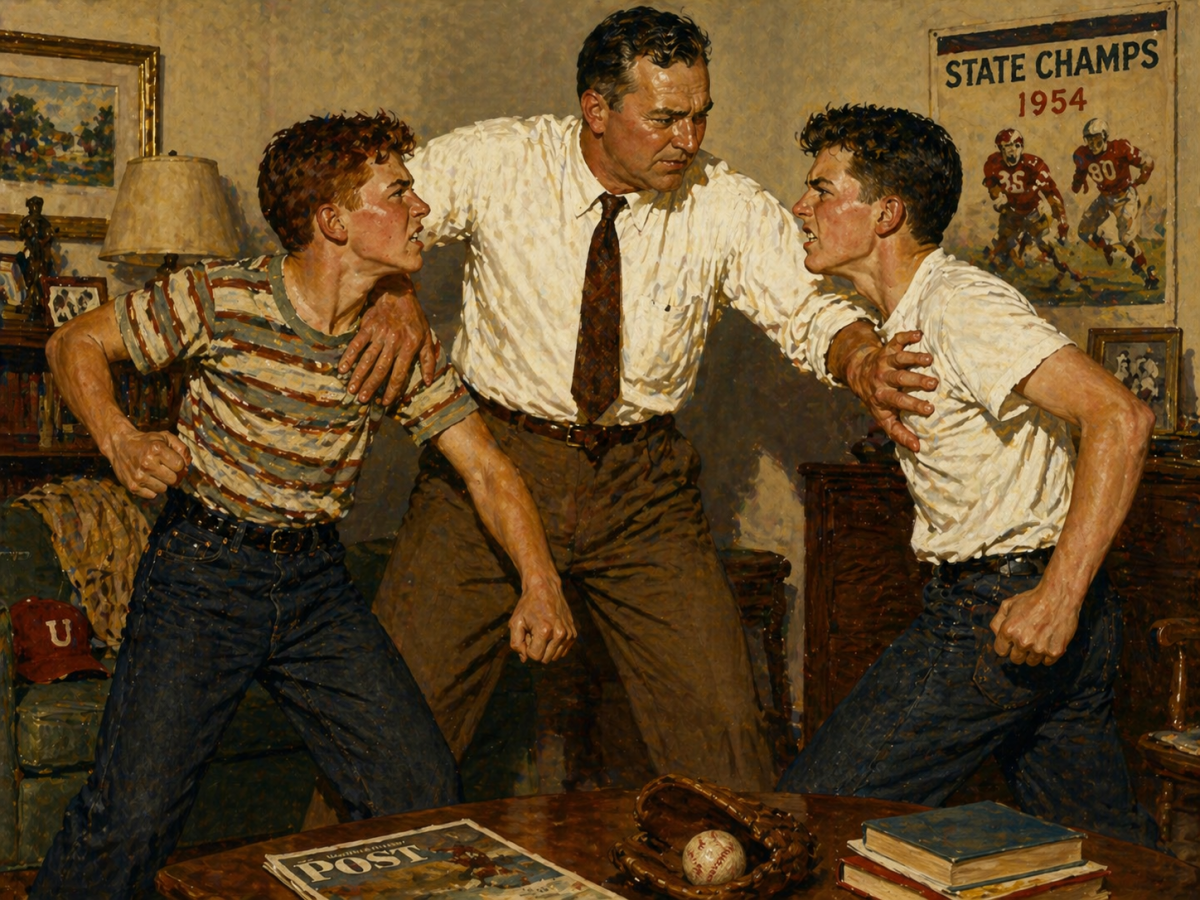
My brother and I fought a lot when we were kids. I was older and bigger, but he was a better fighter, so most of the time nobody won, and fortunately, nobody got hurt, except when our dad caught us in the act. As kids usually do when a parent breaks up a fight, we’d point at each other and say, “He started it!”
We had no idea we were appealing to Just War theory, but that’s how the theory works: a just cause for war is required (whoever gets hit first gets to hit back), and the war must be fought justly (don’t hit too hard or too much—a “proportional response,” as we say). And the resolution must be just (restorative, but not punitive). Even as pre-teens, we knew we weren’t supposed to do any real harm to each other—just enough violence to end the dispute, followed by a reconciliation that would last until the next time.
Our dad was a veteran of D-Day. He went ashore at Normandy with George Patton’s Third Army, and he had no illusions about what war actually involves. He had no sense of humor about fighting either. There was no “boys will be boys” for us. We’d have to “kiss and make up.” But at that moment when we were blaming each other for striking first, he’d cut in and say, “I don’t care who started it!” As we had appealed to Just War Theory to exonerate ourselves, both claiming to be on the side of justice, so he dismissed the whole idea as nonsense.
Years later, when both of us had come home from Vietnam, we understood why he’d always responded to our fights the way he did, and why he didn’t care who’d started it. We’d learned first hand that “just war” is an oxymoron—an elaborate attempt to rationalize an activity that cannot be rationalized. Some wars are unavoidable; most are not. And they’re not justifiable either, even with a theory embraced by philosophical heavy hitters like Plato, Aristotle, Augustine, and Aquinas.
Related stories
Recently I happened to catch a clip of J.D. Vance speaking at a Turning Point USA event. He was trying to justify the US and Israeli war against Iran by appealing to Just War theory. Could Vance be right? Could the attack on Iran be just, or justified, by a theory? As far as I know, there was no talk before the bombs started falling, no effort to avoid violence—just a lot of chest thumping and finger pointing. Trump and Netanyahu just went for it, assuming we’d all agree that it had to happen.
Lindsey Graham claims justice is on our side because we’ve been at war with Iran since 1979, when they started it with a revolution that overthrew America’s Cold War proxy, Reza Shah Pahlavi, and established an Islamist regime. Iranians, on the other hand, would tell Graham that if there is a war, we started it in 1953, when MI6 and the CIA organized a coup that overthrew Iran’s legally elected prime minister, Mohammad Mossadegh, and placed Pahlavi in power, both to frustrate Soviet ambitions, and to keep Iran from nationalizing the assets of the Anglo-Iranian Oil Company.
Trump and Netanyahu tell us that Iranians have been chanting “death to America, death to Israel” since 1979, but hostile posturing is not war, or cause for war, even if it was usually enough for my brother and me to start throwing hands. Americans are still angry about the hostages taken in the revolution and held for over a year, and Iranians are still angry about the overthrow of their legitimate government to set them up as a Cold War pawn, and to protect the interests of a foreign corporation, not to mention the colonization and ethnic cleansing of Palestine by Israel, with steadfast support from America.
If it really matters who struck first, there’s no mystery. American and Israeli forces attacked Iranian nuclear facilities in 2025, in violation of a treaty that Trump simply ignored. Now Americans, Israelis, and Iranians are pointing at each other and growling, “He started it!” Each claims the justice the theory requires, but historians of warfare would warn that once a war starts, all constraints are removed, and neither side will hesitate to resort to atrocity if circumstances seem to call for it. Truth may be the first casualty in war, but justice goes down right next to it.
What’s the upshot? Leaders choosing to make war like to talk about duty, honor, inegrity, national security, patriotism, courage, sacrifice, altruism, and other noble values—anything but what war is really about. They even talk about justice. But regardless of the justifications offered, there can be no place for anything worthy of the name justice in an activity whose fundamental business is to kill people and destroy their stuff. Anyone who has actually participated in a war knows this, whether they will admit it or not.
With no apologies to J.D. Vance, then, even if there is such a thing as a just war, which is dubious at best, the US and Israeli war on Iran does not qualify.
Comments

Powered by RoundtableAn AI/DeFi-powered Enterprise Media Operating System. Learn more at Roundtable.io.© Roundtable 2026. By using this site you agree to the Terms of Use and Privacy Policy