
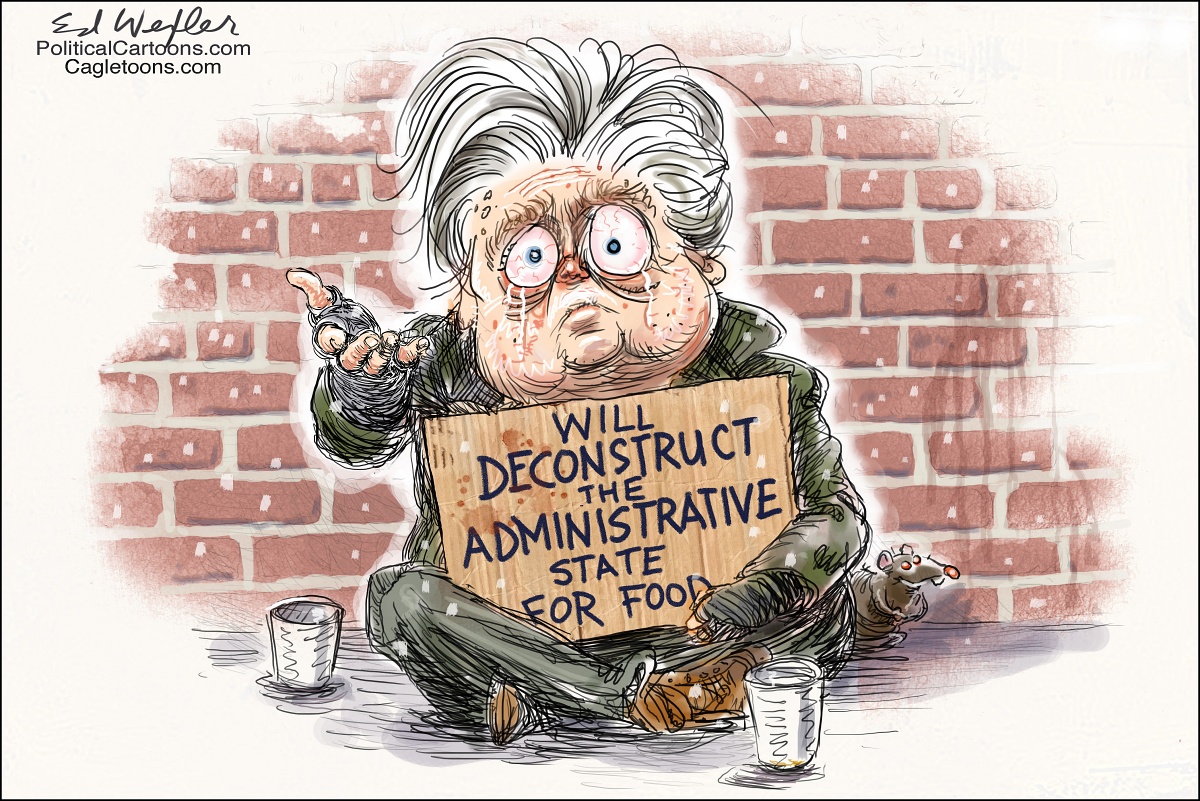


Steve Bannon Returning
Oct 24, 2024 4:57 PM
Overlord of the Dark Enlightenment is about to be released from prison.
Donald Trump’s prodigal courtier, Steve Bannon, is due to emerge from the ignominy of confinement on October 29, after serving four months at the Federal Correctional Institution in Danbury, Connecticut. No doubt he will emerge cloaked in the tattered mantle of self-proclaimed martyrdom, reforged by the fires of captivity, yet unrepentant in his allegiances. The contemptuous charge that held him there—defiance toward a subpoena in the congressional quest to unravel the tangled strands of the U.S. Capitol’s stormed battlements—will hang upon him as a badge of dubious honor.
For “political prisoner” Bannon, there will be no regret, only a strange pride in his ordeal, a twisted victory in his incarceration. He will stand resolute, a knight of some dark court, proclaiming himself a bulwark against the forces that sought to confine him, an avenger rallying in the wake of what he perceives as a battle far from over.
Bannon will soon be back at the helm of his popular War Room podcast, a protected sanctuary where the Trump-whisperer’s cabal of Republican operatives concoct legislative potions infused with the elixir of cultural warfare, pandering to the whims of Trumpian loyalists with red meat and hot-button issues.
In his absence, Bannon marshaled a formidable battalion of nearly twenty guest hosts to keep the fires of his War Room podcast blazing. With relentless fervor, they carried the torch of his unyielding, pro-Trump narrative, churning out a steady stream of partisan patter.
Related stories
Bannon’s history requires some refreshment. In 2016, he fortified Breitbart News, the arch-conservative publication he helmed, into a relentlessly pro-Trump tool. After the election, he joined Trump as a senior White House aide. During his tenure as the White House chief strategist, Bannon was infamous for his expansive whiteboards crammed with meticulously detailed lists of objectives—objectives which were thwarted by a confluence of judicial rulings, congressional roadblocks and internal disarray. The architect behind Trump’s America First crusade, Bannon found himself unceremoniously ousted from the echelons of power after a mere seven months. His forced exile from the White House marked not the demise of this ideological juggernaut, but rather Bannon’s ascent to omnipresent media menace, casting a pall over the global stage that still lingers today. Reports whispered of tumultuous clashes with the President’s kin, Jared Kushner, and other luminaries of Trumpian counsel. Trump himself bristled at Bannon’s audacious claims to the laurels of electoral triumph, while accusations of clandestine dealings with the press—not uncommon in the DC circuit—swirled in the political maelstrom. With a defiant flourish upon his return to the helm of Breitbart, Bannon’s declaration echoed through the corridors of political power: "I've got my hands back on my weapons," he said. "It's Bannon the Barbarian."
Despite Trump’s bravado in claiming sole credit for his electoral coronation, the scroll of victory bore the indelible wax seal of Steve Bannon’s brain, whose iconic strategy and subterfuge played a major role in Trump’s ascendence to the White House throne. Yet, as time unfurled, Bannon found himself ensnared in the web of justice, facing legal retribution for his defiance before the January 6 Committee, tasked with unravelling the dark web of insurgency that gripped the nation’s capital in its icy, treasonous, embrace.
Earlier, a federal case had emerged against Bannon, with New York prosecutors accusing him and three associates of swindling donors out of over a million dollars in a fundraising campaign ostensibly designed to support Trump’s border wall. Trump pardoned Bannon during his final hours in office. Despite their estrangement, Trump was keen to extend clemency to his erstwhile advisor, having rekindled their alliance as Bannon amplified Trump’s election conspiracy narratives.
According to Doyle, Bannon’s War Room offered him a vehicle to re-enter Trump’s inner circle, championing the push to overturn the 2020 election and Trump’s baseless claims of rampant fraud. He used his podcast to fight against the former President’s enemies in Congress and within the Republican Party itself. Since then, Bannon has emerged as one of Trump’s most aggressive zealots, largely due to his ‘War Room’ show. He has meticulously crafted this platform to rally the grassroots of the Republican Party to the ballot box in November, mainly through a mixture of intellectual swashbuckling and his signature rascality.
Bannon’s flair for messaging is evident, yet he envisions the show as more than just a megaphone for rallying cries; he sees it as a serious forum for discussing policy and ideas. Doyle describes how the show fosters skepticism on topics like artificial intelligence, vaccines, global trade, China and foreign wars, urging listeners to engage at every level of the political process. Trump remains the ideological weathervane, guiding the discourse and direction. Some claim Bannon is creating a shadow party within the GOP, a subterranean force aiming to reshape the political landscape from within through the ethereal whispers of New Thought and the arcane incantations of Chaos Magick to the shadowed corridors of Julius Evola’s far-right esotericism and the mystic dogmas of the Traditionalists.
Bannon’s hourlong ‘War Room’ podcast episodes are broadcast at least twice daily. A recent study by the Brookings Institution has crowned Mr. Bannon’s show as the leading purveyor of false, misleading and unsubstantiated statements among political podcasts. According to Stuart A. Thompson of The New York Times, ‘[r]esearchers at Brookings downloaded and transcribed 36,603 podcast episodes from 79 political talk shows that had been released before January 22, 2022. When researchers compared the shows’ transcripts against a list of keywords and common falsehoods identified by fact checkers, they found that nearly 20 per cent of Mr. Bannon’s ‘War Room’ episodes contained a false, misleading or unsubstantiated statement, more than shows by other conservatives like Glenn Beck and Charlie Kirk. Overall, about 70 per cent of the podcasts reviewed had shared at least one false or misleading claim, the researchers found. Conservative podcasters were 11 times as likely as liberal podcasters to share a claim that fact-checkers could refute.’
According to Bannon, Americans should rally behind the ‘anti-woke’ Russian President Vladimir Putin, a figure renowned for his staunch anti-LGBTQ stance. Bannon extolled Putin mere hours before the Russian leader commenced his invasion of Ukraine. His praise followed similar commendations from Trump and other conservative voices. ‘Putin ain’t woke. He is anti-woke,’ Bannon declared to private military contractor Erik Prince during a broadcast. ‘The Russian people still know which bathroom to use,’ Prince concurred. Putin is infamous among global human-rights organizations for his vehemently anti-LGBTQ policies.
The makeshift nature of Bannon’s War Room podcast, with its glitchy audio and buzzing phones, lends an air of absurdity to the proceedings, evoking visions of ‘Father Coughlin stumbling into Wayne and Garth’s basement’ according to Jennifer Senior.
In the tangled recesses of Steve Bannon’s mind, there swirls a tempestuous amalgam of esoteric philosophies, a grim confluence where the gnostic visions of Norman Vincent Peale, the Trump family’s own apostle of positive thinking, intersect with the arcane wisdom of Manly P. Hall and the sinister allure of Julius Evola, the fascist muse and Nazi sympathizer. These are squeezed alongside the perverse metaphysical doctrines of René Guénon, the French-Egyptian sage who forged the spiritual underpinnings of Traditionalism. Looming in this shadowy congregation is also the contemporary intellectual specter of Aleksandr Gelyevich Dugin, the fascist Russian philosopher and geopolitical theorist adored by Putin.
Bannon, a scion of Latin-speaking Tridentine Catholics, traversed a path strewn with accolades from private military academies to the ivy-clad bastions of academia, culminating in a dizzying ascent through the maze-like catacombs of political power. A polymath of sorts, he donned the mantle of a naval officer, adorned the finery of investment banking and tread the boards of Hollywood as a producer before etching his name indelibly upon the annals of media as co-founder of Breitbart News. Now, a luminary in the realm of podcasting and ultra-masculinist media jocksniffery, Bannon’s pale, grubby visage, atop his trademark ensemble of multi-shirts and barn coat, has become both a caricature and a symbol of his enigmatic presence.
The War Room’s rotating cast of loyal emissaries ensured that Bannon’s vision—a world painted in stark reds and blues, with no shades in between—is cast right out of the propaganda mills of the Third Reich. Zachary B. Wolf described a conservative gathering featuring Steve Bannon as speaker. ‘Are we at war?’ Bannon demanded of the crowd, his voice slicing through the air. ‘Is this a political war to the knife?’ The phrase, steeped in historical resonance, harks back to a pro-slavery newspaper from the era preceding the American Civil War. Its invocation was deliberate, laden with the weight of conflict and division, evoking a time when the nation stood on the precipice of its most devastating internal struggle.
In the cavernous chambers of his War Room podcast, Bannon’s oratory unfurls like billowing clouds, heavy with accusation and insinuation. A colossus in the eyes of his fervent disciples, Bannon’s bloviating sway extends across a diverse spectrum, from the earnest truth-seekers to the axe-grinding zealots and conspiracy mongers. Yet, behind the veneer of his charismatic charm lies a mind honed in the art of manipulation. Cunningly cloaked in the garb of conspiracy cognoscenti, Bannon deftly maneuvers through the labyrinth of public discourse, wielding his Harvard and Georgetown pedigree like a two-edged sword.
Bannon has transformed his War Room into a space where the gratuitous violence of his fellow conspiracy peddlers can be celebrated and where lamentations for the lost tribe of America’s great leaders can be voiced through billowing vapors of disingenuousness. It is a space where Trump is the measure of all things orange and beautiful, a space of deception, a diversion from the narrative cultivated by the mainstream media that Bannon is a figure of pompous self-importance draped in the tattered cloak of Gothic melodrama. It is a trompe l’oeil, a devilish illusion designed to cover up the fact that Bannon and Trump ooze the same decrepit odor of shamelessness, of egomaniacal cunning, of boorishness, of mean-spirited destructiveness under the thrall of self-delusion and in the service of personal power.
Bannon thrives in this environment, excelling at re-imagining history and challenging the conventional wisdom of US involvement in the affairs of other nations. His audience, preconditioned and eager for his madcap ravings, is ever ready to fracture the social structures founded upon Enlightenment ideals. Each crack and fissure that he induces brings him closer to his medievalist vision—a vision where the dark allure of his polemics garners a fervent following, from America’s rural heartlands to the corridors of power along K Street, positioning him as the nation’s preeminent political miscreant.
In his sinister transformation, Bannon is not merely a puppet master of discontent but a disguised embodiment of the cranky old uncle you try to tolerate at Thanksgiving dinner. But unlike our cranky old uncles, Bannon commands millions of devout followers. This dichotomy of harmlessness and menace encapsulates his strategy: to cloak conservative radicalism in the guise of tradition, to rally a disillusioned populace around a banner of nostalgic extremism and to march them inexorably toward his dystopian dream of a Francoist-like (i.e., Catholic dictatorship). Francoist repression claimed the lives of between 30,000 and 50,000 souls, a grim testament to the era’s brutality. In 1937, Franco seized the severed hand of Saint Teresa of Avila, the revered Doctor of the Catholic Faith, and kept it beside his bed until his death in 1975. This relic, thankfully now returned to the nuns of Nuestra Señora de la Merced in Ronda, Spain, resides in a darkened, locked room, enshrined within a silver glove adorned with precious stones.
Franco’s act of stark hypocrisy and deliberate sacrilege stands as a potent symbol of the inhumanity of right-wing demagogues throughout history. Teresa of Avila is a saint known for transforming self-centeredness into other-centeredness, a feature that Bannon would find incomprehensible, although he would very much like to align himself with the Catholic saints and the Tridentine Mass.
Bannon, in his own words, wants to ‘weaponise’ the type of people who write into comments sections of stories—and turn them into his ‘posse, cadre or vanguard’ of deputized agents who have come to love the online personas they have carefully manufactured but who in real life are more likely to be frustrated geeks or incels. This makes Steve Bannon a very dangerous man.
Bannon has called on people who are critical of Christian nationalism to be ‘purged’ from the US. This proclamation echoes Trump, who bragged about building detention camps for mass deportations of migrants. Who will be next? According to Jeffrey C. Alexander, ‘Bannon’s ideology is constructed around binary codes and temporal narratives, the former deeply othering, the latter dangerously, frothingly apocalyptic. At the core of Bannon-ideology is a series of extraordinarily simplistic contrasts between good and bad, sacred and profane. This series creates dangerous others whose continuing existence threatens the good folks who make up what Bannon describes as the “real America.” These ‘others’ include immigrants. As Alexander notes, ‘Bannon heaps scorn on non-white immigrants—Hispanic, East Asian, South Asian—and purifies the people he describes as “native Americans.” This fantasy category most definitely does not include our nation’s actual natives, America’s indigenous ‘Indians,’ much less the most culturally “American” racial and ethnic groups of all, African-Americans.’
Disturbingly, when Bannon discusses whom he regards as the big thinkers, ‘he gestures admiringly to fascists, bigots, dictators and theocrats’ such as Charles Maurras, ‘the rabidly anti-Semitic French Catholic political intellectual; fan of Mussolini and Franco; leader of the “anti-Dreyfusards” who persecuted the Jewish army captain falsely accused of treason’ and Julius Evola, ‘Italian professor at the weird but aptly named ‘‘School of Fascist Mysticism’’; ferociously anti-Semitic; intellectual and spiritual advisor to Mussolini; god father of the Racial Laws that sent thousands of Italian Jews to their deaths in the late 1930s.’
A figure evocative of bygone eras, Bannon orchestrates a resurgence of ideological specters thought long interred. Bannon loves to invite guests who condemn ‘woke’ liberal culture—transgender rights, LGTBQ rights, voting rights, cancel culture and critical race theory, the current bugaboos of the Republican right. Bannon is joined at the hip with the Tea Party as far as the culture wars are concerned. From transgender rights to voting rights, Bannon and the Tea Party stand united against what they perceive as the encroachment of progressive ideals. Yet, amidst Bannon’s bombast lies a deeper truth: a calculated manipulation of fear and uncertainty aimed at galvanizing support for his vision of a world order rooted in tradition and hierarchy. In Bannon’s world, chaos is not a threat but a promise, a means to an end in his relentless pursuit of power and influence.
Steve Bannon’s vision stretches far beyond Election Day as he eagerly enumerates a litany of priorities for the MAGA movement. His ambitions, notes Wolf, are grandiose and unyielding: severing financial aid to Ukraine, executing draconian cuts to government expenditures, initiating the dismantling of the Federal Reserve, fortifying the southern border with an impenetrable seal, deporting a staggering 10 to 15 million individuals and dismantling the administrative state piece by piece.
Steve Bannon likened Donald Trump’s infamous escalator descent to announce his White House candidacy to ‘Triumph of the Will,’ the notorious Nazi propaganda film crafted by Leni Riefenstahl, according to the book, ‘Insurgency: How Republicans Lost Their Party and Got Everything They Ever Wanted,’ by Jeremy W. Peters. Riefenstahl is best remembered for ‘Triumph of the Will,’ her cinematic opus on Hitler, centered on the 1934 Nuremberg Nazi Party Congress. As Trump descended the golden escalator of his New York skyscraper to announce his presidential bid, Jeremy W. Peters notes in his book that this iconic film ‘flashed’ through Steve Bannon’s mind: ‘Triumph opens with a shot of Hitler’s aircraft high above Nuremberg as it begins descending through the clouds…. When it touches down in a field, the massive crowd that has assembled to greet their leader rejoices. Hitler smiles as he drinks in the adulation…. Bannon thought that Trump’s entrance looked strikingly similar and that he was witnessing someone with an uncanny sense for manipulating public perception.’
Bannon’s rage is, in large part, fueled by his disdain for the Baby Boomer generation. Bannon fervently believes that this generation has undermined the capitalist system and, in so doing, destroyed the system of values that led their parents out of the hardship of the Great Depression and World War II. He decries the left’s socialist values that he believes encourage dependency on the government, sounding very much like Margaret Thatcher and Ronald Reagan. Guilford and Sonnad cite Edmund Burke, an influential 18th-century Irish political thinker, as a philosopher who has influenced Bannon in his declamations against the ‘liberal, secular, global-minded'elite'—those progressive leftists whom Bannon believes have egregiously shirked their Judeo-Christian heritage that built the US and cast aside their ‘Burkean responsibility by abandoning the tried-and-true values of their parents (nationalism, modesty, patriarchy, religion) in favor of new abstractions (pluralism, sexuality, egalitarianism, secularism)’ and in this account Bannon sounds very much like Tea Party Republicans. He sees immigrant labor as profiting the globalist elite, both in terms of profits and votes. According to Bannon, we are in the ‘Fourth Turning’ (prophesied by Neil Howe and William Strauss in their book of the same title) that followed the American Revolution, Civil War and the Great Depression/World War II, and now are facing the prospect of a major conflict with Islam. Bannon views immigrant labor as a dual boon for the globalist elite, benefiting them both in terms of profits and political support.
Bannon is an apocalyptic thinker who despises incremental change. A historical determinist, he falls for the pseudo-science of generational upheaval proposed by William Strauss and Neil Howe in their book The Fourth Turning. Alexander notes that, for Bannon, ‘victory in the climatic struggle will pave the way for reactionary policy and belief about property, class, immigration, race, religion, nationalism, gender and sexuality. Victory would turn back the clock to good old American time when Americans really were God’s Chosen People.’
When Bannon proclaims, ‘I want to bring everything crashing down, destroying all of today’s establishment,’ Bannon is referring to demolishing what he calls the ‘Administrative state.’ Those who occupy the ‘dark side’ of this state, whom he refers to as ‘the Beast,’ voraciously feasted on the generations of liberals throughout the 20th century. Only the far right and Ronald Reagan could defeat the Beast, which they did when Reagan won the Cold War. But the Beast, according to Bannon, has grown stronger and once again threatens the ‘real’ America with woke culture.
Bannon is smart enough to know better, but he has found himself living in a narrative of his own creation, rubbing shoulders with lesser intellects who possess the power to elevate him further into the stockyards of political power that he never dreamed possible.
If Bannon’s ideological compass is accurate, it portends the institutionalization of the megalomania of the leader, authoritarianism, intolerance, inequality, injustice and violence against any and all outsiders deemed secularists, cosmopolitanists, communists, liberals, gays, migrants and others Bannon assumes are the ‘face of evil.’ His narrative perfectly suits a disgruntled and enraged data-streamed population in the age of social media and artificial intelligence, where algorithmic ideologies premised on live feedback can be perfected by commercial codemakers adept at computer programming and who are willing to sell their overshared souls.
Bannon is counting on a disaffected, burned out, always Twitter-skimming populace in the thrall of work-life crises joining him in creating an Ultimate Fighting Championship culture based on taunts and personal attacks, often related to race and religion, and the thrill of crushing social justice warriors and the woke liberal elites.
His peculiar blend of intellectual eccentricity, in some ways sets Bannon apart from the cacophony of gospel-shouting, truth-bending, rage-fueled demagogues that animate Trump’s base of fervent followers. His affinity for the ‘trad'Caths'—stanch adherents of traditional Catholicism—serves as a badge of distinction, a shield against the chaotic chorus of election-denying, gospel-screeching, fact-compromised, pathological, rage-tweeting, putschist, despotic, pandemic-denying fascists who populate Trump’s wide-ranging, calamitous base.
Bannon’s self-styled image as an apocalyptic prophet, combined with his vitriolic critiques and inflammatory rhetoric unleased with a Medusan fury, paint a portrait of a man who sees himself not just as a political strategist but as a harbinger of radical transformation, someone who, upon his death, expects a barrow to be erected in some promontory in his honor. His rhetoric and actions suggest a deep-seated belief in the necessity of upheaval to restore what he perceives as lost virtues and to combat the perceived threats posed by globalism and modernity. Through this lens, Bannon emerges not merely as a provocateur but as a figure who seeks to redefine the American political landscape by resurrecting a mythic past and ushering in a contentious future.
It should come as no surprise that Steve Bannon commands a passionate following among the adherents of the Great Replacement and Great Reset conspiracy fantasies. These narratives find an unholy resonance in contemporary political culture where ‘Sieg heil!’ is to be replaced by an outward respectability, although for the hyper-active Bannon, that will prove to be a formidable struggle. How many will heed the call for a refurbished fascism? This question arises at a time when the far-right militia movement is mobilizing, armed and ready. When more Americans, and young people worldwide, are susceptible to the allure of hate. (Take notice if your neighbors start sporting ‘fashist’ high-and-tight haircuts—long on top and shaved on the sides – sometimes known as the Edwardian, the Breitbart, the Grace Jones, the Prussian Army or the Park Slope).
Bannon himself is neither stupid nor foolish—nor, for that matter, earnest. He exercises his charm through cultspeak, by pretending to be part of the conspiracy Illuminati, by charming his opponents with dime-store intellectual banter (embarrassing for a Harvard and Georgetown graduate) and by appearing earnest when he is the most crookedly deceptive. Yet beneath this tempestuous facade lies a darker undercurrent, a megalomania tinged with a malevolence that threatens to rend the fabric of American democracy asunder.
Jennifer Senior has written about Steve Bannon with stunning alacrity and insight: ‘He says he has five phones, two encrypted, and he’s forever pecking away, issuing pronunciamentos with incontinent abandon—after midnight; during commercial breaks for his show, War Room; sometimes while the broadcast is still live.’ He’s obviously a busy man. Bannon’s character is perfectly suited to what she calls ‘this id-favorable internet age.’ And she is correct. Of his character, she writes: ‘The chaos and the focus, the pugnacity and the enthusiasm, the transparency and the industrial-grade bullshit. Also, the mania: logomania, arithmomania, monomania (he’d likely cop to all of these, especially that last one—he’s the first to say that one of the features of his show is ‘wash, rinse, repeat’). Garden-variety hypermania (with a generous assist from espressos). And, last of all, perhaps above all else, straight-up megalomania, which even those who profess affection for the man can see, though it appears to be a problem only for those who believe, as I do, that he’s attempting to insert a lit bomb into the mouth of American democracy.’
Senior notes how Bannon advocates the ‘precinct strategy’ (first developed by the Republican lawyer Dan Schultz, which encourages interested citizens to sign up for the grunt work of elections) to advance his agenda, which is to hoodwink ordinary citizens and convince them to ‘work the system’ on behalf of Republican lies and therefore become loyal compatriots of his ‘citizen army.’ Bannon is brilliant at this kind of grassroots scheme, and his show is a goldmine for Republican fundraising.
It is bad news for democracy-loving Americans that the Dark Enlightenment, or neo-reactionary movement, often abbreviated as NRx, has emerged as an ominous force with DARK MAGA, weaving an anti-democratic, anti-egalitarian web of reactionary philosophy. Conceived by Curtis Yarvin, an American software engineer blogging under the alias ‘Mencius Moldbug,’ and further refined by English philosopher Nick Land, this ideology serves as a stake in the heart of modern democratic values. In his 2012 online manifesto, Land denounces democracy and invokes libertarian thinkers like Peter Thiel, who famously contends that freedom and democracy are fundamentally ‘incompatible.’
The Dark Enlightenment’s shadow stretches further, entwining with white supremacist and anti-immigration factions such as the VDARE Foundation. As highlighted by the Southern Poverty Law Centre, VDARE serves as a platform for the more intellectually inclined leaders of the anti-immigrant movement to disseminate their views, perpetuating a cycle of exclusion and division. Steve Bannon, ever the connoisseur of radical thought, a far-right conjuror of post-truth devilry and celebrity Republican spellcaster, has aligned himself with the Dark Enlightenment, embracing its tenets with unique fervor. In this bleak landscape of ideological warfare, Bannon seeks a kinship with those who wish to dismantle the pillars of democracy, casting a long, foreboding shadow over the future.
As Trump lurches closer to a possible second term, Bannon stands atop the political firmament as a political operative who embodies the ‘dark triad,’ that includes psychopathy (a lack of empathy), narcissism (excessive self-absorption) and Machiavellianism (the belief that the ends justify the means), and who has an ideological affinity for mixing occultism and political science.
While Bannon may not go the full Monty when it comes to QAnon reports that Democrats from the ‘Hollywood elite’ are pedophiles kidnapping children whom they rape and then skewer on a spit after harvesting their adrenochrome and mixing it into a potent Moloko Plus with which they toast Satan, he does little to quash such reports. In Bannon’s court of opinion, dialogue is deemed obsolete, replaced by the swift stroke of judgment, unyielding and final.
To dismiss Bannon solely as a cookie-cutter villain or an evil genius would be to overlook the complexities that summon our natural susceptibility to intrigue. Bannon is, first and foremost, an eccentric politico, his philosophical fabric deeply imbricated in the writings of various masters of the occult. When he isn’t busy trolling otherworldly spirits, one might imagine him shuffling about his penthouse apartment in a cotton waffle bathrobe and rubber flip-flops, unshaven and engrossed in tomes on tantric sex magic and Wicca.
Bannon’s infatuation with Julius Evola is not uncommon among fascists. Born amidst the splendor of Rome to a lineage steeped in nobility, Baron Julius Evola epitomized the paradoxes of tradition and rebellion, bespoke a disdain for Christian dogma, and embraced Italy’s primordial ethos, entwined with the sinews of Roman paganism. His literary pursuits drew him deep into the arcane worlds of occultism and philosophy. He penned extensive treatises on Eastern religions, alchemy, sexuality, politics and mythology, casting a wide net over the esoteric and the forbidden. His journey took a darker turn as he collaborated with the SS Ahnenerbe in Austria—Himmler’s cadre of Nazi intellectuals intent on proving the supremacy of the ‘Aryan’ race. Yet, like a specter, he evaded retribution after World War II, facing trial only once in 1951 for his fascist ideologies and slipping through the grasp of justice for lack of evidence.
Similar to his hero, Evola, Bannon’s vision is one of a return to a world of communal belonging, a Volksgemeinschaft, where the sacral nation is reborn through the purification of its racial lines. His polemical path is one of mythic restoration, a quest to revive a nationalistic utopia that draws heavily on the aesthetics and ethos of a mythical past. Bannon’s dream, much like that of his European counterparts, is steeped in the romanticism of an idealized history, where the nation is a sacred entity, untainted by the amalgamation of diverse identities, as seen in the occult dimensions of Nazism.
Bannon’s self-aggrandizing delusions that he is a modern-day Evola have helped him craft his appeal to the fringes of political thought that are symptomatic of a deeper, more insidious trend in contemporary politics. His vision, however muddled and malevolent, taps into the anxieties and discontents of the age, offering a dark mirror to the tumultuous landscape of our times. Bannon’s influence is not merely a testament to his own cunning but also to the vulnerabilities and fears that he so adeptly manipulates. His vision, a stark reversal from democratic enlightenment to a fashionable feudal tableau, adorns the landscape with neo-medieval fiefdoms, where the yoke of ritual and obedience weighs heavily, relegating dissenters—the ‘woke,’ the liberal, the marginalized—to stocks and chains.
Bannon beckons us to forsake the annals of history, embracing instead a mythical consciousness that enwraps the trajectory of universal narrative in the hues of the American flag and places democracy on the slaughter bench of history. His ambition: to dismantle the sepulcher of modern epistemology, erecting in its stead an occult agora, shrouded in the fog of historical amnesia, a studied forgetfulness and cultivated ignorance surrounding the contributions of American figures who fought for social justice.
In the shadowy recesses of Himmler’s notorious SS-Schule Haus Wewelsburg, festooned with esoteric emblems, Bannon finds kinship.
We are in a time of national crisis. Bannon is making headway by claiming the United States is not a democracy but a Constitutional Republic. He will twist the notion of Constitutional Republic to bring it in line with his fascist politics, and millions of his listeners will be deceived. The Republicans, with the help of QAnon crazies and non-compos mentis podcast perpetrators, are going to galvanise the vote for those who are bent on turning our government into a hurricane of hapless haranguing hacks.
Bannon has his pudgy finger on the pulse of the country because he has supplied the arteries and veins of public opinion with a toxic form of haemoglobin. He has oxygenized the country with hate. Bannon is confident: ‘We will show full-spectrum dominance in November. We will run the tables on those feckless Democrats; we will fieldstrip these clowns. Trump was the tip of the spear, an armour-piercing shell.’
Bannon will likely come out of prison stronger and more popular. Annie Karni of the New York Times writes: ‘Mr. Bannon, who has long reveled in his infamy, insisted that his impending imprisonment would only make him stronger. He framed it as the ultimate act of patriotism by a MAGA warrior whom the government was bent on silencing in the months leading up to the presidential election.’ Bannon concludes, ‘There’s no downside…. I served on a Navy destroyer in my 20s in the North Arabian Sea and Persian Gulf. I’m serving in prison in my 70s. Not a bad bookend.’
Karni notes that ‘Mr. Bannon’s main concern now is for the future of the movement he has helped foster through his show. There, listeners are known as ‘‘the posse,’’ and Mr. Bannon preaches to them endlessly about all of his obsessions: the lie that the 2020 presidential election was stolen from Mr. Trump, what he calls the ‘‘criminal invasion’’ of the southern border; the out-of-control federal budget; the insanity of sending aid to Ukraine; and the ‘‘uniparty’’ Republicans in Congress who have become indistinguishable from Democrats.’
Bannon would like to be one of the era’s great demolishers of liberal doctrine. But at his core, he is little more than a self-interested opportunist, a pompous, fist-pumping worldling hitching a ride on the coattails of a professional grifter, a Mr. Moneybags with an increasing girth and diminishing gift of the gab, similarly drunk on power and with an insatiable thirst for fame, sharing a Lords of the Flatbush philosophy of breaking rules, embracing action, living hedonistically, and basking in the public limelight. His idol has become the most powerful man in the world by spewing garbled, vindictive, jigsaw puzzle utterances in a lilting cadence that seems a purposeful mocking of Cary Grant’s mid-Atlantic accent (remember that Cary Grant was one of Trump’s favorite movie stars). You can speak lies and still keep your followers salivating at your every word as long as you can master the art of persuasion. Simply adhere to the following cardinal principles–never admit that you are wrong, always lie and the bigger the lie, the better; ceaselessly attack and humiliate your enemies unsparingly; make outlandish claims about your abilities and insist that you, and only you, can save a declining, decaying America. Trump is proof of that.
Despite the outcome of the 2024 election, Bannon is in for the long haul. He’s going to milk his association with Trump for all it’s worth. It’s already secured him a presidential pardon and will most assuredly earn him more pardons in the years to come, should Trump emerge victorious in November.
We must remember that history has been ravaged by political figures far less charismatic and erudite than Bannon, charlatans who have managed to exploit a contemporary zeitgeist of revenge and hate in order to wreak political havoc on an unsuspecting world.
Comments

Powered by RoundtableAn AI/DeFi-powered Enterprise Media Operating System. Learn more at Roundtable.io.© Roundtable 2026. By using this site you agree to the Terms of Use and Privacy Policy