
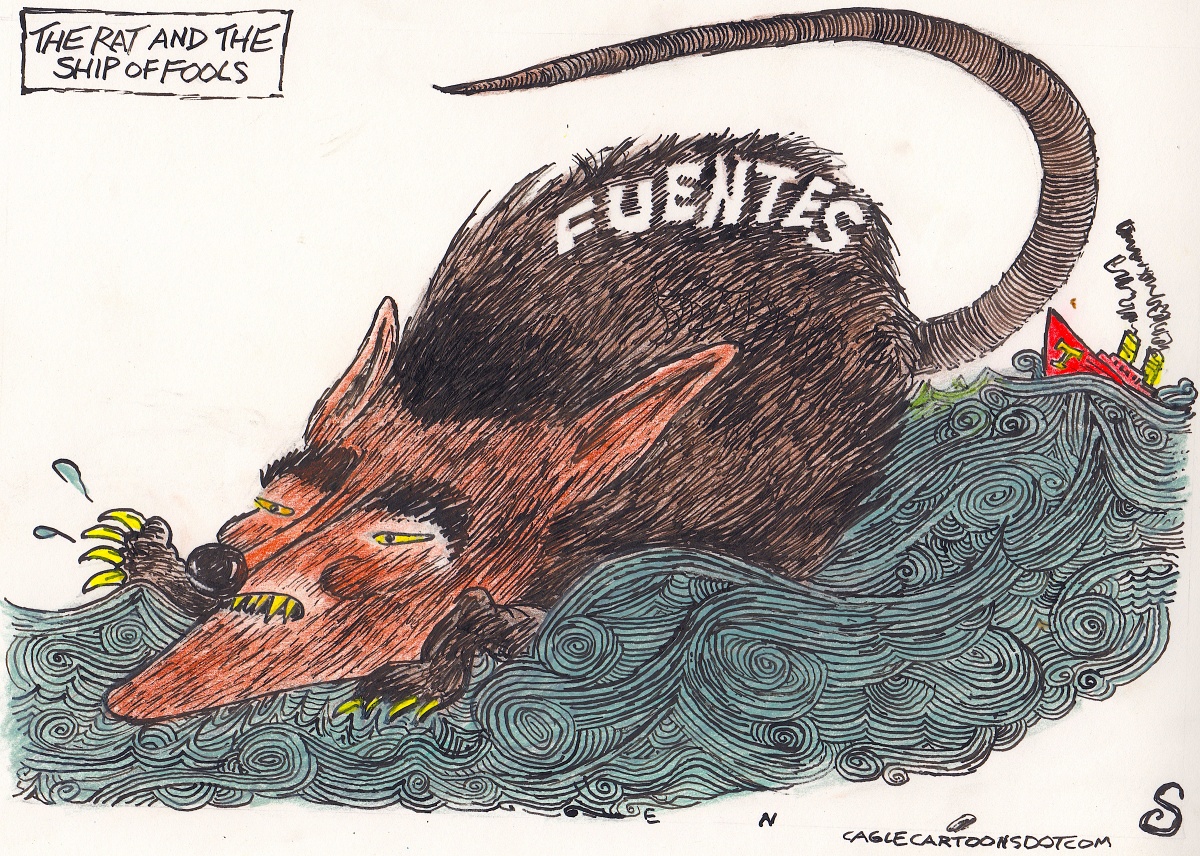
Cagle Cartoon: Randall Enos


Sep 25, 2025 9:47 PM
Updated Sep 25, 2025 9:53 PM
Nick Fuentes is the monster the American Right created: an amalgamation of internet radicalism, paleo-conservatism, and MAGA racial populism, built through years of opportunistic rhetoric and ideological recklessness.
In Mary Shelley’s Frankenstein, the monster is not evil by nature—it is a creation, stitched together from discarded parts, animated with hubris, and then cast away by its creator. The horror lies not just in the monster’s violence, but in the denial of responsibility by the man who made it.
Today, Nick Fuentes is the monster the American Right created: an amalgamation of internet radicalism, paleo-conservatism, and MAGA racial populism, built through years of opportunistic rhetoric and ideological recklessness. The Right created him, slowly adopting his views, and now, unable to control him, it scrambles to disown its own creation. But Fuentes is not just an accidental byproduct—he is an inevitable outcome.
His rise is best understood as the dark flowering of the Trump era, which swept away the old guard of Republican neo-conservatism—represented through decades of American neo-colonial, interventionist supremacy—and replaced it with a movement increasingly defined by cultural grievance, ethno-nationalism, and archaic authoritarian nostalgia.
For decades, paleo-conservatism—an ideology rooted in racial anxiety, isolationist anti-“globalism” (typically code for thinly veiled antisemitism), and religious fundamentalism—remained at the margins of American conservatism.
Related stories
For decades, paleo-conservatism—an ideology rooted in racial anxiety, isolationist anti-“globalism” (typically code for thinly veiled antisemitism), and religious fundamentalism—remained at the margins of American conservatism. Its champions, from David Duke to Pat Buchanan, were relegated to the fringes. Buchanan, in particular, attempted to lay the intellectual groundwork for paleo-conservatism’s legitimacy and reemergence in the 90s and early 2000s, yet the GOP saw him as too toxic to embrace fully. That changed with Donald Trump. In 2016, the door that had been shut for decades was kicked open, and in walked “America First”—a slogan Trump pilfered from preceding nativist, isolationist ideologues, like Charles Lindbergh, who sought to keep America out of WWII. Now “America First” has become the rallying cry for a new, emboldened Right. It is no coincidence that Fuentes chose this phrase to represent his political movement, media label and ideological banner.
The MAGA movement didn't just revive these ideas; it made them fashionable. But Trump’s brand of populism didn’t arise in a vacuum—it was accompanied by a generation of young, disillusioned men online. Platforms courting disenchanted young men like Barstool Sports, a seemingly apolitical arena for sports and pop culture, played a subtle but significant role in this transformation. In packaging anti-woke rhetoric and performative masculinity as entertainment, they laid the foundation for a broader political evolution. The so-called “manosphere” became a pipeline.
From there, audiences graduated to political influencers like Ben Shapiro and Jordan Peterson, whose veneer of intellectualism and traditional values masked a deeper undercurrent of right-wing racism and radicalism. Shapiro, alongside other youth-centered neo-conservative voices like Benny Johnson and the late Charlie Kirk—each relentlessly assaulted and belittled by legions of Fuentes’ followers today—served as gateways by helping to normalize socio-racial unrest in a rapidly shifting media landscape.
Hence, the journey rarely stopped at Shapiro and Kirk. As these young audiences grew more ideologically hungry, they moved on to louder, more explicitly racially populist voices: Candace Owens, Matt Walsh, and most notably, Tucker Carlson. Carlson, once a bowtie-wearing champion of Bush-era conservatism, rebranded himself into the most powerful voice of isolationist and nationalist right-wing media—not out of genuine ideological evolution or conviction, but calculation. As the American Right drifted further toward paleo-conservatism, Carlson followed, adapting his monologues to match the anger of a movement growing ever more radical. And for the past nine years, Nick Fuentes has been one of the primary voices responsible for fomenting this ethno-nationalistic rage—slowly compelling mainstream conservatives to adopt his messaging and, in the process, leading their audiences into his clutches.
Fuentes’ ascent is impossible to understand without recognizing the inroads paleo-conservatism made into the Trump campaign, a product of a decades-long process by paleo-conservative institutions to make their ideology mainstream. These beliefs truly got their foot inside the GOP with the help of groups like the ‘Tea Party’—a right-wing movement, born in the early years of President Obama’s first term, which combined the racist backlash brewing against America’s first Black president with more traditional Reaganite economic fearmongering against so-called ‘socialist’ policies like ObamaCare. The Tea Party was largely seen as a bridge between the neo-conservative GOP old guard and the anti-establishment paleo-conservatives.
The paleo-conservative base within the Republican party began to further crystallize and politically ascend with the rise of far-right conspiratorial movements like QAnon—which prided itself on combining anti-establishment and anti-elitist sentiments with antisemitism. These spaces propelled political figures like Marjorie Taylor Greene and Lauren Boebert, who used the dogwhistles and antisemitic conspiracies of the QAnon movement to build their political careers.
Thus, Fuentes did not storm the scene with swastikas and Sieg Heils—he was far more intelligent than that. He sought to rebrand white and Christian nationalism with polished suits and Gen Z memes that targeted the politically untapped ‘incel’ demographic lurking on internet forums like 4Chan. He launched his “America First” PAC and began courting young conservatives disillusioned with the GOP establishment. Slowly, he was molding his own Hitler Youth through his ‘Groyper Army’—a digital force devoted to Fuentes that is now making even fellow, albeit more disingenuous, paleo-conservatives like Tucker sweat.
By the time Fuentes entered the public eye near the start of Trump’s first term, he saw no need for dogwhistles. The table had already been set for him to powercharge the full evolution of the American Right to remove the KKK hood to publicly—and proudly—assert itself as an unabashedly fascist movement.
Fuentes, however, does not seek to upend the American system through a far-right coup—he seeks to colonize it from within.
Fuentes, however, does not seek to upend the American system through a far-right coup—he seeks to colonize it from within. That lesson came, in part, from failure. His participation in the January 6th Capitol insurrection, and the backlash that followed, was his own Beer Hall Putsch. Like Hitler in 1923, Fuentes came to see that brute force would not deliver power. The state cracked down. He was de-platformed, ostracized, and temporarily sidelined. But as Hitler realized after his imprisonment, legitimacy would have to be seized through the system itself before ushering in totalitarianism. Fuentes recalibrated. He took his message back to livestreams, conferences, and youth summits, where he could quietly radicalize thousands without drawing the same scrutiny—and was even being implicitly defended by mainstream GOP figures in the name of defending free speech.
While mainstream conservatives now decry his growing influence, their own evolution made it possible. The recent feud between Fuentes and Carlson, in which Carlson labeled Nick “a weird little gay kid” who was discrediting “non-crazy right voices” and leading the white working class in a very dangerous direction, is telling—not regarding a split in ideology, but of a rivalry over who gets to own it.
Carlson’s gradual shift to the populist right didn’t precede Fuentes’ rise; it mirrored it—with Carlson adopting many of Fuentes’ bigoted talking points, even if only through subliminal messaging, due to their undeniable popularity. This messaging reflected the same anxieties—about race, Christianity, immigration, and cultural decay. The difference now is one of presentation, not substance. Carlson attempts to sanitize, to couch racial radicalism in plausibly deniable dogwhistles and palatable language for suburban viewers. Fuentes says the quiet part out loud. Yet increasingly, that quiet part is no longer remotely quiet.
The monster is now speaking in mainstream tones. Ethno-nationalism and Christian nationalism are applauded in the vast majority of contemporary conservative spaces. Therefore, Fuentes does not even need to run for office, at least not right away—he needs only to keep dragging the conversation in his direction. The conservative ecosystem, desperate for youth engagement, has already handed the reins to Fuentes whether they know it or not. And the more the Right adapts to keep these already riled-up audiences, the more it will validate and integrate Fuentes’ vision.
Ultimately, Nick Fuentes didn’t hijack conservatism. He rode shotgun as it took a hard turn, offering directions all along the way. He stripped the fascist right of its most grotesque aesthetic excesses—not out of decency, but strategy—replacing them with something far more marketable to a digital, alienated, and irate generation. Skinheads may be out of fashion, but the ideology persists—repackaged, rebranded, and livestreamed nightly.
The Right can no longer feign ignorance. Fuentes is not an outsider storming the gates. He is their creation—built from their racist rhetoric, empowered by their platforms, and legitimized by their silence. Like Frankenstein’s monster, he was assembled piece by piece and then cast aside, only to return more powerful and more dangerous than anyone expected. Now, with the assassination of Charlie Kirk—the last standing popular pillar upholding old guard neo-conservatism—there is nothing left to impede the Right’s Frankenstein from total dominance.
Comments

Powered by RoundtableAn AI/DeFi-powered Enterprise Media Operating System. Learn more at Roundtable.io.© Roundtable 2026. By using this site you agree to the Terms of Use and Privacy Policy