


Feb 4, 2015 9:12 PM
Updated Feb 10, 2022 10:53 PM
Frank Fear: Many of us neither have the time nor the inclination to do that. We’re too busy, too involved in other things to make sure. So what’s passed on to us by others often passes as true—whether or not it is.
Leonard Pitts’ Column on Fox News Provokes Indignation and More
Talk about striking a nerve! Nationally syndicated columnist Leonard Pitts did just that. His January 24 column, “Fox faux news forces rare apology,” generated strong reactions from readers around the country. What did he say?
Pitts recounted a litany of mistruths broadcast by Fox News commentators. He wrote: “Tucker Carlson said more children die of bathtub drowning than of accidental shooting. They don’t. Steve Doocy said NASA scientists faked data to make the case for global warming. They didn’t. Rudy Giuliani said President Obama has issued propaganda asking everybody to “hate the police.” He hasn’t. John Stossel said there is “no good data” proving secondhand cigarette smoke kills non-smokers. There is.”
There are connections between Fox claims and controversial political matters—gun control and climate change, to name two—domains in which particular positions are preferred over others.
Related stories
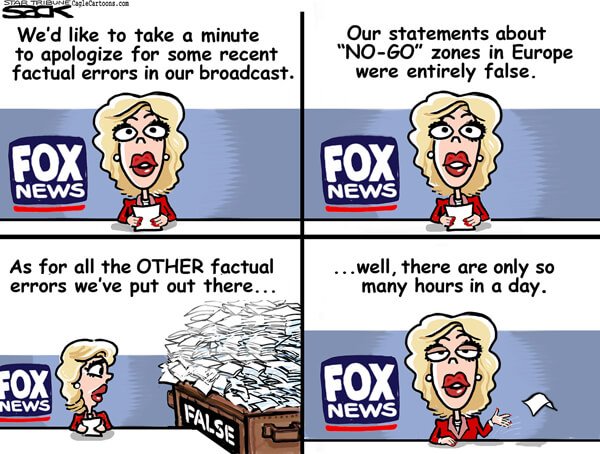
If that wasn’t enough to provoke the ire of some readers, Pitts went a step further. He offered a strident interpretation of the apology Fox News issued following another on-air gaffe. Presumed terrorism expert, Steve Emerson, claimed that there are European “no go” zones where non-Muslims don’t travel. In response, Pitts wrote: “There erupted from Europe the jarring sound of a continent laughing. British Prime Minister David Cameron called Emerson an “idiot.” A French program in the mold of The Daily Show sent correspondents —in helmets!—to interview people peaceably sipping coffee in the no-go zones.”
My local paper (Fort Myers FL News-Press) filed Pitts’ column under a response-provoking headline: “Fox continues to produce, spread untruths through arrogance.” Comebacks came quickly in comments and via Letters to the Editor. Writers said that Pitts has “liberal followers”; “lefties like to stretch it”; and “Pitts was quick to pounce (on Fox).” One writer flipped the script by arguing that Europeans, while eager to criticize the American press, have their own (and broadly unrecognized) journalistic challenges. Another writer contended that Emerson was right in what he meant, but wrong in how he said it. He should have called no-go zones “Sensitive Urban Zones.”
One public respondent fused two points of view: “Mr. Pitts may have a liberal bias, but he is not wrong about Fox News.” The writer reported data drawn from Pundit-Fact, a site where analysts rate and compare the accuracy-validity of news reports and reporters. Inaccuracy numbers (% of reports in the range of mostly false to “pants-on-fire” false) stand out for Fox-Fox News: it’s rated at 60% (reported for a period that ended January 27 2015). But the number was also high, 44%, for left-leaning NBC-MSNBC. CNN, by comparison, was evaluated as “false” 21% of the time. (See article with comparisons here.)
Pitts believes that we can get used to receiving slanted broadcast material. He writes: “It’s amazing, the things…that can come to seem normal.” And he continues by writing this:
“If you live with aberrance long enough, you can forget its aberrance. You can forget that facts matter, that logic is important, that science is critical, that he who speaks claptrap loudly still speaks claptrap — and that claptrap has no place in reasoned and informed debate.”
He’s inarguably right, of course. But making that claim only against Fox News overlooks a more onerous reality: Pitts’ statement applies more generally to the state of America 2015.
Many of us neither have the time nor the inclination to do that. We’re too busy, too involved in other things to make sure. So what’s passed on to us by others often passes as true—whether or not it is.
It’s on us. It’s on us to fact-check information we receive—from all sources. The problem: many of us neither have the time nor the inclination to do that. We’re too busy, too involved in other things to make sure. So what’s passed on to us by others often passes as true—whether or not it is.
We can’t be sure. It could be presented to us with partisan intent. That’s especially bad when the press is involved because it mocks the purpose of the 4th Estate. We think we’re getting “straight news” only to find we’ve been thrown a curve instead. We’ve been duped.
That’s an interesting word, “duped.” It means to be deceived, to be used (unwittingly) to carry out others’ designs. It’s of French derivation—17th Century, to be specific—referring to a bird, the hoopoe—an attractive, but especially dim-witted, bird.
It’s easy to be a hoopoe these days. And, sadly, it’s not just about having to cope with the news industry. It’s about having to cope with all industries. You can’t trust. You can’t assume. You can’t do anything without being aware, of taking note, and deciding—for yourself—what and whom to believe. It’s just as Pitts writes: what should be an aberration, appears to be normal.
It’s ubiquitous, lurking in places you’d never expect. Here’s an example. Last week I was watching a college basketball game. During halftime one of the schools ran a PR piece. The school proclaimed it has ”fearless ideas.” Anthropomorphizing, I thought: it makes no sense to say that ideas (inanimate objects) are fearless (a personal characteristic). When I did a Google search I found that the school had “fearless days” and that the school president had a “fearless fund” to solicit financial support. What nonsense, I thought.
Then I wondered: How many other schools use “fearless” in their branding? A quick Google search revealed there were more. One proclaimed to be “Fearless,” replete with what it called “fearless stories.” There was a list of what the school labeled, “fearless facts,” which included reference to having “over 200 degree programs” and “a rec center that is second to none in the state.” Fearless? “Accommodating” would seem to make more sense.
It’s hard to believe probably because it is unbelievable, that is, it’s not to be believed.
Perhaps more than ever (in my lifetime at least) there’s a real need to be discerning, to take a step back and consider—quite carefully—what’s being promulgated. Consider the intent: Is it what they want you to believe? Or is the message in your best interests? Put another way: Are there reasonable alternatives to what’s being communicated… alternatives that make more sense, not for the communicator only, but for you?
Sadly for America it's not just about Fox News. It's about that and a whole lot more. Sometimes we want to believe what we’re receiving; it’s a form of wishful thinking. But we sometimes don’t have the capacity to decipher and discern what we’re receiving.
An antidote would seem to be higher education—not the type that focuses on job training—but the old-fashioned kind. The kind that’s steeped in the humanities and social sciences, rich in logic and thought, reading and writing, and critical thinking and analysis. It’s the kind of education that enables you to construct and deconstruct arguments. The kind that goes beyond enabling you to answer questions; it's the kind that provokes you to question answers.
It’s the kind of education that makes it more difficult to be duped.
Frank Fear
Comments

Powered by RoundtableAn AI/DeFi-powered Enterprise Media Operating System. Learn more at Roundtable.io.© Roundtable 2026. By using this site you agree to the Terms of Use and Privacy Policy