


Feb 5, 2026 8:53 PM
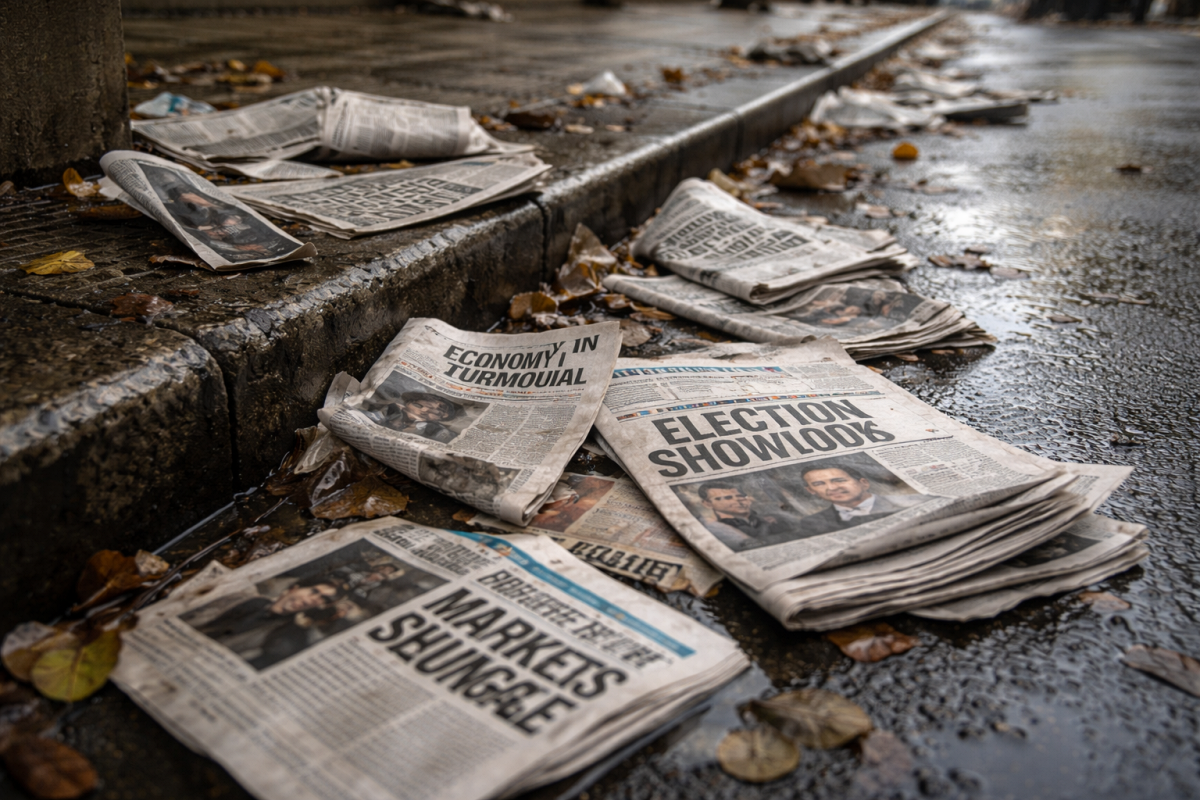
Corporate media died because it stopped doing journalism, and a new generation of outlets proved it. The readers noticed.
The Washington Post laid off a third of its workforce yesterday. More than 300 journalists received emails telling them their roles had been eliminated. The sports desk is gone. The books section is gone. The podcast is gone. And in a twist so on the nose it reads like satire, the entire Middle East desk was gutted, every correspondent, every editor, from Jerusalem to Cairo to Tehran. All of them, gone.
I weep not.
I do not say this with pleasure. I say it with the weariness of someone who has watched corporate media’s slow-motion implosion for years, and who watched it fail to meet the most basic obligation of journalism during the defining moral crisis of our time. The Post’s collapse is a symptom that corporate media has been dying for a long time, undone by a business model that could not sustain itself, an audience that stopped believing in it, and a catastrophic failure of moral courage when it mattered most.
For over two years, as Israel waged a campaign that the International Court of Justice has adjudicated as a plausible genocide, as over 260 journalists were killed in Gaza making it the deadliest conflict for the press in modern history, as hospitals were bombed and children starved, the Washington Post and its corporate media peers sanitized, minimized, and looked away. And the Post still wonders why the ceasefire declared months ago has not worked.
Related stories
They could not bring themselves to say the word genocide. They adopted the framing of the Israeli military as their own. They buried Palestinian suffering under euphemism and bothsidesism, as if the destruction of an entire people could be balanced like a budget sheet. CNN’s coverage reportedly went through Israeli military censors. The New York Times, the Washington Post, and the Los Angeles Times consistently favored Israeli narratives, deploying emotive language for Israeli casualties while treating Palestinian death as statistical background noise.
And now the Post has laid off the very journalists who were supposed to be covering the region. The message is unmistakable: the Middle East never mattered to them, not the people, not the story, not the truth.
A Model That Was Already Broken
The Post’s demise did not happen overnight. The entire architecture of corporate media has been crumbling for years. Advertising revenue has migrated to Google and Meta. Print subscriptions have evaporated. The attention economy has fractured into a thousand pieces across platforms that legacy newsrooms were too slow to understand and too proud to adapt to.
The Post lost an estimated $100 million in 2024 alone. Its subscriber base, once over three million, has contracted dramatically. Congress pulled funding from the Corporation for Public Broadcasting last year, shuttering it after fifty-seven years and forcing layoffs across NPR and PBS stations nationwide. The Pittsburgh Post-Gazette, one of America's oldest newspapers, closed rather than negotiate with its unions after the longest newspaper strike in U.S. history. Local newsrooms across the country have been hollowed out or shuttered entirely. The Pentagon announced it would overhaul the previously independent Stars and Stripes. The FBI raided a Post reporter's home. The structural assault on journalism is systemic, coming from every direction: economic, political, technological.
Half of all Americans now get their news from social media. Trust in mainstream media sits at historic lows. Younger audiences, raised on YouTube and TikTok and personalized algorithms, feel no attachment to legacy brands. The Post was not killed by any single decision. It was killed by an era that no longer needed it, or more precisely, an era that needed it to be something it refused to become.
The Rise of the Outlets That Did the Work
While the Post was failing its readers, the readers were not sitting still. They were finding the journalism they needed elsewhere, and paying for it.
When MSNBC canceled Mehdi Hasan’s show in late 2023, many saw it as corporate media silencing one of its sharpest voices on Palestine. Hasan did not disappear. He launched Zeteo on Substack in April 2024, and within fifteen months it had grown to over 450,000 subscribers, with more than 50,000 paying readers, a trajectory that outpaced many legacy outlets. Zeteo brought contributors like Naomi Klein and Greta Thunberg into its orbit, produced the documentary Gaza: Doctors Under Attack after the BBC refused to air it, and built an audience across 197 countries hungry for the adversarial journalism that cable news had abandoned.
When Jeremy Scahill and Ryan Grim left The Intercept, they founded Drop Site News in July 2024, declaring their mission to cover “power and greed” and to debunk the disinformation that corporate journalism left unchallenged. Drop Site deployed Palestinian journalist Hossam Shabat to report from inside northern Gaza, the kind of on-the-ground reporting the Post’s newsroom could have done. Shabat was killed by Israeli forces in March 2025 while doing the work the legacy press abdicated. Drop Site’s Peabody Award-winning editor Sharif Abdel Kouddous and its team of veteran investigative journalists filled a void so conspicuous that the outlet was recently given a seat in the White House press pool rotation, a remarkable ascent for an organization barely eighteen months old.
These outlets did not rise in spite of corporate media’s collapse. They rose because of it. The Intercept had already documented how major U.S. newspapers skewed their Gaza coverage. Mondoweiss continued its years-long commitment to centering Palestinian voices. Electronic Intifada persisted as a critical resource. Al Jazeera's journalists, dozens of whom were killed covering the war, did the reporting at a cost that should shame every American newsroom. Even social media, TikTok, Instagram, Bluesky, became primary theaters of truth while legacy media played stenographer to power. The first live-streamed genocide in history was documented not by the institutions that claim to hold power accountable, but by the people power was trying to destroy.
The numbers tell the story of a seismic shift. Substack now has over five million paid subscriptions across its platform, more than the Washington Post or the Wall Street Journal. More than thirty political newsletters on Substack generate over a million dollars in annual revenue each. Substack's co-founder has compared traditional media to crumbling temples, replaced by a garden of thousands of independent voices. The audience did not vanish. It migrated away from institutions that betrayed its trust and toward voices that earned it.
The Genocide That Broke the Covenant
The corporate media model was already fragile. But the coverage of Gaza shattered whatever remaining compact existed between legacy outlets and their readers.
The failure was not subtle. Over 750 journalists from dozens of news organizations signed an open letter condemning the coverage, calling out Western newsroom leaders for dehumanizing rhetoric and the dismissal of Palestinian, Arab, and Muslim perspectives as unreliable. BBC staffers wrote to Al Jazeera expressing concern over double standards in their own organization’s coverage compared to its reporting on Russian war crimes in Ukraine. CNN staffers reported internal restrictions on using the words “war crime” and “genocide.” Reporters who spoke up were disciplined or fired, a pattern documented across roughly 100 journalists who faced institutional retaliation for their positions on Gaza.
Readers could see it. They could watch Palestinian journalists broadcasting from the rubble on their phones and then turn to the Post or the Times and find the same events rendered in passive voice, stripped of context, sanitized beyond recognition. The contrast was impossible to ignore. Corporate media did not just fail to cover the genocide. It failed the intelligence of its own audience. And the audience responded by leaving.
The Darkness Was Already Here
The Post’s former executive editor called this week one of the darkest days in American journalism. I understand the sentiment, but I would reframe it. The darkest days were not this week. The darkest days were the ones when corporate media had the resources, the reach, and the platform to tell the world what was happening in Gaza and chose not to. The darkest days were when editors spiked stories, when reporters were told not to use certain words, when Palestinian voices were treated as inherently suspect. The layoffs are the consequence of these failures.
The Post’s race and ethnicity reporter Emmanuel Felton, himself laid off this week, put it plainly: “This comes six months after hearing in a national meeting that race coverage drives subscriptions. This wasn’t a financial decision, it was an ideological one.”
Corporate media died because it stopped doing journalism, and a new generation of outlets proved it. The readers noticed. They found Zeteo and Drop Site News. They found Mondoweiss and Electronic Intifada and the Palestinian journalists risking their lives on Instagram and TikTok. They found the newsletters and the podcasts and the independent outlets that did not need corporate permission to tell the truth.
The Washington Post’s motto is “Democracy Dies in Darkness.” They were right. They just did not realize they were the ones holding the curtain.
Comments

Powered by RoundtableAn AI/DeFi-powered Enterprise Media Operating System. Learn more at Roundtable.io.© Roundtable 2026. By using this site you agree to the Terms of Use and Privacy Policy