


Mar 1, 2026 7:33 PM
Oligarchs' erosion of America’s winner-take-all democracy continues in the Trump era on multiple fronts
In recent years, a number of alpha legacy media outlets have been bought–and decapitated–by some of the wealthiest men in America. These media outlets were once part of a vibrant news and information landscape, breaking investigative stories that have become part of the cultural fabric of America: Watergate, Pentagon Papers, Trump’s Hollywood Access tape, Pulitzer Prize winning journalists, the Edward Snowden exposé about NSA surveillance, exposing McCarthyism, Harvey Weinstein #MeToo coverage, all of these stories and more were launched by some of the prized media companies that are now being brought to heel by their wealthy “media plantation” owners.
Beyond the legacy media defenestration, as the news and information ecosystem has morphed with the rise of the so-called “social” media, the original dream of “internet liberation” has been replaced by the nightmare of surveillance capitalism, personal data grabs and privacy violations, and viral disinformation campaigns resulting in an increasingly toxic politics. Large chunks of the US media landscape have turned into a cesspool that violates long cherished norms of a free and responsible press. Not that the American media-scape ever fully lived up to the highest norms and ideals, but the “great free press” standard was crucial toward some measure of accountability, both at home and abroad.
Now that media standard is in freefall, and the downward slide has been abetted by a disturbing trend: the purchase of media flagships by wealthy American aristocrats. “Freedom of the press” is being rapidly replaced by “freedom of oligarchs to publish—or not—whatever they damn well please.”
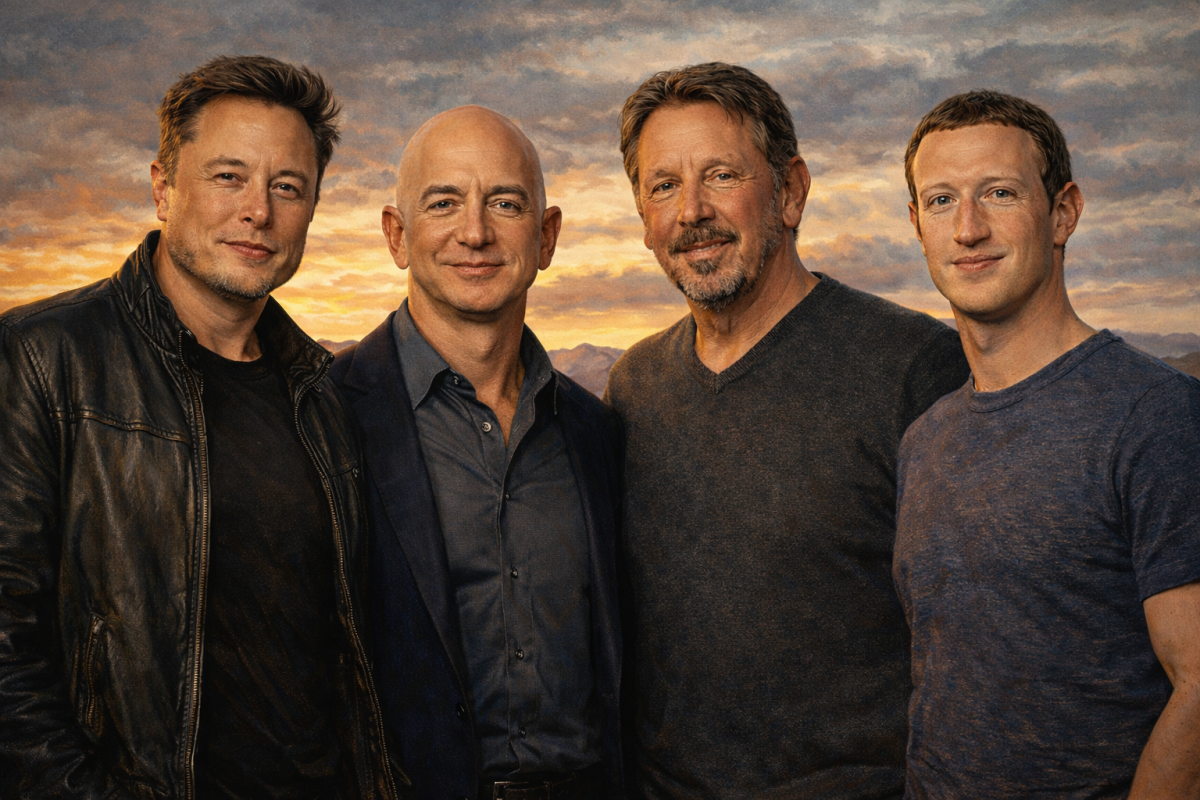
The richest man in the world, Elon Musk, purchased Twitter, and has turned it into his personal vehicle for his own toxic brand of sneering insult politics. The world’s fifth richest man, Jeff Bezos from Amazon, bought one of America’s flagship newspapers, the Washington Post, and has gutted the newsroom, circumscribed the opinion section, and handcuffed its liberties to make political endorsements. The Post is dying in the full light of day, descending into a murky Bezos-ian darkness.
Related stories
The world’s sixth richest man, Larry Ellison from Oracle, has financed his son’s purchase of Paramount, which includes CBS and 60 Minutes, and has put a conservative pundit with no broadcasting experience in charge of these media gems (it’s hardly a surprise that Stephen Colbert, one of Trump’s most popular critics, is having his show on CBS canceled). Ellison may also soon own Warner Brothers, which owns CNN. Dr. Patrick Soon-Shiong, a multibillionaire known as the “world’s richest doctor,” bought the Los Angeles Times in 2018 and has also gutted its newsroom, editorial department and stopped its political endorsements. Salesforce multi-multi billionaire CEO Marc Benioff purchased the iconic newsweekly TIME magazine in 2018.
Wealthy people have always owned the media and played an oversized role in the nation’s news and info transmission sphere. But this time seems different. These billionaire media owners are in an either explicit or tacit alliance with President Donald Trump. Mark Zuckerberg from Meta/Facebook/Instagram, Salesforce’s Benioff, and Google’s leaders also have decided it’s best to tap dance to the Trump tune. TikTok has gone from being a wholly Chinese-owned company to being part-owned by Trump ally-Larry Ellison.
The democratic world has not seen a media ecosystem in an allegedly democratic system of governance so shrink wrapped around a single powerful political figure like Donald Trump since Italy under media magnate Silvio Berlusconi. Berlusconi owned most of the private media in Italy, and then as prime minister controlled the public media as well. With his domination of the native media, the buffoonish Berlusconi perfected a campaigning method that consisted of sailing up and down the Italian coast in his private yacht, and pulling into ports where his TV stations covered his press conferences and beamed his perennially tanned face to Italians all over the country.
Italy has long been Europe’s poster child for a struggling, flat-footed democracy, and now the US is following in Italy’s footsteps. Truly, this is an alarming sign of further democratic erosion. Countries of this retrograde caliber have long been labelled as “banana republics,” but seldom have they been as militarily-armed and dangerous as Trump’s United Fortress of America. The US is falling off the cliff into a new level of dysfunction that is beyond bananas, it’s more like a Gorilla Republic.
The Pyramid of Money
The role of privately financed campaigns in US elections has never been as simple as “money buys elections,” despite many bumper sticker slogans to the contrary. Certainly one can point to numerous examples of money’s corruption of the political process going back many years – the Keating Five, the Lincoln Bedroom, and Buddhist temples becoming the stuff of political legend – but there has always been a more complex reality operating in a more under-the-radar way.
Elections based on single-seat, winner-take-all districts, whether in the US Congress, state legislatures or city councils, results in an appalling lack of competition. And the amount of campaign funds raised and spent has little impact on that reality. The fact is, most legislative districts are partisan fiefdoms for one political party or another, and it’s not usually the result of either campaign spending or the other alleged culprit, gerrymandering abuses during the redistricting process.
No, the lack of competition is a direct byproduct of where people live, with Democrats dominating in cities, Republicans in rural areas and ex-urbs, and many suburbs acting as the battleground regions populated by swing districts that decide which major party wins control of legislatures. In over 90 percent of these “me against you” legislative districts–at both federal and state levels–it’s impossible for one side to win because there are simply too many of the other side’s partisan voters living in those districts. That’s why three-quarters of House districts are won by huge landslide margins. Partisan demographics have become destiny in most legislative districts.
Given the predictability of all these elections, that reality impacts other aspects of our representative democracy, including the role that private money plays in who gets elected. For example, former Speaker of the House Nancy Pelosi represents the San Francisco district in which I lived for many years. As a heavily Democratic city, there is no chance that a Republican could ever beat Pelosi or any other Democrat in San Francisco. Pelosi won her 2024 election with 81% of the vote, she obviously did not need to spend a dime on her own reelection. That’s true also of GOP House speaker Mike Johnson, who won his 2024 race with 86% in his heavily GOP district in Louisiana. Democratic House minority leader Hakeem Jeffries won his race in a landslide of 75%, none of them needed to raise any money for their re-elections.
Nevertheless, the Big Money queens and kings like Pelosi, Johnson and Jeffries raised huge sums of money. When Pelosi was still Speaker in 2022, she raised over $25 million. Johnson as Speaker in 2024 raised nearly$20 million and Hakeem Jeffries as minority leader raised $24 million, even though they all won by huge landslide margins.
Why do they all raise so much money, one might ask, when they represent the safest of seats?
The answer: because they funnel the money into “soft money” activities to finance colleagues in the handful of hotly contested races. In the process, they buy themselves influence among their peers, as well as important party leadership positions, as their parties try to win legislative majorities.
This is the Pyramid of Money, with each party’s kings and queens sitting at the top, at the apex of the pyramid. These party fat cats target the slush flow of money to the predictably tight races, hoping to win a majority of seats for their team. On the next tier of the pyramid are more of each party’s safe-seat incumbents, who also raise way more campaign slush than they need for their own reelections. They too help fund the re-election of colleagues in more competitive races, in exchange for committee chair and other plum assignments. And then the lobbyists, lawyers, allied political action committees and high roller donors fill out the lower levels of the pyramid, funneling money into its labyrinth, where it is directed by party leaders skilled in the dark art of overseeing this crooked yet well-oiled operation. They are all on the same team, each playing their role within the Pyramid.
The Pyramid allows the targeting of a handful of undecided swing voters in battleground districts and states, as party leaders ignore the vast majority of Americans who live in winner-take-all districts and states that are lopsided landslides for one party or another. Instead, they focus like a laser on the handful of undecided battleground districts and states. Make no mistake, this has been a dysfunctional form of democracy for as long as this 236-year-old experiment in representative government has existed. But it was better than basing governance on the divine right of kings, and more or less we have been trying to make it work, however imperfectly.
Enter the centi-billionaires
A recent Substack column by economist Paul Krugman provides a blast of reality about how the extreme concentration of extreme wealth at the very top of the top of the billionaire pyramid is creating an oligarchy that not only is corrupting our politics, but (as Krugman puts it) is fomenting “a fundamental change in the way our society works.”
Krugman starts his analysis with a few numbers. First, the number of American billionaires has increased, as has the number of centi-billionaires – mega-billionaires with over $100 billion, an unprecedented level of wealth. Between 2010 and 2023, the number of billionaires increased by 85%, from 404 to 748. I find this to be a creepy statistic, as it reflects the further erosion of our New Deal society’s redistribution mechanisms, which in the past forced the wealthy to pay for their fair share of our common social safety net.
The damage from the metastasizing of so many billionaires could perhaps be contained if these billionaires were content to ride off into the sunset on their superyachts, or inside their space capsules into outer space. But unfortunately they are not.
Instead, as Krugman points out, “standard measures of political spending show an explosion of billionaire money seeking to influence American elections… the percentage of total contributions accounted for by billionaire money has skyrocketed” and he shows this chart:
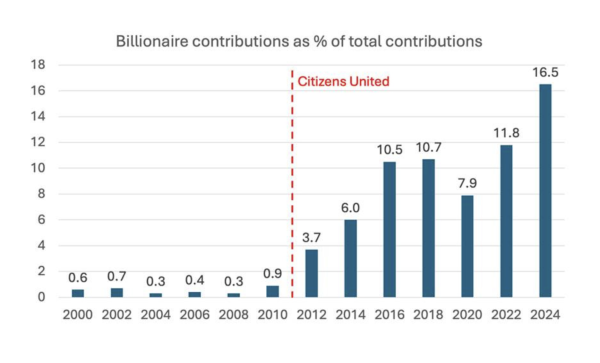
That’s a lot of tall blue bars on the right and tiny little bite-sized bars on the left. The growth has been exponential, an explosion of political contributions by billionaires from 0.3% of total contributions in 2008 – the year Barack Obama got elected president – to 16.5% in 2024 – a 5400% increase. This huge campaign spending increase is what allowed Elon Musk and the creepy crypto moguls to be so frighteningly influential in the 2024 election.
As Krugman points out, some of the rise in billionaire spending can be explained by that alarming 85% growth in the number of US billionaires between 2010 and 2023, but only partially, since over that same time frame the billionaires’ share of political contributions rose by 1700 percent.
So the Pyramid of Money, long the operative model for how the octopus tentacles of money slither around in our winner-take-all political system, is itself being flooded by the tsunami of a centi-billionaire deluge. Krugman, a Nobel Prize winning economist, comes to a chilling conclusion:
“…an increase in oligarchic power far surpassing even what one might have expected given soaring wealth at the top. At this point it’s clear that we have experienced a fundamental change in the way our society works. Everything that is downstream of the American political system – federal and state governments, the courts, regulatory power, economic policy, health policy, media independence – and of course democracy itself – is under extreme threat from the tidal wave of billionaire influence.”
It’s more imperative than ever that “We, the People” enact the urgent democratic reforms necessary to transform our broken, antiquated institutions, many of which are rooted in the 18th century. The changes we need include public financing of campaigns, proportional representation and ranked choice voting, universal voter registration, direct election of the president, more robust and better funded public broadcasting, and the reining in of surveillance (anti-)social media and its non-curated virality.
Without a fully robust representative democracy, we can expect more meltdowns in the months and years ahead. Upcoming elections for Congress (November 2026) and president (2028) will present recurring potential for nationally traumatic episodes, including stolen elections and fraud. Fasten your seat belts, it’s going to be rocky ride.
Comments

Powered by RoundtableAn AI/DeFi-powered Enterprise Media Operating System. Learn more at Roundtable.io.© Roundtable 2026. By using this site you agree to the Terms of Use and Privacy Policy