


Feb 1, 2026 12:31 AM
Updated Feb 2, 2026 4:59 PM
How targeting Black independent journalists creates a foothold for broader civil liberties erosion
Federal Agents Arrest Black Journalists Don Lemon and Georgia Fort — A Flashpoint for Press Freedom, Racial Justice, and Political Pressure
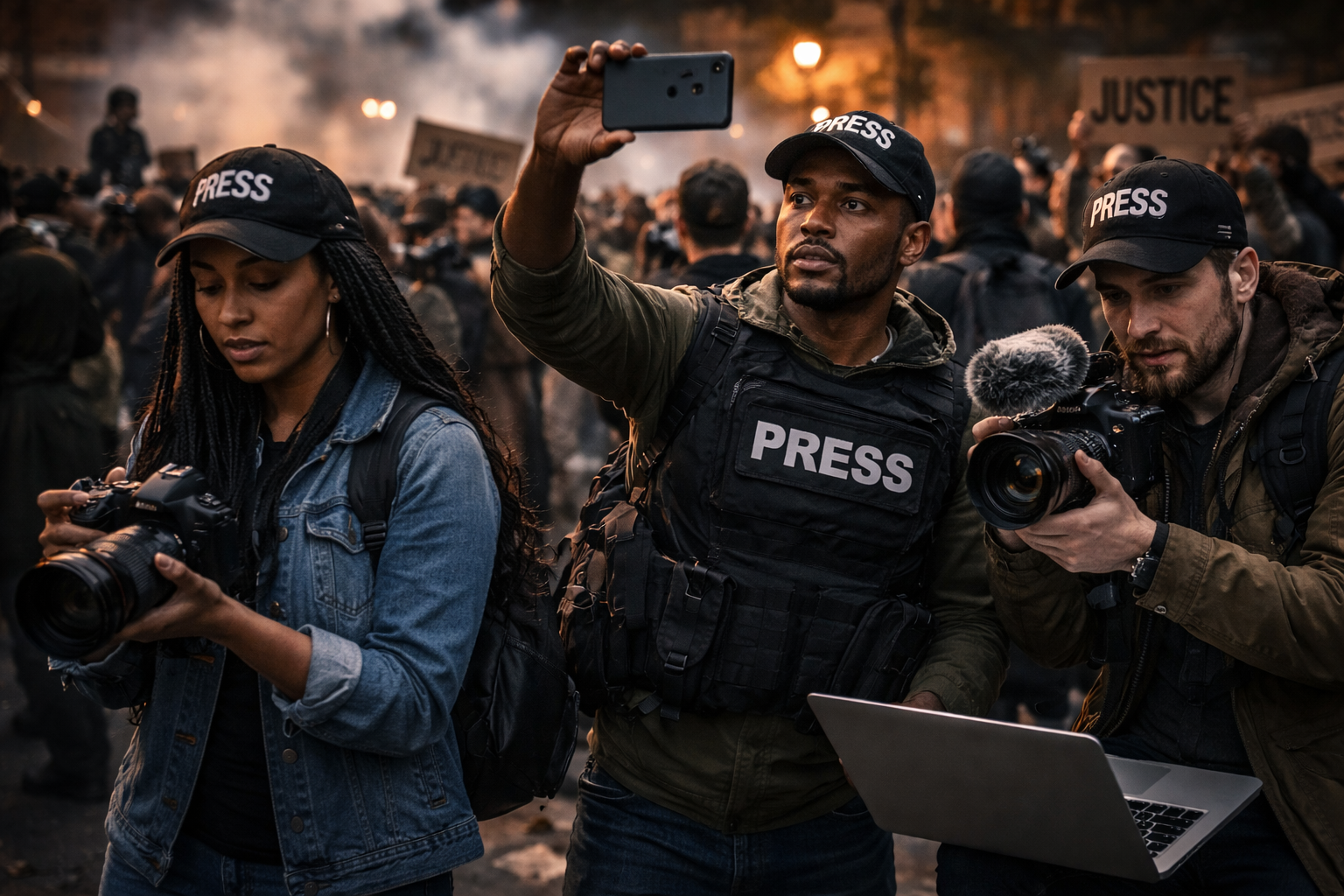
In a move that has rattled press freedom advocates, civil rights groups, and Black political leadership alike, federal agents this week arrested two Black independent journalists — Don Lemon and Georgia Fort — in connection with their coverage of an anti-ICE protest inside a church in St. Paul, Minnesota. The arrests have ignited fierce debate about the criminalization of journalism and the targeting of independent Black voices in media - yes, race is relevant.
Who They Are — Not Just Reporters, But Black Truth-Tellers
Don Lemon is a veteran journalist of more than thirty years, widely known for his tenure as a CNN anchor and now a prominent independent media figure. After leaving corporate news, Lemon embraced direct reporting and commentary on racial justice, state power, and politics, attracting national audiences.
Georgia Fort is an independent Black journalist based in the Minneapolis–St. Paul area, where she founded BLCK Press and built a significant following through livestreams and grassroots reporting. Fort’s work amplifies voices rarely centered in mainstream media and has made her a respected — and now embattled — figure in community journalism.
Related stories
Both were present covering a protest at Cities Church on January 18, 2026 — demonstrators challenging federal immigration enforcement and the church’s alleged ties to ICE — when authorities moved to indict and arrest those present.
The Relevance of Race
The fact that both journalists arrested are Black independent reporters is not incidental — it is strategic. Through the lens of Foothold Theory, this looks like a classic authoritarian testing maneuver. Foothold Theory is a theory that holds that power rarely launches its most extreme overreach against the most socially protected group first. Instead, it establishes a “foothold” by violating a core right in a space where resistance is expected to be fragmented, muted, minimal or dismissible. Marginalized populations understand this all too well. You can learn more about Foothold Theory here.
By targeting Black independent journalists — reporters operating outside of the protection of corporate media structures and rooted in communities that have historically endured state surveillance, criminalization, and narrative marginalization — the administration appears to be probing whether the First Amendment can be weakened with limited institutional backlash. The calculation is clear: the defense of Black press freedom has not always triggered the same reflexive, cross-institutional outrage that an equivalent action against a high-profile white journalist might provoke. If this incursion holds — if the arrests normalize the idea that journalists can be criminally charged for documenting protest — then the foothold becomes precedent, and precedent becomes policy.
But even if the legal incursion fails, the strategy still functions. Disruption itself becomes the outcome. Arrest, indictment, legal defense, reputational strain, financial burden, and emotional toll all drain time, energy, and resources from individuals who have historically challenged the administration’s narratives and policies. In that sense, the maneuver operates as a “win-win” from a power perspective: either the state expands its authority over the press, or it imposes punishment through process alone. What starts with the Black press does not end there; it becomes both a legal test case and a deterrent signal — a message that scrutiny carries personal risk.
The Arrests — How, Where, and When
Federal authorities, invoking rarely used statutes typically applied to violent interference, secured grand jury indictments against Lemon, Fort, and others for allegedly conspiring to deprive civil rights and interfering with religious freedom during the protest.
- Don Lemon was arrested by a team of more than two dozen federal agents around midnight on January 29, 2026, at a hotel in Beverly Hills, Los Angeles, where he was covering the Grammy Awards.
- Georgia Fort was arrested on January 30, 2026, at her St. Paul home, livestreaming her detention before being taken into custody.
Both were later released — Lemon on his own recognizance, Fort after processing — but now face federal civil rights charges and must appear in court.
Mayor Karen Bass, Sydney Kamlager-Dove, Holly Mitchell and other Black California Leaders Convene
Fresh from attending Lemon’s federal arraignment in Los Angeles, Mayor Karen Bass called an emergency meeting to brief Black elected officials from the city, county, state, and federal levels, along with senior staff, on what she had witnessed and what the arrests could signal for Black communities and the press more broadly. The convening also drew prominent Black journalists for solidarity and perspective, including Dominique DiPrima of KBLA, Sharon Kyle of LA Progressive, and April Ryan—who has previously been targeted by Trump—underscoring both the gravity of the moment and the concern rippling through independent Black media circles.
Mayor Bass — joined by Congressional Representative Sydney Kamlager-Dove, LA County Supervisor Holly Mitchell, and California leaders — framed the arrests not just as legal overreach, but as a symbolic assault on democratic oversight and Black civic voice, particularly at a time when federal power has been deployed with little transparency or accountability.
Bass made clear that the spectacle of federal agents arresting journalists for doing their job was “shocking” and “alarming,” and struck many present as a warning to Black media professionals who have long been on the front lines documenting injustice.
What followed was candid conversation about fear, resilience, and responsibility — and a shared commitment among Black press leaders and legislators to defend the First Amendment and protect community voices from state intimidation.
What This Means — To Black Communities, Independent Press and Beyond
This isn’t a legal quirk. It’s a political statement with real psychological impact:
- To Black communities, the state’s actions feel familiar — a legacy of surveillance, punishment, and scrutiny directed at Black dissent and Black documentation of state violence. When Black journalists are targeted for doing their jobs, it reverberates beyond newsrooms and into neighborhoods where people already feel disposable.
- To independent journalists, especially those of color, this moment is a harsh reminder: without corporate legal shields, reporting on controversial public events now carries a risk of federal reprisal. That threat chills not just coverage of immigration enforcement but coverage of every movement that makes the powerful uncomfortable.
Press freedom organizations — including the National Association of Black Journalists and the Knight First Amendment Institute — have condemned the arrests as an unprecedented overreach attacking not only the First Amendment but marginalized voices in the press.
This crisis is bigger than Lemon and Fort. It’s about who gets to witness power and whose stories get heard. It’s about whether journalists — especially those who are Black, independent, and community-centered — will be able to operate without fear of midnight raids, grand juries, and politicized prosecutions.
If we give in to intimidation, we’re ceding the narrative, the public forum, and ultimately our democratic oversight to those who prefer darkness to scrutiny.
A Press Freedom Call to Action
The arrests of Don Lemon and Georgia Fort are not just about two journalists, one protest, or one administration. This is a stress test for whether the United States still recognizes journalism as a protected democratic function — especially when that journalism centers state violence, immigration enforcement, and Black community impact.
When the federal government sends a tactical team of agents to arrest a journalist at night in a hotel, and arrests another at home at dawn, the message is unmistakable: coverage of state power is being reframed as criminal conduct.
That is the definition of a chilling effect.
And chilling effects don’t just freeze reporters. They freeze:
- Whistleblowers
- Community witnesses
- Protest documentation
- Public oversight of law enforcement
- The ability of marginalized communities to have their reality recorded
This moment demands more than statements of concern.
What Must Happen Now
1. National Elected Officials Must Publicly Oppose the Use of Federal Criminal Statutes Against Journalists
Silence equals normalization. Members of Congress — particularly those who claim to defend civil liberties — must state clearly that journalists documenting protests are not criminal conspirators.
2. Civil Rights and Press Organizations Must Treat This as a Structural Case
This is not a “bad arrest.” This is a precedent-setting test of whether federal power can be used to intimidate independent media. Legal defense funds, amicus briefs, and coordinated litigation strategies are essential.
3. Newsrooms Must Close Ranks — Corporate and Independent
If only independent reporters are defended while legacy outlets stay quiet, the message becomes: protection depends on employer status. The First Amendment does not recognize tiers of journalism.
4. Black Political Leadership Must Continue the Intervention Begun by Mayor Karen Bass
Mayor Karen Bass convening Black press and legislators after Lemon’s arraignment was not symbolic — it was strategic. This case lives at the intersection of racial power, state authority, and narrative control. Black journalists have historically been targeted first when truth threatens the state’s story.
5. The Public Must Recognize This Is About Their Access to Truth
If journalists can be charged for proximity to protest, then the only remaining narratives about public unrest will come from police departments and federal press releases.
That is not journalism. That is state messaging.
The Legal Strategy Being Used — And Why It’s So Concerning
What makes this situation especially alarming is not just the arrests — it’s the type of federal statutes reportedly being invoked. These are not minor trespass charges. They are heavy federal civil rights and conspiracy laws that carry prison exposure and are usually reserved for violent or organized rights violations.
Here’s what appears to be happening in legal terms.
1. “Conspiracy Against Rights” — 18 U.S.C. § 241
This law was originally designed to prosecute groups who conspire to deprive people of constitutional rights — historically used against the Klan and violent civil rights violators.
Using it against journalists covering a protest reframes documentation of events as participation in a coordinated plan to violate rights.
That is a dramatic expansion of the statute’s intent.
If journalists filming, livestreaming, or narrating protest activity can be interpreted as “joining a conspiracy,” then journalistic presence itself becomes criminal risk.
2. “Deprivation of Rights Under Color of Law” or Related Civil Rights Theories
Civil rights statutes typically punish officials or actors using authority to harm others. Applying rights-based charges to journalists flips the logic: the state is positioning reporters not as witnesses, but as actors causing harm simply by being present.
That is legally aggressive and constitutionally shaky.
3. Interference with Religious Exercise (Church Protection Statutes)
Federal law does prohibit violent or obstructive interference with religious worship. But these laws are generally used when there is:
- Violence
- Threats
- Property damage
Applying them to protest coverage risks equating journalistic observation with religious disruption. If upheld, this could criminalize reporting at protests near houses of worship, government buildings, or public events.
Why This Is a First Amendment Collision
The Supreme Court has long recognized that:
- The press has a right to document public events
- The government cannot selectively punish journalists for coverage
- Laws cannot be stretched in ways that chill protected speech
The state’s strategy here appears to rely on a dangerous move:
Blurring the line between “covering” and “participating.”
If proximity, narration, or livestreaming can be reframed as “coordination,” then any reporter at a protest becomes legally vulnerable.
That erodes:
- The right to gather news
- The public’s right to receive information
- The constitutional distinction between speech and crime
What Is Really at Stake
This is not just a prosecution.
This is a test of whether the government can:
- Use civil rights laws as political weapons
- Target independent journalists outside corporate protection
- Intimidate Black media voices documenting state power
- Reframe journalism as conspiracy
If that door opens, it will not close easily.
Today it is Don Lemon and Georgia Fort.
Tomorrow it is anyone holding a phone, a press badge, or a livestream.
The Bottom Line
Democracy does not collapse in one dramatic moment. It erodes when the state convinces people that:
- Journalists are criminals
- Witnesses are agitators
- Truth-telling is interference
The arrests of Lemon and Fort are a warning shot.
The response — legal, political, journalistic, and public — will determine whether it remains an outlier… or becomes the new normal.
Freedom Of Speech•Freedom Of The Press•Civil Liberties And Civil Rights•Authoritarianism•Media•Foothold Theory
Comments

Powered by RoundtableAn AI/DeFi-powered Enterprise Media Operating System. Learn more at Roundtable.io.© Roundtable 2026. By using this site you agree to the Terms of Use and Privacy Policy