


Jan 22, 2026 6:59 PM
Updated Jan 22, 2026 7:07 PM
A teach-in at the high school will educate the community about the deadly dangers “Hydrogen fluoride (“HF”), poses to humans.
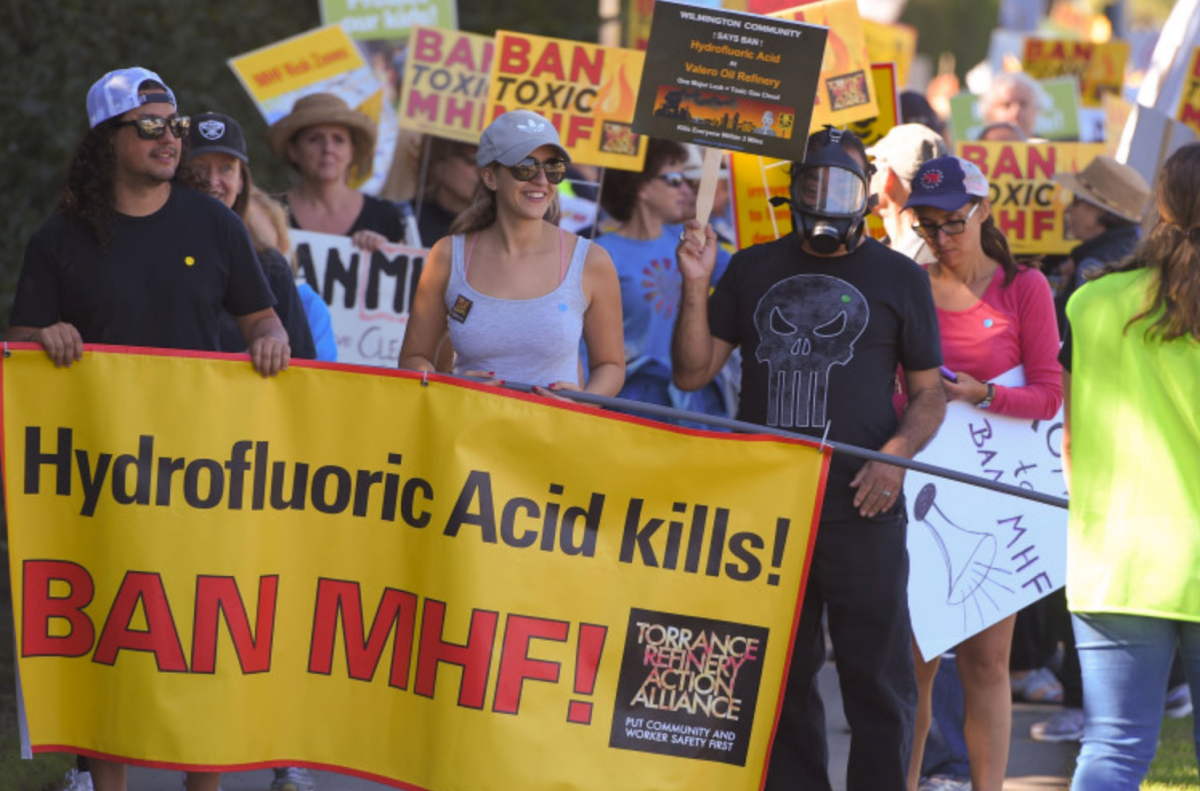
A coalition of progressive organizations are gathering at North Torrance High School on February 7th to mark the 11th anniversary of the refinery explosion that could have caused mass casualties throughout the South Bay. A 2019 New York Times Op-ed by Dr. Daniel Horowitz (former managing director, U.S. Chemical Safety Board (“CSB”)), carried the headline "This Chemical Kills. Why Aren't Regulators Banning It?". That question still calls for an answer.
A teach-in at the high school will educate the community about the deadly dangers “Hydrogen fluoride (“HF”), poses to humans. HF, used to make high octane gasoline in only two refineries in California, has been known for decades for its exceptional danger. Efforts to combat its use have gone on just as long. In 1989, the City of Torrance filed suit, claiming the refinery and its toxic chemicals, including HF, put Torrance residents at unreasonable risk. After another accident, Torrance entered into a Consent Decree with Mobil, which allowed continued use of HF using an additive that had little impact on its danger to the community.
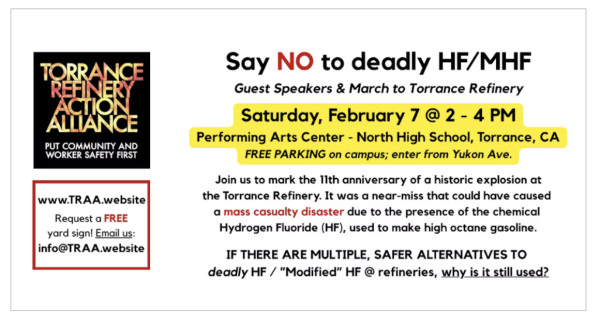
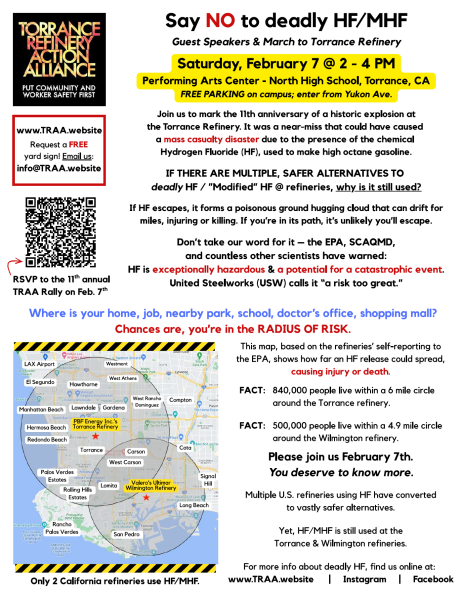
On February 18, 2015, an explosion occurred at the Torrance Refinery, resulting in a near miss for a large release. In its wake, community members formed Torrance Refinery Action Alliance, ("TRAA"). Every year, TRAA holds an event marking the anniversary and calling for conversion to a vastly safer alternative. This year, TRAA Indivisible, Sierra Club, Climate Center and other groups will mark the 11th anniversary on February 7, 2026, 2 PM – 4:30 PM, North High School in Torrance. This event will feature a teach-in with speakers focused on HF/MHF’s risks and alternatives at both Torrance and Wilmington refineries, followed by a walk and rally at the Torrance Refinery.
The explosion in 2015 registered as a 1.7 magnitude earthquake, leaving the community covered in catalytic dust. It was heard and felt throughout the South Bay. The U.S. Chemical Safety Board Report found that a 40-ton piece of debris nearly struck tanks carrying 50 thousand pounds of HF/MHF, jeopardizing the lives of those in West Torrance, Hermosa and Redondo. CSB Animation of Torrance Refinery Explosion (2015) TRAA has built a broad coalition, including leading area scientists, environmental and progressive organizations, unions, teachers, and doctors, and ordinary citizens, all demanding California’s two refineries using HF, and 40 US refineries, be required to convert from HF to available, proven, affordable alternatives.
Related stories
In the past decade, TRAA has received strong support from numerous elected officials: members of Congress; LA County’s Board of Supervisors; all South Bay cities save Torrance, and many others.
While TRAA has yet to eliminate HF and its danger to those within the “radius of risk” (a region of over 1,000,000 people), it has fought Big Oil at both the local and federal level with SCAQMD and EPA Staff backing up every fact on TRAA’s website.
In 2025, Natural Resources Defense Council (“NRDC”) a non-profit environmental legal and advocacy group, filed suit against EPA, calling for phase out of HF. Noted Los Angeles Congresswoman Maxine Waters also introduced federal legislation seeking to accomplish the same goal. HR 10441
TRAA continues to demand release of the refineries’ “Hazard Control Analysis” report to California, which they seem reluctant to produce to the public. Inexplicably, both refineries claim there are no alternatives to HF while also claiming they cannot afford alternatives. Yet, government and industry sources confirm multiple alternatives are available and conversions have occurred at refineries in Utah and Oklahoma,.
A September 3, 2019 letter to SCAQMD from LA County’s Department of Public Health reiterated the “unacceptable health and safety hazards” MHF posed to the public, concluding, “[i]n the absence of such regulation, local refineries will continue to jeopardize the health and safety of workers and residents.”
Residents can come to the February 7th event and learn about these “unacceptable health and safety hazards” which “jeopardize” our communities. Such knowledge will enable them to stand up for community health and safety, the most powerful stand a citizen can take.
Deborah Blair Porter, TRAA Event Committee
Zachary Badaouie, President TRAA
Steve Goldsmith, TRAA Boardmember
Comments

Powered by RoundtableAn AI/DeFi-powered Enterprise Media Operating System. Learn more at Roundtable.io.© Roundtable 2026. By using this site you agree to the Terms of Use and Privacy Policy