
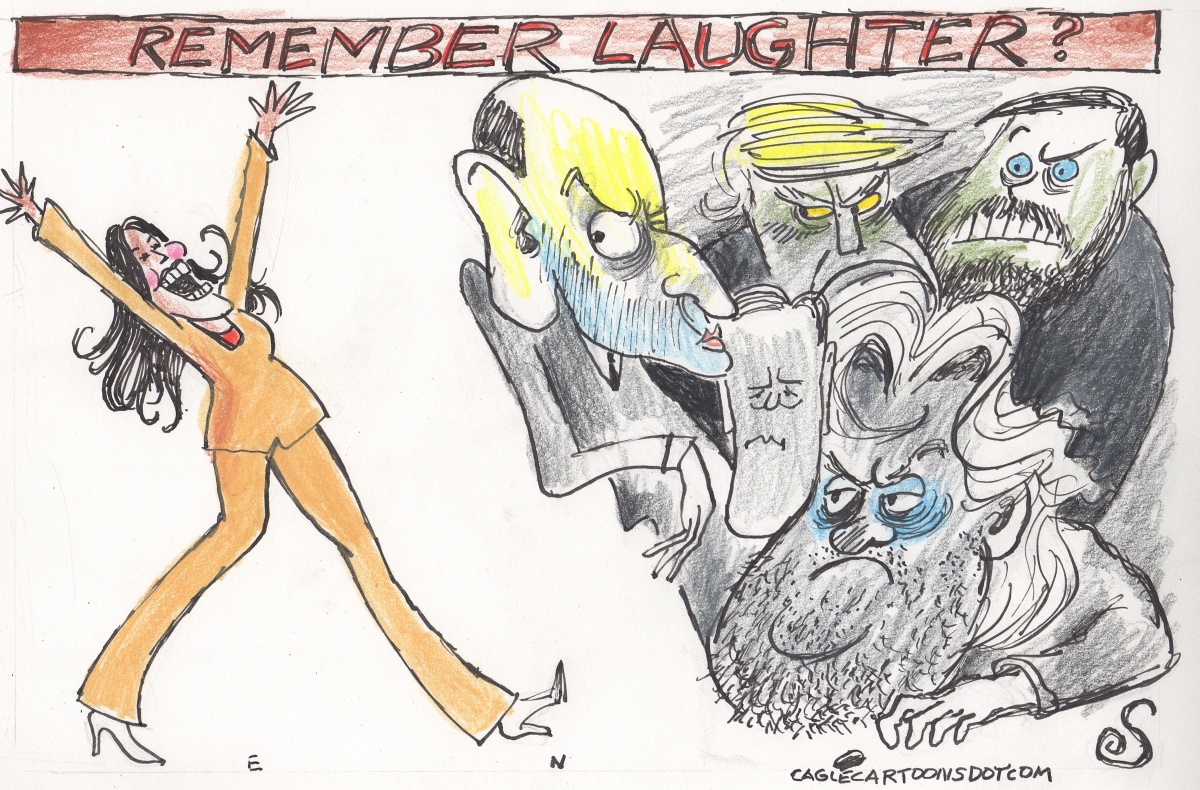
Cagle Cartoon: Randall Enos


Radical Climate Progressives
Aug 8, 2024 3:37 PM
Walz’s climate policies have indeed been radical and progressive. But he should not downplay their radical nature, but rather trumpet it.
Republicans are now screaming that the Democratic candidates Kamala Harris and Tim Walz are radical progressives. The answer I suggest for them? “Yes Indeed.” Let me explain why.
As I was sweating out VP Harris’s choice of a running mate, I was influenced by what I read. First, there was Jeff Cohen and Norman Solomon’s La Progressive piece, Josh Shapiro: A Dangerous Choice for Kamala's Running Mate. As they point out, “in Gaza, Shapiro sounds much less bothered by the lethal violence than by U.S. ceasefire activists, many of whom he has demonized.” Secondly, there was Sen. Mark Kelly, who has many appealing qualities and positions. But in the progressive Nation magazine there appeared this article, “Mark Kelly Wasn’t There for Labor When Labor Needed Him.”
Without necessarily agreeing with all points in these two articles, I feared that some progressives might desert a Harris ticket with either Shapiro or Kelly on it. And by the last few days before Harris’s announcement of her choice on the morning of 6 August, the only other name still considered a top contender was Gov. Tim Walz of Minnesota.
Like many of my fellow citizens, however, I didn’t know much about him. But after the announcement of her pick, articles about him tumbled after one another. The ones that impressed me the most were those about an issue I mentioned a few months ago as “perhaps the most significant issue we face today . . . our climate crisis.”
Related stories
Thus, rather than detail some of his other winning characteristics—e.g., appeal to rural and small-town citizens, to responsible hunters and military veterans—which are traits not common among many Democrats, the rest of this essay will focus on his climate record and responses. Why they are radical and progressive and why the Democrats should trumpet them as such. As I wrote in 2020, “a sense of alarm is just what is now needed.”
Among the many recent pieces dealing with Walz, I will focus on three.
- A New York Times (NYT) “Climate Forward newsletter” that was emailed to me, written by Manuela Andreoni and entitled “Tim Walz’s big climate ambitions.”
- A NYT article written by Coral Davenport, “Tim Walz Has Championed Climate as Governor.”
- A Huffington Post piece labeled “Tim Walz Gives Kamala Harris A Climate Boost.”
The first of these, from the NYT newsletter and sometimes quoting Davenport (see above), indicates that Minnesota is home of “one of the most remarkable transitions to clean energy in the country.” Moreover, over his two terms as governor, Walz has “emerged as one of the nation’s most forceful advocates for tackling climate change.”
He has been a leader in helping Minnesota transition from coal as a source of electricity to “emissions-free energy sources—including wind, solar and nuclear power—[which now] provide more than 50 percent of the power produced in Minnesota.” Furthermore, in 2023 Walz signed a “law requiring Minnesota to generate or procure all of its electricity” from emissions-free sources by 2040.
From various polls we know that most voters, especially Republicans, do not consider climate change one of their most important priorities. Thus, progressive politicians need to convince them of its significance. Ms. Andreoni states that “Walz’s communication style seems to emphasize the need for politicians to explain both the benefits and the specifics of climate policy to voters.” So an important contribution he could make to increasing societal concern about human-caused climate change is an educative one—convincing more of the public that climate change should be one of their most important priorities.
The NYT article written by Davenport, who has been writing on energy and the environment for that paper for over a decade, adds more background information on Walz’s environmental record. As a new governor in 2019, he established a climate change sub-cabinet within his administration. “Communities, farms, and industry face more frequent extreme weather events that threaten the infrastructure that we rely on,” he wrote that year, “climate change threatens Minnesotans’ health and well being.”
In 2023 he signed into law almost 40 climate initiatives. In June 2024, after extensive flooding that devastated parts of the state, he approved of a law that would streamline “clean energy projects that are going to help fight climate change.”
Davenport also quotes former Vice President Al Gore, winner of the 2007 Nobel Peace Prize for his climate advocacy: Mr. Walz “is a proven leader on climate and knows the issue inside and out.”
The third source I mentioned, from the Huffington Post (HP), mentions a few of Walz’s pragmatic compromises that have not pleased some progressive climate activists. For example, he has been open to studying the potential for next-generation atomic reactors. And some activists have faulted him for not taking a more hardline stance against a controversial oil pipeline. But the piece also quotes Gina McCarthy—“I am all in for Walz,”—who served as President Biden’s early domestic climate policy czar. And the HP article points out some of Walz’s policies to reduce carbon pollution—e.g., advocacy of a $1,500 rebate program for funding the purchase of e-bikes and “a massive expansion of a light-rail network.”
Thus, Walz’s climate policies have indeed been radical and progressive. But he should not downplay their radical nature, but rather trumpet it. Trumpet it just as in 1932 Franklin Rossevelt (FDR) did not downplay his approach to the Depression. To President Herbert Hoover’s insistence that “Federal aid would be a disservice to the unemployed,” FDR’s answer (in his inaugural address of March 4, 1933) was, “This is preeminently the time to speak the truth, the whole truth, frankly and boldly. Nor need we shrink from honestly facing conditions in our country today. This great Nation will endure as it has endured, will revive and will prosper. So, first of all, let me assert my firm belief that the only thing we have to fear is fear itself—nameless, unreasoning, unjustified terror which paralyzes needed efforts to convert retreat into advance. In every dark hour of our national life a leadership of frankness and vigor has met with that understanding and support of the people themselves which is essential to victory.”
FDR did not call his approach the “Politics as Usual Deal.” No, he labeled it “The New Deal.” I quoted FDR’s above words in my "What Do the Democrats Need in 2020?" In that same piece I cited columnist Frank Bruni’s belief that the Democratic challenger to Trump must be “consistent, direct, blunt, original, stirring, visionary,” and “convey strength.”
If one of Walz’s strengths is his ability to “explain both the benefits and the specifics of climate policy to voters” (see above), then he can mention some of the facts that I recently garnered from watching the PBS Newshour. In 2023, floods, wildfires, droughts, and earthquakes forced more than 26 million people to leave their homes. In that same year the USA experienced 28 weather or climate disasters that each resulted in at least $ 1 billion in damages. The frequency of heat waves in the USA has increased from an average of two per year during the 1960s to six per year during the 2010s and 2020s. So far, 2024 has been the hottest year on record. 56 percent of households in Miami Dade County could be displaced because rising sea levels are expected to make inland housing more expensive.
The effects of climate change are not some abstract phenomena that is hard to understand. Just ask people in California or Oregon where hundreds of thousands of acres have gone up in smoke. Or those in Florida and other southern states lashed by Tropical Storm Debby.
And Walz’s folksy ability to talk to average voters fits in nicely with the Biden-Harris climate policies. In August 2022, The New York Times opined that the Inflation Reduction Act was the “most significant federal investment in history to counter climate change.”
Thus, radical and progressive need not be words to run away from. Rather let the Harris-Walz ticket embrace them. Let them also emphasize their present and future- mindedness. At 78, Trump is not so much hampered by age, as by old-fashioned thinking—just as Hoover was in 1932.
To think that global warming alarmism was the "greatest hoax ever perpetrated on the American people," as Republican Senator James Inhofe of Oklahoma declared on the Senate floor in 2003, was head-in-the-sandism back then. Today such denialism, as Trump and Vance manifest, is not only antiquarian but delusional.
In our past we have prided ourselves on being the “New World,” named some of our states “new” (like New York and New Mexico), and programs new. Not only FDR’s New Deal, but John Kennedy’s New Frontier.
Trump’s slogan “Make American Great Again” looks backwards. But FDR did not. He was a radical progressive, the architect not of any old deal, but of a “New Deal.” And in the 1932 election, he carried 42 of the then existing 48 states. And in 1936, he won 46 of them. By emphasizing the present and future, the Harris-Walz ticket can also triumph.
Comments

Powered by RoundtableAn AI/DeFi-powered Enterprise Media Operating System. Learn more at Roundtable.io.© Roundtable 2026. By using this site you agree to the Terms of Use and Privacy Policy