


Jul 23, 2026 6:59 PM
Dissent in the pursuit of justice has never been the enemy of patriotism. It has been one of its highest expressions.
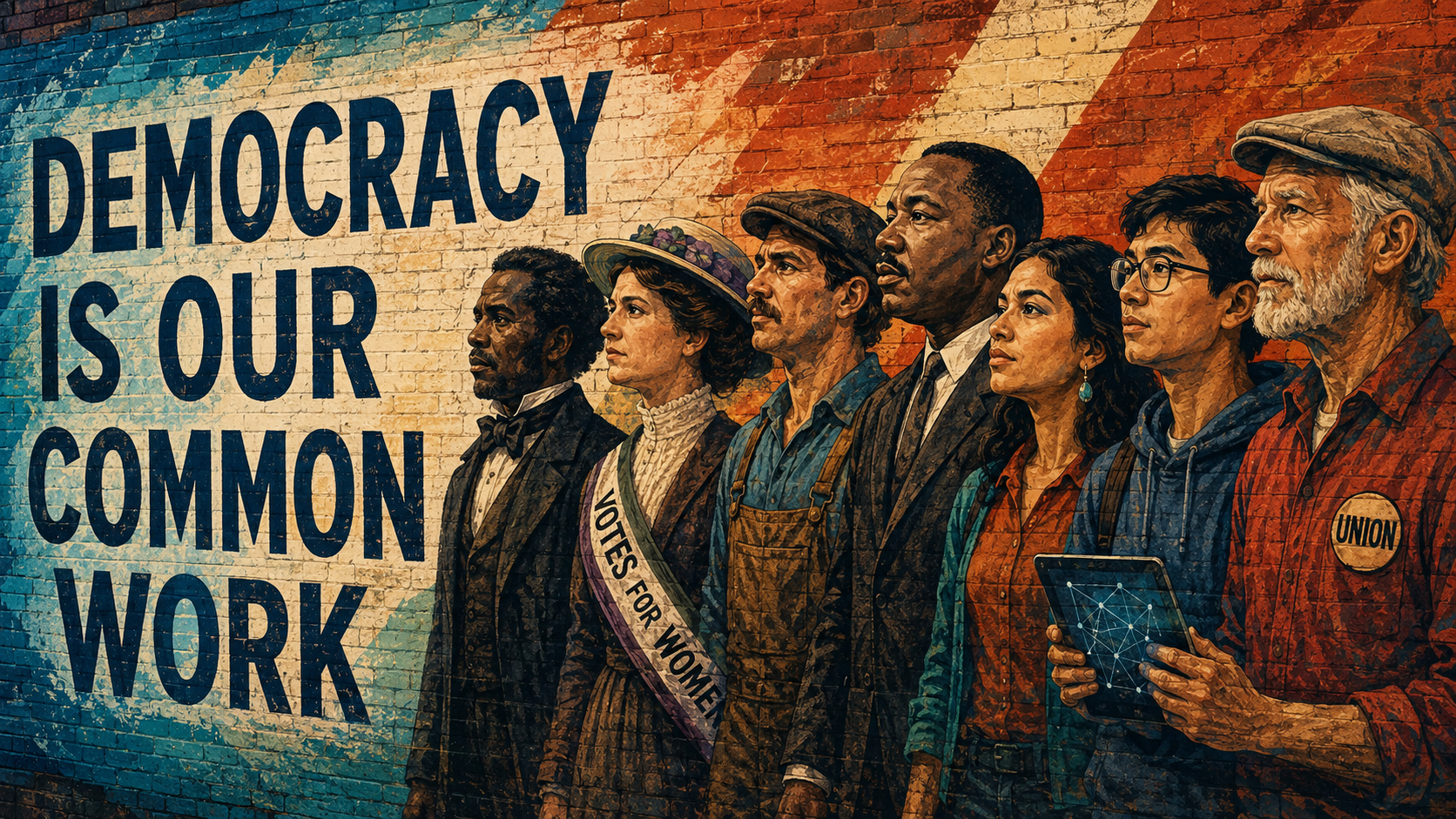
The history of the United States bears witness to a paradox that authoritarian movements have always sought to conceal. The women and men who most profoundly transformed American democracy were rarely celebrated in their own time. They were denounced as agitators, extremists, radicals, socialists, traitors, enemies of the nation. Yet history remembers them differently. Frederick Douglass exposed the moral bankruptcy of slavery while appealing to the democratic promise embedded within the Constitution. Labor organizers challenged the tyranny of industrial capitalism in the name of human dignity. Women demanding right to vote were ridiculed before becoming architects of democratic equality. The Civil Rights Movement confronted segregation not by abandoning the American democratic project but by insisting that the nation finally honor its own professed ideals.
American democracy has advanced because citizens repeatedly refused to confuse obedience with patriotism. This distinction has become increasingly urgent in our own political moment. Across the United States, the language of patriotism has been appropriated by movements that define the nation not as a democratic community of equal citizens but as the exclusive possession of a privileged cultural or racial identity. Flags, military symbolism, choreographed demonstrations, and declarations of national greatness increasingly substitute for the democratic practices that alone give patriotism moral substance.
This transformation was vividly illustrated by the July 4, 2026, march of Patriot Front through Washington, D.C. Like the infamous Unite the Right rally in Charlottesville nearly a decade earlier, the demonstration wrapped itself in the symbols of the nation while advancing a political vision fundamentally at odds with the democratic principles those symbols are supposed to represent. The methods differed. Charlottesville openly displayed swastikas, Confederate banners, and explicitly racist slogans. Patriot Front has adopted a more disciplined aesthetic: identical uniforms, concealed faces, military formations, and carefully managed public messaging centered on nationalism and patriotic imagery. Yet beneath these stylistic differences lies a common effort to redefine patriotism as exclusion rather than democratic belonging.
The central question raised by these movements is therefore not simply whether they possess the constitutional right to march. They do. The deeper question is whether nationalism itself has become confused with patriotism.
Related stories
The answer matters because patriotism and nationalism are not synonymous.
Nationalism asks who belongs. Democratic patriotism asks what kind of society we are collectively responsible for creating.
Nationalism seeks unity through conformity. Democratic patriotism flourishes through disagreement, criticism, and the protection of political difference.
Nationalism demands loyalty to power. Democratic patriotism demands fidelity to justice.
Throughout American history, patriotic dissent has repeatedly rescued democracy from those who sought to reduce citizenship to obedience. Every major democratic advance—from abolition and labor rights to women's suffrage and the Civil Rights Movement—required citizens willing to challenge existing institutions in the name of a more expansive understanding of freedom. Democracy has never been strengthened by silence. It has been renewed whenever ordinary people insisted that the nation become more faithful to its own democratic aspirations.
Today that democratic tradition confronts new dangers. One is familiar: the resurgence of authoritarian nationalism clothed in patriotic symbols. The other is emerging with extraordinary speed: the concentration of technological, economic, and political power in the hands of an AI-driven corporate order whose influence increasingly reaches into every dimension of public life.
These developments may appear unrelated. They are not.
Authoritarian nationalism seeks political conformity. AI-driven capitalism increasingly centralizes economic, informational, and surveillance power in institutions that remain largely insulated from democratic accountability. Together they threaten to narrow the public sphere in which democratic citizenship can flourish.
For this reason, patriotic dissent must expand its horizons. It is no longer sufficient merely to defend democratic institutions against authoritarian politics. Citizens must also ask who owns the technological infrastructure that increasingly governs everyday life, whose interests artificial intelligence ultimately serves, and whether the extraordinary productive capacities created by AI will deepen democracy or reinforce existing structures of inequality.
These are not simply technological questions.
They are democratic questions.
And democracy has always depended upon citizens willing to ask uncomfortable questions in the name of the common good.
Nationalism in Patriotic Dress
The July 4, 2026, march of Patriot Front through Washington, D.C., was carefully staged to communicate a political message that extended far beyond the demonstration itself. Uniformed marchers carrying American flags advanced in disciplined formation through the nation's capital, projecting order, unity, and patriotic resolve. Unlike the torch-bearing spectacle of Charlottesville in 2017, there were no swastikas, no Confederate banners, and few of the overtly racist slogans that had shocked the nation nearly a decade earlier.
The difference, however, was largely aesthetic rather than philosophical.
Charlottesville represented a politics of explicit white supremacy. Patriot Front represents a politics of strategic respectability. It has learned that the most effective way to normalize exclusionary nationalism is not through the open display of fascist symbols but through the appropriation of democratic ones. The flag becomes detached from the democratic values it is meant to symbolize and transformed into a badge of cultural ownership. Patriotism becomes less a commitment to constitutional democracy than a declaration about who truly belongs within the nation.
This transformation should concern every democrat, regardless of political affiliation.
Democracy does not depend upon uniformity. It depends upon plurality. It does not require citizens to think alike, worship alike, or vote alike. It requires only that they recognize one another as political equals entitled to the same rights, protections, and opportunities for democratic participation.
Nationalism begins from a different premise. It seeks cohesion through exclusion. It divides society into those who authentically belong and those whose loyalty is forever suspect. Difference is not treated as a democratic resource but as a political danger. The nation is imagined less as a constitutional community than as a cultural inheritance to be defended against internal contamination.
History teaches us that such movements rarely begin by rejecting democracy outright. They begin by redefining it.
The language of freedom is retained while its substance is gradually emptied. Constitutional rights are defended selectively. Elections remain important so long as they produce the desired outcomes. Critics become enemies. Independent institutions become obstacles. Political disagreement is increasingly portrayed not as an ordinary feature of democratic life but as evidence of national betrayal.
This rhetorical inversion has become one of the defining features of contemporary American politics.
For several years Donald Trump has portrayed political opponents not simply as advocates of different policies but as existential threats to the nation itself. Progressives, democratic socialists, labor organizers, advocates of racial justice, environmental activists, and defenders of expanded social rights are repeatedly described as radical thugs, Marxists, communists, or enemies intent upon destroying America. The effect is not merely partisan polarization. It is the moral delegitimization of democratic opposition.
Every democracy depends upon a loyal opposition. Citizens must remain free to criticize governments, challenge economic arrangements, organize unions, protest injustice, make collective decisions concerning foreign adversaries, and advocate alternative visions of the common good without having their citizenship called into question. When disagreement itself becomes evidence of disloyalty, democracy begins to lose one of its defining characteristics: the recognition that political conflict is both legitimate and necessary.
This is why the distinction between patriotism and nationalism matters so profoundly.
Patriotism measures a nation against its highest ideals.
Nationalism measures citizens against ideological conformity.
Patriotism asks whether democracy is becoming more inclusive, more just, and more faithful to constitutional principles.
Nationalism asks only whether citizens are sufficiently loyal to those who claim to speak in the nation's name.
These are fundamentally different political traditions. One enlarges democracy. The other steadily contracts it.
The task before us is therefore not merely to expose extremist organizations or condemn inflammatory rhetoric. It is to recover a democratic understanding of patriotism that refuses to surrender the language of love of country to those who equate citizenship with obedience and unity with silence.
Manufacturing Fear: The Politics of Naming Enemies
Authoritarian politics rarely triumphs by persuading citizens to reject democracy outright. It succeeds by teaching them to reinterpret democracy through the language of fear. One of the central insights of critical pedagogy is that domination depends not only upon controlling institutions but also upon shaping common sense. Citizens come to mistake obedience for responsibility, conformity for patriotism, and criticism for betrayal. The vocabulary of democracy remains intact while its meanings are quietly transformed.
This transformation is evident in the contemporary use of the word communism.
For several years Donald Trump has repeatedly portrayed progressives, democratic socialists, labor organizers, and advocates of expanded social rights as communists or Marxists. The strategy is politically effective precisely because it bypasses historical understanding. Rather than inviting citizens to evaluate concrete proposals—universal health care, stronger labor protections, affordable housing, public education, progressive taxation, or greater democratic oversight of corporate power—the rhetoric collapses an extraordinary range of political traditions into a single frightening image.
Fear becomes a substitute for argument.
This strategy is hardly new. During the first Red Scare and later during the McCarthy era, accusations of communist sympathies often served to silence criticism, intimidate intellectuals, weaken labor movements, and narrow the boundaries of acceptable democratic debate. The objective was not historical precision. It was political discipline. Once dissent could be identified with treason, democratic disagreement itself became suspect.
A similar rhetorical pattern has re-emerged in our own time.
Democratic socialism is routinely equated with Stalinism despite the profound differences separating them. Stalin's Soviet Union abolished competitive elections, suppressed independent political parties, imprisoned opponents, censored the press, and concentrated power within an authoritarian state sustained through coercion and terror. Democratic socialism, whatever one thinks of its policy agenda, accepts constitutional government, competitive elections, civil liberties, judicial independence, and the peaceful transfer of political power. It seeks to reform capitalism through democratic institutions rather than replace democracy with one-party rule.
Reasonable people may disagree about the wisdom of particular reforms. Such disagreement is the lifeblood of democratic politics. But disagreement requires conceptual clarity. When every proposal for expanding public education, strengthening organized labor, regulating concentrated corporate power, or guaranteeing health care is dismissed as "communism," serious political discussion becomes impossible. Labels replace analysis. Anxiety replaces evidence.
The deeper issue, however, extends beyond one political figure or one election cycle. The repeated invocation of communism performs an ideological function. It encourages citizens to understand every demand for greater social equality as the first step toward dictatorship while leaving existing concentrations of wealth and power largely beyond critical examination. Economic inequality, corporate monopolization, and democratic erosion disappear from view because public attention has been redirected toward an imagined internal enemy.
Critical pedagogy invites us to reverse this process. Instead of asking who has been successfully branded as dangerous, we must ask who benefits when democratic reform itself becomes politically unspeakable. What forms of power remain invisible when fear dominates public discourse? Which economic interests are protected when the language of democracy is systematically emptied of its social content?
These questions become even more urgent as artificial intelligence assumes an increasingly central role in organizing economic life. The concentration of technological power in a handful of corporations raises democratic questions that cannot be answered through slogans about communism or patriotism. They require informed public deliberation about ownership, accountability, labor, surveillance, environmental sustainability, and the future of democratic citizenship itself.
It is here that the politics of fear reaches its limits. Citizens cannot meet the challenges posed by AI if they have been taught to fear every proposal for democratic oversight as an assault on freedom. Democracy requires a richer political vocabulary than the language of ideological panic. It requires citizens capable of distinguishing between authoritarian control and democratic regulation, between public accountability and state domination, between economic democracy and political dictatorship.
Only then can political disagreement recover its proper place—not as evidence of national betrayal but as one of democracy's indispensable conditions.
The New Frontier of Patriotic Dissent: Democracy in the Age of Artificial Intelligence
Every democratic generation inherits its own frontier of patriotic dissent.
For abolitionists, the defining struggle was slavery. For labor movements, it was the brutal inequalities of industrial capitalism. For the Civil Rights Movement, it was segregation, racial terror, and the unfinished promise of constitutional equality. Those movements did not reject America; they challenged the nation to become more democratic than it was prepared to be.
Our generation confronts a different historical landscape.
Artificial intelligence is often presented as an inevitable technological revolution, a neutral instrument whose consequences will depend upon how efficiently it is deployed. Such a view mistakes technology for destiny. AI is not merely a collection of algorithms. It is becoming the central infrastructure through which economic production, communication, education, health care, finance, policing, warfare, and public knowledge are increasingly organized. The decisive question is therefore not whether AI will shape the future. It already is. The question is who will shape AI.
Critical pedagogy teaches that no technology is politically innocent. Every technology is embedded within relations of power. It reflects particular assumptions about whose knowledge counts, whose labor matters, whose lives are made visible, and whose interests are permitted to define the common good. Artificial intelligence is no exception. It enters a society already marked by profound inequalities of wealth, race, labor, and political influence. Unless those inequalities are confronted democratically, AI risks becoming less an instrument of liberation than a machinery for reproducing and intensifying existing forms of state domination.
William I. Robinson has argued that the rise of AI marks a new phase in the development of transnational capitalism. Vast data centers, global supply chains, extractive mining operations, and automated systems of production are reorganizing the world economy around unprecedented concentrations of digital power. The environmental costs are immense. Communities are displaced to secure land, water, rare earth minerals, and energy. Workers face growing precarity as automation restructures production while those who remain employed often labor under increasingly intensive systems of digital surveillance and algorithmic management. AI, in this analysis, is not simply transforming technology; it is reshaping capitalism itself.
Yet the implications extend beyond economics.
Artificial intelligence is also reorganizing the architecture of democratic life. The same computational systems capable of diagnosing disease or advancing scientific research can also be deployed to expand surveillance, automate warfare, manipulate public opinion, and deepen the concentration of political power. As governments and corporations become increasingly dependent upon AI, decisions that once belonged within democratic institutions risk migrating into opaque technological systems governed by private ownership, proprietary algorithms, and commercial imperatives.
This is why the struggle over AI cannot be reduced to questions of efficiency or innovation.
It is fundamentally a struggle over democracy.
Who owns the infrastructures that increasingly organize social life? Who decides how data are collected, analyzed, and monetized? Who benefits from automation? What protections exist for workers displaced by algorithmic restructuring? How should democratic societies regulate technologies capable of transforming education, employment, health care, policing, and political communication? These are not technical questions to be delegated exclusively to engineers or corporate executives. They are public questions that demand democratic deliberation.
Here the meaning of patriotic dissent acquires renewed urgency.
To question the unrestrained expansion of AI is not to oppose technological progress. It is to insist that technological development remain accountable to democratic values. Genuine patriotism today requires more than celebrating innovation or competing for technological supremacy. It requires asking whether innovation enlarges human freedom, strengthens democratic institutions, protects the dignity of labor, sustains ecological life, and distributes its benefits broadly rather than concentrating them in the hands of an increasingly powerful technological elite.
The struggle for democratic oversight of artificial intelligence is therefore not a distraction from the defense of democracy. It has become one of democracy's central battlegrounds. Citizens who demand transparency, public accountability, environmental responsibility, labor protections, and democratic governance are not obstructing progress. They are extending one of the oldest traditions in American political life: the conviction that concentrated power—whether political, economic, or technological—must always remain answerable to the people.
Every age produces new forms of domination. Every democratic generation must discover new forms of resistance. The challenge before us is not to reject artificial intelligence but to ensure that it serves the flourishing of democratic life rather than the consolidation of unaccountable power. That is the work of patriotic dissent in the twenty-first century.
Conclusion: Democracy's Unfinished Work
The history of democracy is not the history of national consensus. It is the history of principled disagreement.
Frederick Douglass challenged a republic that proclaimed liberty while sustaining slavery. Eugene V. Debs insisted that democracy could not flourish where wealth and power were concentrated in the hands of a privileged few. Martin Luther King Jr. reminded the nation that civil rights, economic justice, and peace were inseparable democratic commitments. Paulo Freire taught generations of educators that democracy survives only when ordinary people develop the critical capacities necessary to question domination rather than accommodate it.
None of these figures accepted the comforting fiction that patriotism requires silence. Each understood that democracy is sustained not by unquestioning loyalty to existing institutions but by the courage to measure those institutions against the ideals they claim to embody. Their struggles differed because history continually presents new forms of domination. Yet they shared a common conviction: love of country is measured not by conformity but by the determination to enlarge the possibilities of freedom, justice, and human dignity.
That tradition now confronts a new historical moment.
The convergence of authoritarian nationalism, fascism, concentrated corporate power, and artificial intelligence is transforming the conditions under which democracy itself operates. Nationalism seeks to narrow the boundaries of political belonging. AI-driven capitalism threatens to concentrate unprecedented economic, informational, and technological power in institutions that remain only weakly accountable to democratic publics. Together they challenge not merely particular policies but the capacity of citizens to govern the forces that increasingly govern their lives.
The central question before us is therefore neither technological nor partisan.
It is democratic.
Will artificial intelligence become another instrument through which wealth, surveillance, and political authority are consolidated in the hands of a small corporate and governmental elite? Or will democratic societies insist that technologies capable of reshaping human life remain accountable to the people whose futures they profoundly affect?
The answer will not be determined by algorithms alone. It will be determined by political struggle, democratic imagination, and public courage.
Every democratic generation inherits its own frontier of patriotic dissent.
For abolitionists, that frontier was slavery.
For labor organizers, it was industrial capitalism.
For the Civil Rights Movement, it was segregation and racial domination.
For our generation, it is the struggle to defend democracy against the intertwined forces of authoritarian nationalism and unaccountable technological power.
To insist that artificial intelligence serve human flourishing rather than private accumulation; to demand that technological innovation strengthen rather than weaken democratic institutions; to protect workers, communities, and the ecological conditions upon which life depends; to refuse the politics of fear that confuses criticism with betrayal—these are not acts of disloyalty. They are among the highest expressions of democratic citizenship.
Patriotism has never been measured by the number of flags displayed, the volume of nationalist rhetoric, or the willingness to denounce political opponents as enemies of the nation. It is measured by fidelity to constitutional democracy, equal justice, democratic participation, and the common good.
The unfinished work of democracy has always belonged to citizens prepared to dissent in the name of a more just society.
That work is now ours.
Comments

Powered by RoundtableAn AI/DeFi-powered Enterprise Media Operating System. Learn more at Roundtable.io.© Roundtable 2026. By using this site you agree to the Terms of Use and Privacy Policy