


Brain Snatchers
Mar 5, 2025 4:02 PM
Unlike almost all of my colleagues, my students still read words printed on paper, typed and turned in written assignments on paper, and wrote in-class exams in Blue Books.
This essay was prompted by an invitation I recently received to speak at a public forum about whether or not schools should ban students’ access to their cellphones during the school day.
Some of you may be old enough to remember the chilling 1956 science fiction movie Invasion of the Body Snatchers. If you’re a bit younger, but still on the old side, you may remember the even bleaker 1978 remake. The 1956 version ended with at least a hint of optimism. The later remake left no hope at all for the fate of humanity.
Both stories were, of course, just science fiction fantasy. But now, only a few decades into the new millennium comes something far more frightening than either of those two movies because what is happening today is not fiction. It is all too real, and all too relentless. I call it the Invasion of the Brain Snatchers, and I am perfectly serious. A little background:
I was in and out of teaching, mostly at the high school level, between the ages of 30 and 50. But early in this millennium, I took a fulltime faculty appointment as a Master Teacher of English and History at the Haverford School for Boys. When I began teaching there, classrooms did not have computers, nor did any of the students, and cell phones were not smart.
Related stories
Thus, my late-life teaching career pretty much spanned the creation of the internet, the world wide web, and what has become an astounding array of portable handheld electronic devices, the most insidious of which are the ubiquitous Smart Phones that can do just about anything from text messaging to sophisticated videography to encyclopedic research to providing easy and unlimited access to staggeringly graphic pornography.
After a 20-year career at Haverford, I retired in 2019. There were several reasons I chose to retire. I was nearly 71 years old, and though no one else had yet seemed to notice, I was slowing down, not teaching as crisply or sharply as I had even a few years earlier, and I wanted to leave before others did begin to notice.
But another major reason I retired when I did was the seemingly unstoppable encroachment of technology. I was, by the time I retired, a real oddball. Unlike almost all of my colleagues, my students still read words printed on paper, typed and turned in written assignments on paper, and wrote in-class exams in Blue Books.
The administration didn’t particularly like my Neanderthal approach to 21st century teaching, but by the time senior administrators realized how resistant I was to the arrival of the techno-classroom, I was already on Medicare, and they knew I wouldn’t be sticking around that much longer in any case. And I was, quite frankly and immodestly, good at what I did, so they grudgingly left me alone.
But it wasn’t just technology in the classroom that finally drove me out. It was, in particular, those damnable little electronic devices every kid owned. The misuse of these things—SmartPhones? iPhones? I don’t even know what to call them. I do not own one myself—got so bad that I finally instituted this policy for my own classroom:
I catch you with a phone once, I confiscate it and give it back to you at the end of the day. I catch you a second time, I give it to the dean of students and you can argue with him for it. I catch you a third time, and I call your parents and tell them they can come to school and pick up your phone. I had to turn a phone over to the dean maybe three or four times in half a dozen years. Believe it or not, I never had to call a parent. My students knew I would really do it, and chose not to risk their parents’ wrath.
I could get away with such a policy because I was teaching in a private school (I was deemed unqualified to each in public schools because I was not certified, but that’s a different story), and therefore had a great deal more latitude to set my own rules—even when they did not entirely conform to what my fellow teachers were doing—than most public school teachers have.
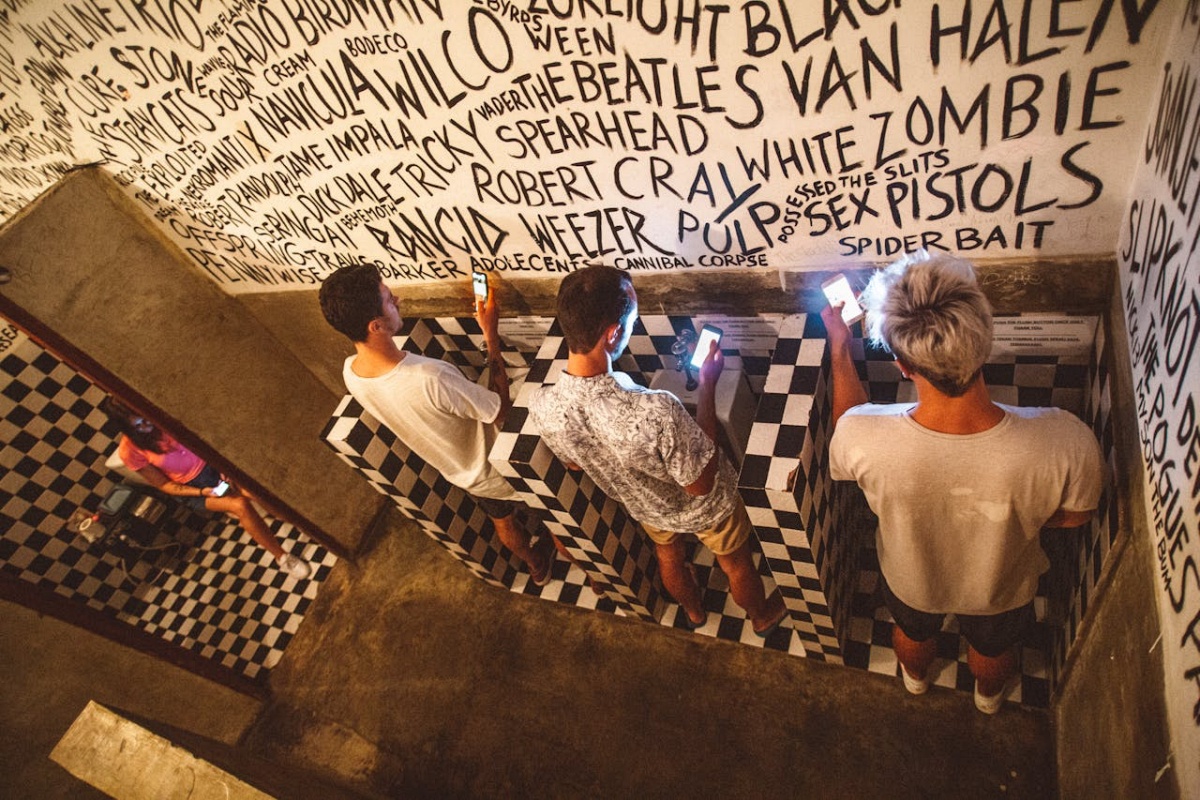
But it wasn’t only what was happening in the classroom that left me dismayed and despairing. Just outside my classroom door was a student lounge area big enough for a dozen or more kids. And for my last four or five years of teaching, every single time I looked out my door—I mean every time every day, day in and day out, week in and week out—there would be six or eight or a dozen kids sitting out there. And every one of them would be holding a cellphone and staring into its tiny screen. There was almost never any conversation among the kids. Each kid was completely absorbed with whatever he was watching on that little screen.
The boys were simply no longer interacting with each other anymore. It was just plain depressing. And there was nothing I could do about it. I had some control over what happened in my classroom, but not in the halls or the cafeteria or the library or anywhere else in the school. And those who ran my school seemed unwilling to tackle or even acknowledge the problem.
Last fall, September 2024, five years after I retired, I happened to drop by school one day just before classes began, and I noticed a big box of rubber-looking things, each about the size of an old VHS cartridge. When I asked what the heck they were, I was told they are some kind of locking device for cellphones. This year, the boys have to put their phones into one of these pouches every morning, and while they get to keep physical possession of their phones, they are not allowed to access them during the school day.
I’m glad to see that my old school is finally beginning to deal with this problem, which is—in my opinion—highly detrimental not only to the education of our youth, but also to healthy socialization and the development of well-rounded and vibrant personalities. I think every school in the United States of America should be doing everything possible to arrest and reverse the invasion of these brain-snatchers.
I know of not one child psychologist or mental health professional or experienced educator who has anything good to say about these insidious little machines. Apparently, at least a few schools other than the one I taught at are slowly beginning to acknowledge this problem and trying to deal with it. But it is going to take more than “a few other schools” and a lot more determination to put a stop to this very unhealthy and destructive application of technology. The threat is no longer being posed by a fictional alien life form from a distant planet, but by a very real device created by our own all-too-clever human ingenuity.
Comments

Powered by RoundtableAn AI/DeFi-powered Enterprise Media Operating System. Learn more at Roundtable.io.© Roundtable 2026. By using this site you agree to the Terms of Use and Privacy Policy