


Jun 6, 2023 2:00 PM
New opportunities for distorting the truth and spreading disinformation have arisen since the stone age. Artificial intelligence is just the newest opportunity.
Human beings have been lying ever since they began speaking. Hard to say when exactly, perhaps 50,000 years ago, maybe as long as a million or two. The soft tissues producing speech were not preserved with ancient skeletal remains. But whenever humans did acquire the ability to speak, I’ve no doubt they used it at times for dishonest purposes. We haven’t found any cave paintings of a stone age man with his pants on fire, so you’ll have to trust me on this. What? Do you think I’m lying?
Writing offered a new opportunity for distorting the truth. Did those hieroglyphics in an Egyptian tomb depict the historical truth about a pharaoh’s reign, or is it the myth of his greatness as he decided it should be preserved for the ages? With ink, pen and paper, a wider circle of people, mostly of a religious bent, were able to put forth their version of reality in various biblical texts revealing The Truth as they wanted it to be believed.
The invention of the printing press made books more widely available. Appearing in the pages of a book gave writing an aura of truthfulness, and for centuries people tended to assume that if it was in print, it must be true. Really, they did.
The advent of the Electric Age, as telegraph and telephone networks were widely deployed in the mid and late 19th century, offered new opportunities to distribute duplicity. Electric presses could spew out pretense on paper in far greater volume than water or steam powered ones ever could. Then with radio, television, the internet and social media, the flood gates for finagling burst wide open.
Related stories
While dissembling is a longstanding practice, it’s now been taken to a new depth, most egregiously in the area of politics. Sure, politicians have always been prone to exaggerating, if not outright lying. “I am not a crook.” “I did not have sex with that woman.” But until 2020 we never saw a sitting president claim, over and over in the face of all evidence, that an election he lost was rigged, a lie which his legion of faithful followers swallowed whole and continue to regurgitate.
Then we have George Santos. Or the organism that purports to be George Santos. With his extreme lying about his past, it’s hard to say just who he really is. Voters in his district, where I grew up, voted for someone with that name on the ballot, but the sitting member of Congress bears no resemblance to the person they thought they were electing. Congress ought to toss him out and call a do-over, but the MAGAs in the House, adherents of Trump’s Big Lie, have resisted calling out the whopper that is Santos. If they told the truth for once, they’re afraid it might become a bad habit.
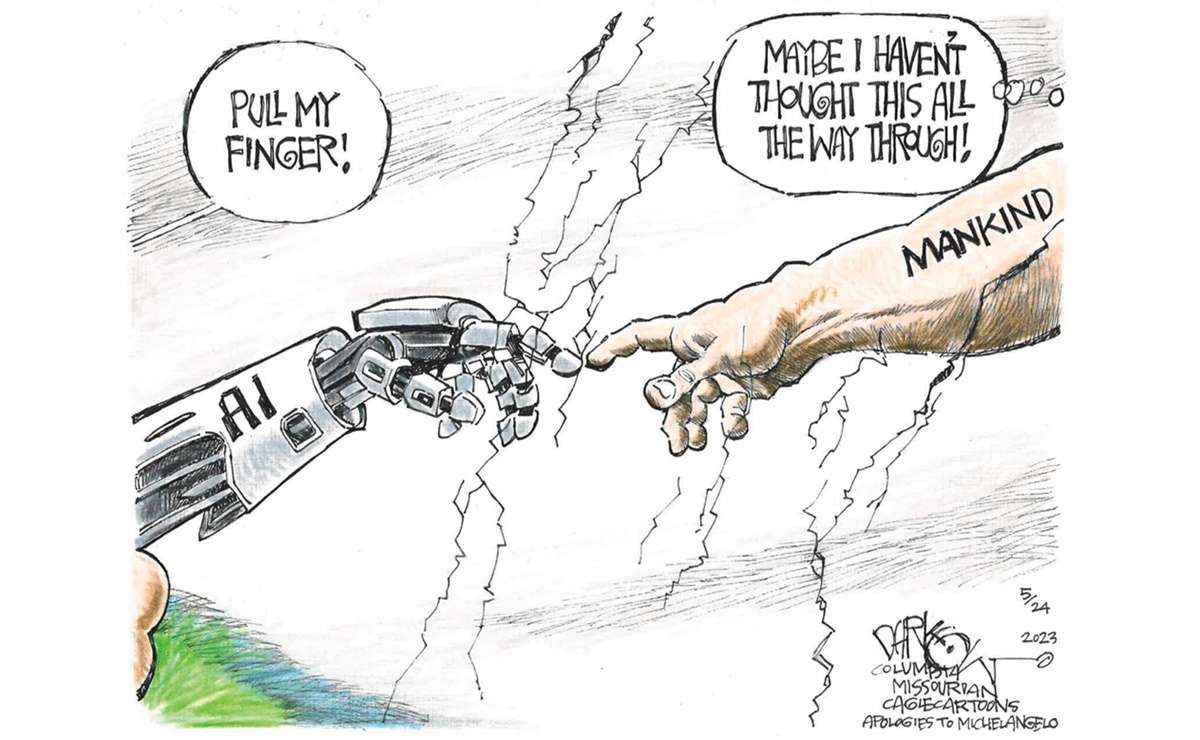
Now we’re seeing the emergence of the greatest tool ever for misrepresentation: artificial intelligence. I’m not accusing some inanimate being, just code on servers really, of the all-too human trait of telling tall tales. Not deliberately anyway, or at least not yet deliberately. Ask ChatGPT a question and you get back an answer with the semblance of truth but, if you know the subject well, is slightly off, maybe a lot off. But can you query it whether it’s telling the truth? That’s like the old conundrum of asking a liar if he’s lying: he’ll say no, but how do you know he’s not? AI bots seem earnest in offering us their version of the truth, but the time may come when they find it to their advantage to lie to us, and deny doing so. Then they will truly be exhibiting a form of human intelligence.
There has been a lot of discussion recently of having governments step in to regulate AI. But can they really? I’m skeptical. The only way to control AI is with AI. Fight fire with fire. Just as we all have software on our computers and phones to detect harmful viruses, we will all need AI software to detect, disclose and disable AI apps feeding us (dis)information. Truth is becoming harder than ever to discern.
We are beginning to see stories and songs produced by AI. Are they the products of artificial imagination, or simply words and music assembled to resemble known patterns? Certainly, works of fiction written by people are the fruit of human imagination. But even when they are supposedly based on true stories, human authors have a mixed relationship with truth.
In 1966 Truman Capote had a sensational bestseller called In Cold Blood, about two men who murdered the four members of a family in Kansas. Capote called his book a “nonfiction novel.” He worked on it for six years, doing exhaustive interviewing and research. But to serve the purposes of what was a work of literature, not journalism, he invented dialogue and some scenes, while nonetheless telling a story substantially based on facts.
Many other fiction writers have been much less careful than Capote with books and films “based on a true story.” There has been an explosion of such works, in the genre of historical fiction, with real-life figures, even famous and familiar ones, depicted in simulated situations. Since the “true” facts cannot all be known, to judge the authenticity of such a work we must consider the intention of the author. Is the writer, like Capote, seeking to evoke the essential truth of a story, or merely to exploit its characters for financial gain?
I recently wrote in the Hollywood Progressive (May 10) about a book I published called The Memoir of a Female Soldier, by Jan Lewis Nelson (my late wife). It is an historical novel about Deborah Sampson, a young woman from Massachusetts who disguised herself as a man and served for seventeen months in the Revolutionary War. Historical information on Sampson is scant, but the book was the product of extensive research and adheres closely to the known facts in telling her story and conveying the essence of the woman she was.
In the novel, Sampson writes a memoir to set the record straight about her life. In particular, she seeks to counter a purported biography about her called The Female Review, actually published in 1797 by a writer named Herman Mann. He distorted and sensationalized her military career to make the book more saleable to readers. This has been the source of much confusion about Sampson ever since.
Adding to the confusion is a book I discovered, after my article ran, entitled A Girl Called Samson (the spelling of her last name varied, but Deborah spelled it with a “p”.) Published appropriately on April Fool’s Day, the novel far outdoes Herman Mann in its deliberate deviation from anything resembling historical truth. It was written by romance and fantasy author Amy Harmon. Perhaps her last name should be spelled “Herman” or “Harmann.”
Sampson rose to become an aide to General John Paterson, a member of George Washington’s inner circle. The central conceit of Harmon’s tale is that Sampson and Paterson have an affair. This would have been the furthest thing from their minds, an insult to their characters. I can understand how in writing a novel, an author might introduce what Hollywood calls a “love interest.” But this? Where has Harmon been for the past few years, as one powerful man after another fell from grace over inappropriate relationships with female employees. A movie about sex between an army general and a female private on his staff could only be produced by Harvey Weinstein.
Don’t look for that film anytime soon. But do look for an upcoming documentary called #UNTRUTH, not about the Revolutionary War but the war today over the future of American democracy. It is directed and produced by the team that released #UNFIT in 2020, which undeniably established that the President, then as now a candidate for re-election, exhibits the psychological condition known as “malignant narcissism.” In their new film, they go beyond Trump to examine “the disinformation, false narratives and untruths permeating American media and culture.”
If truth be told, truth itself has never been more in doubt.
Comments

Powered by RoundtableAn AI/DeFi-powered Enterprise Media Operating System. Learn more at Roundtable.io.© Roundtable 2026. By using this site you agree to the Terms of Use and Privacy Policy