
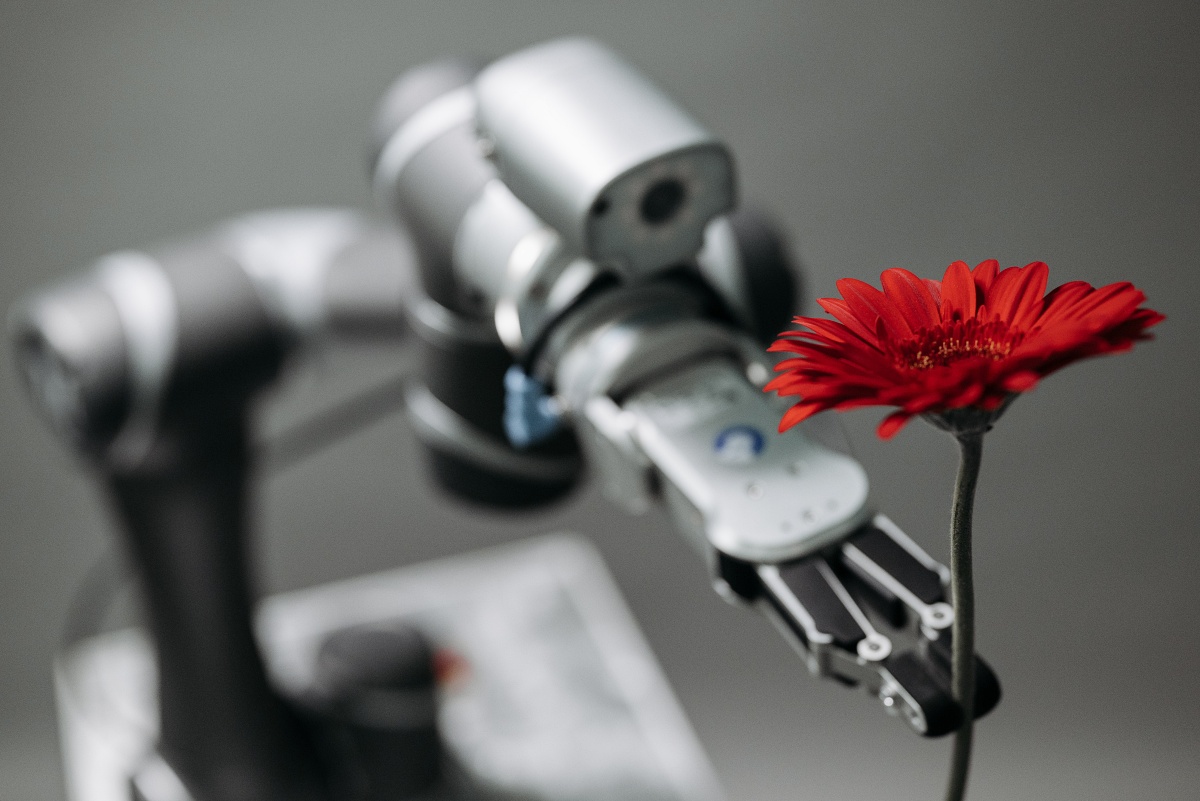
Photo by Pavel Danilyuk


Oct 2, 2025 5:30 PM
At present, arguably the most powerful country in the world has a president who certainly puts profitability before the common good.
The Stock Market continues to go up. By the end of September 2025, both the S&P 500 and the Dow had gone up for five straight months. As one source noted on Sept. 25th, “Since President Donald Trump’s second term began, the S&P 500 has increased more than 10%.” Moreover, one of the stock market leaders has been Nvidia, described by the Yahoo Finance site as “Artificial intelligence (AI) titan...almost universally loved by Wall Street analysts, with 58 out of 63 rating it the equivalent of buy or strong buy in September.” In the late stages of that month “Nvidia and [AI leader] OpenAI's massive deal...signals no slowdown in the artificial intelligence buildou...[and] the AI revolution is striking a new stage of growth.”
Moreover, we see AI being used in more and more places. Foreign Affairs recently declared that “the United States faces an energy crunch of historic proportions...The data centers that undergird the country’s artificial intelligence ambitions consume unprecedented amounts of electricity.” Or take for example if I go to the Google site and type, “Will Trump's tariffs cause inflation?” What I get at the top of my screen in an “AI Overeview” that reads, “Yes, Trump's tariffs are expected to increase consumer prices and cause inflation, although the effect has been delayed due to factors like stockpiling imports and retailers absorbing costs by eating into profits or lowering supplier prices. However, economists predict the price increases will mount over time, leading to higher costs for everyday items like food, shoes, and furniture, particularly as retailers adjust to the prolonged tariff regime.”
Below it is a box where I can click “Show more,” and it will, but with another phrase that I can click telling me to “Dive deeper in AI mode” and below that, “AI responses may include mistakes.”
In 2023, despite mentioning some AI positives, I twice wrote about its growing dangers. In my first piece I cited as perspicacious the economist/environmentalist E. F.Schumacher, who stated that technology was “the greatest destructive force in modern society.” And he warned, “Whatever becomes technologically possible . . . must be done. Society must adapt itself to it. The question whether or not it does any good is ruled out.” I also furnished two more quotes. The first was General Omar Bradley’s: "Ours is a world of nuclear giants and ethical infants. If we continue to develop our technology without wisdom or prudence, our servant may prove to be our executioner." And the second was by psychologist and futurist Tom Lombardo, who observed that “the overriding goal” of technology has often been “to make money...without much consideration given to other possible values or consequences.” In my second article, I supported Lombardo’s claim, suggesting that the chief reason AI has developed with few “guardrails” to contain it is “profit.”
Related stories
Now, in September 2025, a new book comes out by Eliezer Yudkowsky and Nate Soares, entitled If Anyone Builds It, Everyone Dies: Why Superhuman AI Would Kill Us All (hereafter, If Anyone Builds It). What it and some other sources have told us in the last two years is that the threat of AI is greater than ever.
The authors write that they are not so much concerned with the present state of AI, but “our concern is for what comes after: machine intelligence that is genuinely smart, smarter than any living human, smarter than humanity collectively. We are concerned about AI that surpasses the human ability to think, and to generalize from experience, and to solve scientific puzzles and invent new technologies, and to plan and strategize and plot, and to reflect on and improve itself. We might call AI like that ‘artificial superintelligence’ (ASI), once it exceeds every human at almost every mental task.”
But the authors of If Anyone Builds It observed that “efforts to build it [AI] as quickly as possible, before their competitors could do it—started looking to us like a race to the bottom. The industry was careening toward disaster: the sort that would get into textbooks as an example of how not to do engineering—except no one would be left alive to write the analysis.”
Whether the authors are correct in their alarmism, it is difficult to say. A Washington Post review of the book noted that the authors “lay out a fully apocalyptic account of the AI revolution. The projected results, while terrifying, are not all equally convincing.” Nevertheless, the past is not especially encouraging. Whenever technology has been able to construct something—e.g., poison gas, atomic bombs, greenhouse gasses, social media—it has generally been done, and we have just had to adapt to it.
I and many more knowledgeable people before me have argued that the common good—not profitability—should be our main political good. But as Lombardo has stated, “the overriding goal” of technology has often been “to make money...without much consideration given to other possible values or consequences.” And at present, arguably the most powerful country in the world has a president (Trump) who certainly puts profitability before the common good. Moreover, he has no problem ignoring the conclusions of wiser men—for example, in regard to our present climate crisis.
Yet, for all the alarmism about AI, we must—as former President Obama proposed before he became our leader—embrace the “audacity of hope.” And we must—like one of his favorite presidents (Lincoln)—believe that out of our dark times it’s still possible for “the better angels of our nature” to emerge. For us to choose the common good rather than profitability for a distinct group of seekers who put money first.
Comments

Powered by RoundtableAn AI/DeFi-powered Enterprise Media Operating System. Learn more at Roundtable.io.© Roundtable 2026. By using this site you agree to the Terms of Use and Privacy Policy