


Artificial Intelligence Isn't
Jan 19, 2024 6:11 PM
A.I. programs can craft images of flowers by comparing millions of flower images. But A.I. programs cannot imbue a flower painting with the beauty that Georgia O’Keefe did.
Artificial Intelligence is the natural evolution of counting and organizing that began when Mrs.Caveman first realized that she had dug more clams out of the beach sand than would be consumed atrhat night’s dinner. Artificial Intelligence programs allow people to sort and collate and compare data in more sophisticated ways than has been possible before. Think back to the days before before word processing programs could check spelling and format pages, change fonts and automatically renumber footnotes and data lists.
This should be really good news for medical researchers, historians, journalists and wannabe revolutionaries. A.I. programs can sort through billions of data bits and bytes per second and recognize patterns and relationships that might otherwise take months or years of research and analysis to reveal. Such programs can note similarities. But they still need the much more complex human mind to give meaning to similarities and differences.
A.I. programs can craft images of flowers by comparing millions of flower images. But A.I. programs cannot imbue a flower painting with the beauty that Georgia O’Keefe did. A.L programs can mimic la Giaconda’s smile, but can’t create the emotional mystery rendered by DaVinci.
But A.I. programs can, and will reveal many things that are data driven. Consider the long touted truism that a good offense is the best defense. Think back to the excess of clams that Mrs. Caveman had. She knew about the tasty clams inside the hard shells by watching the seagulls dropping the clams on rocks from on high to break them open, and then peck out the delicious innards. After breaking shells to get at the clams, she cut her fingers on the sharp shell edges and realized that those sharp edged shells would be better than the edged sticks her mother used to scrape clean animal hides before using them to make sandals and clothes.
Related stories
Mr. Caveman, seeing his wife’s injured fingers, realized that a broken clamshell, jammed into a crack in his favorite club, made a much more formidable weapon against prey animals or enemy cavemen. At the same time, neighbor Barney Rubble was realizing that a thick animal hide stretched between a couple of sticks was a better defense against Mr. Caveman’s club than trying to deflect it with his bare arm.
And so humanity advanced, with one man making a better club, spear or arrow and his enemy making better shields, helmets and body armor. Then tribal war leaders evolved into princes and religious warriors, each using their best weapons to seize the best lands and power over weaker peoples.
Once societies began to be organized, farmers were put to work feeding the ruler’s troops, and craftsmen specialized in forging the best swords, spears, arrows and shields that they could. One can olny imagine Musashi Myamoto fighting with Hattori Hanzo swords.
Wealthy empires like China and Rome could develop weapons like catapults, that for centuries were the most effective tools against the stone wall shields of cities and castles. A Roman general like Russell Crowe could use his catapults to rain flaming tar balls on enemy forces. And Roman war industries had to make the catapults and tar balls to hurl.
It is an essential feature of war profiteering that 2,000 years later, we still hurl flaming tar balls, in the form of napalm and white phosphorus, at each other. “Modern” armor piercing shells mimic ancient weaponry by being longer, to impart more directed kinetic force.
What if the war profiteers’ slogan is wrong? What if the best defense is a defense? What if ever increasing force is not the best approach to war?
But what if the war profiteers’ slogan is wrong? What if the best defense is a defense? What if ever increasing force is not the best approach to war?
Think about modern cars, with crumple zones, collapsible steering columns and air bags. Each of these things is designed to reduce injuries caused by vehicles colliding. Bike helmets, Football pads and bulletproof vests serve the same purpose. They all serve to dissipate tthe force of collisions and protect their users from injury.
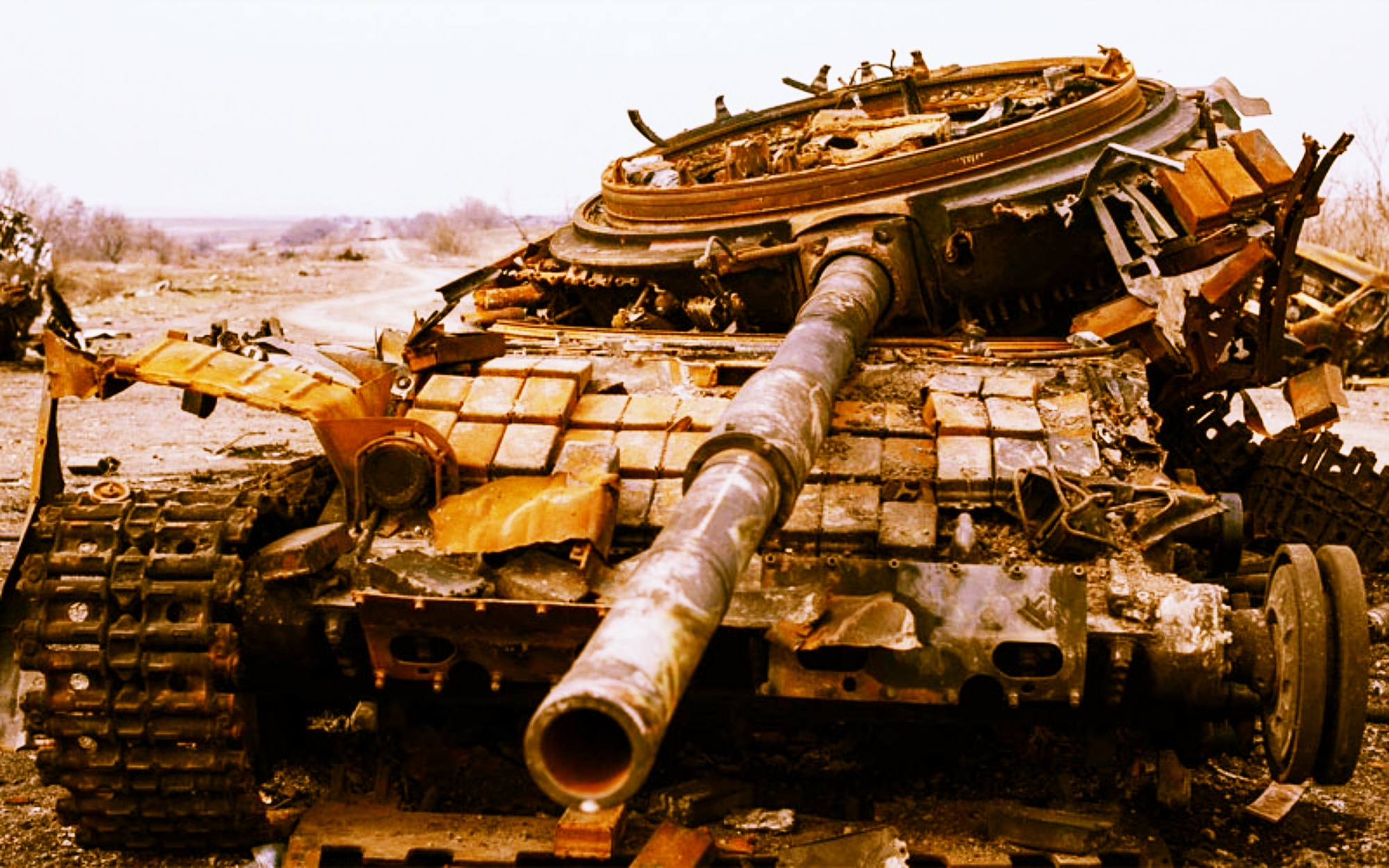
What happens when this principle gets taken too far? The Abrams Tank. Each Abrams Tank U.S. taxpayers pay for has super secret armor technology that wards off injury from opposing forces. It is so effective that the Pentagon has classified it as too effective to be used in battle. If an Abrams Tank were captured by enemy forces, they say, then the enemy could also develop such effective armor that U.S. offensive fire wouldn’t be effective!
Effective armor has traditionally been a barrier that either deflects, or absorbs force directed at it. Absorbing force often means damaging the armor. A car’s airbag works only once. Body armor plates crack and break while preventing the force from reaching the protected body.
Deflecting armor is different and evolving. Deflecting armor, like medieval knights wore, deflect incoming force. An arrow or a sword strike bounce off the armor, which isn’t destroyed. In a similar way, the “armor” of an invisible jet deflects enemy radar waves so that they don’t disclose the plane’s presence. Some radar evading armor also absorbs some of the radar waves dissipating them as heat.
If the Abrams Tank is indestructable, and an invisible jet can’t be shot down, that’s bad news for war profiteers who make these war toys. We don’t need to replace a tank that doesn’t get destroyed or a plane that doesn’t get shot down. War toy manufacturers lose profits.
With the Abrams Tank too invulerable to be used in combat, war profiteers need other sources of income. Donald Rumsfeld told us during the Cheney/bush wars that we wouldn’t be providing body armor for some troops or armoring Humvees. More sales for replacement troops, uniforms, small arms and unarmored vehicles keep the profits rolling in.
What if A.I. programs wrested control of war toy decisionmaking fom the war toys industry?
What if A.I. programs wrested control of war toy decisionmaking fom the war toys industry?
Pause to remember that while many Americans were denying that DNA even exists, a pair of Muslim scientists, looking at RNA solutions to cancers, deveoped the first Covid-19 vaccine without Big Pharma money. Remember that over 1,000 years ago, while good Christian doctors were still bleeding patients and diagnosing prayers as treatments, scientists in the Ottoman Empire were mapping the circulatory system and writing texts about how to use science to treat illnesses.
Then remember Charles Goodyear, working alone, who discovered how to successfully vulcanize rubber, making modern tires, waterhoses, etc. practical. Will A.I. open the doors to more discoveries like vulcanizing? Charles Goodyear made his discovery in 1839, long before computers, using the long established methods of scientific hypothezation and experimenting.
Can A.I. help others, solo or corporate scientists make similar breakthroughs? By magnifying the ability to collect, collate and analyze data, will A.I. programs help researchers finally develop lighter, higher energy-density batteries that will make electric vehicles lighter and cheaper to buy?
Will A.I. lead researchers to the development of lightweight materials that can stop bullets and absorb their energy, storing it, rather than simply dispersing it. Lots of corporate research money is already being devoted to developing better batteries, and better solar cells that absorb incoming energy and convert it to electricity. War profiteers have little or no interest in research to develop materials to absorb incoming energy and render it less harmful.
But there are, no doubt, individuals out there, like Charles Goodyear, Robert Fulton, and Eli Whitney who see the possibilities of new ideas and who then use A.I. to look across broader fields of knowledge to develop new concepts for dealing with kinetic energy.
It is possible to image that the Burqa, now an international symbol of the repression of women, becoming clothing that provides protection against incoming force, and also absorbs and stores energy directed against it, from men or from the sun.
It is possible to reimagine Reagan’s anti-ballistic missile system and Israel’s “Iron Dome” as energy absorbing systems, which simply defeat the purpose of incoming missiles and redirect their energy to power grids or electric propulsion networks.
Artificial Intelligence is scary, and the corporate media keeps warning us of the dangers it poses. But the biggest danger may be like the danger the printing press posed for “divine right” rulers. By distributing the ability to gather and extend knowledge to encourage those not in power or control to think on their own. A.I. may also provide an extension of democracy and rewritten social rules which allow power and authority to be more fairly distributed. And lead to the reduction of profitable war toys, maybe encouraging some businessmen to redirect their energies to helping societies, rather than ravaging them with war.
Comments

Powered by RoundtableAn AI/DeFi-powered Enterprise Media Operating System. Learn more at Roundtable.io.© Roundtable 2026. By using this site you agree to the Terms of Use and Privacy Policy