


Jun 14, 2023 5:08 PM
We need regulations that will protect the consumer instead of the industry but that is not likely to be the outcome.
Artificial Intelligence can be productive, unfortunately, AI programs are already being programmed to benefit corporate sales interests and not to protect consumers
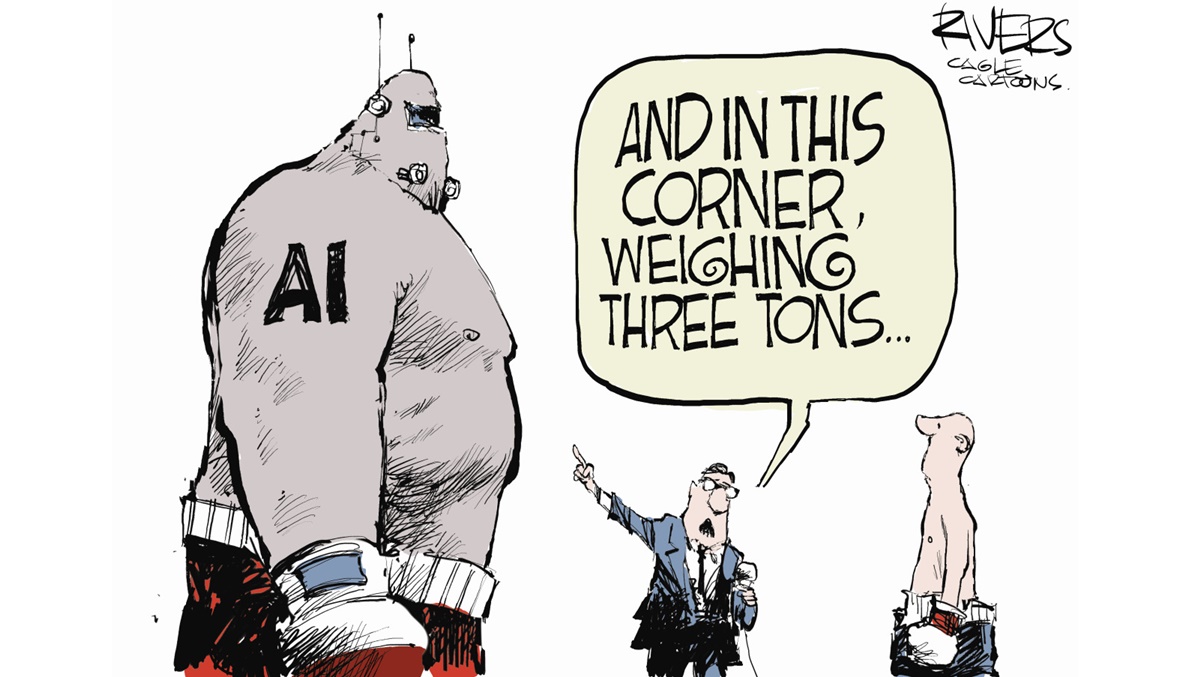
We have been fed months of warnings about the dangers of Artificial Intelligence - “AI,” particularly about the risks it poses for “thinking” machines taking over warfare and war decision making at faster speeds than human generals and politicans can think.
But now salvation is at hand. AI developers have gone to Congress and testified to the need for regulation of their own industry. And politicians from the far left to the far right have sounded very supportive of this method of “controlling” AI dangers. Doesn’t it feel reassuring to see industry and politicians joining hands to do what is right for consumers?
Not for me it doesn’t!
Related stories
This past winter, the “if it bleeds it leads” news media fed us days of video from a train wreck that dumped deadly hazardous chemicals into a small town and then into the air. That wreck was the direct result of the railroad industry and its lobbyists working with Congress to protect the rail industry from wasteful requirements for safety equipment. The result was that consumers benefited from the artful towering plumes of toxic smoke rising into the sky from their town, and spreading in the wind to be shared with consumers in neighboring towns and states.
Food safety and animal welfare activists have been arrested, over and over, for revealing conditions on factory farms in which animals are kept in savage conditions, stuffed with hormones and other chemicals, and fed with feeds sometimes made from the waste of other animals being butchered. The activists are arrested under laws that big Agra and big Pharma convinced Congress and state legislatures to pass, “for the good of consumers.”
Perhaps the most consequential result of industry lobbyists and Congressional donation seekers cooperating was the insane early efforts to “reduce” polluting, poisonous automobile exhaust emissions. Through the 70s and 80s, the rules targeting auto emissions encouraged car makers to keep increasing the size of their engines. Small engines, like those found in so many foreign cars, running without any emission controls, put out less total emissions than the huge gas guzzler engines with emission controls. But the “per CC” measure of emissions of the smaller engines was higher than that of the huge engines. So the huge engines, with their massive fuel consumption, and higher total overall emissions were deemed “better” for consumers and for our still polluted air.
In this context it is useful to wonder what exactly industry supported “regulation” of AI might look like. But it isn’t really necessary to wonder, as the self-regulation of AI companies is already affecting us. We can see the future simply by asking programs like Chat-GPT4 questions. I offer a few samples. Spoiler alert, Chat-GPT4 is programmed to help spammers sell you things that you don’t need and maybe don’t yet know that you want.
In the 1970s, we saw an explosion of polyethlene plastics. Do you know that those white jugs that hold milk and orange juice and the film that wraps meat, chicken and so much else in the supermarket are made of the same thing? Polyethlene is a kind of plastic that can be used for all sorts of storage because it doesn’t react with other things. Leave some fruit or veggies in your refridgerator while you’re on vacation. You come home to find them all moldy in their bags or other wrapping. Ick. Instead of throwing out the package, open, dump out the spoiled food and then wash the plastic. It becomes clean and reusable remarkably easily, because it doesn’t interact with either the fruit or the mold. Modern science.
Drive through any of the agricultural areas in southern California and see the big tanks used to hold harvested crops, or on trailers to carry pesticides and fertilizers out to the fields. They’re made of the same plastic as the milk jugs. It’s called High Density PolyEthlene (“HDPE”). In the 1970s, trying to reduce the weight of new cars, automakers started using it for gas tanks. It’s lighter than metal tanks and gasoline and diesel don’t corrode it. It doesn’t rust. You can let packaging made of the stuff sit in hostile environments and it doesn’t degrade. We have islands of it in our oceans.
Ask non-AI Google how to glue two pieces of HDPE together. You will get a bunch of videos and print stories explaining why it is essentially impossible to glue two pieces of HDPE together. It simply doesn’t react with glues, they can’t get a good hold on the non-reactive HDPE material. But there are plenty of online sellers willing to sell you stuff to “glue” HDPE.
Ask Chat-GPT4 what will glue HDPE and it gives a paragraph saying that cyanoacrilates (superglue) and epoxies will glue HDPE. In fact they won’t, or at least not with strong or lasting bonds. But Chat GPT4 doesn’t tell you that. Its purpose is to help online sellers more than to tell the truth.
Does your internet mailbox fill up with sales offers for all manner of things that you really don’t want, and feel like they are scams? Are your children getting porn email coming from e-addresses that look like they’re from an evangelical ministry? If you ask Chat-GPT4 to hunt down and give you the true identity of spammers and online perverts, it will tell you that it is programmed not to disclose names of spammers, online stalkers, and other miscreants who have “privacy interests.”
If you get hoards of emails offering you miracle cures for everything from Covid-19 to bad breath, Chat-GPT4 will again tell you that it would be improper to research and reveal the true identities of such online hucksters.
But if you are a business that is looking for innovative programming ways to defeat people’s “spam blocker” programs, well that’s different. That’s legit business, and as fast as someone develops a new program to block spam, Chatn-GPT4 will aid the huckster and stalker communities to develop ways around the new spam blocker.
On May 18, the U.S. Supreme Court upheld the right of internet service providers to market spamming and stalker services to everyone
On May 18, the U.S. Supreme Court upheld the right of internet service providers to market spamming and stalker services to everyone from your daughter’s neighborhood stalker to international terrorist groups. Back in the 1990s, internet service providers went to Congress, wallets in hand and begged for laws protecting ISPs from liability for defamation and other forms of harm. The excuse was that the internet was a small, developing industry that needed protection.
Congress, eagerly understanding the financial donations of Silicon Valley businessmen, wrote §230 of the “Communications Decency Act,” providing that internet companies cannot be sued no matter how indecent, malicious, threatening, etc. their content is. The one caveat is that for every such posting, the ISP has to pretend that it was posted by some 3 rd party. If the ISP says it is 3 rd party content, they don’t have to prove that, or provide supporting evidence. Because Congress wanted to help protect the ISPs, the ISP’ were given protection - in reciprocal measure to the financial help the ISPs gave Congress-people.
Now Chat-GPT4's creator is asking for the same thing - regulations that will protect the industry, rather than consumers. And poliicians from all sides seem ready to accomodate. So if you’ve been convinced to pay for a spam blocker service, that subscription will soon be worthless. If you’re used to getting hard information from Bing or Google searches, AI will soon fix that (Microsoft has already incorporated AI into Bing - ask Bing the HDPE glue question).
What AI does most effectively is troll through immense amounts of available data to find relationships. What’s coming is the ability of corporations, political parties, and marketeers of every sort to integrate your census data with undercover police reports, and medical insurance records and bookstore purchases and Koch brothers and Heritage Foundation mailing lists and phone records and cell phone GPS trails to generate more precise information about you and your physical actions and then to extrapolate your beliefs and feelings.
But AI, right now, mostly compiles data. That isn’t thinking. Thinking is still up to those who buy permission to use the most sophisticated AI programs. Do you have the ability to buy an AI program as sophisticated at the Desantis campaign can afford?
Did you buy Randall Kennedy’s 2021 book Say it Loud!, or Mathew Dallek’s 2023 book Birchers because you care about U.S. modern history or because you are a dangerous leftist subversive who needs to be kept under surveillance? (Or, is there a difference?)
Does your purchase of a ticket to Martin Scorsese’s Killers of the Flower Moon prove that you are a fan of Scorsese or of murder mysteries, or that you are a bleeding heart who wants to groom children to believe the ‘myths’ that White people abused Native Americans?
Artificial Intelligence can be an enormously productive and helpful tool for advancing science and our understanding of our world. But the requests by the AI industry for protective regulations, at a time when AI programs are already being programmed to benefit corporate sales interests more than knowledge, portend even worse social disruption than the current protection ISPs have to spread lies, bigotry and social disruption. And politicians are lining up to help the AI industry do worse.
Be afraid. Be very, very afraid.
Read Also:
Comments

Powered by RoundtableAn AI/DeFi-powered Enterprise Media Operating System. Learn more at Roundtable.io.© Roundtable 2026. By using this site you agree to the Terms of Use and Privacy Policy