


May 13, 2026 4:16 PM
Updated May 13, 2026 6:28 PM
As artificial intelligence reshapes labor, millions may be pushed outside the traditional economy—forcing America to confront its deepest instincts about work, value, survival, and who deserves dignity.
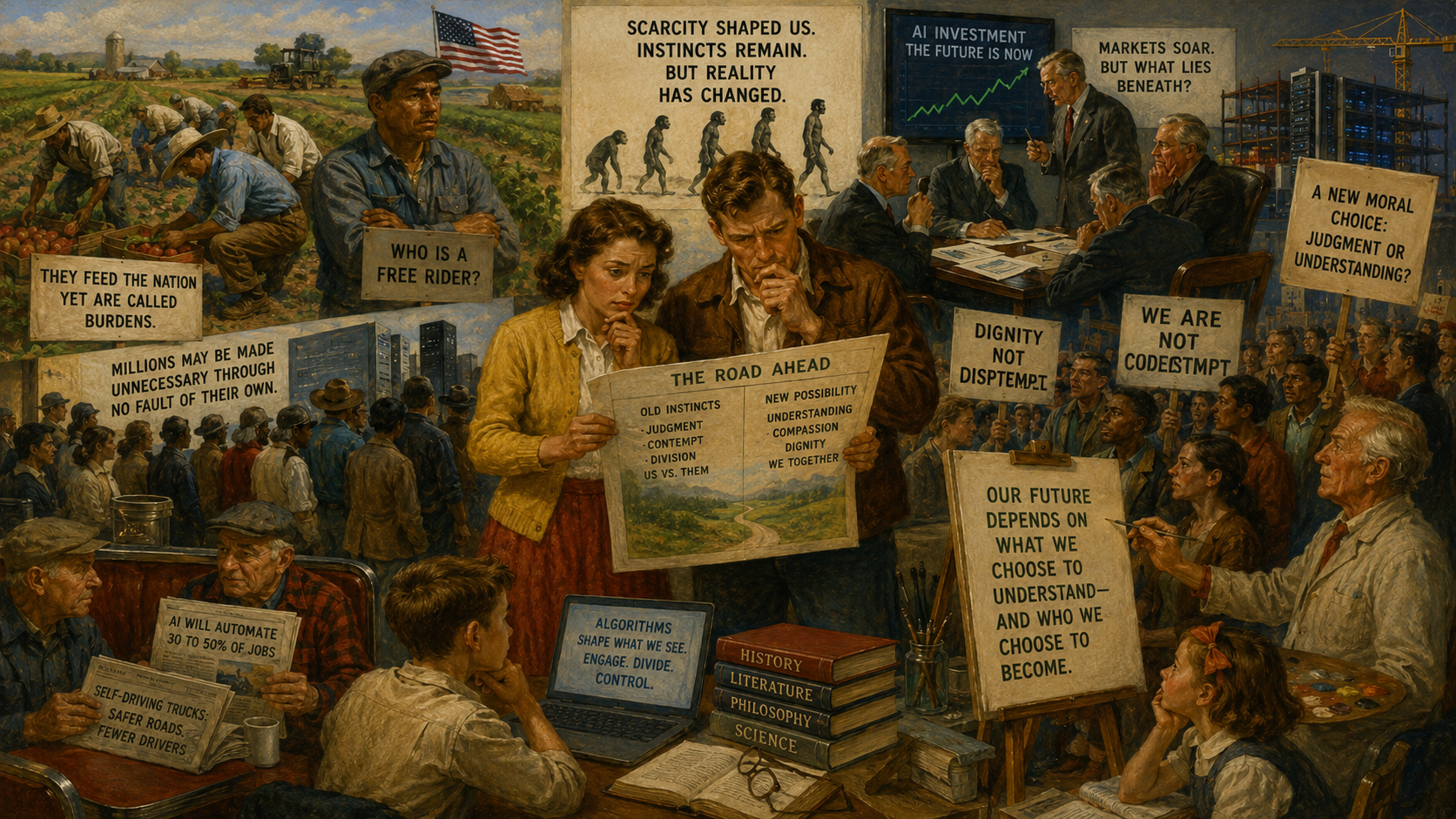
Scarcity and the threat of starvation shaped our species for tens of thousands of years. That pressure is not just historical, it is biological. It is embedded in our nervous system. We are predisposed to scan for imbalance, to notice who contributes and who does not. The instinct to detect “free riders” is not a moral invention, it is an evolutionary inheritance.
When Survival Instincts Become Political Ideology
In many cases, that instinct is amplified by cultural conditioning. Right-wing, paternalistic models of authority tend to reinforce rigid ideas about discipline, contribution, and worth. I know because I grew up with it.
These frameworks reward conformity and punish deviation, often long after the original conditions that justified them have disappeared. The result is a psychological posture that is constantly on guard, suspicious of anyone who appears not to be “pulling their weight.” The misalignment with present-day reality can become extreme.
Migrant Labor and America’s Psychological Contradiction
Consider a simple contradiction. Since World War II, when the United States actively recruited Mexican labor through programs like the Bracero initiative, migrant workers have played a central role in American agriculture. They harvest the food that fills American grocery stores and dinner tables.
Related stories
These are jobs that many native-born Americans have consistently refused to do. Yet the same workers are often framed as burdens, as parasites, as free riders. The contradiction is not subtle. It is psychological.
The Illusion of Stability Beneath the AI Boom
The current oil shock by the war in Iran portends a slew of indices that we are headed for a global recession. But our relatively high Stock market makes it appear that everything is okay. But what is keeping the stock market high is a gargantuan investment in AI. There are literally thousands of data centers under construction coast to coast in America.
What remains underappreciated is what happens when these systems reach maturity. Artificial intelligence is not just another technological wave. It has the potential to automate not only repetitive physical labor but also large segments of cognitive work.
Estimates vary, but credible projections suggest that 30 to 50 percent of existing jobs could be displaced within a relatively short timeframe. Self-driving systems alone could eliminate millions of driving jobs, even as they ultimately reduce accidents and save thousands of lives each year.
The End of the Traditional Labor Bargain
This creates profound tension. The same system that increases efficiency and safety also erodes the traditional link between labor and survival.
We are moving toward a world in which a significant portion of the population may be structurally unemployable or relegated to tasks dictated by algorithms. In that environment, the old instinct to identify and condemn free riders will collide with a new reality in which millions of people are displaced through no failure of effort or character.
That collision will not be merely economic. It will be psychological. For the first time on a scale, large numbers of people will experience what it means to be seen as unnecessary within the traditional framework of contribution. If our inherited instincts remain unchanged, the result will be widespread resentment, stigma, and social fracture. But there is another possibility.
When Unemployment Is No Longer a Moral Failure
This moment will force a reexamination of one of our oldest moral reflexes. If “free riding” becomes a condition imposed by systems rather than chosen by individuals, then the basis for contempt begins to erode. In its place, there is an opportunity, not a guarantee, but a genuine opportunity, to shift from judgment to understanding.
What lies ahead is not just a technological transition. It is a test of whether we can outgrow the psychological machinery that once ensured our survival but now risks undermining our future.
The way I have presented this so far sounds like a relatively peaceful transition, but my guess is that it will be anything but. The current level of political divide is severe and most Americans from what I’ve observed have very little understanding of what the full development of AI portends for our way of life.
But to expect the top ten percent in this country to look after the interests of the rest of us without the mother of all political battles is in my view naive. The replacement of people with AI is barely underway and when it starts in earnest the conflict and turmoil will very likely put people in the streets in protest.
The Psychological Crisis Ahead
The anxiety in anticipation of being unemployed because of AI is already here and yet our politicians have yet to tackle the subject with a viable plan because they don’t know yet how we are going to deal with it.
One thing for sure is that Bubba economics is not going to help and neither is howling about people who just don’t want to work. The bewilderment of the hard political right is likely to be stratospheric. Crying socialism will fall on deaf ears.
It turns out that the liberal education right-wingers so readily dismissed as useless was our prefrontal cortex defense against tribalism. It also represents our personal opportunity to cope with the anxieties of the human condition without the need for scapegoats.
The Liberal Arts Were Never the Enemy
For years, conservatives dismissed the liberal arts as indulgent, impractical, even worthless. Now, amid our political and cultural unraveling, we are finally seeing what they were for. Liberal education was never a luxury. It was a kind of malware patch against tribalism, and it is a way to work through the frustration that comes from being haunted by our own mortality.
We were raised to believe that human beings are rational actors, that character is fixed, and that the conscious mind is in control. That belief is not just wrong. It is dangerously wrong. It is like setting out on a long journey with a GPS that is off by a few country miles. You may not notice the error at first, but over time you end up somewhere you never intended to go. That, in many ways, is where we are now.
The Myth of the Rational Human Being
Neuroscience has spent decades dismantling the myth of the rational, self-governing individual. We are driven largely by emotion. Our decisions are shaped by an unconscious accumulation of experience, by stress, by environment, and by forces we neither see nor control.
Character is not fixed. It is fluid, responsive, and deeply contingent. And we are, by our very biology, primed for tribal behavior.
Why the Humanities Still Matter
This does not diminish the humanities. It clarifies their role. Literature, history, and philosophy are not ornamental pursuits. They are tools that help us step outside our immediate identities, question our assumptions, and recognize ourselves in others. But without grounding in human biology and neuroscience, they are incomplete. To understand ourselves, we need both.
If the coming election cycles fail to serve as a wake-up call, the trajectory is not hard to see. We risk becoming increasingly subordinate to systems we do not understand, shaped by algorithms designed not to inform us, but to keep us engaged, distracted, and divided. AI is perfectly capable of making undereducated citizens into permanent compliable servants of a system they cannot understand. It may even come described as gospel.
“I Love the Uneducated”
The tragedy is that we once had the beginnings of an answer. A liberal education, properly understood, was not about elitism or abstraction. It was about learning how to live with one another in a complex society. It was about building the intellectual and emotional capacity to move beyond tribal instincts.
We did not simply neglect that education. We mocked it. Donald Trump said he “loves the uneducated.” He was not joking. He was describing the political environment that makes all this chaos possible. Now we are living with the consequences.
Comments

Powered by RoundtableAn AI/DeFi-powered Enterprise Media Operating System. Learn more at Roundtable.io.© Roundtable 2026. By using this site you agree to the Terms of Use and Privacy Policy