
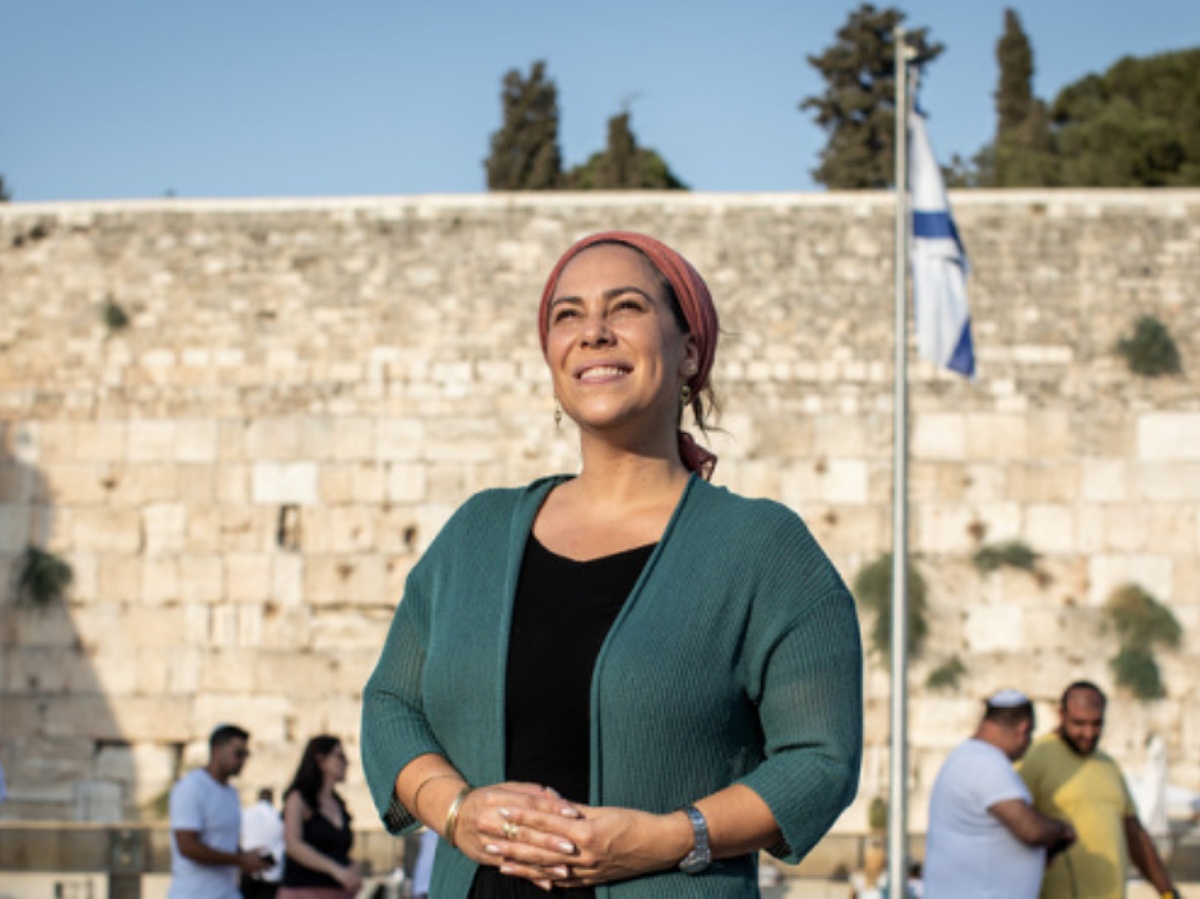


Yael Eckstein
Mar 2, 2024 8:00 AM
Updated Mar 5, 2024 3:15 AM
Based in Israel with her husband and their four children, Yael is a published writer and a respected social services professional.
Yael Eckstein, President and CEO of the International Fellowship of Christians and Jews (also referred to as IFCJ or The Fellowship), oversees all ministry programs and serves as the international spokesperson for the organization.
Prior to her present duties, Yael Eckstein served as Global Executive Vice President, Senior Vice President, and Director of Program Development and Ministry Outreach. Based in Israel with her husband and their four children, Yael is a published writer and a respected social services professional.
Yael Eckstein has contributed to The Jerusalem Post, The Times of Israel, and other publications, and is the author of three books: Generation to Generation: Passing on a Legacy of Faith to Our Children, Holy Land Reflections: A Collection of Inspirational Insights from Israel, and Spiritual Cooking with Yael. In addition, her insights into life in Israel, the Jewish faith, and Jewish-Christian relations can be heard on The Fellowship’s radio programs and on her podcast, Nourish Your Biblical Roots – Conversations with Yael.
Yael Eckstein has partnered with other global organizations, appeared on national television, and visited with U.S. and world leaders on issues of shared concern. She has been a featured guest on CBN’s The 700 Club with Gordon Robertson, and she served on a Religious Liberty Panel on Capitol Hill in May 2015 in Washington, D.C., discussing religious persecution in the Middle East. She was also featured as the cover story of Nashim (Women) magazine in May 2015. Her influence as one of the young leaders in Israel has been recognized with her inclusion in The Jerusalem Post’s 50 Most Influential Jews of 2020, 2021, and 2023, and The Algemeiner’s Jewish 100 of 2019. She was named a winner in the 10th Annual 2022 CEO World Awards®, and received The Jerusalem Post’s 2023 Humanitarian Award.
Related stories
Born in Evanston, Illinois, outside of Chicago, and well-educated at both American and Israeli institutions – including biblical studies at Torat Chesed Seminary in Israel, Jewish and sociology studies at Queens College in New York, and additional study at Hebrew University in Jerusalem – Yael Eckstein has also been a Hebrew and Jewish Studies teacher in the United States.
In the aftermath of the devastating events on October 7, southern Israel, particularly the region near Gaza, has become a focal point of global attention. The attacks by Hamas on that day and the ongoing barrage of terrorist rockets have shed light on the resilience and hope of the Israelis living in this border area.
In this special episode of her podcast Nourish Your Biblical Roots – Conversations with Yael, host Yael Eckstein interviews Adele Raemer, a blogger, activist, and resident of kibbutz Nirim, situated near Israel's border with Gaza. Adele shares her journey from the Bronx to Israel, her life on the kibbutz, and the harrowing experiences of October 7th and the subsequent days of war. This episode aims to bring forth the untold stories of survival, resilience, and hope from the heart of the Holy Land.
Yael Eckstein: In the week since October 7th, the world's eyes have been focused on Israel. Especially southern Israel, the part of the Holy Land hit hardest by the Hamas attacks that day and the ongoing barrages of terrorist rockets ever since. But while the world is only now becoming aware of life on Israel's border with Gaza because of the attacks and because of the ongoing war, the region is the longtime home to so many Israelis and so many Fellowship projects, and was the target of the worst violence carried out on that day.
In the days since, because The Fellowship was already on the ground in southern Israel, we have seen and heard the stories of what happened that day and we've had the privilege of being able to help the people of the south begin to heal – thanks to our supporters who stand with Israel from all around the world. But we also want to share these stories, both the stories of October 7th and the difficult days of war since, as well as the stories of healing and hope from this region of Israel.
These people have inspired the world with their hope, with their unity, and with their desire to go on and rebuild instead of falling into despair. This week's guest is someone who is singularly qualified to speak to life in southern Israel, both before October 7th, on October 7th, and in the days since. Adele Raemer is a blogger, activist, and an Israeli who lives in Kibbutz Nirim near Israel's border with Gaza. A mother, a grandmother, a teacher, a Zionist, a desert dweller, a hospital clown, and so much more. And so, Adele, I want to welcome you to my podcast and thank you so much for joining.
Adele Raemer: Thank you. It's an honor to be here.
Yael Eckstein: Well, Adele, before we talk about October 7th and the days since, you had a very full, exciting life on kibbutz Nirim. I'd love for my listeners to hear a little bit about you. You actually were born and raised in America. So if you could tell us a little bit about your life in America, why you ended up moving to Israel, and how long you lived on the kibbutz and what life there was like.
Adele Raemer: With pleasure. I was born in the Bronx and raised, and was part of a Zionist youth movement, Young Judaea. And when I finished high school, I went on the Young Judaea year course which brought us to Israel, and I fell in love with the country. But at the end of the year course in July – August 1973, my parents expected me to come home to do the university thing and do what every good Jewish person does, so I did.
But while I was waiting to be accepted into the college and stream of my choice in 1973, the October War broke out. And so, I wasn't in college yet and I said, "Well, what am I doing in America? Israel needs me," and that's when I took the decision to make aliyah. I made aliyah finally to Kibbutz Ketura which was founded by Young Judaea. It had just been transferred from the army to a civilian kibbutz. And so, that's where I made aliyah.
The Yom Kippur War was sort of petering out and I was 19, so I was given my draft papers. I went into the army and while I was in the middle of my army service, I realized that Ketura wasn't the place that I wanted to stay, and that's how I got to kibbutz Nirim where I am today on the border. We're two kilometers, just under two kilometers from the border with the Gaza Strip, and that was in November 1975. So that's how long I've been living there.
It was not a war zone when I went to live there. We used to get in a car on a Saturday and drive over to the Shuk and Gaza to the open air market and go to the beach. And Gazans used to come in and work in our kibbutz. In fact, a Gazan built my house. It was in 1996. So I asked him, "It must be hard for you to get here too... You have to go through the security and get up really early in order to get here." And he said, "Yeah. But I can earn an honest living. I could put food on my table and get education for my children so it was worth it." And we called the area 95% heaven because it really was 95% of the time, if not more, heaven on earth.
It was beautiful and quiet and green. It's a desert but it's green and beautiful. And community, we have a very, very special community. Here, I was in Jerusalem yesterday visiting my cousin and I'm driving home with a cab driver and talking to him about October 7th and life on the border, he knows exactly what I'm talking about. You go to the States, who can you talk to about it? So all in all, this is my place. This is unfortunately not a lot but I do believe that eventually, hopefully sooner rather than later, but it has to be secure rather than insecurely, I'll be back in my home in my own chair. I was at my cousin's house, as I said in Jerusalem, and I had this longing just to be in a normal house with a kitchen.
Yael Eckstein: And I'm going to clarify here that you're a refugee. Right now, Adele is a refugee. The kibbutz that she lived on, her home of over 30 years, of over 40 years, she's been evacuated from because it's the town where terrorists infiltrated, where they killed people, where they kidnapped people, where they burned down homes. And so, it's not safe for them to be there.
So for the past two and a half months, Adele, along with over 150,000 others in Israel, have been living as refugees. And so, Adele, it makes perfect sense that what you're longing for is home. But not just home, a secure home that you don't need to worry about terrorists infiltrating like they did on October 7th.
I want to go back to something that you said. You're living there in a peaceful neighborhood, in a town that is longing for peace with the Palestinians. The simple citizens of Gaza are being held hostage by Hamas just like Israel is. And for years, even though you didn't have a physical infiltration, you had lots of rocket attacks. And so, when you mentioned that life there on the border was 95% heaven and 5% difficult, paint for us a picture of what that 5% difficult looked like. How long did you have to run to your shelter? How often did you have rocket attacks? What was going on in your mind when you were out and just taking care of your garden or drinking coffee? Was the terror situation, the security situation, always there front of mind for you and what did that look like?
Adele Raemer: So where we lived we have between zero to ten seconds. From the second you hear that alarm, the voice saying, "red alert," until the second you hear the explosion. And we don't always get warnings even because mortars don't always trigger the warning. So sometimes, you hear an explosion and you know you've got to get to someplace safe. I never say that we get used to it. We learn to deal with it. We learn how to handle ourselves. Rocket fire is not anything that anybody can or should ever get used to.
When my children were growing up, we didn't have that threat. There were always people that feared infiltration, but that could also happen any place in the country. It could happen in Judea and Samaria. It could happen in Tel Aviv. I mean, infiltration and terror has happened all over the country at some point or another but I felt very secure because we have the fence around our community and we have the army in the area and all eyes are on the border.
We have a new fence that was just built since 2014. It was finished I think about two years ago. An underground barrier that cut off the tunnel threat which before that was a very severe threat of infiltration through these tunnels. In fact, my daughter, who's now 41, was so traumatized when she was a child. She was about eight or nine years old and it was Passover and we were having Passover on the kibbutz and her grandfather was walking around with his gun because there was an alert of possible infiltration.
And since then, she was scared of infiltration. She was sure that a terrorist was going to pop up in a tunnel outside her window and abduct her. And she even... She was so traumatized that when she studied scriptwriting one year, she made a short movie about her fear, about her worst nightmare, and it came true. Inconceivably, it came true. I always told her, "It can't happen," especially with the underground barrier. I mean, she's now married. She lives on the kibbutz.
Yael Eckstein: Oh, she lives on the kibbutz.
Adele Raemer: She lives on Nirim. If you told me one of my four kids would come back and live on Nirim, I would've said, "Okay, but not her." But she did because she fell in love with another son of Nirim and they built her house there and they have three children.
Yael Eckstein: So as a mother, from the time your child was young, you've assured her, "We're safe. We're protected. Nothing can happen." And she ended up moving back to Nirim, raising her own children there, and you had rocket attacks that you would find shelter from. That was just a part of life that you never got used to but that you learned how to deal with. And then, came October 7th. Tell me about that day.
Adele Raemer: So before October 7th, we did not have... A safe room is a concrete reinforced room that is part of your house because in zero to ten seconds, you do not have time to go outside of your house and run to a bomb shelter. Those were fine for the '73 war but they're no good if you've got zero to ten seconds. Anyway, in the 2008, '09 war, we did not have a safe room. We had no place safe to be at that period so we just had to find a safe area, the safest place in your house with no external walls or windows. Kibbutz houses are very small so it had a very small corridor that fit the criteria and that's where we would run to and just hope nothing fell on the roof because nothing would've helped us then. After the 2008, '09 escalation, the government of Israel invested billions of dollars to build safe rooms, concrete reinforced safe rooms, on every house within four kilometers of the border and then it was widened out to seven kilometers. So we have a safe room and that's where we run to.
So on October 7th, that evening before I went to bed, I told my son, "If you don't see me in the morning, it's because I'm going to go out to take pictures of a field of wildflowers and the fields before the sun rises." So thankfully, I did not do that because I would not be sitting here today if I had. People who were where I intended to go were murdered that morning. So on October 7th, 6:00 in the morning, I was too tired to get up out of my bed and do that.
Yael Eckstein: Thank God.
Adele Raemer: Ah. I'll do it another day. They'll be there tomorrow.
So at 6:30 we started getting the incoming rocket warnings and I jumped out of my bed, ran to the safe room where my son was sleeping. The safe room has a heavy iron sleeve which you're supposed to close in times of threat and an iron door that you pull closed and click. The barrage was so intense that I ran into the safe room but I was scared to stand up to close the window. The window is to prevent shrapnel from coming in which can kill you.
So we waited a bit until it calmed down but it was so heavy. And we were on a WhatsApp group. I was on a WhatsApp group with other English teachers. I'm a recently retired English teacher and we're saying, "This is crazy. It's such a heavy barrage and was from the north of Tel Aviv until south below us and what's going on?" And a friend of mine who I know takes sunrise walks in the fields, she didn't write. She sent a picture of the sky and I didn't really understand what that was about. But we were in survival mode, I didn't bother going into it too deeply. And eventually after a few minutes, after about 5, 10 minutes, it calmed down. I was able to close the window and we got notification that we should go out of the safe room, lock our doors and windows, and then return to the safe room and lock it and not leave.
Yael Eckstein: So you knew by that point that there was an infiltration on top of the huge rocket barrage.
Adele Raemer: We knew that... We realized in retrospect that this huge barrage was cover, camouflage for the main event that was happening over on the border. So I went out and I closed the windows and the doors. And it's funny, because I didn't remember that I had done this but when I was preparing for an interview, I looked back, I have a Facebook group called Life on the Border with Gaza, things people may not know but should and I was doing Facebook Lives already. And at that point, I went out. I was doing a Facebook Live and you can still see it there and I'm saying, "I don't really think this is necessary because I'm sure nobody's going to infiltrate the kibbutz but I'll do it anyway." And I'm walking around and locking the doors and the windows and then I go back into the safe room but you can't lock a safe room. The safe room is built to keep you safe from rockets.
Yael Eckstein: Right. Not from infiltrators. And they're made that if a rocket hits, that someone could specifically open it from the outside and come rescue you.
Adele Raemer: Absolutely. And it has a lock that you click in order to protect you in case the house is hit someplace and there's an implosion so that it doesn't blow the door open. But anybody, as you said, from the outside, has to be able to open it so that they can come in and take cover as well. People realize very quickly that you can't lock the safe room. The only way to keep it locked is by pulling down the handle. So that was my son's job. We sat by the door-
Yael Eckstein: He was holding it. And so if anyone tried to open it, he would be holding it closed.
Adele Raemer: Yeah. Hopefully, you're strong enough to keep it clear-
Yael Eckstein: Or stronger than the terrorist that would be fighting with-
Adele Raemer: Stronger than the terrorist on the other side.
So we started getting frantic messages of people in our kibbutz. We have a special messaging system that's internal to the kibbutz. We're about 450 people on my kibbutz so I know everybody and I know where everybody lives. So I'm following the progression as this is developing through the messages on the WhatsApp group because we weren't getting any official notifications because nobody knew anything. Nobody understood what was going on.
And I'm following these messages and I'm seeing this person saying, "We hear shooting outside." So we know what it sounds like when a rocket explodes, that's a sound we know how to identify. But all of a sudden, we're seeing other sounds that I'd never heard in Nirim. Of automatic gunfire, of grenades exploding, of RPGs exploding, and people are writing, "There's shooting near our house. We can hear people shouting in Arabic."
Yael Eckstein: Terrifying.
Adele Raemer: And I'm following the progression as it's happening and reading what people are saying. "They're entering our house. There are terrorists in our house. We can hear them. They're trying to force the door open. They're setting our house on fire." The terrorists took gas balloons from outside the house, detached them, put them in the house, turned on the gas, and lit a match.
So they exploded inside our houses. There's a family there on the other side of the kibbutz who are saying, "Our house is on fire," and we know that they have a 10-day-old baby with them in the safe room and when the terrorists tried to open their safe room door at first, they managed to dislodge it just enough to have a crack where the smoke, at this point, was flooding into the safe room and choking them and this 10-day-old baby. So that's a whole story in itself. They've given many interviews. I just saw them interviewed again this morning on Israel TV. Thank God they're okay.
But my point is, we're following live the horrors of what is happening. So we have a group of first responders, only four of them were out and active on that day against tens of highly armed trained terrorists. We figured there were between 50 and 60 terrorists that had infiltrated our community. Afterwards through the cameras, they counted people.
So the first responders were out there doing what they could, but there wasn't all that much they could do against tens of terrorists. My son-in-law is a first responder so he had a gun with him. My three grandchildren aged two, six, and eight were with my son-in-law in his house. So when he heard the terrorists entering his house, he told the girls, "Lie under the blanket. Don't make a noise. You're going to hear a loud noise but do not run after me." These girls never listen, but they listened.
He stepped outside his safe room and shot a terrorist just in front of the safe room. He killed him. He ran after two others that were in the house. But when he got to the threshold, he realized that there were multiple armed terrorists outside and he didn't stand a chance. He went back to protect my grandchildren in the safe room. He went in, he closed the door, he didn't hold the handle, he just kneeled on the ground, cocked his gun, and stayed that way for hours. He said, "Anybody who comes through that room is getting a bullet."
Around the same time, my son who understands a little bit Arabic, we already heard the shooting by us. We heard the Arabic voices by us and my son said, they're saying, "Come away from there," or something like that in Arabic. And we didn't understand what that was about, but he was sitting there holding the handle, and I'm sitting there just trying to follow what's going on, on the WhatsApp groups. The TV was off. Usually, the TV is on when there's an escalation so I can keep track of what's going on but that was already too much information overload and we were in survival mode. We were just trying to survive ourselves. We had enough information going on by us, I didn't need to know what was going around in any other place in the country except for Nirim.
So my son and I are sitting there and we look at each other, we hear the Arabic voices, and my son heard these sounds. I'm hearing impaired which means that there's stuff that I don't hear which is even more scary because your senses are there to protect you. So if you don't hear danger, that's a very scary feeling in itself. But we look at each other and tell each other, "I love you," and basically, I did not think that I was going to see another sunrise, that I was going to be able to go out and take another picture of flowers at sunrise. I truly did not. I was sure this was the end.
After a while, we stopped hearing the voices about an hour later and I was in physical pain because I hadn't gone to the bathroom. So I opened the door of the safe room to go to the bathroom and I saw the slats on my window had been busted. So what we heard earlier with the Arabic voices were terrorists. And my son says he heard a sound that he didn't recognize, that was them starting to break into the window. And for some reason, they got called away.
Divine intervention or dumb luck or my late husband watching over us, I can't say what it was but …
Yael Eckstein: So how many people from your kibbutz that day ended up being killed or kidnapped?
Adele Raemer: So on Nirim, five people were slaughtered. Two of them were visitors. Three of them were people I've known since I came or since they were born, whichever happened later. Five people were taken hostage. Again, one of those five was a visitor. She's since been released and two of the other hostages were released because they're women. We have two hostages still there in Gaza.
And the story that I told you at the beginning about my friend who was out walking in the fields about an hour after this started, I tried contacting her because all of a sudden I remember Judy's walking with her husband, Gadi, in the fields. I wonder if they got home okay and I tried to message her and there was no response. And we're talking in the WhatsApp group, "Has anybody heard from Judy?" No response. Somebody suggested, "Call Gadi," and I tried to call Gadi, no response.
And a few days later, I was talking to her children because by then we realized that they were abducted and what her children knew was that at five after 7:00, their mother called the ambulance driver on Nigos to say that her husband had been shot and was in bad shape and she had been shot in the hand and to bring the ambulance over.
But by then, the ambulance had been destroyed by the terrorists. So they asked me to check and see when she sent the picture in the WhatsApp group. And I went back and I realized it wasn't a picture, it was a video. So there's a video that she took of the sky, you can hear the red alert in the background, you can hear the machine gun shots, and you hear them whispering to each other, "What's that? What's going on? What's happening?" and they're lying like they laid down in the fields and we're hiding by this time. So until this day, no one has seen them. We've got no word. Their family knows nothing. 72 days, we don't know if they're alive, if they're dead, if they've been taken care of.
The Red Cross have been totally useless aside from acting as taxi drivers during the hostage return, and we're just devastated. Every time I turn on the TV, I see people I know or parents of people I know or children of people I know... The TV is full of people from our communities. We're a small community and we don't know what's happening with them or if they've been slaughtered. It's heartbreaking to turn on the TV.
Yael Eckstein: And I think for everyone in Israel, this has been personal to a different extent. And for you, Adele, and for your family who thank God miraculously survived, it's personal in a different way. It's people that you know, people that you love, your community, and it's something that you never thought would happen, that in an instant the entire reality changed. That you went from being a comfortable person with a passionate life of helping others, you do medical clowning and you help others in so many ways to suddenly being a refugee yourself with loved ones, friends, and family members who will have to rebuild their lives in a way we don't even know how.
And so, I want to tell you that as you and the people of your community have done for so many others, that The Fellowship is here with you, with the people of Nirim, with the people of Israel. And I think the most important message right now is to know that you're not alone, that there are millions of people around the world, both Christians and Jews, who stand with you, who stand with the people of Nirim, who stand with Israel. And in face of the rise of anti-Semitism, there is a voice, in a way now louder than ever, saying, "We stand with the people of Israel." And so, we just thank you for sharing everything with the world, your story, your thoughts, your wisdom, and taking the time to speak with me today.
Adele Raemer: And I need you to know, that helps us stay strong. That is truly significant. The hug that we got, first of all, from the hotel here, the King Solomon Hotel, that until this day see to all of our needs, the people in Eilat who got together and had a whole hall full of clothing and things for us because we escaped and many people escaped just with the shirts on their back. And the people of Israel. This is what gives us strength. We have received an amazing hug from so many and I need to thank you and your audience for perpetuating this hug and for letting us know that you have our backs.
Yael Eckstein: Thank you so much, Adele. We're with you for the long run and we're thinking about you, praying for you, and believing that life will somehow move on. Thank you so much, Adele. God bless you.
Adele Raemer: Thank you. God bless you too.
Yael Eckstein: Please check out my weekly podcast, Nourish Your Biblical Roots, that explores the Jewish roots of the Christian faith with inspirational and ancient teachings. You can also visit me at mybiblicalroots.org for more of my teachings, videos, blogs, and books. Follow me on Instagram at yael_eckstein or on Facebook at Yael Eckstein. Shalom, and see you next month.
Looking Ahead

Our hearts go out to Adele Raemer and the people of Nirim, who have faced unimaginable challenges. The solidarity expressed by supporters worldwide, including The Fellowship, serves as a testament to the strength of the human spirit in the face of adversity. Despite the tragic events, Adele's recounting of the community's response and the outpouring of support offers a glimmer of hope. Let us stand together, united in compassion, and continue to support those affected by the ongoing struggles in the region. Our thoughts and prayers remain with the people of Israel, and we thank you for joining us in this important conversation.
Comments

Powered by RoundtableAn AI/DeFi-powered Enterprise Media Operating System. Learn more at Roundtable.io.© Roundtable 2026. By using this site you agree to the Terms of Use and Privacy Policy