


Apr 6, 2025 7:00 AM
Updated Apr 10, 2025 1:09 AM
As micro-payments continue to power Asia’s digital future, small payment policy will be the invisible force shaping how users interact with money.
In a region known for rapid technological progress and digitally savvy populations, small payments—once considered minor, back-end transactions—have evolved into a major economic force. From mobile transit fares and digital tips to streaming subscriptions and e-commerce checkouts, micro-transactions power Asia’s digital economy.
But as these tiny transactions grow in volume and value, governments are realizing that innovation must be matched by smart policy. South Korea, Japan, China, and Singapore are leading the charge—each with its own strategy for balancing growth, user protection, and regulatory oversight.
This article compares South Korea’s 소액결제 정책 (Small Payment Policy) with small payment regulations and digital frameworks in Japan, China, and Singapore—highlighting where Korea leads, where it’s catching up, and what the rest of Asia can learn from each other.
South Korea: Transparency, Real-Time Controls, and Consumer Rights
Related stories
South Korea’s small payment policy has evolved rapidly over the last five years. As digital transactions became commonplace through platforms like KakaoPay, Naver Pay, and Toss, the government recognized the need to regulate low-value payments more intentionally.
Key elements of Korea’s current 소액결제 정책 include:
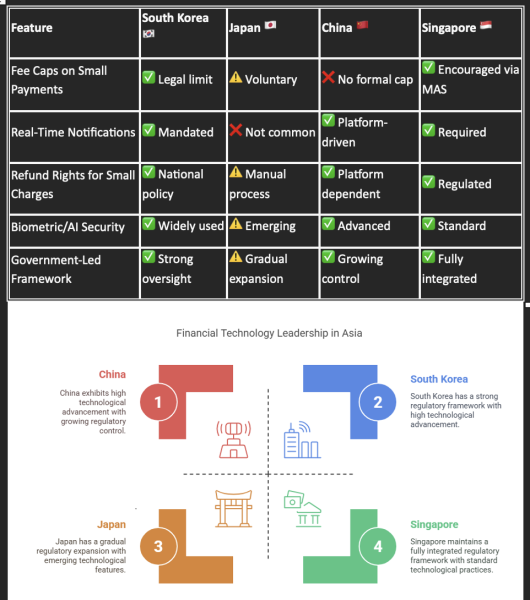
- Maximum fee caps on processing costs for transactions under ₩50,000
- Real-time notifications for recurring payments or auto-renewals
- Mandatory refund and dispute rights for users, even for amounts under ₩5,000
- Integration of biometric and AI-driven fraud detection systems
In 2024 alone, updates to these regulations saved Korean consumers an estimated ₩67 billion in excessive fees. The policies have also boosted consumer trust in digital wallets and encouraged wider adoption, especially among older users and rural populations.
Japan: Conservative Innovation, But Fast Catch-Up
Japan has traditionally been cautious in its approach to cashless adoption. Until recently, many small merchants and service providers preferred cash due to high card transaction fees and complex integration costs.
However, government-backed initiatives like “Cashless Japan” (2019–2025) have shifted that dynamic. The Ministry of Economy, Trade and Industry introduced subsidies for businesses to adopt QR code payment systems, leading to a surge in small digital transactions—especially in convenience stores, vending machines, and transportation systems.
Japan's Small Payment Framework Highlights:
- Fee controls are voluntary but encouraged through incentive programs
- QR-based platforms like PayPay dominate micro-transaction markets
- Consumer protection laws prioritize paper trail and disclosure, not real-time control
- Dispute processes remain manual, slowing resolution
Compared to South Korea, Japan lags in real-time refund mechanisms and biometric verification. However, its strict focus on transparency and digital receipts aligns closely with Korea’s regulatory intent.
China: Scale, Speed, and Private Sector Dominance
China arguably leads the world in mobile payment volume, thanks to platforms like Alipay and WeChat Pay. The country's entire ecosystem is designed around frictionless micro-payments—from street food vendors to public utilities.
What sets China apart is how private sector innovation has outpaced government regulation—though that balance is now shifting. The People’s Bank of China is implementing stronger controls on transaction transparency, fee structures, and data security.
China's Small Payment Highlights:
- Most micro-transactions are processed in under 1 second
- Platforms use dynamic QR codes, facial recognition, and voice pay
- Refunds are instant, but often depend on platform terms rather than national law
- New Digital Yuan pilot programs offer state-controlled micro-payment trials
In contrast to South Korea, where 소액결제 정책 is designed to enforce platform compliance, China focuses on regulating fintech giants directly. Both approaches aim to protect users, but China’s model relies more on centralized infrastructure and platform accountability.
Singapore: Compliance by Design
Singapore’s small payment landscape is a model of “compliance by design.” With fewer platforms but high trust in government-tech partnerships, Singapore integrates regulation directly into its digital infrastructure.
The Monetary Authority of Singapore (MAS) has clear guidelines for micro-payments through the e-Payments User Protection Guidelines, requiring:
- User consent for all recurring deductions
- Detailed digital receipts for transactions under SGD 20
- Two-factor authentication for high-frequency accounts
- Platform liability for unauthorized small payments, unless proven otherwise
Singapore’s fintechs, like GrabPay and PayNow, are built with these rules baked in. Unlike Korea, where some small players scramble to stay compliant with evolving policy, Singapore’s controlled ecosystem allows for consistent consumer protection from day one.
Side-by-Side Summary: Who Leads Where?
What South Korea Can Learn—and Teach
South Korea’s 소액결제 정책 shines in its user-focused transparency, rapid notification systems, and AI-powered fraud control. It sets a high bar for digital rights, especially for micro-consumers who often go overlooked.
But it can also draw lessons from its neighbors:
- Japan’s methodical vendor education
- China’s platform-led refund speed
- Singapore’s built-in compliance infrastructure
By synthesizing these insights, South Korea can continue improving its fintech environment—not only as a leader in digital volume but also as a regional benchmark for smart regulation.
Conclusion
As micro-payments continue to power Asia’s digital future, small payment policy will be the invisible force shaping how users interact with money.

South Korea’s approach—through 소액결제 정책 has created a safe, innovative, and fair space for users and businesses alike. But in a region defined by diverse fintech models, continued comparison and collaboration with neighbors like Japan, China, and Singapore will ensure that small payments stay secure, efficient, and empowering for all.
Comments

Powered by RoundtableAn AI/DeFi-powered Enterprise Media Operating System. Learn more at Roundtable.io.© Roundtable 2026. By using this site you agree to the Terms of Use and Privacy Policy