


Aug 19, 2024 7:00 AM
Updated Aug 23, 2024 2:33 PM
Physical silver continues to serve a two-fold purpose in portfolio management – to act as insurance and investment.
What is Silver Bullion?
In critical economic times, investors often strugulle to find right asset to safeguard their wealth. This ie where silver bullion plays great role in safe haven assets. But what is silver bullion and how to identify it?
Silver bullion is often referred to as silver bars but is much more than that. It refers to any investment-grade silver with a purity of at least 99. 95% available in bars or coins. Precious silver bullion is viewed by investors not only as a means of making more profits but as a part of the security. They help in managing inflation, geopolitical risks, and other system risks that may occur within and outside an economy. Also, it has a stable record of financial performance during tough economic times and stands to gain during economic turnarounds. Therefore, physical silver continues to serve a two-fold purpose in portfolio management – to act as insurance and investment.
To understand more about what is silver bullion, let's explore its various forms.
Forms of Silver Bullion
Silver bullion is available in three different forms, and other forms that are not within these categories do not qualify as bullion, such as jewelry made from silver or silver wire.
Related stories
The primary types of silver bullion are:
- Silver Bullion Coins: These coins are the legal tender minted by government mints and primarily bought for collection and storage. It is normally one troy ounce, but there are also larger types like the America the Beautiful five troy ounce. These coins are stamped by respective national mints and possess a face value.
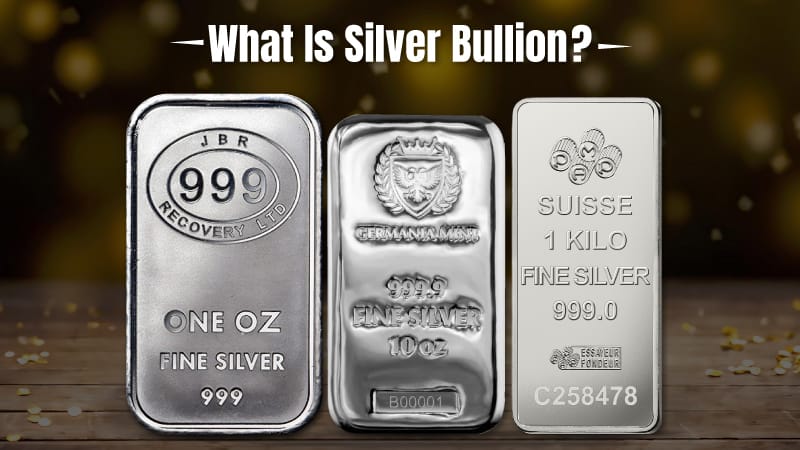
- Silver Bars: Available from private as well as government producers such as the Royal Canadian Mint. Bar sizes are not standard, but bars are generally between 1 oz, 1 kilo, and 1,000 ounces in size. Silver bars are ideal for portfolio diversification and IRA invetsments.
- Silver Rounds: Another type of bullion coin equivalent in size and appearance to coins, silver rounds are minted by various private mints and some banks. It does not have an actual face value and also is not legal tender. Unlike official coins, rounds have clear no tender status inscriptions, which means that they cannot be used as cash. Yet, they are used as a safe haven due to their silver content and collectible value.
Now that you understand what is silver bullion, let's explore its investment potential.
Silver as an Investment
Silver has been used as money for more than 5000 years, and even up to 1964, the U.S. quarters were ninety percent silver. Today, such products as silver bullion coins like 1 oz American Silver Eagle are made from almost 100% pure silver and cost approximately $32 as of Aug 19, 2024, for their metal content. However, they have a face value of $1.
Traditionally, the ratio of silver to gold has decreased with the relative abundance of silver, and it is now priced at 78:1 of that of gold. Due to its numerous uses across industrial, medical, and technological fields, silver is a vital and more contemporary precious material than gold.
What Affects the Price of Silver
Understanding what is silver bullion is not sufficient; you also should understand its price-affecting factors if you are interested in silver investment:
Supply and Demand
Silver’s supply and demand are essential to driving the spot price of silver and its market price since it is very sensitive to such changes.
Here are some driving factors:
- Limited supply- Lack of supply also increases demand, especially if the mining projects are disrupted.
- Demand fluctuations- The new application, such as in the solar panels, may also exert price pressure upward.
- Price sensitivity- Fluctuations in price depend to a small degree on changes in supply or demand.
Silver Scrap
Although while discussing what is silver bullion, it becomes clear that silver scrape cannot be classified as bullion. However, it does play a significant role in the dynamics of supply and demand for this precious metal.
The main determinants are-
- Photography Decline: As technology transitions from using silver for photo imaging to digital methods, the demand for silver in this sector has been affected.
- Recycling Trends: Consumers are recycling the stock of photographic films to increase the available stock of silver in the market.
- Jewelry Sales: High prices act as a stimulus for selling silver ornaments and coins and hence enhance its market supply.
All these factors contribute to the supply factors of silver as a commodity in the market.
Technology
Silver is influenced by technological advancement in a big way from both the angle of use and the threat of substitutability. These dynamic facts make technology a key consideration in the pricing of silver in the future-
- Innovative Uses: The application of new technologies like photovoltaic systems results in higher demand for silver since it possesses a unique quality.
- Replacement Technologies: There are examples where the use of silver has been minimized by the development of new materials like alloys of aluminum.
- Green Tech: In the case of silver, increasing the use of green technologies should, in general, be positively correlated with price increases.
National and Global Economic Trends
Larger economic factors are reflected in silver as both a commodity for speculation and an actual need for use in various industries. Hence, in a period of economic transition, silver is in great demand as an investment commodity.
As we can see-
- Safe-Haven Role: Higher silver consumption in the global economy during the period of crises as people turn to stronger assets.
- Economic Growth: It is important to note that in a strong economy, silver demand for investments may decline, but industrial and jewelry uses may remain fairly high.
- Market Stability: The function of Silver in the context of a diverse investment portfolio is particularly significant in periods of economic turmoil.
This threefold usefulness is reasonable in evidencing the impact of global economic factors on the value of silver.
Inflation
Understanding what is silver bullion gets more exciting when we study its inflationary perks. Silver has also traditionally acted as an inflation hedge that provided insurance against the decline in currency purchasing power. Whenever inflation takes place, people can easily realize that silver remains valuable as compared to paper money.
The top highlights are-
- Inflation Hedge: In inflationary periods, paper currency drops its value, but silver or silver dollars will retain it based on their composition.
- Purchasing Power: Offers cover in case the purchasing power of money decreases in the long run or with time.
- Historical Performance: Silver has been effective in maintaining wealth during inflationary cycles over many centuries. This silver property makes it a good investment in periods of economic instability.
Strength of the Dollar
The U.S. dollar value works in reverse proportion to the price value of silver, thus influencing investments. A higher dollar means that the actual dollar price of silver decreases, and a strong dollar means investors are looking for cheaper items.
- Inverse Relationship: A strong dollar also usually opens up downward pressures for silver prices.
- Investment Timing: Professional traders may buy silver when the dollar is high with the aim of benefiting from the low prices.
- Market Dynamics: Movements in the dollar are reflected in strategies and investment plans in the silver market.
This relationship explains how investors can invest effectively in the silver market and respond effectively to changing market conditions.
Gold Prices
Silver prices are commonly tied to gold prices having historical correlation, given the gold/silver ratio. But as the price of gold increases or decreases, the price of silver tends to mirror it, and traders leverage on the gold/silver ratio.
These tie-ups show how invaluable is the link of the precious metal markets-
- Price Correlation: Silver has a similar price performance to gold most of the time, and often moves in the equal direction.
- Gold-to-Silver Ratio: Buyers and sellers rely on the gold-silver ratio to guide their actions based on price differences.
- Investment Strategies: Silver-gold interaction can help identify potential lucrative silver investments.
Interest Rates
Interest rates relate to income-generating investments and their connection to the price of silver in the markets. Higher real interest rates tend to reduce the demand for silver as there are no current returns, and low rates increase demand.
The following dynamic explains how interest rates impact the supply and demand of silver:
- Inverse Effect: In this case, higher interest rates may pose a threat to silver since there is no current return on the metal.
- Investment Choices: Hence, lower interest rates can raise the metal’s appeal relative to income-generating assets.
- Market Reactions: Silver prices typically fluctuate according to the movement of interest rate changes determining investment.
Government Policies
Production and reserves are major ways through which government control affects the silver market. There are important market players that include central banks and mints, and these ultimately have power over the supply and prices within this market.
- Central Bank Activities: Central banks keep gold, but legal changes and national strategic holdings can affect silver prices.
- Minting: Silver supply depends a lot on the demand from national mints such as the U. S. Mint, where large quantities of silver are used to mint coins and produce bars.
- Regulatory Impact: State actions and legislation can impact the silver markets and investor activities.
Such factors assist investors in analyzing the current trends of the market and the potential effects of policies.
Conclusion

This article has aptly described what is silver bullion and its price-affecting factors. Physical silver in coins, bars, and rounds has real-world usefulness, which is an advantage. These types of silver investments offer you good inflation and economic risk hedges and have inherent value and portfolio diversification benefits. Investing in silver can yield outstanding returns when you choose to invest with trusted bullion dealers like BOLD Precious Metals. Choose products listed on such sites and realize that your investment is safe and you get original quality silver bullion.
Comments

Powered by RoundtableAn AI/DeFi-powered Enterprise Media Operating System. Learn more at Roundtable.io.© Roundtable 2026. By using this site you agree to the Terms of Use and Privacy Policy