


Jul 22, 2021 8:56 AM
Updated Feb 10, 2022 10:56 PM
While many modern industries are yet to realize the full potential of automation, the painting industry was one of the first industries to be automated.
Automation has been transforming many industries with its effective and profitable solutions, and one such prominent industry is the painting industry.
While many modern industries are yet to realize the full potential of automation, the painting industry was one of the first industries to be automated.
While many modern industries are yet to realize the full potential of automation, the painting industry was one of the first industries to be automated. It involved the use of robotic arms to apply paint with programmed patterns over a surface.
Industrial Painting Robots
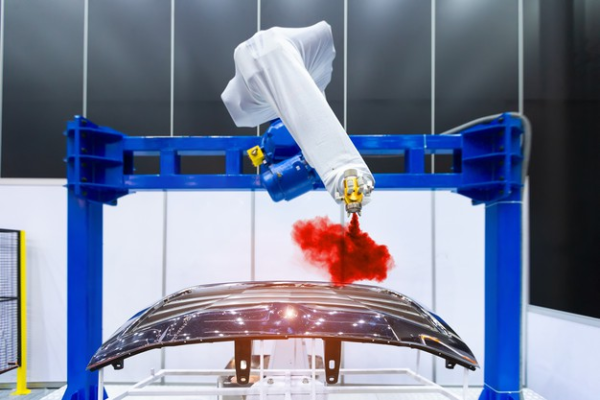
A six-axis mechanical arm is a common industrial robot in the painting industry for spraying and coating operations.
Related stories
We have seen robotic arms in manufacturing industry being used for various processes like welding, drilling, and material handling. Their function is just like a human arm and is either pre-programmed or operated by automation software.
These arms provide more stability and accuracy to the work. They can perform various tasks simultaneously without taking breaks and play a major role in reducing human error.
Features of a Painting Robot
Painting robots have various features that give them an edge over humans. These features contribute to making the industry more safe and versatile. These features include:
- Explosion Proof
Painting operations require workers to work with flammable liquids, posing a danger of explosions that might put their lives at risk.
Using robots in the painting sector basically reduces the risk factor.
- Efficient Programming Softwares
These automation robots usually come with programming software that can help workers to monitor their status and activity. Continuous monitoring of these values can help them ensure the proper and required functioning of the robots.
In case of false values, precautionary actions can be taken. These software are also used for calculating efficient painting trajectories for applying less amount of paint and covering more surface area.
This feature helps the company save raw materials and time.
- Colour Changing Ability
At times, painting robots perform complex painting and coating tasks, These may require them to switch between multiple colors. They must do it quickly and accurately. This feature is very essential for the overall productivity of the process.
- Multiple Degrees of Freedom
The degree of freedom means the number of modes in which a robot can move. While painting, the robot may need to approach a particular surface from multiple angles.
Hence, it is important to have a robot that can move in various directions without altering the surface distance.
- Rotary Atomizer
An atomizer produces spray from fine liquid. Rotary atomizer is used for high-volume industrial paints. It is one of the equipment that comes with painting robots. It is mounted on a painting robot to spray paint.
These types of atomizers provide a high-quality finish and can regulate pressure and paint flow. These two features are necessary for a consistent paint finish.
It is important to know about these features so as to know about their capabilities to automate and make the processes efficient and easier.
Benefits of Robots
Industrial painting may require workers to do challenging tasks that require great stability, error-free spraying. Working in this kind of environment with precision involves many risks and can decrease the quality of the work.
Moreover, manually spraying paint is very inefficient as it can be done by robots in very little time without wasting many resources. Hence, substituting them with workers is the best solution as they have the following benefits with which they are revolutionizing the industry:
- Flawless Spraying
Robots are programmed to spray the paint evenly over the surface. Robots work precisely. They don’t waste paint, leave unfinished edges or drips. Products are sprayed evenly with the exact and same amount of paint over the whole surface.
- Reduced Health Risks for Employees
Working with industrial paint for longer durations may cause serious health problems. These paints contain Volatile Organic Compounds (VOCs) which can cause irritation in nose, eyes and cause breathing problems.
As discussed above, these paints are flammable. Hence, working with these paints can involve serious health hazards. Industrial robots can eliminate these risks and protect the health of all workers.
- Cost-Efficient
The painting industry has been automated for many years now. Modern robotic solutions are readily available at low prices. Moreover, the work environment is very hazardous for human health. Hence, recruiting a workforce and arranging safety kits for them requires huge capital.
Using robots is cutting these costs. The precision of robots leads to very little raw material wastage and increases the quality of the product. Hence, many companies are able to cut down costs and make a good reputation in the market in terms of the quality of products.
Robots have definitely given them a good Return on Investment (ROI). Marketing research predicts that the paint automation industry will reach from a value of $ 3.34 billion in 2020 to $9.22 billion in 2030.
- Capable of Working for Advanced Verticals of Painting Industry
Painting industry is not all about spraying paints. It also involves applying coatings on manufactured surfaces. There are several verticals under this industry. One of such verticals is the Aerospace and Defence industry.
Various Aerospace vehicles like satellite launching vehicles require protective coatings on their outer surface to protect them from corrosion and extensive heat due to atmospheric friction.
Applying such important coatings requires consistency, stability, and accuracy. Coatings should be applied evenly everywhere with the correct amount of thickness. Leaving any area uncoated may result in serious accidents, damage, and loss of life. These complex and precise tasks can only be done with the help of robots.

Robots have played a major role in revolutionizing the paint industry. Their involvement has made it one of the most automated and fastest-growing industries in the world.
Due to robotic solutions, the quality of products has been improved, companies are gaining more profits and workers are able to work in safe environments.
Comments

Powered by RoundtableAn AI/DeFi-powered Enterprise Media Operating System. Learn more at Roundtable.io.© Roundtable 2026. By using this site you agree to the Terms of Use and Privacy Policy