


Apr 30, 2024 7:00 AM
Updated Oct 31, 2024 10:23 PM
Operational Technology (OT) is a stronghold technology system for running and regulating critical infrastructure and vital services in domains including energy, transportation, manufacturing, and health.
Currently, in the 21st century, Operational Technology (OT) is a stronghold technology system for running and regulating critical infrastructure and vital services in domains including energy, transportation, manufacturing, and health. However, as OT systems access the internet and other digital networks, they become vulnerable to cyber hijacking, making OT security a pressing issue. These measures should be comprehensive and robust enough to withstand any potential cyber-attacks and system failures. Accordingly, safeguarding the functioning of the critical network should be a top priority. This article outlines best practices for daily OT cybersecurity, fostering professional dialogue and thoroughly covering both general and specific topics.
Asset Inventory and Classification
Planning begins with an extensive audit of all OT devices that are components of the organization. Categorize these assets based on their criticality and function. Recognize that the assets you already have are crucial to your network’s security. If you understand its significance to strategy building, then you can start working on effective security solutions with appropriate NERC compliance.
Risk Assessment and Management
Conduct regular risk assessments to discover system vulnerabilities and any potential threat to OT systems using the nerc cyber security standards. Assess risks based on their probability of occurrence and potential financial impact. Implement and maintain risk reduction measures for well-founded hazards.
Network Segmentation
Use network segmentation to isolate sensitive OT systems from less critical networks and the Internet. This approach, based on NERC cybersecurity, reduces adversaries' effectiveness across the network and significantly decreases the attack surface, thereby enhancing security.
Related stories
Access Control and Authentication
Provide tight mechanisms of system access to prevent the access of the ones who are not authorized to use these OT security solutions. Implement secure authentication like MFA for admin rights and mind the principle of least privilege in order to restrict the rights of the users to the necessary ones only.
Patch Management
Set up a valid patch management process from nerc cip security to do the needful as well as timely software updates. Set a regular time to scan vendor advisories and security bulletins for alerts to appreciate current cyber vulnerabilities and patches.
Security Monitoring and Incident Response
Run IDS and SIEM for network monitoring on OT in search of anomalies that may be signs of an attack. Formulate and run a security breach reaction plan as a critical infrastructure protection nerc, enabling prompt reaction to incidents and their resolution before they develop. Additionally, use SNMP monitor to continuously track and manage network devices, ensuring early detection of potential issues and minimizing downtime.
Employee Training and Awareness
Educate the employees on the role of OT security and also on security best practices. Promote a culture that is safety-oriented and trains the employees to know how to report, analyze, and respond to security threats.
Physical Security
Develop a security regime rooted from nerc standards of physical applicability to OT facilities and equipment so that unauthorized tampering and malicious sabotage would be prevented. Take measures like access controls, surveillance cameras, and perimeter fencing that will safeguard the infrastructure assets that are considered as critical assets.
Vendor Management
Develop definite security nerc requirements for those providers and third-party manufacturers who participate in OT systems' supply chain, which assures connectivities and exchanges. Security audits to make sure all the vendors are in compliance with the security standards and processes.
Data Encryption
Encrypt sensitive data at risk and in a resting state to avoid future data breaches and cyber-attacks. Resort to encryption algorithms with robust force basing from nerc cip cybersecurity standards and protocols to protect the communication channels and data storage system.
Incident Reporting and Information Sharing
Make everyone, including suppliers, employees, and members of contractors' families, aware of the reporting rules and provide clear channels of communication within the company. Engage in information sharing with official and unofficial platforms that will allow me to establish relationships with other professionals and share experiences and knowledge.
Backup and Recovery
Make implementing regular backup procedures your main goal so that you will be able to create fault-tolerant OT data replicas and configurations. Regularly test backup systems to ensure their reliability and effectively play the part they are supposed to in terms of restoring operations after a cyber incident.
Security by Design
Integration of security concerns in the OT system starting process from the very beginning will assist in the prevention of cyber security beforehand. Implement secure coding practices, do security reviews throughout your development and subsequent processes, and maintain adherence to industry standards and guidelines.
Regulatory Compliance
Be updated on regulations and compliance requirements concerning ICS security which are, NERC CIP standard, IEC 62443, and ISO 27001 respectively. To ensure the security of information supplied by OT systems, ensure that applicable regulations are met and periodic audits for compliance.
Continuous Improvement and Adaptation
Cybersecurity for IoT demands routine precautionary measures and appropriate adjustments as to partial IT infrastructure vulnerabilities and innovative threats. Continuously have security measures audited, update policies and procedures, and allocation of budgets to new security technology, so as to keep on top of cyber adversaries.
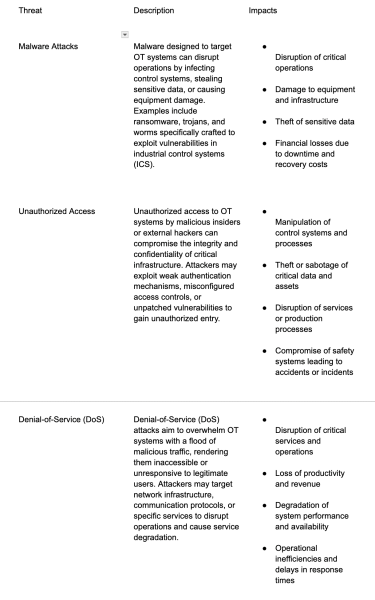
Common Cyber Threats to OT Systems
Conclusion
Regular protection of critical infrastructure from cyber threats must be based on a comprehensive approach covering advanced engineering, organizational regulation, and end-user action. By implementing the 15 guidelines outlined in this article, businesses will enhance their OT systems' defense capabilities and protect their interests from cyber-attacks. In our increasingly interconnected and digitalized world, OT security is not an option but a strategic necessity to achieve high-quality operational uptime and performance.
FAQs
1. What is operational technology (OT)?
Operational Technology (OT) is the real-time hardware and software used to monitor operations as well as control physical processes. The OT can be found in machines used for production, power plants, and in the transport sector.
2. What is the difference between OT security and IT security?
The security goals of the OT and IT domains are the same – these two domains protect systems and data, but they are differentiated by their priorities and profiles. IT security efforts mainly are related to protecting data from unauthorized access and information systems from corruption, however, OT security implies the safeguarding of physical processes as well as industrial control systems.
3. What can organizations do to measure their OT system's security status

Organizations will know the security posture level of their industrial operation at the same time through thorough risk assessments, reconnaissance, and vulnerability detection. These assessments show and then determine where weaknesses and vulnerabilities lie in OT infrastructure. That way, organizations going ahead can make informed decisions to establish priorities and allocate resources accordingly.
Comments

Powered by RoundtableAn AI/DeFi-powered Enterprise Media Operating System. Learn more at Roundtable.io.© Roundtable 2026. By using this site you agree to the Terms of Use and Privacy Policy