



Nov 24, 2025 8:00 AM
Updated Dec 1, 2025 9:14 AM
New Zealand and Australia have seen the rapid emergence of low-cost digital entertainment platforms, particularly in the online gaming and casino sectors.
Digital inequality is not merely an abstract policy concern; It is a lived reality that shapes the way people work, communicate, learn, and even entertain themselves. As online services become core components of modern life, the divide between those with full digital access and those with limited financial or technological resources continues to widen. One of the most overlooked areas where this disparity becomes visible is online entertainment, especially in segments where real-money interaction is involved.
Over the last three years, New Zealand and Australia have seen the rapid emergence of low-cost digital entertainment platforms, particularly in the online gaming and casino sectors. The rise of the $5 deposit casino is a striking indicator of how consumers are shifting their habits in response to cost pressures, limited disposable income, and broader digital inequality. For many, a trusted $5 deposit casino provides an accessible entry point into an entertainment category that was once financially restrictive.
This article examines why these budget-friendly platforms are gaining momentum and what they reveal about the broader landscape of digital inequality.
The New Economics of Online Entertainment
As inflation and cost-of-living pressures rise globally, discretionary spending has tightened. Entertainment, traditionally the first expense consumers cut, has adapted accordingly. Online platforms, especially gaming services, have become more cost-sensitive in their offerings. Micro-transactions, subscription tiers, and low-deposit payment structures reflect this reality.
Related stories
In New Zealand, the surge of trusted $5 deposit casino sites mirrors international trends: consumers want entertainment that is affordable, flexible, and low-risk. For many, the ability to engage without making large upfront payments dramatically changes accessibility.
But the rise of these platforms points to a deeper truth: digital inequality is not just about internet access; it is about financial access to online experiences.
Understanding Digital Inequality Beyond Connectivity
Traditionally, discussions about digital inequality focus on issues like broadband availability, device access, or rural connectivity gaps. Yet, a parallel form of inequality persists, financial inequality in digital participation. Even with a stable internet connection, not all consumers can fully engage with online services.
This form of inequality is driven by factors such as:
● limited disposable income
● high upfront costs for certain online platforms
● growing subscription fatigue
● banking access barriers
● payment method restrictions
Low-cost digital entertainment platforms have emerged as an adaptive response to these limitations. They provide access to experiences that were once locked behind higher financial thresholds.
Why $5 Deposit Platforms Are Gaining Momentum
1. They Lower the Barrier to Entry
A $5 deposit provides an extremely gentle entry point for users who want to participate but cannot, or prefer not to, spend more.
For younger adults, students, and households with tight budgets, small deposit requirements make online entertainment attainable without financial strain.
2. They Reflect Shifts in Digital Spending Behaviour
Consumers are becoming more selective. Instead of large, risky purchases, they now prefer:
● small deposits
● trial periods
● incremental engagement
Online gaming platforms have adapted by offering generous beginner bonuses even at low deposit levels. A trusted $5 deposit casino often adds free spins, match bonuses, or reward multipliers to stretch the entertainment value further.
3. They Appeal to Financially Cautious Users
Not every user wants to link credit cards or commit large sums upfront. A low deposit amount reduces perceived risk and enables safer, more controlled spending.
This aligns with broader trends in fintech toward micro-payments and flexible budget management.
4. They Are Supported by Accessible Banking Methods
Low-cost digital platforms rely on banking rails that support small, fast, and inexpensive payments. That’s why systems like POLi, PayID, and other direct-bank payment methods are often built into these entertainment platforms.
These payment technologies allow users to deposit small amounts without incurring heavy fees.
What $5 Deposit Platforms Reveal About Digital Inequality
While these platforms offer important pathways to access, their growing popularity also highlights systemic issues:
Many users cannot afford larger entertainment costs
The demand for $5 and even $1 deposit platforms reveals a tightening financial landscape. For a significant portion of online users, small deposits are not preference; they are limitations.
Digital entertainment is still stratified by economic capability
Users with more resources can afford pricier subscriptions, premium gaming tiers, or high-stakes environments. Those with less rely on low-cost alternatives to access the same digital spaces.
Payment flexibility has become a core part of digital inclusion
If online entertainment platforms accept only credit cards or high deposit minimums, entire demographic segments are excluded. The rise of low deposit requirements is a sign that platforms are adjusting, but not always proactively.
Users value control and transparency in digital payments
Digital inequality also manifests as a lack of trust. Consumers with limited budgets need transparency more than ever, as unexpected fees or unclear terms have immediate negative impacts.
To gain a deeper perspective, we spoke with Alina Anisimova, Banking Expert at Mr. Gamble, who explained the behavioural economics behind the shift: “Low-deposit platforms thrive because they empower users to participate on their own financial terms. A $5 deposit feels manageable, safe, and predictable. It reduces the psychological barrier to entry and creates a more inclusive online entertainment environment.”
Her observation captures the essence of the trend: affordability and psychological comfort drive user engagement just as much as entertainment value.
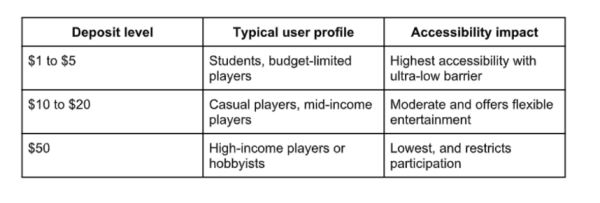
Below is a simplified view of how deposit levels shape user access:
Global Trends Supporting the Growth of Low-Cost Online Entertainment
The shift toward small deposits is not isolated to New Zealand. Global data shows similar patterns:
● Mobile gaming microtransactions have skyrocketed.
● Subscription platforms now push “starter tiers” at lower prices.
● Digital payment systems are optimised for small, fast, low-fee transactions.
Consumers worldwide show reduced willingness to commit financially up front.
Organisations like the OECD continue to underline how economic and digital disparities intersect, affecting populations’ ability to access online services.
The Inclusion Economy: Why Affordability Matters
Affordable entertainment is not trivial, as it plays a critical role in well-being and social participation. When individuals are priced out of digital leisure, it reinforces broader exclusion patterns.
Low-deposit platforms help democratise access by:
● reducing financial risk
● offering scalable entertainment
● accommodating diverse economic backgrounds
● providing alternatives to expensive subscription models
In essence, they represent a small but meaningful step toward a more inclusive digital ecosystem.
The rise of $5 deposit platforms is not just a trend in digital entertainment; it is a mirror reflecting broader patterns of digital inequality. While such platforms expand access and empower users with limited financial means, they also highlight how economic disparities continue to shape digital participation.
As long as significant portions of the population rely on low-cost alternatives, the discussion about digital inequality must move beyond connectivity and infrastructure to address financial accessibility in online environments.

And as consumers increasingly seek safe, budget-friendly options such as a trusted $5 deposit casino, digital service providers must recognise that affordability is not optional; it is a cornerstone of equitable digital access.
Comments

Powered by RoundtableAn AI/DeFi-powered Enterprise Media Operating System. Learn more at Roundtable.io.© Roundtable 2026. By using this site you agree to the Terms of Use and Privacy Policy